
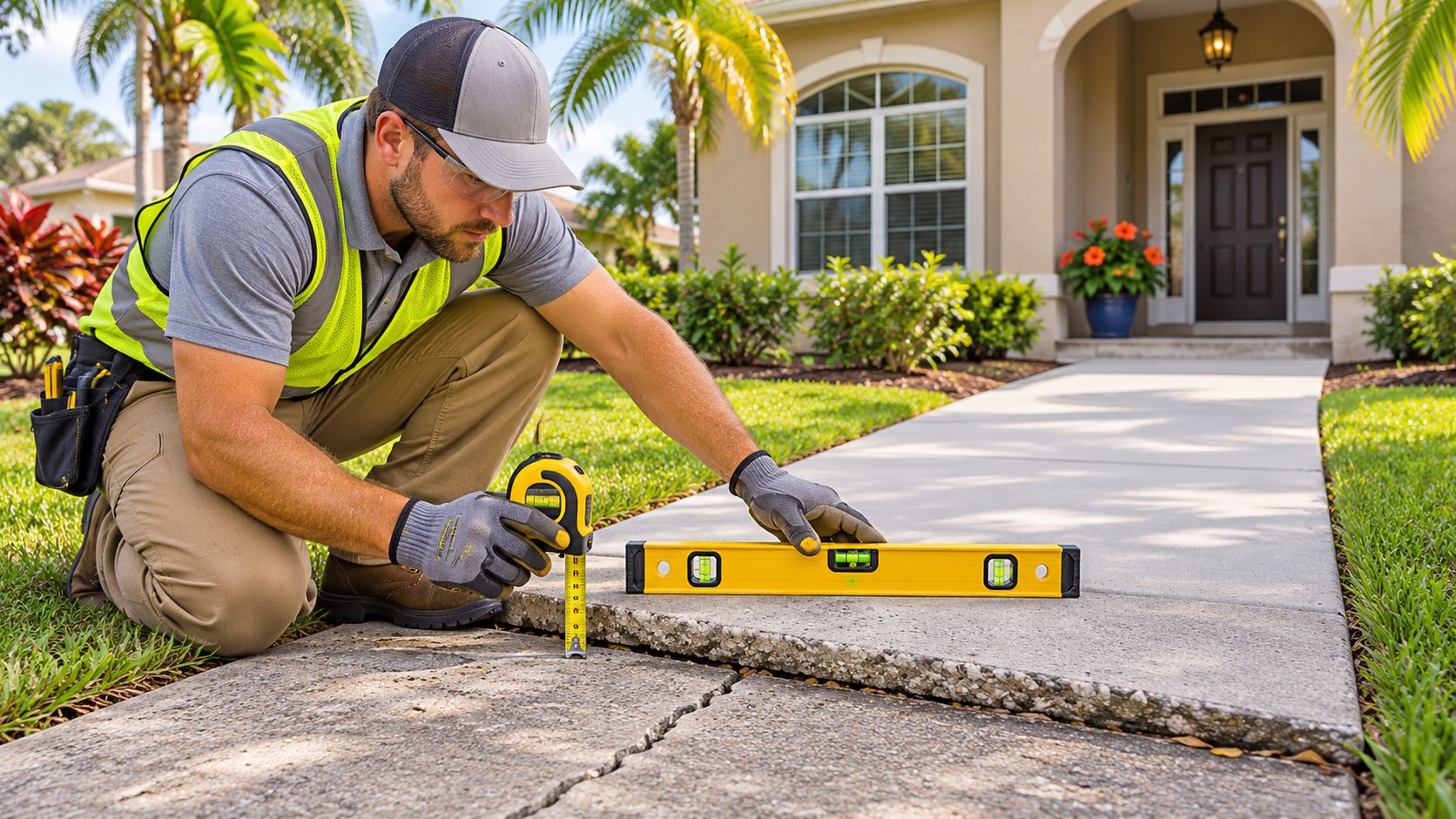
The edge of the slab by your front walk sits a finger's width above the next one. You notice it every time you wheel the trash bin out, and last week a guest caught a toe on it and stumbled. Now you're standing in the driveway with your phone out, typing concrete sidewalk repair near me, trying to work out whether this is a Saturday morning patch or a full panel replacement.
In Marion County and Citrus County, that question has an answer, and it starts with a tape measure rather than a contractor's phone number. Sidewalk damage in Central Florida usually falls into one of three groups: a surface problem a patch or a grind will fix, a support problem where the base, roots, or drainage moved the slab, or an accessibility problem where the concrete is sound but the slope, width, or transition fails a standard. Each one carries a different remedy and a different price.
I'd rather you spend fifteen minutes measuring before you spend money guessing. Here's how to sort the damage, what each repair method fixes, and what to have ready when you call for an estimate.
Table of Contents
- Repair or Replace Your Concrete Sidewalk
- How to Inspect a Sidewalk Before You Call for Repair
- What Causes Concrete Sidewalk Damage in Central Florida
- Accessibility Rules That Shape Sidewalk Repair
- Repair Methods and What Each One Can Fix
- How to Request a Concrete Sidewalk Repair Estimate Near You
- Concrete Sidewalk Repair Questions Local Owners Ask
- Your Next Step Toward a Safer Sidewalk
Repair or Replace Your Concrete Sidewalk
The first decision isn't which contractor to call. It's whether the slab in front of you is a repair candidate, a replacement candidate, or a hazard you should document with photos before anyone touches it. A panel that dropped two inches beside a downspout and a single cracked panel on a firm base are not the same job, even though both get described as cracked concrete on the phone.
Use the table as a first sort. It won't replace an on-site look, but it tells you which questions to ask and whether the estimate coming next week should be a few hundred dollars or a few thousand.
| Condition | Typical remedy | Replace the panel? | What to watch |
|---|---|---|---|
| Hairline crack under 1/8 in, no offset | Clean and seal the crack | No | Recheck for movement and water intrusion |
| Spalling or a rough, scaling surface | Patch spalled areas and restore the finish | No, if the slab is sound | Failed patches often signal a weak base |
| One cracked panel on a stable base | Remove and replace the panel | Yes, that panel | Match joint layout, grade, and finish |
| Vertical offset under 1/2 in | Grind or build a gradual transition | Sometimes not | Keep the transition smooth and below the 1/2 in threshold |
| Vertical offset from 1/2 in to 1 in | Grind, patch, or replace the panel | Often | Accessibility transition and trip liability |
| Vertical offset over 1 in | Reconstruct the panel or section | Yes | Lifts that large are the minority, so measure before you assume replacement |
| Tree-root heave or lifted section | Address the root cause, then replace the panel | Yes | Roots and soil movement can repeat the damage |
| Settled slab or water ponding | Correct the base and replace or lift the slab | Usually | Drainage must be fixed before the surface |
| Crumbling edge or failed cold joint | Full-depth repair at the joint | Yes, localized | Check for base erosion and joint movement |
| Noncompliant curb ramp or steep transition | Retrofit the curb ramp and adjoining walk | Localized reconstruction | 1:12 running slope and 2% cross slope on ramps |
Measurement settles most of these rows. The City of Alameda sidewalk repair program, working from a municipal ADA assessment, reports that only about 6% of measured sidewalk lifts exceeded one inch. That's one city's inventory, not a promise about your front walk, but the logic travels: read the offset and the slopes before you assume a panel has to come out.
A raised edge deserves more attention than its size suggests. Federal Highway Administration research reports that roadways without sidewalks are more than twice as likely to experience pedestrian crashes as comparable sites with sidewalks on both sides, and the agency counts more than 6,200 pedestrian fatalities and about 75,000 pedestrian injuries in U.S. roadway crashes each year (FHWA pedestrian and sidewalk data). A walk people avoid because it's broken stops doing the job it was built for.
Practical rule: if a slab has moved, the repair has to answer why it moved. A patch over a moving slab is a rental, not a fix.
Some rows overlap on purpose. A settled panel with a wide crack is both a movement problem and a trip hazard, and the remedy that satisfies one may not satisfy the other. When two conditions point at different fixes, the stricter one wins: if the panel has to come out for the base, the accessibility limits come with it. That's the part most pages targeting concrete sidewalk repair near me leave out, and it's why a cheap repair sometimes gets paid for twice.
How to Inspect a Sidewalk Before You Call for Repair
Fifteen minutes with a phone, a tape measure, and a 4-foot level produces better information than any description you can give over the phone. Start with the photo record, then work down the list.
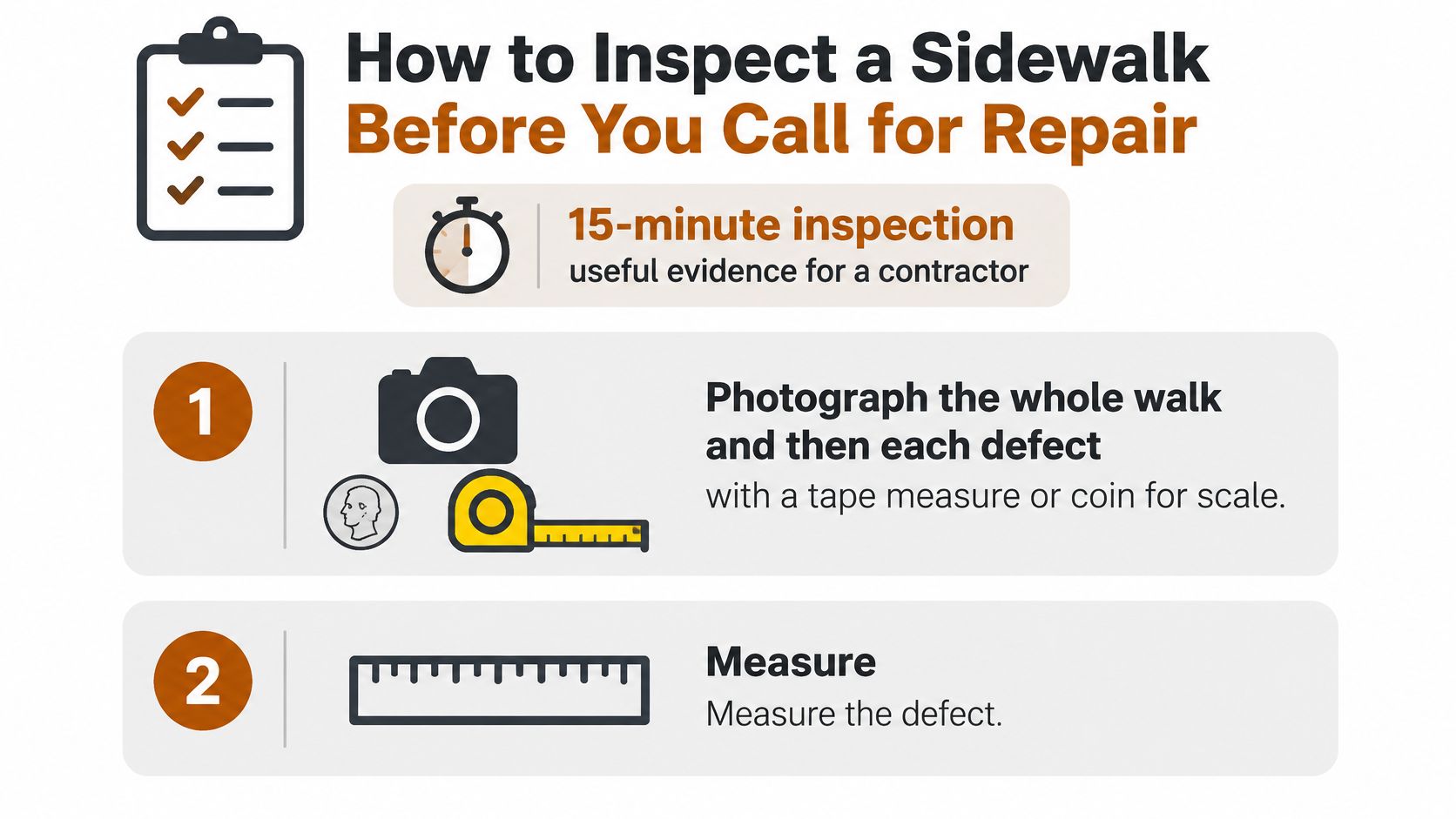
- Photograph the route, then the defect. Shoot the full walk from one end so the layout is clear, then get close and put a tape measure or a coin in the frame for scale.
- Measure the crack at its widest point. Not the average. Note whether the crack is tight at the surface and wider below, since that points to a full-depth break rather than a surface split.
- Measure the offset at the joint. Lay a straightedge across the joint and read the gap with a ruler. Write down which side sits high, because that tells the contractor which panel is moving.
- Check both slopes with a 4-foot level. Set it across the walk for cross slope, then along the walk for running slope. Mark any spot where the bubble runs hard to one side, especially near the driveway apron.
- Watch where water stands. After a summer storm, walk the route and note the puddles that last more than a day. Check downspout discharge, swale lines, and the low corner at the apron.
- Look for roots and lifted soil. A panel tilted up beside a pine or an oak, with soil pushed up at the joint, is a root problem wearing a concrete costume.
- Find the property line. A sidewalk inside your lot is yours to authorize. One in an HOA common area or a public right-of-way usually needs someone else's sign-off first.
- Count the panels and note the transitions and users. Panels affected, curb ramps, driveway crossings, plus who walks it: children heading to school, older adults on the way to church, wheelchair users, delivery carts.
An estimator can price a job from eight photos and four measurements in a way they can't from "my sidewalk is cracked." You also get a fairer comparison, because every bidder is looking at the same facts.
In practice, the measuring step looks like this:
However you record it, the point is the same. Numbers and photos on a phone beat a description from memory every time.
What Causes Concrete Sidewalk Damage in Central Florida
Concrete sidewalks here rarely fail because the mix was too weak. They fail because something held the panel in place while it tried to shrink or move, or because water got under it and took the support away. Those two mechanisms produce cracks that look alike and need completely different repairs.
The National Institute of Standards and Technology reports that unrestrained drying shrinkage under standard conditions commonly runs from about 400 to 1,100 microstrain, depending on mixture proportions and aggregate characteristics (NIST report on concrete shrinkage and cracking). A panel wants to get slightly smaller as it dries. When adjoining slabs, a thickened edge, or a hard, poorly prepared base restrains it, that shrinkage turns into tensile stress, and the concrete cracks once the stress passes what it can carry.
Then the local conditions go to work. A July afternoon moves the concrete thermally, a summer downpour soaks the base, downspouts and swales discharge right at slab edges, and tree roots lift panels from below. Original construction problems surface a few years in: a base that was too thin, control joints that were never cut, grading that drains toward the house instead of away from it.
Read the crack, and you read the cause
- A crack that follows a control joint: the joint did its job and the movement is still happening. Usually a maintenance item, not an emergency.
- A random crack across the panel: restraint, thermal movement, or base settlement. Check for an offset on either side.
- Spalling or scaling at the surface: finishing, repeated wetting, or a slab that never cured properly. Often cosmetic until the aggregate starts coming loose.
- A full-depth break with a lip: the base under the slab has moved. Patch it and the patch will break on the same line.
- A crack that tracks a line of trees or a downspout: water or roots, and neither one is fixed by concrete.
A thin overlay is the repair I steer people away from when the slab is moving or the base is saturated. It can look right for a season, then fail along the same line because the restraint and the drainage were never addressed. When a pine or oak is the culprit, the panel has to come out and the root situation has to be handled, which is its own discussion about repairing a sidewalk lifted by tree roots.
For a property in Ocala, Dunnellon, Belleview, or The Villages, the repair plan should name water, base, roots, and movement. If it only names the crack, it isn't a plan yet.
Accessibility Rules That Shape Sidewalk Repair
A sidewalk can look perfectly smooth and still fail an accessibility check. The failures that matter in a repair are the ones you can't see from standing height: a cross slope that tips a wheelchair toward the street, a clear width pinched by planters and signposts, a vertical lip at a joint that catches a walker or a toe.
The U.S. Access Board sets hard limits on walking surfaces in both directions, along the path and across it, and those limits govern every transition in a repair (U.S. Access Board ADA Chapter 4). A new panel that drains poorly or settles toward the street can break the rules while looking better than what it replaced.
| Element | Limit | Exception or note | Why it matters |
|---|---|---|---|
| Sidewalk running slope | 5% (1:20) | Doesn't apply to a designed ramp | A steeper segment becomes a ramp and needs ramp features |
| Sidewalk cross slope | 2% (1:48, about 2.1%) | Limited exceptions may apply | Controls the side-to-side fall and wheelchair stability |
| Minimum clear sidewalk width | 48 in | Limited exceptions may apply | Keep planters, poles, and signs out of the route |
| Level change at a joint | 1/2 in | Above 1/2 in may need a ramp or curb-ramp treatment | Measure both sides of the joint |
| Curb ramp running slope, new construction | 8.33% (1:12) | 10% for a 6 in rise and 12.5% for a 3 in rise may apply to some alterations | Measure the ramp, not just the sidewalk |
| Curb ramp cross slope | 2% | Same limit as walkways | Flared sides don't count toward clear width |
| Curb ramp clear width | 36 in | Excluding flared sides | Check the landing and transition too |
| Detectable warning area | Required at curb ramps in many cases | Local design standards control details | Never cover or remove an existing warning surface |
Curb ramps carry stricter numbers than the walk behind them. Federal survey guidance puts the maximum running slope for a curb-ramp run at 1:12, or 8.33%, with a minimum clear width of 36 inches excluding flared sides and a cross slope cap of 2% (federal curb-ramp survey guidance). That means measuring the ramp in both directions. A crew can hit the lengthwise slope and still leave a side-to-side fall that fails, which is the mistake I see most often on retrofits.
Altered ramps can reach 10% for a 6-inch rise or 12.5% for a 3-inch rise under the evaluation framework federal guidance describes (ADA curb-ramp toolkit appendix). That's a narrow allowance for existing conditions, not a target to design toward on new work.
How the limits get checked before demolition
Measure both panel edges and every transition during layout, then set finished grades so water drains without blowing past the slope limits. Write the elevations down. On commercial properties, HOA common areas, and church or school campuses, that record is quality control and it prevents rework.
The rules have a longer reach than the slab itself. The revised 2010 ADA Standards were issued on September 15, 2010, and they cover pedestrian routes connecting buildings, sidewalks, streets, and parking areas, not just a single panel in isolation (U.S. Access Board rulemaking history). If the walk serves a storefront, a sanctuary, or a school pickup line, ADA sidewalk requirements apply to the whole route.
A repair that leaves a vertical lip, excessive crossfall, or an abrupt grade change creates a hazard on concrete that's structurally fine.
Ask two questions of any bid: how will the finished surface drain, and does this repair pull a curb-ramp upgrade into scope? For HOAs, churches, and commercial managers, get the answer in writing before work starts.
Repair Methods and What Each One Can Fix
Every defect on your walk has a method that fits it and a method that only looks like it fits. Matching the two is the whole job. Here's the honest comparison.
| Method | Best for | Limits |
|---|---|---|
| Clean and seal cracks | Hairline cracks under 1/8 in with no vertical movement | Does not correct offsets, roots, or a failed base |
| Partial-depth patch | Spalled corners, shallow surface breaks, cosmetic scaling | Can fail if the subbase is soft or water is trapped |
| Grinding | Minor vertical offsets, often 1/4 in to 1/2 in | Not for structural cracks or offsets over about 1/2 in |
| Full-depth patch | Broken edges, utility cuts, isolated deep breaks | Joint can reopen if the base isn't compacted and drained |
| Panel replacement | Cracked, settled, or heaving panel with sound neighbors | Roots, poor drainage, or a bad base can damage the new panel |
| Slab lifting or mudjacking | Settled slab with sound concrete and no root heave | Not for shattered concrete; doesn't fix a failed base on its own |
| Curb ramp retrofit | Ramp that's too steep, too narrow, or has excess cross slope | May trigger work on the adjoining walk and transitions |
| Full sidewalk reconstruction | Multiple failed panels, severe root damage, or a continuous grade problem | Higher cost and more disruption |
Grinding is the cheapest fix and the easiest to get wrong. It removes a trip lip fast, but grind too deep and you steepen the approach, trading a step for a slope the accessibility limits won't accept. Grinding suits offsets up to about half an inch. Past that, replacement or a properly built transition holds up better.
A patch is only as good as the base under it. Partial-depth patching handles spalled corners and shallow breaks well when the slab is sound. If the subbase is soft or water sits under the slab, the patch pops within a season. Probe first. Concrete that sounds hollow or breaks away under a screwdriver is telling you the water problem comes first.
Lifting is for sound concrete that dropped. Foam or slurry lifting raises a settled slab with no demolition and minimal disruption to the lawn. It can't rebuild concrete that's cracked through in several directions, and it won't hold against active root heave. Lifting a shattered panel just moves the pieces.
Ramps have their own trigger. Federal guidance states that when streets, roads, sidewalks, or walkways are newly built or altered, curb ramps or sloped areas must be provided where pedestrian routes intersect streets or roads (ADA Title II curb-ramp guidance). Replace the panel at a corner and the ramp at that corner may come into scope, which is how a one-panel job grows.
Before you accept a method, check it against the slope, width, and transition limits above, then ask the estimator three things:
- Which method, and why this one? A good answer names the defect, not the price.
- What happens at the transitions? Where the panel meets the apron, the ramp, or the next slab.
- What could change after demolition? Soft base, roots, an old utility cut. The answer tells you how the price might move.
Slab lifting and replacement price very differently, and the concrete sidewalk leveling cost breakdown is worth reading before you weigh one against the other.
How to Request a Concrete Sidewalk Repair Estimate Near You
The estimate call goes better when you hand over evidence instead of adjectives. Here's the sequence I'd follow, from Crystal River across to Silver Springs and Summerfield.
- Ask for an on-site visit, not a phone price. Send your photos first so the estimator knows what they're walking into, then ask them to come measure.
- Hand over your inspection notes. Panel count, crack widths, offsets, ponding spots, roots, and the photos with something for scale in frame.
- Settle ownership before scheduling. Yours, the HOA's, or the city's or county's. If it isn't yours, get approval in writing first.
- Ask for an itemized scope. Demolition, haul-off, base preparation, reinforcement, joint layout, finishing, curing, permits, traffic control, and restoration should each appear as a separate line.
- Ask how slope and drainage get set. Which way the panel falls, what happens at the apron, and whether a transition or curb ramp is included.
- Confirm scheduling and disruption. How many days, when the concrete arrives, how long before foot traffic returns, and who handles utility locates.
- Ask what could change the price after demolition. Soft base, roots, abandoned utilities. A contractor who can answer that has done the work before.
Compare line items, not just totals. Two bids can land within a few hundred dollars of each other while covering completely different work, and the cheaper one often leaves base preparation or haul-off to a change order. Ask for proof of licensing and insurance before the visit, not after.
Ask this on the call: what could you find under this slab that would change the scope, and what does that cost if it happens?
Riverside Sealing & Striping, LLC offers a free consultation and estimate for concrete, asphalt sealcoating, or striping projects. For a free estimate, the company meets you at your site, at your convenience, to talk through the project. It's a family owned and operated concrete and sealing business made up of 3rd and 4th generation professionals, so the conversation tends to be about what the slab needs rather than what's on a menu.
Concrete Sidewalk Repair Questions Local Owners Ask
Who is responsible for a sidewalk in the public right-of-way
It varies by city, county, HOA, and easement. Check with the local public works department or your association before authorizing anything, and keep a written record of who told you what. Repairing a right-of-way sidewalk without approval can create a problem you didn't have before.
Does a sidewalk repair need a permit
Replacement inside a right-of-way, changes to drainage, or work close to a curb ramp may require one. Ask the contractor to confirm the requirement for Ocala, Dunnellon, Crystal River, or whichever jurisdiction covers the address, and get the permit responsibility named in the scope.
How long does the work take
A single panel is often a short job. Multiple panels, root removal, or curb-ramp work stretch the schedule, and curing time plus summer rain can shift the finish date. Ask how long the surface stays off-limits before anyone walks on it.
What drives the cost of the repair
Panel count, base depth, root removal, demolition access, and curb-ramp work set most of the price. That's why a per-foot figure tells you so little. Ask for line-item pricing so you can see which of those is driving your number.
Prioritize by exposure, not crack size. A peer-reviewed study of Pontiac, Michigan sidewalks covering 80 miles found moderate quality problems on 57.6% of sidewalks and major problems on 29.4%, while inadequate lighting or shade affected 87.2%. Concrete condition is only part of what makes a route safe, and fixing the busiest walk near a school, park, church, or medical office buys more than patching the quietest one first.
Document the hazards you're deferring: photos, measurements, and dates. That record supports the priority call later.
Your Next Step Toward a Safer Sidewalk
Measure the damage, decide whether the problem lives in the surface or in the base, roots, and drainage, check the slopes and transitions, then get an itemized on-site estimate before you authorize anything. A sidewalk is part of a walking route, so the repair should restore a continuous surface from the driveway apron to the curb ramp, not just fill the crack you happened to notice.
Riverside Sealing & Striping, LLC is a concrete and asphalt contractor serving Marion County, Citrus County, and the surrounding Central Florida communities, from Hernando and Lecanto to Inverness, Beverly Hills, and Homosassa. Concrete and Asphalt Experts in Marion and Citrus County, the company provides complete concrete solutions under one roof, from driveways to patios to sidewalks, and sidewalk services include ADA-compliant installation, anti-slip surfaces, professional grading and drainage, and repair and restoration.
Request a free, no-pressure on-site estimate or a professional evaluation of your walk.
Riverside Sealing & Striping, LLC repairs and replaces concrete sidewalks across Marion and Citrus County, from a single lifted panel in Belleview to a full walkway and curb-ramp package at a church or shopping center in Ocala, and the crew also handles concrete driveway replacement, asphalt sealcoating, and parking lot striping when the rest of the property needs attention. The estimate is free and the visit happens at your property, at your convenience, so the scope comes from measurements instead of a phone description. Visit Riverside Sealing & Striping, LLC to schedule that walkthrough.