
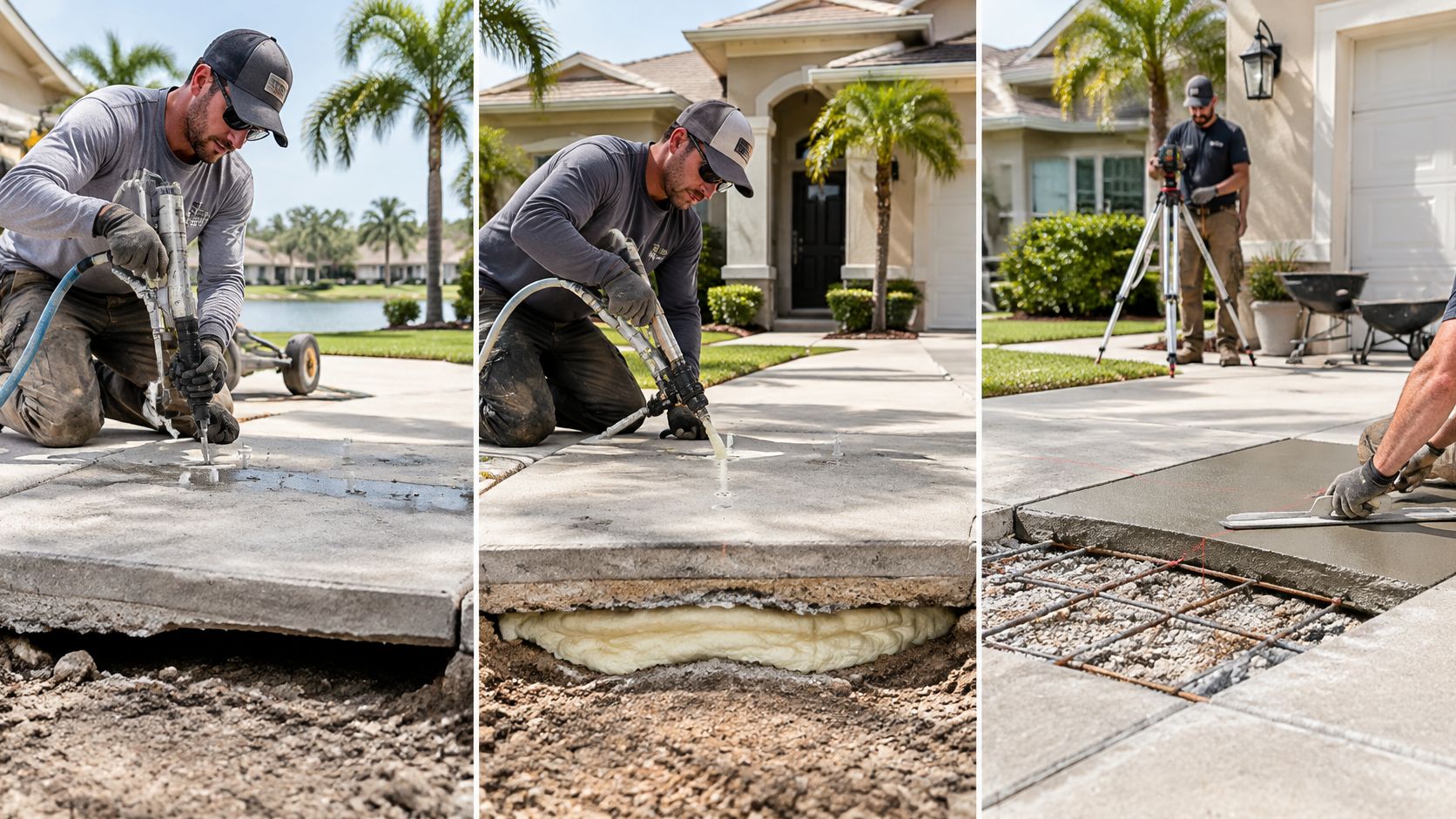
Your driveway has a lip where it meets the garage, or a patio corner now holds water after every storm. The concrete may still look solid, but something underneath it has changed. Before you pay to raise it, you need to know whether the slab has lost support, the soil is still moving, or the concrete itself has failed.
Concrete slab sinking repair starts with the cause, not the injection material. For homeowners and property managers in Central Florida, the right repair must restore support, preserve drainage, and suit the traffic using the surface. A quick lift can be useful, but it isn't a lasting solution to an active washout.
Table of Contents
- Slab Sinking Repair Methods at a Glance
- Why Concrete Slabs Sink and What the Symptoms Mean
- How Mudjacking and Foam Lifting Work
- Foam Lifting Speed, Strength and Limits
- Replacement Costs and Reopening Times
- Florida Conditions That Change the Repair Decision
- Frequently Asked Questions About Slab Sinking Repair
- Choosing the Right Concrete Slab Sinking Repair
Slab Sinking Repair Methods at a Glance
A sinking slab can be repaired with mudjacking, polyurethane foam lifting, or full removal and replacement. The deciding factor is whether the existing concrete remains structurally serviceable and whether the support beneath it can be corrected without excavation.
These options apply to homeowners and property managers in Ocala, Dunnellon, Belleview, Summerfield, Crystal River, Inverness, and The Villages, across Marion County, FL, and Citrus County, FL. A settled walkway and a vehicle-loaded driveway may look similar, but they shouldn't automatically receive the same repair specification.
Slab sinking repair methods compared
| Method | What it fixes | Best fit | Cure or reopening time | Main risk |
|---|---|---|---|---|
| Mudjacking (cementitious slabjacking) | Raises a settled slab and fills voids below it | Structurally sound slab with measurable settlement | Confirm the mix-specific strength and traffic-release requirements in writing | Overcorrection if elevation isn't checked continuously |
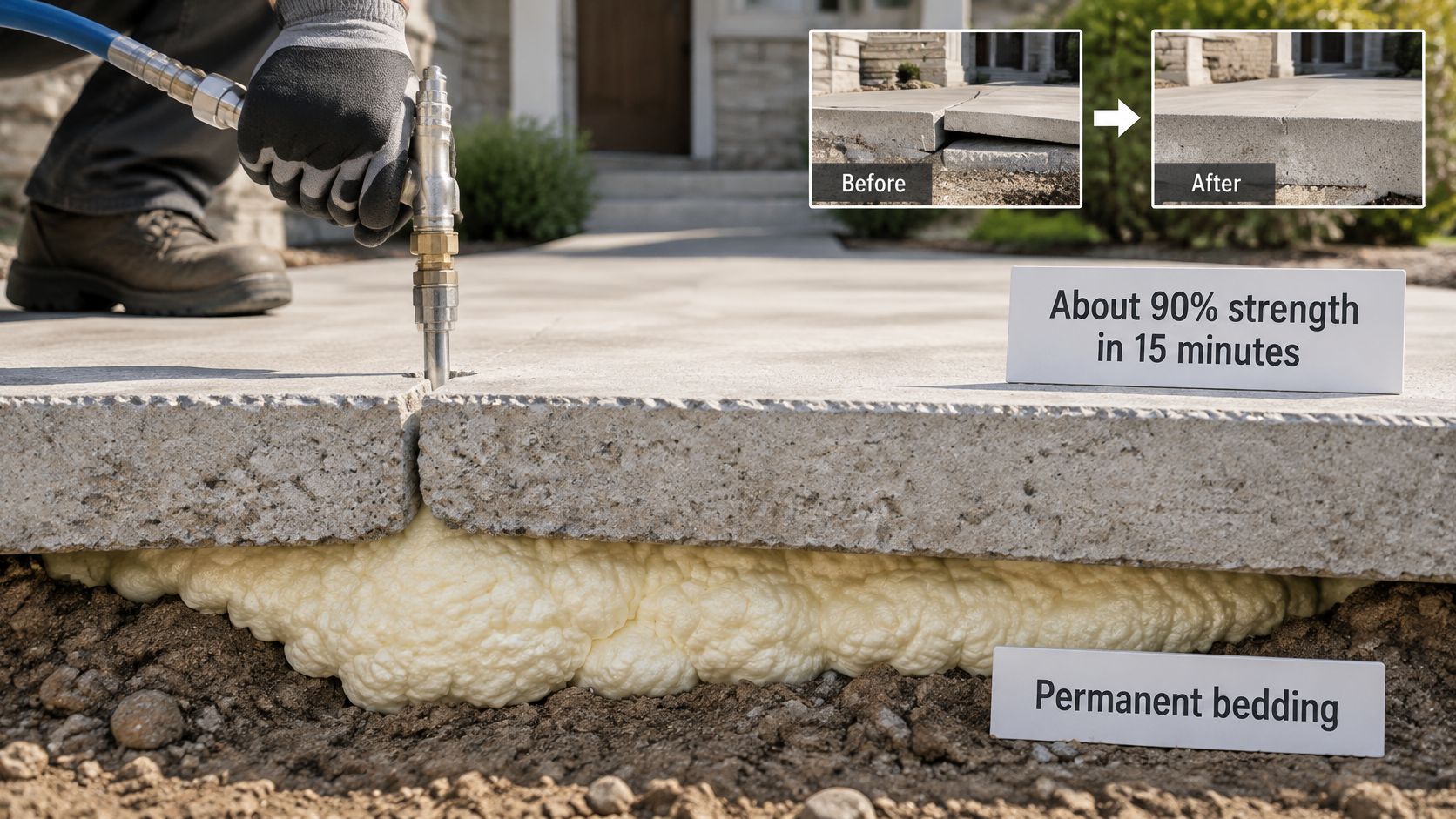
| Polyurethane foam lifting | Fills voids and lifts the slab in a controlled way | Sound slab with localized voids and a need for fast return to traffic | About 15 minutes to roughly 90 percent of full strength as permanent bedding, not automatic traffic approval | Uneven penetration and variable support in some base conditions |
| Full removal and replacement | Replaces failed concrete and allows subgrade correction | Cracked, broken, or repeatedly settling slabs | Written release based on the concrete mix, curing conditions, and intended loads | Highest upfront cost, but resets the slab's condition |
Match the repair to the concrete
Mudjacking and foam lifting preserve existing concrete. They're candidates when the slab holds together and the contractor can establish a suitable injection plan. Neither method turns broken pieces into a new, structurally continuous slab.
Replacement provides access to the base. That matters when a contractor must remove unsuitable material, improve compaction, correct grading, or rebuild an edge that no longer carries its intended load.
Don't compare quotes by method name alone. A low injection price may exclude drainage work, elevation documentation, or treatment of adjacent panels.
Practical rule: Shortlist the repair that matches the slab's condition, then compare bids that address the same underlying problem.
Ask each bidder to identify the repair limits, target elevations, site preparation, cleanup, and traffic restrictions. Those details make the comparison useful rather than inexpensive.
Why Concrete Slabs Sink and What the Symptoms Mean
Lost support beneath the concrete is the central problem. The slab may settle into weak soil, bridge a void left by erosion, or move at a joint where adjacent panels don't share loads effectively.
Pumping occurs when water and repeated loading move fine material out from beneath the slab. Inadequate compaction, soil shrinkage, and weak base material can also leave concrete without uniform support. A surface patch won't correct those conditions.
The Federal Highway Administration's pavement faulting report defines faulting as a difference in elevation across a joint or crack, reports that daily expansion and contraction can produce as much as 0.5 millimeters of faulting per year, and notes that faulting becomes objectionable at approximately 3.3 millimeters at a joint.
Read symptoms as clues, not a diagnosis
A localized step at a joint isn't the same measurement as total faulting accumulated across a long pavement section. Neither measurement, by itself, identifies what's happening below a residential slab.
Slab symptoms, likely causes and what they point to
| Symptom | Likely cause | What it points to |
|---|---|---|
| Hollow sound when walking on the slab | Possible void beneath the slab | Stabilization or lifting candidate after verification |
| Slab rocks underfoot | Lost support and possible pumping of fines | Injection to fill confirmed voids |
| Step at a joint in the objectionable faulting range | Settlement or weak load transfer | Lifting or joint repair after assessment |
| Water pools at the slab edge | Drainage or grading problem | Correct water flow before repair |
| Multiple cracks or corner breaks | Structural failure or repeated movement | Replacement likely |
| Soft area near a spring or drainage channel | Possible washout, sinkhole activity, or groundwater problem | Geotechnical evaluation first |
A hollow sound is a screening clue, not proof that injection will work. Likewise, a soft patch near concrete doesn't establish that a sinkhole exists. It does justify stopping routine repair planning until the ground condition is understood.
Look beyond the lowest corner. Displaced soil, runoff tracks, clogged drainage outlets, and water entering open joints can help explain water damage to concrete and the support beneath it.
Before calling a contractor, photograph the slab and its surroundings. Note where it moves, when you first noticed movement, whether it changes after rain, and whether water flows toward or away from it. Keep people and vehicles away from unstable edges rather than testing them repeatedly.
How Mudjacking and Foam Lifting Work
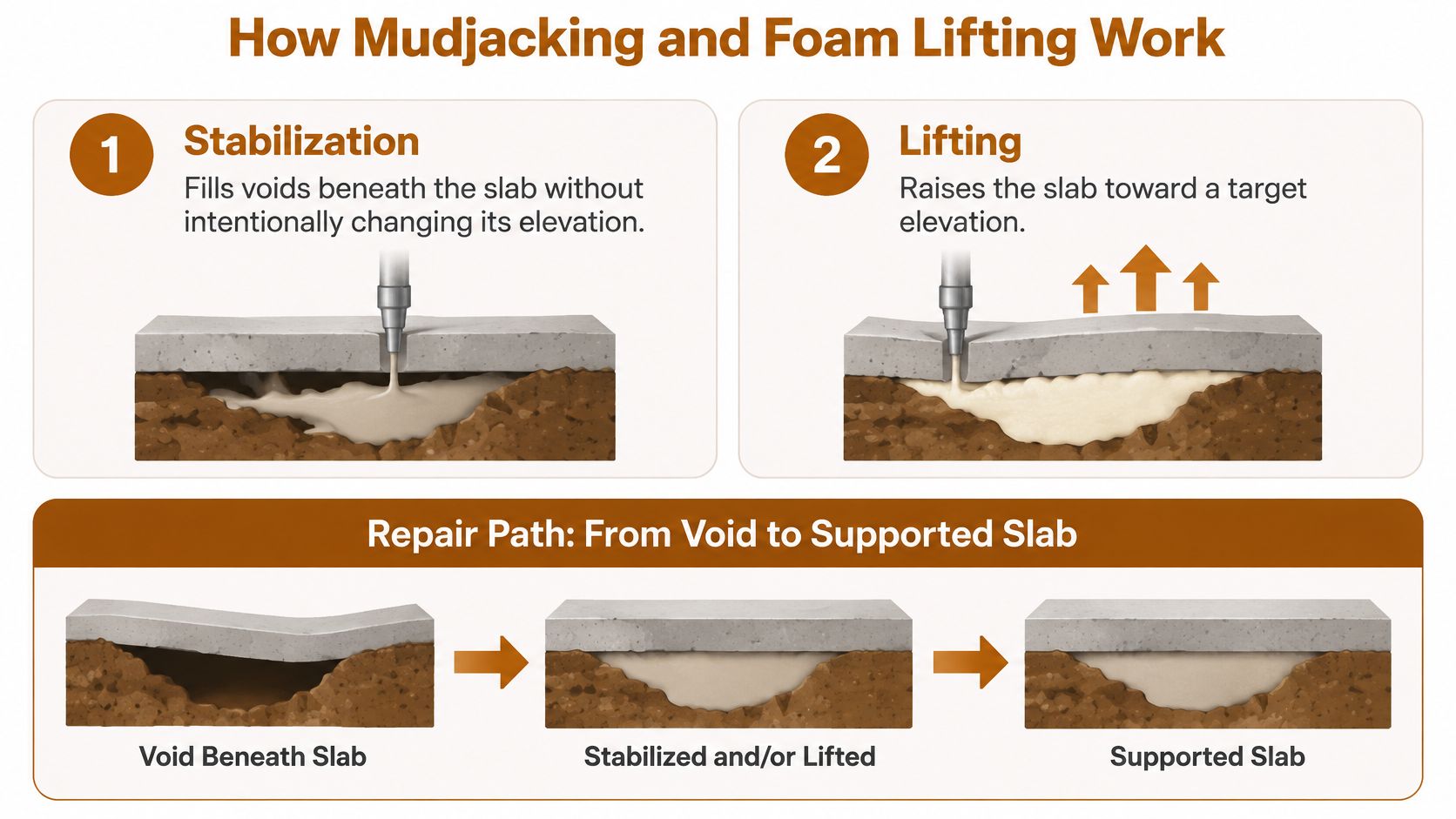
Stabilization fills voids without intentionally raising the concrete. Lifting raises a settled slab toward a planned elevation. The Federal Highway Administration's concrete pavement preservation guidance makes this distinction and recommends targeting stabilization where voids are known to exist rather than injecting indiscriminately.
The repair objective should be written down before drilling begins. A slab that rocks but already drains correctly may need support, not additional height.
The mudjacking sequence
Cementitious slabjacking uses grout injected beneath the concrete. The work should follow a controlled sequence:
- Lay out and drill injection holes. The American Concrete Institute's slabjacking guide describes typical hole spacing of 5 to 10 feet, with holes near edges and joints commonly placed 1 to 2 feet inward. The actual layout must suit the slab and the area needing support.
- Inject cementitious grout under controlled pressure. The crew fills the void or begins raising the slab according to the repair objective. Injection shouldn't proceed blindly because material is disappearing below the surface.
- Monitor elevation continuously. A surveyor's level or laser level provides a consistent reference while the slab moves.
- Stop at the planned position. The target must account for adjoining concrete, door thresholds, drainage, and the intended use of the surface.
- Seal the injection holes. Finish the holes with suitable mortar and leave the surface ready for its specified curing and reopening requirements.
Too much lift can create new cracks or redirect runoff toward a building. Using the neighboring panel as the only reference is risky when that panel has also moved.
How foam lifting differs
Foam lifting follows a similar drilling, injection, monitoring, and finishing sequence. Instead of cementitious grout, the crew injects high-density polyurethane that expands beneath the slab.
The operator must control material placement and watch the response. Expansion isn't a substitute for measurement, and a slab that rises at one injection point may still have unsupported areas elsewhere.
The California construction manual's existing concrete pavement guidance describes drilling, cleaning injection holes, placing grout, and sealing the holes as part of this repair work. For a homeowner, the practical acceptance criteria are straightforward:
- Elevation records: Document the slab before and after work.
- Stable support: Confirm in writing that rocking has stopped.
- Drainage performance: Check that the repaired surface sheds water appropriately.
- Follow-up observations: Record renewed cracking or movement rather than covering it cosmetically.
Stabilization and lifting are alternative objectives, not mandatory consecutive treatments for every slab.
Foam Lifting Speed, Strength and Limits
Fast material strength development is foam lifting's clearest advantage, but it doesn't prove that the ground has been repaired. The FHWA guidance on concrete pavement preservation reports that high-density polyurethane used as permanent bedding may reach approximately 90% of full compressive strength in about 15 minutes; its representative specification lists roughly 4 lb/ft³ density and 60 to 145 psi compressive strength, while cementitious bedding commonly requires approximately 500 psi at opening to traffic.
Those material values aren't interchangeable measures of overall repair quality. Slab thickness, loading, contact beneath the concrete, and the condition of the base still matter.
Where field performance qualifies the promise
The FHWA document also describes Pennsylvania field work in which foam didn't penetrate the full width and depth of an open-graded stone layer. Support was variable, and slab movement exceeded the project's specified limit. Both cementitious and foam-treated sections improved measurements near cracks and joints, but not significantly near the middle of panels.
That distinction matters. A surface can appear corrected while contact underneath remains uneven.
A University of Tennessee at Chattanooga evaluation of Tennessee DOT foam treatment found that the application maintained, rather than improved, overall pavement condition. The investigators recommended detailed ground investigation, better selection of suitable treatment areas, and precision leveling equipment.
Highway pavement isn't a residential patio, but the lesson applies: choose injection because the support problem suits it, not because the material cures quickly.
What a useful foam proposal includes
- Soil and void assessment: Establish where support is missing and whether material is still washing out.
- Controlled injection: Specify how the crew will manage pressures, injection locations, and lift increments.
- Independent elevation checks: Use a stable reference rather than assuming adjacent concrete is correct.
- Job-specific reopening instructions: Separate material strength development from permission to walk or drive on the slab.
A fast cure is valuable only when the slab finishes at the right elevation with dependable support beneath it.
Foam can be appropriate for a sound slab with a treatable void. It's a poor substitute for excavating failed ground or replacing concrete that can no longer carry its intended loads.
Replacement Costs and Reopening Times
Lifting can restore elevation and support. It can't restore concrete that has already broken apart. Replacement becomes the practical choice when the slab has multiple displaced cracks, crumbling load-bearing edges, repeated corner failure, or a base that must be excavated and rebuilt.
A previous repair also changes the evaluation. If settlement returns, another lift shouldn't be approved until the contractor explains what caused the recurrence and how the new scope addresses it.
When a smaller sidewalk correction is appropriate
Not every walkway defect requires demolition. The City of Sierra Madre sidewalk assessment recorded 2,402 hazards, including 2,072 trip hazards involving vertical changes of at least 3/8 inch, and recommended saw-cutting and feathering selected hazards from 3/8 to 2 inches, while identifying 1/2- to 2-inch vertical faces as particularly dangerous.
Those findings aren't a blanket instruction to cut every raised panel. Remaining concrete thickness, adjacent slopes, ongoing movement, and local requirements determine whether spot correction is suitable.
For applicable accessible walking surfaces, the U.S. Department of Justice's ADA Standards limit running slope to 1:20, except where applicable ramp requirements are met, and cross slope to 1:48. Removing a lip while creating an excessive cross slope isn't a successful accessibility repair.
Compare the complete cost
Repair cost drivers and reopening times
| Method | What drives the price | Reopening time | Long-term consideration |
|---|---|---|---|
| Mudjacking (cementitious slabjacking) | Grout volume, hole count, access, and elevation checks | After the specified grout strength and contractor's traffic-release conditions are met | Repeat lifting may be needed if drainage or void formation continues |
| Polyurethane foam lifting | Foam volume, hole count, and soil and void assessment | Rapid bedding strength development, followed by job-specific traffic approval | Results rely on adequate penetration and support through the base |
| Full removal and replacement | Concrete area, subgrade correction, demolition, disposal, and access | After the specified concrete curing and load-release requirements are met | Higher upfront cost, but allows failed concrete and base conditions to be addressed |
Void filling is generally the lower upfront option for a sound slab. Repeated mobilization, continued movement, and later demolition can erase that apparent saving.
A useful concrete slab repair cost comparison includes drainage work, base correction, disposal, finishing, and access restrictions. Get separate written instructions for pedestrian use and vehicle loading, not a verbal promise that the area will be ready quickly.
Florida Conditions That Change the Repair Decision
Central Florida repair planning must account for rainfall, heat cycles, ground conditions, and traffic. A patio beside a roof discharge and a driveway carrying delivery vehicles don't lose support in the same way.
FHWA's concrete pavement preservation guidance identifies excessive moisture, inadequate consolidation, and poor joint load transfer among the support-related problems that stabilization must address. Filling a void doesn't automatically correct any of those causes.
Florida Department of Transportation guidance also flags expansive soils, springs, sinkholes, groundwater, and grading as considerations in pavement and foundation design. These are conditions to investigate where indicated, not assumptions to make about every property.
Florida factors and their effect on sinking slabs
| Florida factor | Effect on slab | Repair implication |
|---|---|---|
| Heavy summer rain | Can carry fines out from beneath concrete and form voids | Correct drainage before injection |
| Daily heat cycles | Repeated expansion and contraction at joints | Check joint load transfer and faulting |
| Expansive soils | Swelling and shrinkage can shift the base | Evaluate soil before choosing a method |
| Springs, sinkholes, or high groundwater | Can contribute to washout and loss of support | Obtain geotechnical evaluation before lifting where suspected |
| Heavy vehicle traffic on driveways | Loads weak joints and unsupported edges | Plan around load paths and edge support |
Evaluate the site beyond the slab
The same site-first approach applies to homes and commercial properties in Ocala, Dunnellon, Belleview, Silver Springs, Summerfield, Crystal River, Homosassa, Inverness, Lecanto, Beverly Hills, Hernando, and The Villages.
Inspect downspout discharge, irrigation overspray, drainage channels, adjacent landscaping, and pavement transitions. During dry weather, runoff stains and deposited sediment can reveal where stormwater travels.
Sun exposure and UV protection matter particularly for adjacent asphalt maintenance. They shouldn't distract from the more immediate question beneath sinking concrete: is water or unstable ground still removing support? Sealcoating and surface treatments don't stabilize an unsupported concrete slab.
Site-first judgment: If water will continue flowing through the failed base after the crew leaves, the repair scope is incomplete.
An unexplained depression, active soil loss, or soft ground deserves investigation before anyone injects material. Where ground conditions are uncertain, a geotechnical evaluation can prevent the owner from paying for the wrong repair.
Frequently Asked Questions About Slab Sinking Repair
Can a sinking slab be fixed without replacing it?
Yes, when the concrete remains serviceable and the problem is a treatable void or settlement. Stabilization can restore support, while lifting can correct elevation. The assessment must still rule out active washout, unsuitable ground, and concrete failure that makes preservation impractical.
How soon can I walk or drive on a repaired slab?
That requires a job-specific written release. Foam develops strength quickly, but material cure alone doesn't establish that the entire repair is ready for traffic. Cementitious injection and replacement concrete need their own strength and curing requirements, with vehicle loading addressed separately from pedestrian access.
Why did my slab sink again after a repair?
A recurring depression can mean the original cause remains active, support was incomplete, or a different part of the base has moved. Check drainage outlets, adjacent joints, soil loss, and the repair records. Don't authorize another injection solely because the previous treatment temporarily raised the surface.
Is a small step on a walkway worth fixing now?
Yes, especially on a frequently used entrance or accessible route. A modest lip can interfere with walking, mobility devices, and carts even when the surrounding concrete looks sound. Document the defect, control access where necessary, and assess the full route rather than judging only the visible step.
For property managers, a simple condition log helps prioritize work:
- Location: Identify the panel and nearby entrance or parking area.
- Condition: Photograph displacement, cracking, and drainage evidence.
- Action: Record temporary protection, evaluation findings, and the completed repair.
- Follow-up: Reinspect after significant rain or reported movement.
This approach supports planned maintenance rather than repeated emergency spot fixes.
Choosing the Right Concrete Slab Sinking Repair
A sunken slab is not automatically a candidate for lifting. First determine whether the concrete is intact, what support it has lost, and whether water or soil movement is still affecting the base. Raising a slab without correcting the cause can leave it vulnerable to settling again, so the lowest initial-cost option may not be the best long-term choice.
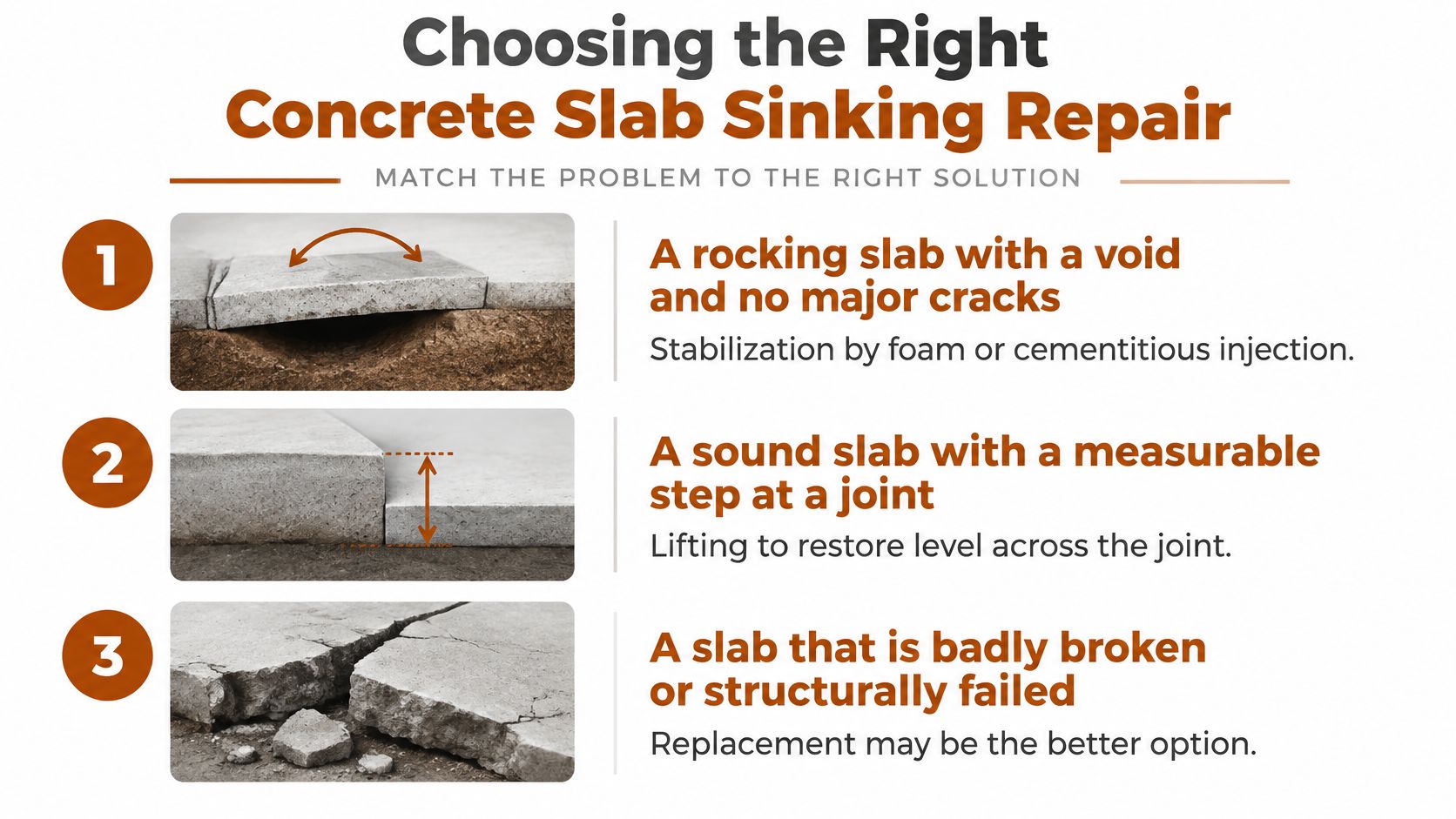
- Rocking with no major cracks: Confirm a void and investigate what caused it before considering stabilization.
- Sound concrete with measurable settlement: Mudjacking or foam lifting may restore elevation, with checks throughout the lift.
- Multiple cracks or broken corners: Assess removal and replacement, since injection cannot restore failed concrete.
- Settlement after an earlier repair: Recheck drainage and soil conditions before selecting another treatment.
Slab situation and the repair it points to
| Slab situation | Likely method | Reason |
|---|---|---|
| Rocking slab with a void beneath, no major cracks | Stabilization by foam or cementitious injection | Fills the void while preserving sound concrete |
| Sound slab with a measurable step at a joint | Lifting by mudjacking or foam | Can restore elevation when the slab remains intact |
| Multiple cracks or broken corners | Full removal and replacement | Injection cannot repair failed concrete |
| Settlement returns after a prior repair | Drainage and soil correction, then replacement if needed | The original cause may still be active |
Put acceptance criteria in the quote
Ask for pre- and post-repair elevation readings, an explanation of uncertain ground conditions, and a drainage check before injection. The proposal should describe pressure control and lift increments. For replacement, it should specify base preparation and how the new slab will meet adjacent surfaces.
Accessible routes need finished-slope verification. Get reopening requirements in writing so you can plan parking, deliveries, and pedestrian access. If preservation no longer makes sense, concrete slab replacement should address the failed support, rather than placing new concrete over the same unresolved problem.
Local help with the right scope
We're Riverside Sealing & Striping, LLC, a family-owned and operated company made up of third- and fourth-generation professionals. Our concrete work includes damaged driveway removal and replacement, new driveway installations, patios, slabs, and sidewalks. We also provide asphalt seal coating and precision striping.
Serving Marion, Citrus, and surrounding Central Florida counties, Riverside handles residential and commercial concrete and sealing projects. Concrete and Asphalt Experts in Marion and Citrus County means matching the work to the surface and its condition, rather than treating every sunken slab as an injection job.
Riverside offers free consultations and estimates for concrete, asphalt seal coating, and striping projects. To discuss whether a damaged slab needs repair or replacement, request a no-pressure on-site consultation through Riverside Sealing & Striping, LLC.