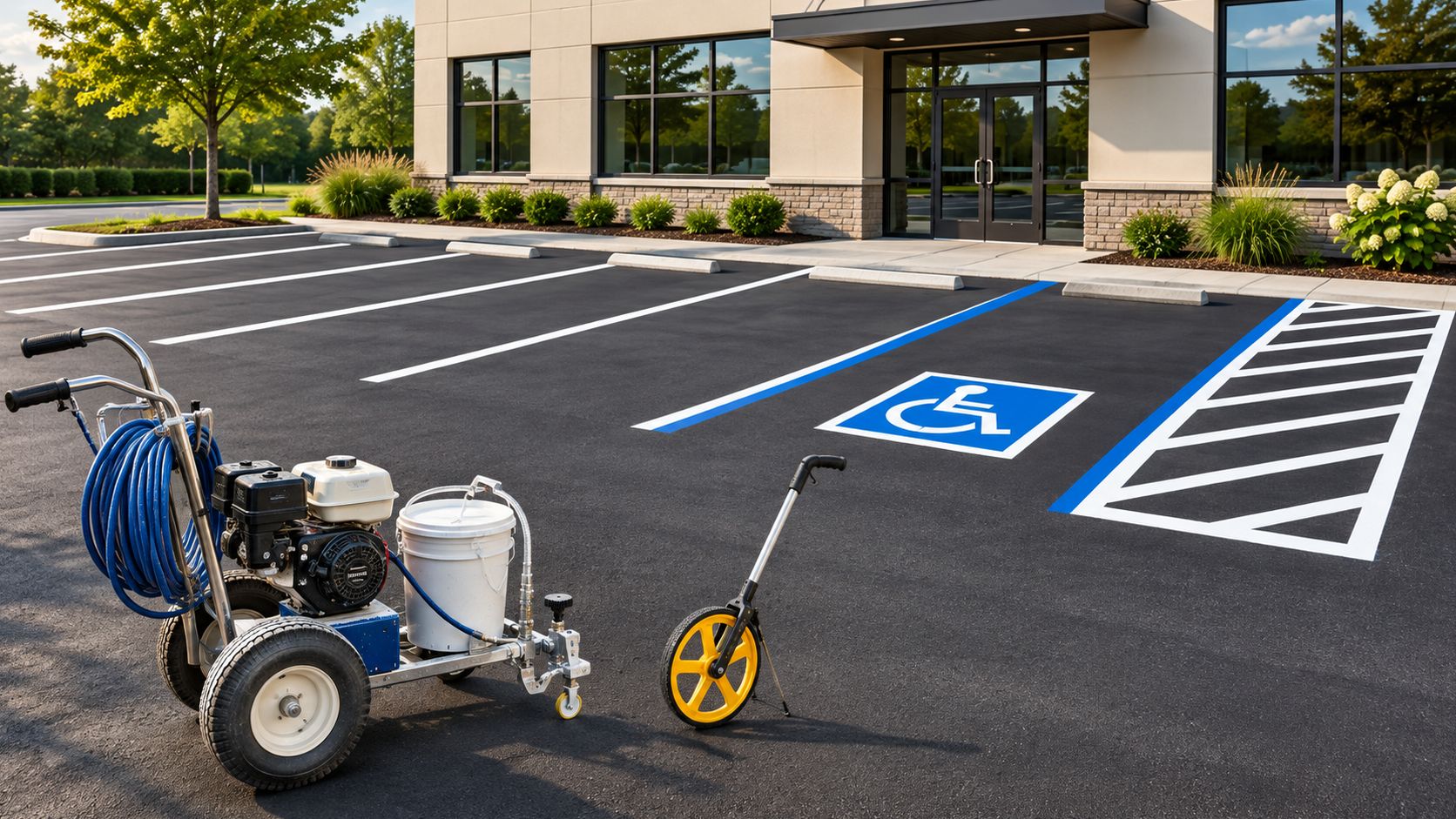
For 2026 budgeting, national estimator ranges put a typical whole-lot restripe near $475 to $1,200, standard 4-inch lines at about $0.25 to $0.65 per linear foot, and minimum trip charges around $350 to $750. These are planning ranges, not guaranteed bids for Marion County, FL or Citrus County, FL.
The useful question isn't just what it costs to repaint parking spaces. It's whether you're buying a same-layout paint refresh or paying to correct a layout that shouldn't be copied. For Central Florida property managers, that distinction can matter more than the advertised price per stall.
Table of Contents
- Planning Ranges for a 2026 Restripe
- Line Items That Set the Price
- Accessible Spaces That Raise the Scope
- What Three Central Florida Lots Might Spend
- Florida Heat Rain and the Right Paint Sequence
- Questions Property Managers Still Ask
- Book a Measured Estimate Not a Guess
Planning Ranges for a 2026 Restripe
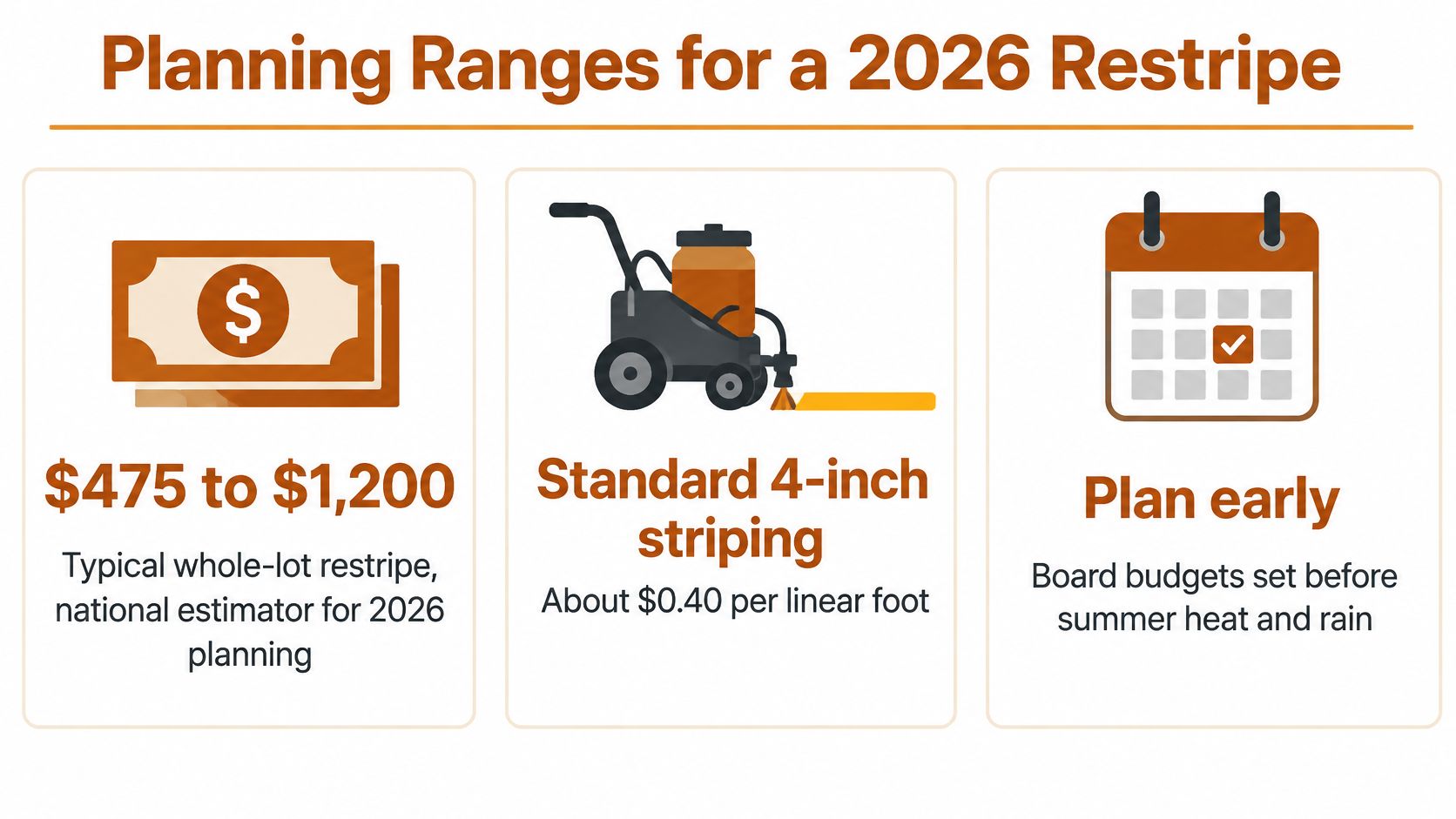
An Ocala property manager or Inverness church treasurer needs a starting budget before scheduling a site visit. The Pinpoint Line striping cost guide reports approximately $475 to $1,200 for a typical whole-lot restripe, $0.25 to $0.65 per linear foot for standard 4-inch lines, and $350 to $750 for minimum trip charges. Use those national industry estimates as a screening tool, not a local price schedule.
2026 planning ranges for parking lot restriping
| Scope | How it is priced | Planning range | What drives it |
|---|---|---|---|
| Typical whole-lot refresh | One project total | $475–$1,200 | A common visit when painted footage is limited |
| Standard 4-inch lines | Per linear foot of traffic paint | $0.25–$0.65 | Paint, layout, and production speed |
| Minimum trip charge | Per visit, even for a short job | $350–$750 | Travel, setup, and a short production day |
| Itemized larger job | Sum of footage, symbols, and mobilization | Above $1,200 when quantities stack | ADA packages, arrows, crosswalks, and long stall runs |
The ranges help distinguish a short repainting visit from a substantial marking project. They don't mean every parking lot fits inside the whole-project band. A contractor still has to measure the work and identify what the quoted total includes.
The visual below summarizes the budget categories worth separating before you request bids.
Why a small lot can cost more per stall
Consider a hypothetical small church lot in Crystal River compared with a larger, open retail lot in Belleview. Both require equipment transport, unloading, paint preparation, layout checks, and cleanup. The church spreads those tasks across fewer painted lines.
The retail crew may spend more time painting, but less time repositioning equipment between individual markings. That can reduce its effective unit cost even though the final invoice is higher.
Budget rule: A typical project range is a starting allowance, not a ceiling or a promise.
What moves the estimate
The most useful parking lot restriping cost comparison starts with the same assumptions:
- Painted footage: Count actual line length, not just parking spaces.
- Layout changes: Identify whether the crew will follow existing markings or establish new ones.
- Surface condition: Note contamination, loose material, and deteriorated pavement.
- Accessible markings: Separate specialized layouts, symbols, and striped aisles.
Don't add a minimum charge automatically to every per-foot calculation. Some proposals use it as the minimum invoice; others identify mobilization separately. Get that distinction in writing so you don't count the same expense twice.
Use the table to decide whether a preliminary budget is plausible. Replace that allowance with a measured takeoff, an itemized list of quantities, before approving the work.
Line Items That Set the Price
A per-space price is convenient, but it hides the production work. Shared stall lines, end lines, drive-aisle edges, directional symbols, and painted curbs don't increase in equal proportion to the number of spaces.
The TruTec pavement-marking estimating guide gives broader planning benchmarks of $0.20 to $1.00 per linear foot for 4-inch lines, $25 to $50 per ADA space, $10 to $30 per arrow, $50 to $100 per crosswalk, and $1 to $4 per linear foot of curb painting, with mobilization adding several hundred dollars. These are estimating units, not a bundled Riverside price list.
Unit prices inside a restriping estimate
| Marking | Unit | Planning range | Notes |
|---|---|---|---|
| 4-inch stall and edge lines | Linear foot | $0.20–$1.00 | Main production item on a same-layout refresh |
| ADA space package | Each | $25–$50 | Symbol, stall, and access-aisle layout, not a plain stall |
| Arrows and similar symbols | Each | $10–$30 | Directional paint beyond straight lines |
| Crosswalks | Each | $50–$100 | Bars or a marked pedestrian crossing |
| Curb painting | Linear foot | $1–$4 | Separate from stall lines |
| Mobilization | Per visit | Several hundred dollars | Highest impact on small lots |
An accessible-space package needs a written definition. A symbol refresh isn't the same scope as remeasuring the stall, establishing its aisle, painting hatching, and addressing signs. Don't assume a package includes every compliance-related task because the estimate calls it an ADA space.
Refresh versus redesign
A same-layout refresh in Summerfield mainly involves cleaning suitable pavement and repainting verified markings. The estimator can use a measuring wheel for line footage and count stencil applications separately.
A redesign in Homosassa requires more layout work. The crew needs reference points, tape measurements, a chalk line or equivalent layout method, and a plan for conflicting old markings.
That explains why published line-striping price ranges aren't identical. A clean, uninterrupted production run isn't the same job as repeated stops around occupied spaces, islands, loading areas, and pedestrian routes.
For material comparisons, our guide to parking lot striping paint helps explain why the product specification belongs beside the quoted quantities.
Read the exclusions before the total
Oil contamination needs treatment before paint application. Loose coatings and failed sealant may require removal rather than another coat over the top. Those operations use labor without producing much visible line footage.
A large, empty lot lets the operator maintain steady machine travel. A segmented property in The Villages may require repeated moves, protected pedestrian access, and coordination with residents or deliveries.
Request a scope that identifies:
- Measured markings: Line footage, symbols, crosswalks, and curb lengths.
- Preparation allowances: Cleaning, paint removal, and areas needing additional treatment.
- Site logistics: Who clears vehicles, places cones, and manages reopening.
- Separate work: Signage, accessible-layout corrections, and pavement repairs.
Compare extended totals, meaning quantity multiplied by unit price, rather than choosing the lowest rate in isolation. A cheaper line rate won't help if the contractor omitted half the markings.
Accessible Spaces That Raise the Scope
Two lots with the same stall count can need different amounts of accessible-parking work. One may already have a usable layout; the other may need wider aisles, relocated markings, and a revised connection to the building.
The U.S. Access Board parking guide establishes the minimum counts below and requires accessible car spaces at least 96 inches wide with a 60-inch access aisle; van configurations generally use a 132-inch space with a 60-inch aisle, or a 96-inch space with a 96-inch aisle. Those dimensions explain why an accessible space isn't priced like an ordinary stall.
Accessible spaces required by facility size
| Total spaces in the facility | Minimum accessible spaces | Cost effect |
|---|---|---|
| 1–25 | 1 | One van-capable layout and aisle on even a small lot |
| 26–50 | 2 | A second accessible stall and shared or separate aisle |
| 51–75 | 3 | More symbols, hatching, and layout checks |
| 76–100 | 4 | Compliance work becomes a visible share of the quote |
| 101–150 | 5 | Five special layouts instead of a uniform stall price |
| 501–1,000 | 2 percent of spaces | Count grows with the facility, not a flat add-on |
| More than 1,000 | 20 plus 1 for each 100, or fraction thereof, above 1,000 | Large-site schedule, not a per-line guess |
This table shows selected facility-size bands, not the complete schedule. Special facility uses can also require a closer review rather than a quick count from an aerial photograph.
Measure the layout instead of trusting old paint
The 2010 ADA Standards generally measure parking-space and access-aisle widths from the centerline of markings, subject to the standards' stated exceptions. A crew should establish those measurements with a tape before applying paint.
Repeated touch-ups can shift the apparent edges of a space. A thick, faded line isn't a reliable reference point, and visual alignment won't establish whether an aisle provides the required clearance.
Hatching, accessibility symbols, and signs also need coordination. A freshly painted symbol can't compensate for an aisle that stops short or a route obstructed by wheel stops.
The cheapest repaint isn't a bargain if it preserves a layout that needs correction.
Make the correction visible in the proposal
For a church in Lecanto or a shop in Silver Springs, the estimate should distinguish ordinary line renewal from accessible-layout correction. That gives the owner a clear record of what changes, why it changes, and which costs belong to the correction.
Our ADA handicap parking space requirements guide is a useful companion when preparing a site review. Bring the existing parking plan if one is available, but verify it against the pavement.
Ask for a before-and-after sketch showing the resulting parking count. Accessible aisles need real space, so don't approve a revised layout without understanding whether it removes ordinary stalls or requires work beyond paint.
What Three Central Florida Lots Might Spend
The following scenarios are hypothetical budgets built from the planning units, not local bids. They show how an estimate changes when the contractor separates line production from specialized markings and corrective work.
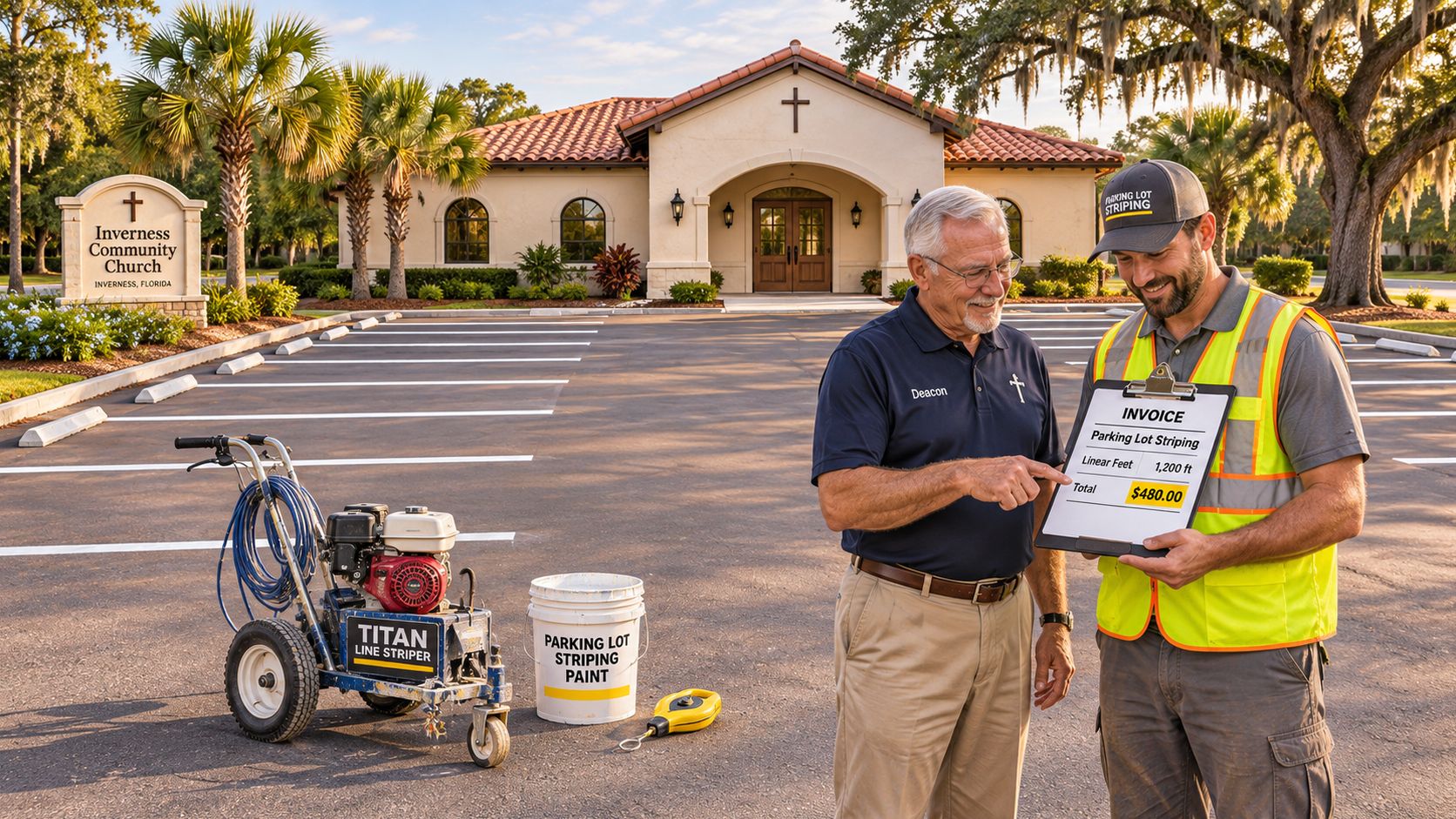
A church invoice should make those components understandable to the person approving the expenditure.
A church refresh and a retail refresh
For a hypothetical 24-space church in Inverness, assume 1,200 linear feet at $0.40, producing $480 in line work. Add $400 mobilization and $40 for an accessible-symbol refresh, and the arithmetic subtotal is $920.
A planning allowance near $900 to $1,100 would describe that scenario, provided the layout is already suitable and no corrective work is included. The symbol allowance isn't a complete accessible-space reconstruction.
For a hypothetical 80-space retail lot in Ocala, assume 4,000 linear feet at $0.35, or $1,400. Add four ADA packages at $40, six arrows at $20, a $75 crosswalk, and $500 mobilization for a calculated subtotal of $2,255.
A $2,200 to $2,800 planning allowance fits that illustrative scope without line removal. The larger total doesn't contradict the opening budget screen; it reflects more measured work.
Three Central Florida restriping budgets
| Lot | Line math | Added items | Planning total |
|---|---|---|---|
| 24-space church in Inverness, same layout | 1,200 feet × $0.40 = $480 | Mobilization about $400 and one ADA symbol about $40 | $920 subtotal; about $900–$1,100 allowance |
| 80-space retail lot in Ocala, same layout | 4,000 feet × $0.35 = $1,400 | Four ADA packages $160; six arrows $120; crosswalk $75; mobilization $500 | $2,255 subtotal; about $2,200–$2,800 allowance |
| HOA lot in Dunnellon, two van spaces widened | Paint quantities similar to the retail lot | Correction could remove about two standard stalls in this hypothetical layout; damaged pavement is a separate repair | Split renewal, compliance, and repair instead of one total |
An HOA correction is a different decision
For the Dunnellon scenario, the assumed stall loss isn't a general rule. The actual result depends on geometry and the proposed accessible route.
The ADA National Network parking guidance explains that planned alterations such as restriping or resurfacing generally must comply with the 2010 ADA Standards to the maximum extent feasible. That makes copying an unsuitable layout a poor basis for a low bid.
Use the video as a visual companion while reviewing the proposed marking scope.
A manager in Beverly Hills or Hernando can use the same comparison format: ordinary renewal, compliance correction, and pavement repair. Each should have its own description and price rather than disappearing inside a single unexplained total.
Florida Heat Rain and the Right Paint Sequence
A 2025 transportation research report describes thermoplastic marking service life of approximately 2 to 7 years, depending heavily on installation quality and conditions, and identifies visibility as the primary durability criterion. That finding isn't a lifespan promise for ordinary parking-lot traffic paint.
Material names matter. A proposal for waterborne traffic paint shouldn't borrow a thermoplastic durability claim, and a higher-priced material shouldn't be selected without considering the pavement beneath it.
Florida conditions affect the whole installation
Snowplow damage is largely irrelevant here. Central Florida contractors instead have to account for hot pavement, ultraviolet exposure, rain, humidity, surface oxidation, and tires turning across fresh markings.
A busy Belleview retail drive may need attention sooner than a lightly used church lot because vehicles repeatedly scrub the same painted areas. Concrete and asphalt also present different bonding conditions, especially where new concrete meets an older parking surface.
The application sequence needs weather checks and a clean, dry substrate, not just a clear-looking sky at arrival.
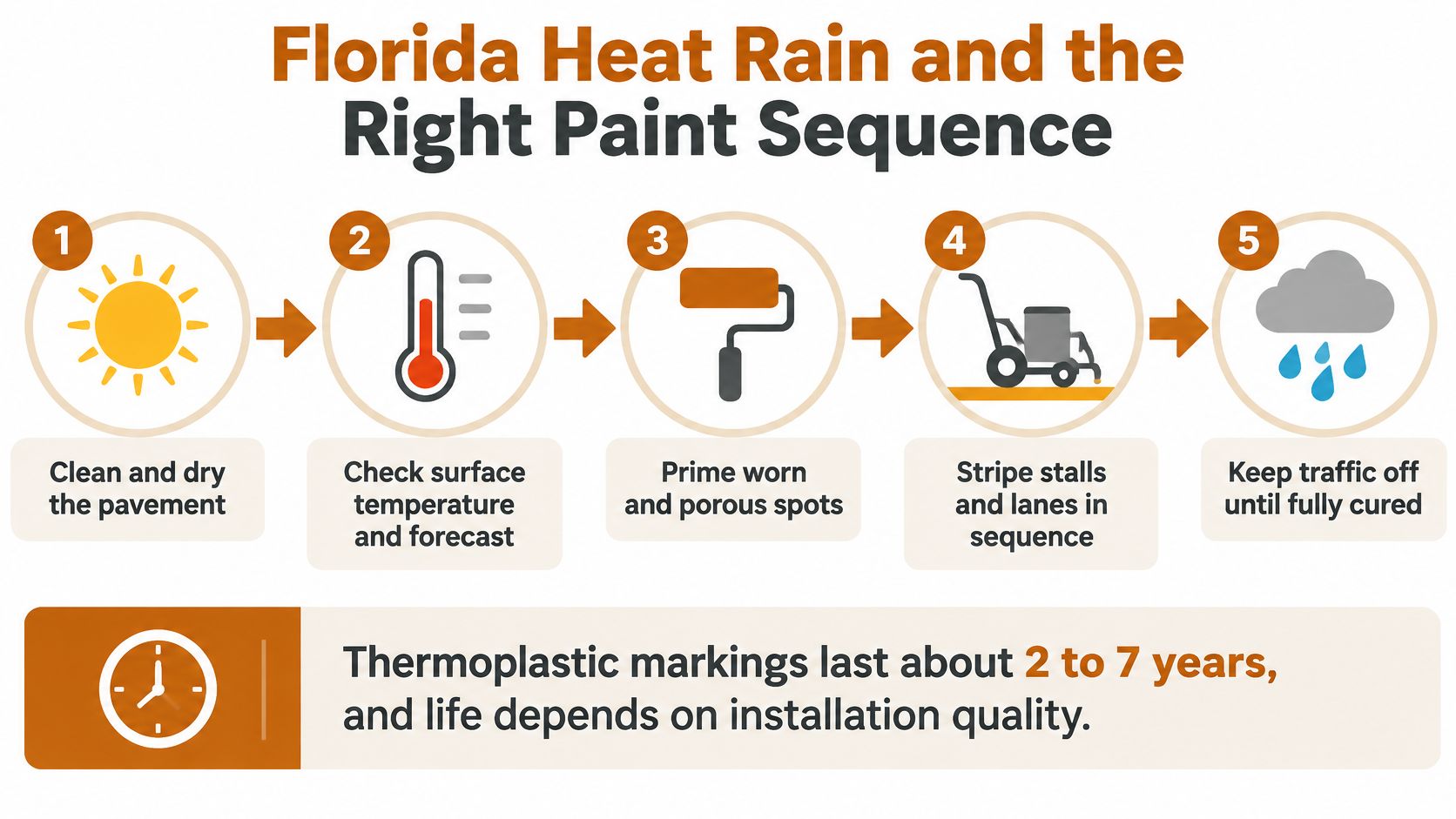
Priming isn't an automatic step for every painted parking lot. Use a primer only where the selected marking system and substrate call for it; applying an incompatible coating can create another adhesion problem.
Repair, sealcoat, then stripe
Painting before planned sealcoating means the new markings will be covered. Painting over raveled asphalt or a depression that holds water leaves the underlying failure in place.
For a coordinated maintenance project, use this order:
- Repair failed areas: Address unstable asphalt, damaged concrete, and drainage-related defects.
- Complete surface maintenance: Sealcoat asphalt where appropriate and allow replacement concrete to cure sufficiently for the selected coating.
- Prepare and mark: Remove interfering contamination, verify layout, and apply the specified marking material.
- Control reopening: Maintain closures until the product and site conditions permit traffic.
Our commercial asphalt maintenance services include sealing and precision striping, allowing those operations to be coordinated rather than treated as unrelated visits.
Scheduling insight: A dry-looking surface after a storm doesn't establish that the pavement and coating conditions are suitable.
The estimate should identify material, preparation assumptions, closure arrangements, and a weather contingency. Request a recheck schedule based on wear at turning points and pedestrian crossings rather than a guaranteed replacement date.
That approach supports long-term savings without pretending that every property needs the most expensive marking system.
Questions Property Managers Still Ask
How soon can cars park on the new lines?
Plan for a dry-weather closure rather than promising tenants an immediate reopening. Humid air after a storm in Ocala or Inverness can extend drying, and a surface skin alone doesn't establish that paint can withstand turning tires.
Keep cones in place until the selected product's traffic-opening conditions are met. Our commercial scheduling is designed to minimize business disruption, but the work window still has to allow proper application and drying.
Does removing old striping cost extra?
Removal is a separate operation from following an existing line. Grinding, suitable removal equipment, cleanup, and any permitted blackout treatment should be identified before work starts.
Covering a conflicting line isn't always a durable substitute for removing it. Old markings can remain visible or reappear as the covering wears, leaving drivers with competing instructions.
- Request a removal boundary: Mark the affected areas on the sketch or site photographs.
- Confirm the finish: Understand whether the method may leave a visible texture or color difference.
- Separate the allowance: Don't bury removal inside an ordinary repainting rate.
Are fire lanes and traffic control included?
Only if the proposal identifies them. Fire-lane lettering, stop bars, hatch marks, curb colors, and closure management require their own quantities or clearly stated inclusions.
An open retail drive also needs a plan for delivery access and pedestrian movement. Don't assume the painting crew is responsible for moving customer vehicles or managing every entrance unless the agreement says so.
Can accessible-space corrections reduce parking capacity?
Yes, where the existing arrangement hasn't reserved enough room for the required layout. The contractor should show the existing count, proposed count, and revised arrangement before the owner approves the project.
An owner can choose among workable, compliant designs, but can't waive accessibility requirements to preserve stalls. Use Planning Ranges for a 2026 Restripe for preliminary budgeting and Accessible Spaces That Raise the Scope when preparing the layout discussion.
Book a Measured Estimate Not a Guess
Approve a scope you can check against the property. A useful site visit identifies stall lines, accessible aisles, faded symbols, arrows, fire lanes, and curbs while distinguishing marking work from problems in the pavement or walking route.
Riverside Sealing & Striping, LLC is a family-owned concrete and asphalt contractor based in Dunnellon. Our commercial striping services include precision line striping and layout, ADA handicap space markings, arrows and symbols, and high-visibility, durable traffic paint.
Concrete and Asphalt Experts in Marion and Citrus County
That combined capability matters when fresh paint isn't the whole solution. We provide asphalt sealcoating to protect against oil, fuel, and weather, alongside concrete driveway replacement, new concrete installations, and sidewalk work.
For an HOA in The Villages, the priority might be a damaged sidewalk connecting parking to the entrance. For a business near Silver Springs, the asphalt may need maintenance before its markings are renewed.
A written proposal should make the approval decision straightforward:
- Paint-only scope: Identify the markings being renewed.
- Correction scope: Show changes to accessible parking or circulation.
- Preceding repairs: Identify concrete or asphalt work that should happen before marking.
Our local Central Florida experience, attention to workmanship, and reliable scheduling support coordinated maintenance rather than disconnected repairs. When comparing contractors, verify that the selected business is licensed and insured for the proposed work; don't substitute an attractive price for that check.
We offer free, no-pressure on-site consultations at the customer's convenience. Call 352-266-6062 to discuss the property, its operating hours, and the work you're considering.
A realistic schedule can support fast turnaround without skipping preparation. The best way to control the cost to restripe a parking lot is to measure the scope before anyone commits to painting it.
Riverside Sealing & Striping, LLC offers parking lot striping, accessible-space markings, asphalt sealcoating, and concrete work for properties across Marion and Citrus counties. Visit Riverside Sealing & Striping, LLC to request a free, no-pressure on-site estimate and discuss which markings, layout corrections, and pavement repairs belong in your project.