
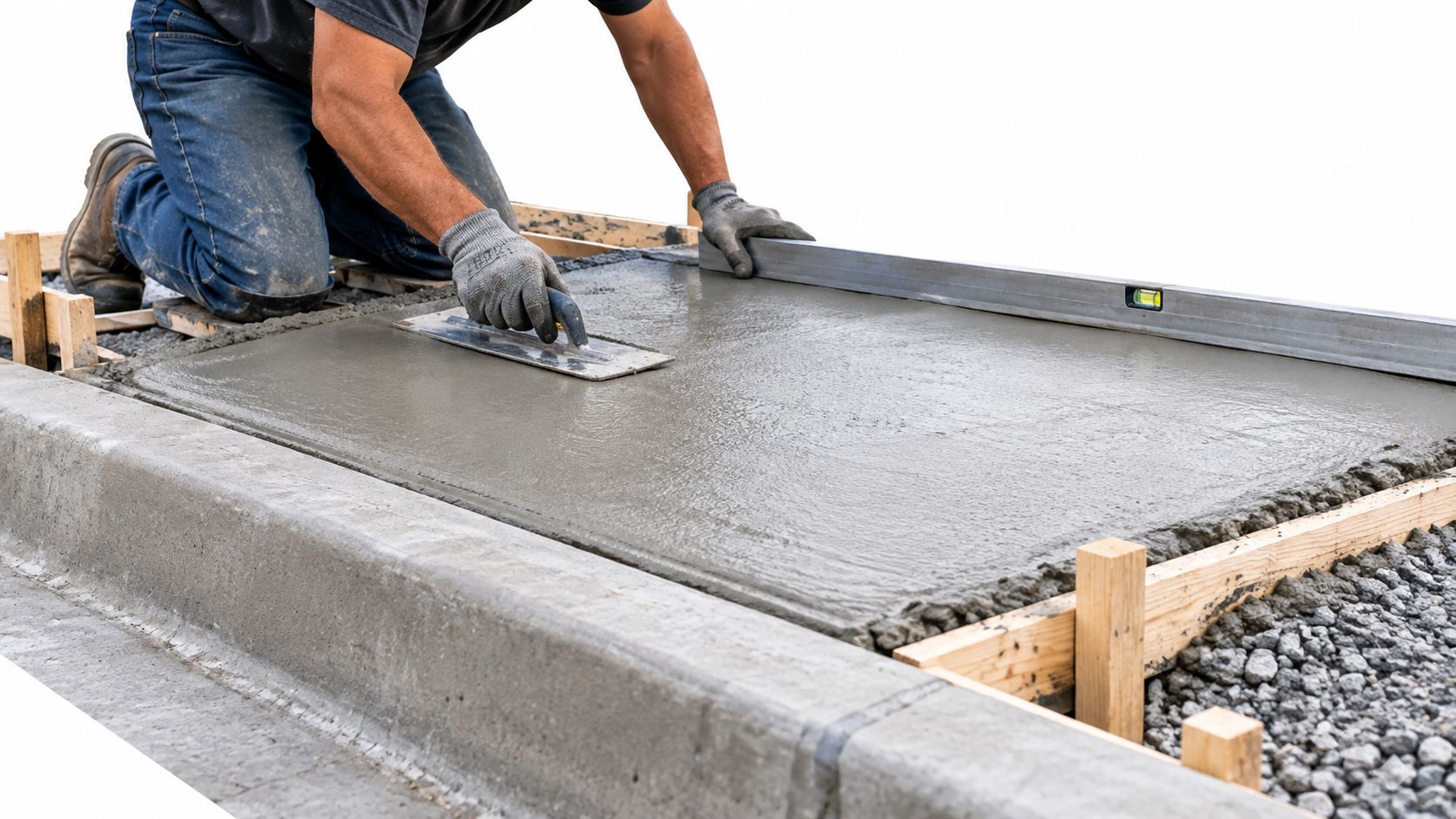
You notice the problem when the car drops hard at the street, the front tires scrape the curb transition, or rainwater sits across the concrete after a summer storm. The driveway may look serviceable from the garage to the sidewalk, yet the short section at the road can be cracked, sunken, or directing runoff toward the wrong property. That section is the driveway apron, and replacing it involves more than breaking out concrete and pouring a new slab.
For homeowners in Marion County, FL, Citrus County, FL, and nearby Central Florida communities, the apron may sit in the public right-of-way and interact with a sidewalk, curb, gutter, drainage path, or accessible pedestrian route. A sound replacement has to account for ownership, permits, finished elevations, base preparation, traffic access, and workmanship. The same questions matter in Ocala, Dunnellon, Belleview, Silver Springs, Summerfield, Crystal River, Homosassa, Inverness, Lecanto, Beverly Hills, Hernando, and The Villages.
Table of Contents
- What a Driveway Apron Actually Is
- Signs Your Apron Needs Replacement Instead of Repair
- How Driveway Apron Replacement Happens Step by Step
- Permits, Right-of-Way, and Who Owns the Apron
- Accessibility and Drainage Constraints Most Homeowners Miss
- How Central Florida Climate Shapes the Right Replacement
- Working With a Concrete and Asphalt Crew on the Job
What a Driveway Apron Actually Is
Stand at the end of your driveway and look toward the street. The apron is the short paved transition between the private driveway and the curb or roadway. It may cross a sidewalk, connect to a rolled curb, or meet a gutter before reaching the street. It isn't usually the long section running from the garage to the property line, although homeowners often use “apron” to describe the entire driveway.
That short transition handles several jobs at once. It absorbs the impact of vehicles moving from the street grade onto the driveway, carries wheel loads, helps guide stormwater, supports continuity across the sidewalk, and establishes the grade that makes entry predictable. A poorly shaped apron can cause scraping, ponding, abrupt edges, or conflicts with neighboring access.
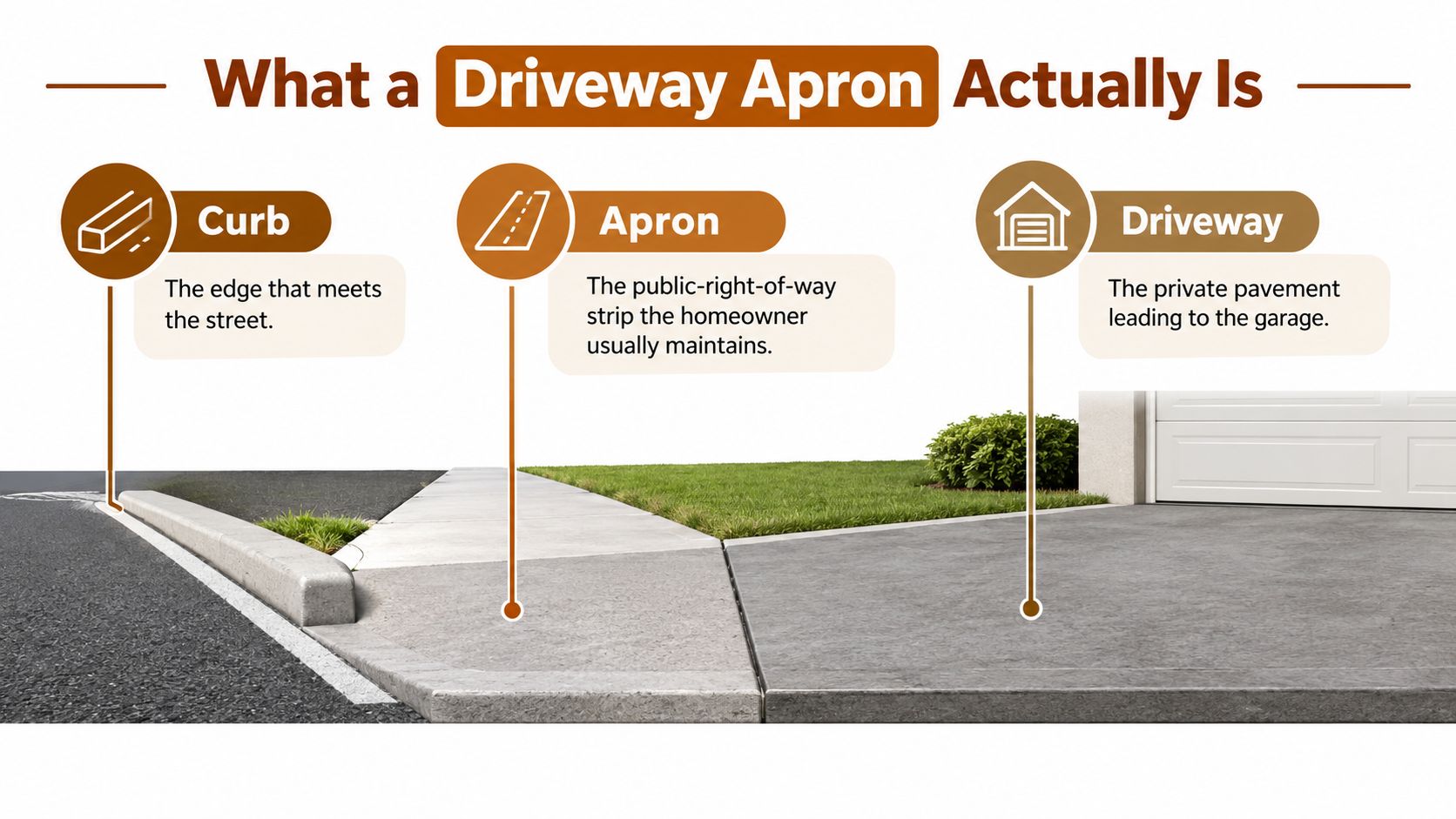
In many Central Florida neighborhoods, the apron occupies public right-of-way, even when the homeowner pays for maintenance. That distinction is why a driveway apron replacement can require a driveway-connection permit or a right-of-way authorization when an ordinary private slab might not.
| Element | Location | Typical Owner |
|---|---|---|
| Apron | Between the curb or road and the private driveway | Public agency controls the right-of-way; homeowner may maintain it |
| Driveway | On private property, leading toward the home or garage | Property owner |
| Sidewalk | Pedestrian path beside or across the driveway entrance | Public agency or other responsible property authority |
The rest of the project comes down to three practical questions: whether the existing concrete can be repaired, how the replacement should be built, and what rules govern the connection. If your property is in Ocala or Crystal River, the local road authority may control details that differ from a driveway entirely inside your lot.
Signs Your Apron Needs Replacement Instead of Repair
A small isolated crack doesn't automatically mean the whole apron must come out. A contractor should first determine whether the damage is superficial, localized, or evidence that the support beneath the slab has failed. Repairing a surface while leaving unstable soil or a saturated base in place usually produces a short-lived result.
Look for a pattern rather than one defect.
Cracking that reflects structural movement
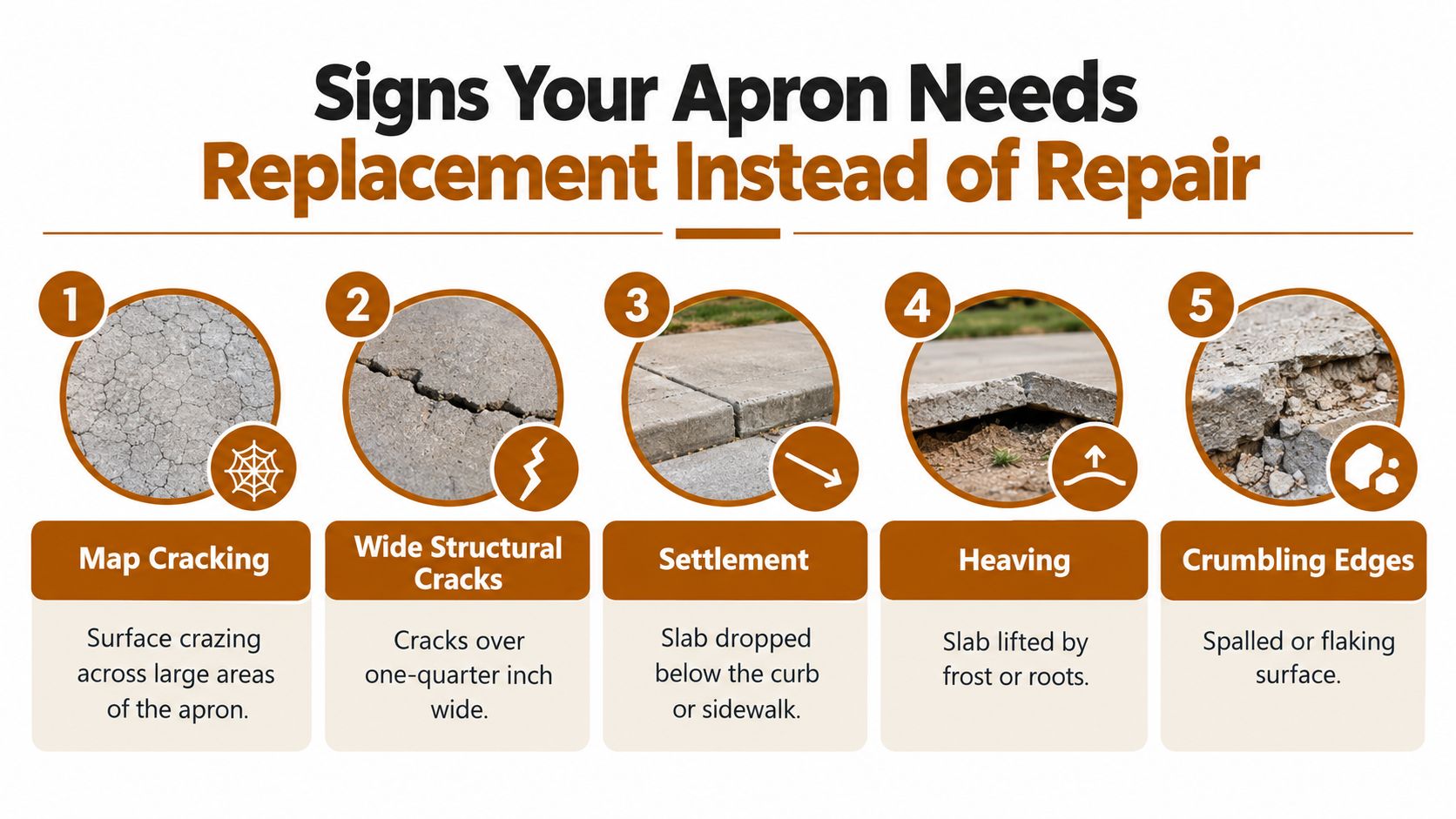
Map cracking across a broad area can indicate surface deterioration, while wide cracks that run through the slab often point to movement below. Cracks crossing the full travel path matter more than a short line near an edge because vehicles repeatedly load the weakened area.
Utility cuts, poorly compacted backfill, and roots can split the slab into separate pieces. If the sections move independently under traffic, sealing the crack won't restore the support.
Settlement and ponding
A settled apron drops below the curb, sidewalk, or adjoining driveway. The cause is commonly weak or wet support, loose fill, or erosion beneath the slab. A lip at the sidewalk or curb also creates a trip and tire-impact problem.
Ponding gives you another useful clue. If water remains on the apron after rain, or flows back toward the garage, the finished grade may have reversed over time. In older neighborhoods around Ocala, Dunnellon, and Inverness, seasonal rainfall can expose drainage defects that weren't obvious during a dry inspection.
Edge failure and buried conflicts
Crumbling outside corners often mean the slab lacks side support, the edge is too thin for the loading, or water has eroded the adjacent material. A patch can fill the missing concrete, but it won't replace the support that keeps the edge from breaking again.
Roots and utility conflicts deserve investigation before demolition. A replacement crew should locate visible utilities, account for previous service cuts, and decide whether roots can be managed without damaging the tree or the new grade. The practical choice may be a targeted repair, a partial rebuild, or full driveway apron replacement after the failed slab and compromised base are removed.
How Driveway Apron Replacement Happens Step by Step
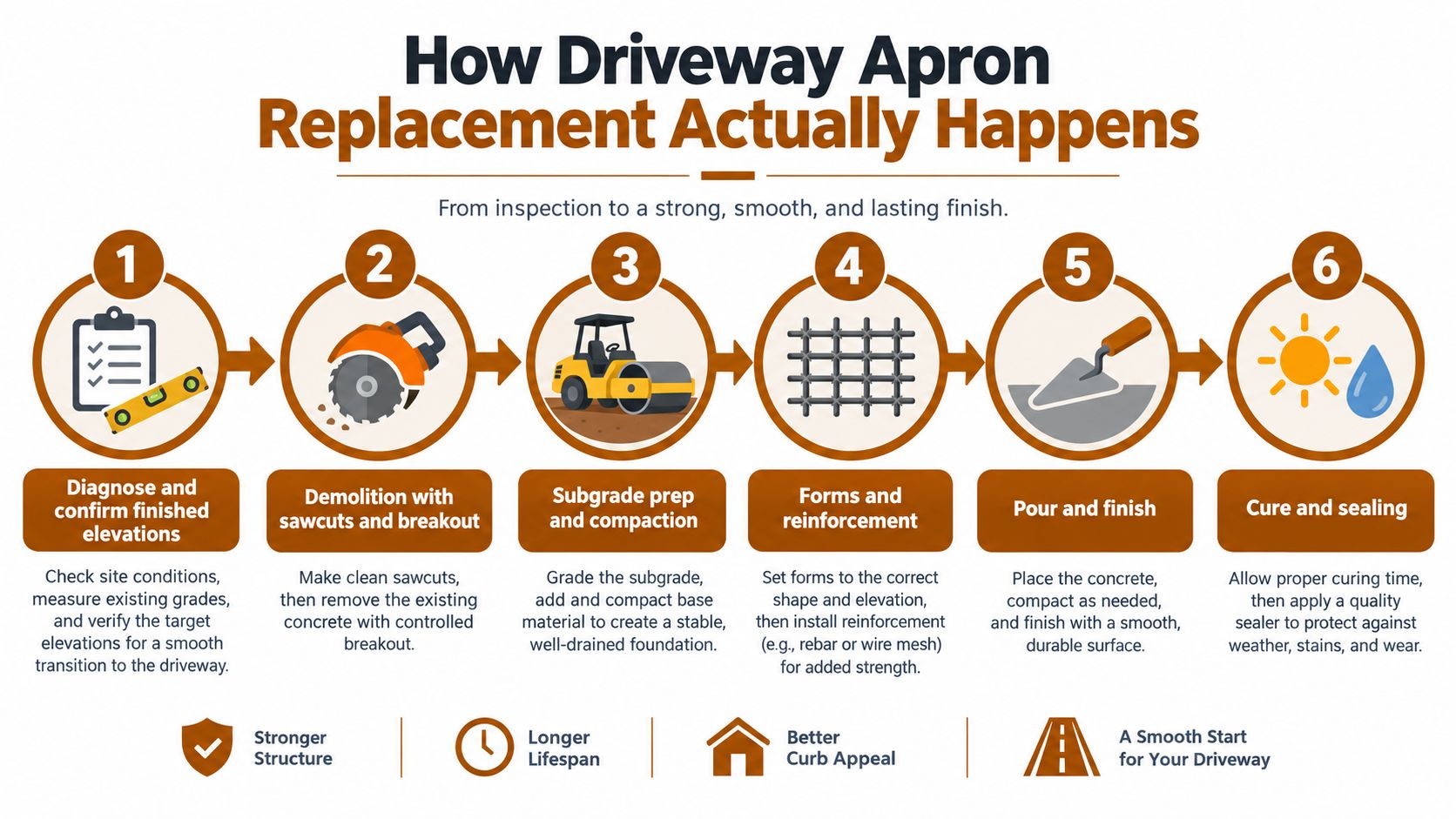
A successful apron replacement starts before the saw cuts. The crew first identifies why the old concrete failed and how the replacement must meet the street, sidewalk, curb, and private driveway. They mark cracks, settlement, ponding, erosion, and utility conflicts, then set elevations so runoff reaches an approved discharge point rather than the garage or sidewalk.
Diagnosis and demolition
Sawcuts create a clean boundary between the failed apron and sound pavement or adjoining concrete. The crew breaks out the slab, removes the debris, and exposes the material beneath it. A proper demolition removes visibly weakened base material too, not only the concrete that lifts easily.
The exposed subgrade then gets trimmed to the planned elevation. The crew checks for loose soil, trapped water, pumping, and rutting before rebuilding the section. FHWA guidance recommends suitable moisture and density during compaction, free-draining base materials where needed, and drainage that keeps the pavement system from remaining saturated (FHWA concrete pavement guidance).
Practical rule: If the subgrade pumps, ruts, or holds standing water, postpone the pour. Fresh concrete will cover a weak base without correcting the failure beneath it.
Base, forms, and reinforcement
Once the subgrade is corrected, the crew places granular base in controlled lifts and compacts each lift. Proof-rolling, or an equivalent inspection, helps expose soft spots before the forms are installed. Areas that fill with rainwater after concrete removal may need pumping or drainage before construction continues.
Forms define the apron's width, edges, thickness, and transitions. The design may call for reinforcement based on loading and site conditions, but steel or mesh cannot correct poor support or an incorrect slope. The contract should state what reinforcement is included and where it will be positioned within the slab.
Pour, finish, and cure
During the pour, workers distribute the concrete, screed it to the forms, float the surface, edge exposed boundaries, and install control joints where specified. A broom or comparable traction finish usually suits a vehicle and pedestrian transition better than a slick surface.
Curing protects the slab while it gains strength. Walking access does not mean vehicles can use the apron, so follow the contractor's written access instructions instead of judging readiness by appearance. Before the crew leaves, the finished surface should meet the adjoining driveway and public route without a sharp level change.
The apron also needs protection during the specified cure window. Keeping vehicles and other loads off the slab during that period gives the concrete time to develop its intended performance.
Permits, Right-of-Way, and Who Owns the Apron
Replacing an apron is not always a private driveway project. The concrete may sit within a public right-of-way, where the road authority controls the connection to the street. That agency may set the apron's width, slope, sidewalk transition, drainage details, and restoration requirements. Permit responsibility and maintenance responsibility aren't necessarily the same thing.
Marion County requires a driveway-connection permit for development or construction accessing a county right-of-way. Right-of-way utilization permits apply to construction in public rights-of-way, according to the Marion County development review information. Other Central Florida jurisdictions may use different permit names or separate applications, and a driveway permit may be separate from a building permit.
Before signing a contract, ask for clear answers:
- Road authority: Is the road controlled by Marion County, Citrus County, a city, a municipality, or another agency?
- Permit applicant: Will the contractor pull the permit, or must the property owner apply?
- Inspection timing: Does the agency inspect the forms, base, or grades before concrete placement?
- Damage responsibility: Who pays if work damages the sidewalk, curb, gutter, or drainage infrastructure?
- Traffic control: What protection is required if equipment or workers occupy a narrow street?
- Restoration duties: Who repairs disturbed right-of-way areas after the pour?
Ask how underground services will be located before excavation, and confirm who coordinates that work. Underground utility location guidance can help you discuss the process with the contractor.
A permit issue can surface after the finished concrete looks acceptable. The owner may receive a correction order or be required to remove and replace the work. Investors and HOA boards face added exposure because the problem can pass to a new owner when the property changes hands.
Get the permit path, inspection requirements, and restoration duties in writing. A promise to “check with the county” does not identify who is responsible or what the agency will require.
Accessibility and Drainage Constraints Most Homeowners Miss
A driveway apron may form part of a pedestrian route as well as a vehicle entrance. If a sidewalk crosses or borders the work, the replacement must maintain a continuous, usable path. A raised lip, steep cross slope, or abrupt change at the curb can turn an otherwise sound concrete job into an accessibility problem.
The accessibility timeline still matters when an existing curb ramp is altered. The ADA was enacted in 1990, and the original 1991 Standards required curb ramps where an accessible route crossed a curb. Those requirements applied to new construction and alterations until March 14, 2012. The 2010 ADA Standards were published on September 15, 2010, and became mandatory for covered new construction and alterations on March 15, 2012, as documented in the 2010 ADA Standards referenced below.
The geometry has limits
ADA standards limit the running slope of a curb ramp to a maximum of 1:12, about 8.33%, and the cross slope of adjoining gutters, road surfaces, and accessible routes beside the ramp to a maximum of 1:20, or 5% (2010 ADA Standards). Transitions between ramps, sidewalks, gutters, and streets must remain flush and free from abrupt level changes. A contractor should check these grades before removing the old apron, because the available height may determine how much concrete and base material must be rebuilt.
An existing curb ramp built or altered before March 15, 2012, may qualify for a safe harbor from upgrades to the 2010 curb-ramp requirements if it complied with the 1991 Standards or UFAS at the time. That protection does not apply if the older ramp failed the earlier requirements, and it does not eliminate review of new alteration work. The DOJ and FHWA technical guidance explains why the construction and alteration history matters.
Water needs a planned path
Drainage can fail while the slab still appears level. Widening an apron, changing its elevations, or removing a rolled curb may send runoff toward a sidewalk, roadway, garage, or neighboring property. Before demolition, record existing grades and identify where water travels during rain.
A Florida-area application from Lake County shows how local rules can affect apron geometry. Where sidewalks exist or are planned, the Lake County driveway connection permit guidance calls for a minimum 4-foot pedestrian path through the apron with a maximum 1.5% cross slope, and references FDOT sidewalk standards and minimum thickness requirements. Confirm the agency controlling your property before concrete is placed.
For a practical review of grading, runoff, and base preparation, use this concrete driveway drainage guidance. The working question is whether the rebuilt transition will stay accessible and direct water safely during Central Florida's heavy summer rain.
How Central Florida Climate Shapes the Right Replacement
Central Florida weather changes how an apron should be rebuilt. Heat and ultraviolet exposure stress the surface, so proper curing and a traction-focused finish matter more than a polished appearance. A lighter gray surface may also show less heat-related discoloration than a dark coating, but appearance cannot compensate for weak construction.
Summer storms make base preparation a drainage decision, not just a compaction task. The rules discussed earlier matter even more here because heavy rain can saturate an excavation or newly placed granular base within hours. The rebuilt apron needs firm support and a planned path for runoff, especially where the driveway meets a sidewalk or roadway.
Sandy ground in Marion, Citrus, and Hernando counties drains readily, but loose or eroded sand can leave weak edges and permit settlement. The crew may need to remove unstable material, shape the base, and compact it in controlled lifts rather than pour over whatever remains. Mature live oak roots create a separate problem. If roots lifted the old slab, pouring directly over them can transfer the movement into the replacement.
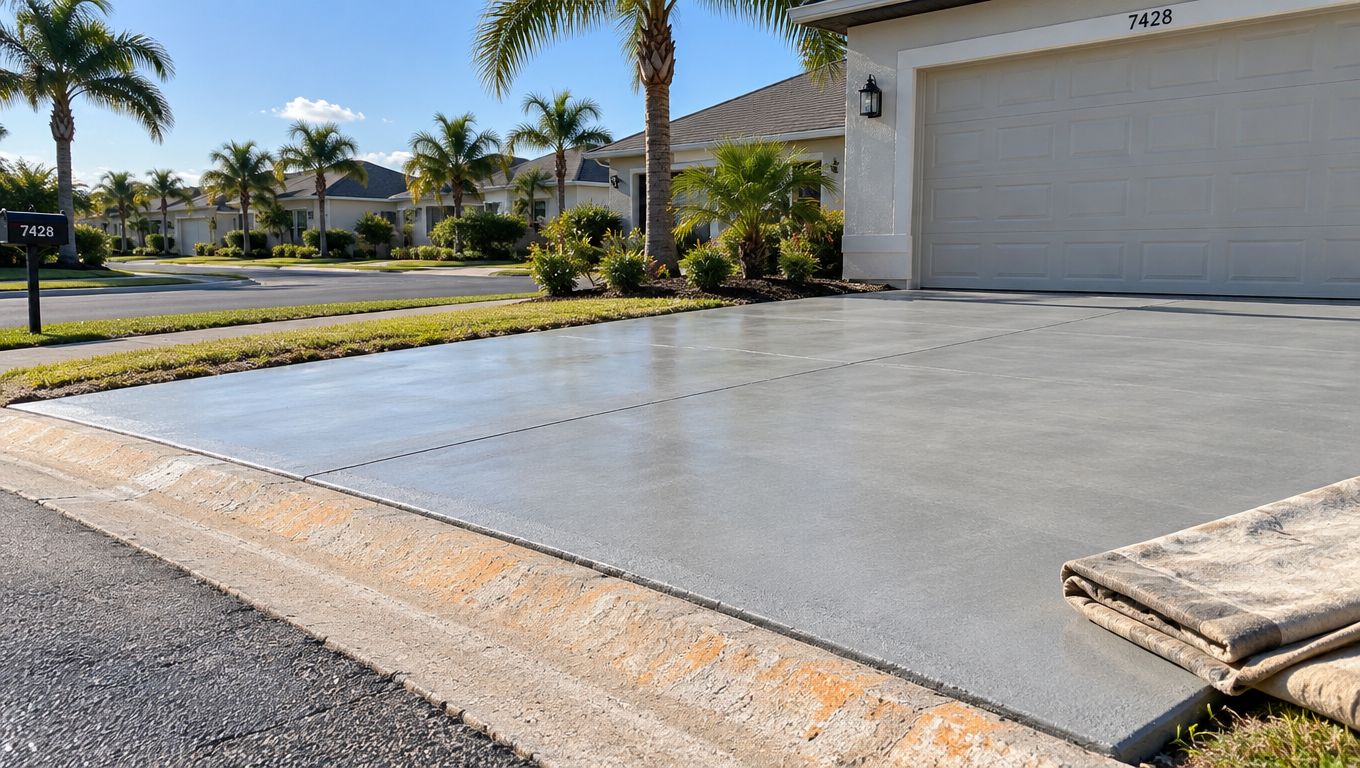
These conditions often meet in The Villages, Summerfield, and Crystal River, where sandy soils, mature landscaping, seasonal downpours, and regular vehicle traffic affect a relatively short slab. Ask the crew what base work the estimate includes, how standing water will be removed, whether roots require agency review, and how long vehicles must stay off the concrete while it cures. Those answers reveal whether the proposal addresses the right-of-way transition and drainage problems, not only the visible slab.
Working With a Concrete and Asphalt Crew on the Job
A good estimate lets you compare construction decisions, not just a total price. The document should describe what gets removed, what supports the new apron, how the concrete will be placed, and what happens if the crew finds wet soil or a utility conflict after demolition.
| Line Item | What to Look For | Red Flag |
|---|---|---|
| Demolition | Removal limits, debris hauling, and treatment of failed base | “Remove and replace” with no depth or disposal detail |
| Subgrade and base | Material, preparation, compaction method, and soft-spot handling | Concrete poured over whatever remains |
| Concrete | Mix specification, thickness, finish, and placement conditions | No description beyond “new concrete” |
| Reinforcement | Type, placement, and whether it suits the design | Reinforcement used as a substitute for base work |
| Grades and transitions | Curb, sidewalk, driveway, and drainage elevations | No reference to slope or water flow |
| Cleanup and access | Hauling, site cleanup, barricades, and vehicle restrictions | Homeowner must guess when the area can be used |
Scheduling matters more than a convenient date
Central Florida weather can change a planned pour quickly. Afternoon storms may leave the excavation or base wet, and a responsible crew should communicate a delay rather than place concrete over standing water or unstable support. Reliable scheduling means giving you a realistic sequence, not promising a date that ignores weather and permit timing.
A single apron can often involve a one- to two-day pour sequence, followed by a cure window before vehicles return. Permit processing may add time before demolition begins. The exact schedule depends on access, inspection requirements, demolition depth, base condition, sidewalk or curb work, and whether the driveway itself must remain usable.
Ask about the contractor, not just the concrete
For a homeowner, the most useful trust signals are straightforward:
- Licensing and insurance: Verify that the business carries the coverage appropriate for the work and can identify who is responsible on site.
- Local experience: Ask whether the crew has worked in Marion County, Citrus County, and surrounding Central Florida right-of-way conditions.
- Clear communication: Confirm who updates you about permits, rain delays, inspection timing, and cure restrictions.
- Workmanship details: Look for written information about grades, base preparation, finish, joints, and cleanup.
- Related capabilities: A crew that handles concrete and asphalt can coordinate adjacent driveway repairs, asphalt patching, sealcoating, or parking lot striping when those surfaces meet.
Riverside Sealing & Striping, LLC handles concrete removal and replacement along with related concrete work, asphalt maintenance, and striping for residential, HOA, and commercial properties. That can be useful when an apron meets a driveway extension, sidewalk tie-in, or adjacent asphalt area, because one coordinated scope reduces mismatched transitions and scheduling between separate trades.
Homeowners in The Villages or Belleview should also ask how HOA approval fits with county or city permitting. An HOA may control appearance, access, or common-area coordination, while the public agency controls the right-of-way. Approval from one doesn't replace approval from the other.
For more preparation before collecting bids, review these questions to ask a concrete contractor. Use the answers to compare scope, not merely price. Cost depends on the apron's size, site access, demolition depth, base condition, finish, and whether sidewalk or curb work is included, so a low bid may omit necessary work.
A useful hiring test: Ask the contractor what they'll do if demolition reveals wet soil, pumping, roots, or a damaged utility connection. The answer tells you whether the estimate reflects a real plan or only the visible pour.
Riverside Sealing & Striping, LLC offers driveway apron replacement, concrete removal and replacement, drainage-focused site evaluation, and related asphalt and concrete work throughout Marion County, FL, Citrus County, FL, and surrounding Central Florida areas. Request a free, no-pressure on-site consultation through Riverside Sealing & Striping, LLC to review the right-of-way, grades, base condition, and replacement scope before work begins.