
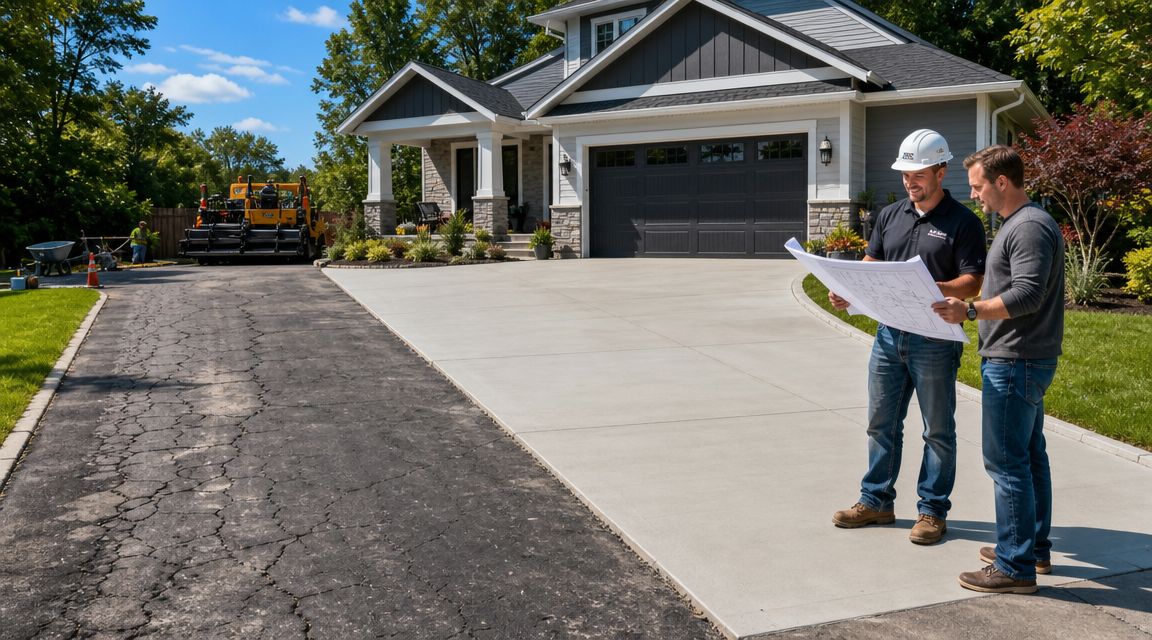
You pull into the driveway after work, and it's the first thing you see. The surface is cracked. There are stains that never wash out. Water sits in the low spots after a Florida storm, and the front of the house looks older than it really is because the driveway gives up before the house does.
That's the point where most homeowners in Ocala, Dunnellon, Belleview, Summerfield, Crystal River, Homosassa, Inverness, Lecanto, Beverly Hills, Hernando, Silver Springs, and The Villages start typing Driveway installation near me into Google. They want a local contractor, but they also want straight answers. Should the driveway be repaired, resurfaced, or torn out and replaced? Should they choose concrete or asphalt? What happens with drainage, permits, and site prep in Marion County, FL and Citrus County, FL?
Those are the right questions.
In Central Florida, a driveway isn't just a flat slab or a strip of blacktop. It has to handle heat, UV exposure, heavy rain, sandy soils, and daily vehicle traffic without turning into a maintenance problem. That's why homeowners need more than a quick quote. They need a decision-making framework that fits local conditions. If you're comparing options and trying to avoid an expensive mistake, this guide will help you make the right call.
Table of Contents
- Your Search for Driveway Installation Ends Here
- First Decision Replace Resurface or Repair
- Concrete vs Asphalt in Central Florida
- The Driveway Installation Process from Start to Finish
- Understanding Driveway Costs in Marion and Citrus County
- Navigating Permits and Site Preparation
- Hiring the Right Concrete and Asphalt Expert
- Frequently Asked Questions About New Driveways
Your Search for Driveway Installation Ends Here
A lot of driveway jobs start the same way. A homeowner in Marion County notices a few cracks near the garage. A homeowner in Citrus County sees standing water near the apron after a hard rain. At first it looks cosmetic. Then edges start breaking, patches fail, and the driveway becomes something you notice every single day.
That's usually when the online search begins. You're not just looking for somebody who can pour concrete or pave asphalt. You're trying to find someone local who understands what works in Central Florida and what doesn't.
A driveway in Ocala doesn't live under the same conditions as one in a colder state. The same goes for homes in Crystal River or Homosassa where drainage can become the whole project. In this region, material choice, sub-base preparation, grading, and runoff control matter more than a polished sales pitch.
Practical rule: If a contractor talks mostly about finish color and almost nothing about base prep or drainage, keep looking.
Homeowners also make better decisions when they stop treating the project as only a material choice. The key question is broader. What condition is the current driveway in? How much of the existing structure can still be trusted? What kind of traffic does the driveway carry? How will Florida rain move across the site?
That's where local experience helps. Concrete and Asphalt Experts in Marion and Citrus County need to think beyond surface appearance. They need to look at access, slope, edges, tie-ins to garages and sidewalks, and the long-term cost of maintaining the finished driveway.
First Decision Replace Resurface or Repair
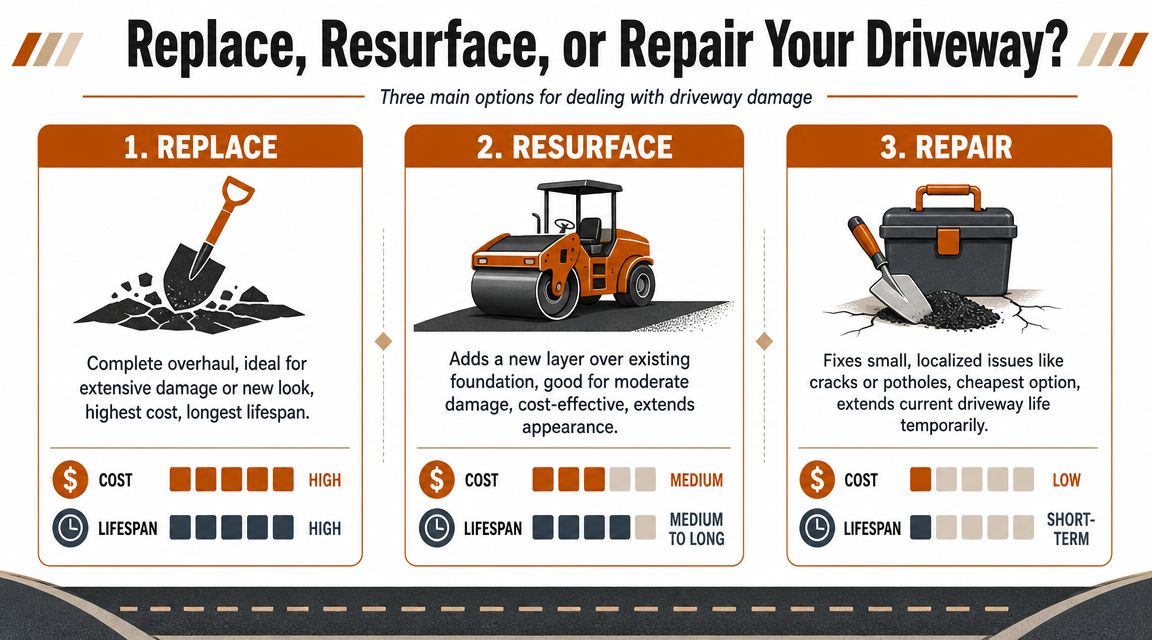
A common starting point is to ask whether concrete or asphalt is better. That's not the first decision. The first decision is whether the driveway should be repaired, resurfaced, or replaced.
If that step gets skipped, homeowners often spend money on the wrong fix.
Start with the base, not the surface
A driveway can look rough and still be structurally sound. It can also look patchable while the base underneath is already failing. That's why the right call depends on structural damage, drainage, and repair history, not just on whether the top looks worn. As noted in this guidance on replacement versus resurfacing decisions, resurfacing can be cheaper, but if the subbase is failing, repeated patching can become false economy.
A few examples make that easier to judge:
- Localized cracks or small surface defects often point to a repair situation, especially if the surrounding driveway is stable and drainage is still working.
- Widespread cracking, repeated settling, or movement near edges usually means the problem goes deeper than the top layer.
- Recurring puddles or washout patterns often tell you the driveway shape or supporting base is part of the failure.
If the same area keeps cracking after every fix, the driveway is usually telling you the problem is underneath.
A simple decision framework
When evaluating a driveway in places like Summerfield, Beverly Hills, or Lecanto, use this framework:
| Condition | Best first option | Why |
|---|---|---|
| Small isolated issues | Repair | Extends service life without overbuilding the solution |
| Moderate wear with solid structure | Resurface | Improves appearance when the base is still dependable |
| Structural failure or persistent drainage issues | Replace | Fixes the root problem instead of covering it |
Honest contractors distinguish themselves from sales-first contractors by their approach. A good installer won't automatically push a full tear-out if a practical repair will do the job. But they also won't sell resurfacing over a weak foundation just to keep the upfront price lower.
For homeowners searching driveway installation near me, this matters because the cheapest proposal on paper can become the most expensive one to live with. A driveway that gets replaced for the right reason usually performs better than a driveway that gets cosmetically revived over a failing base.
Concrete vs Asphalt in Central Florida
Once replacement is the right move, the next question is material. In Central Florida, both concrete and asphalt can work. The better option depends on your budget, the look you want, how much maintenance you're comfortable with, and how the site handles sun and water.
What concrete does well in this climate
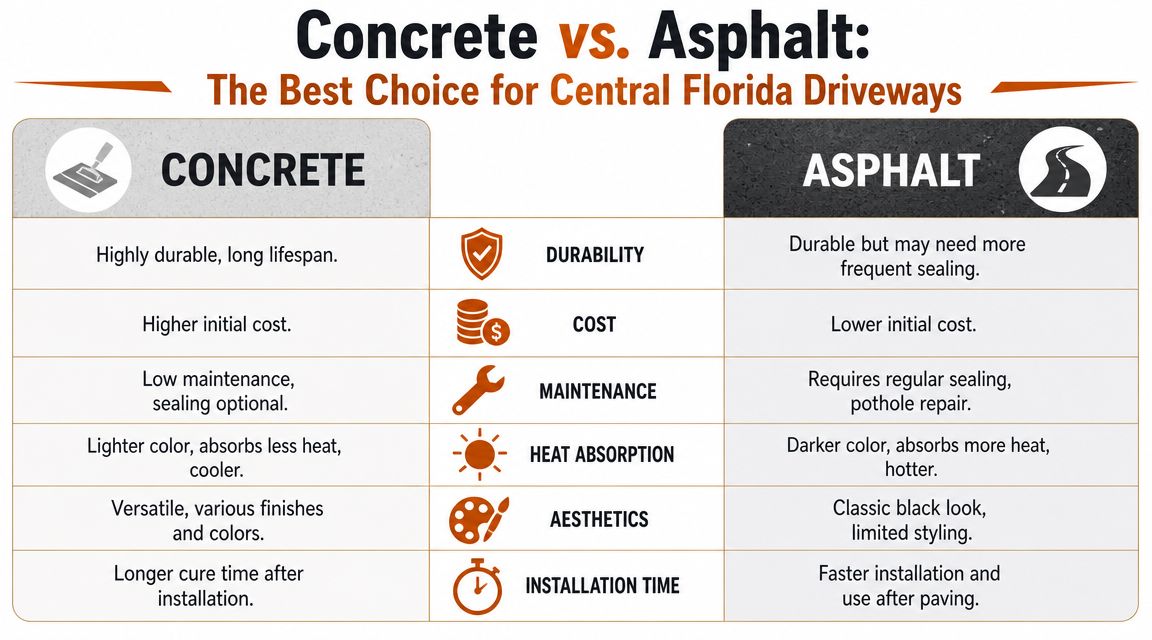
Concrete is a strong fit for many homes in Marion County and Citrus County because it handles residential traffic well, offers a clean finished look, and gives homeowners more design flexibility. It also tends to look brighter and cooler than dark pavement under strong sun, which many Florida homeowners appreciate around garages, entry walks, and front yards.
The part homeowners rarely hear enough about is the structure. For a durable residential concrete driveway, the slab needs a minimum thickness of 4 inches, built on a well-compacted subgrade, with control joints spaced at a maximum of about 10 feet for a 4-inch slab and cut to about one-fourth of the slab thickness. Isolation joints are also recommended where the driveway meets a garage slab, sidewalk, or other pavement, according to Concrete Network's driveway construction guidance.
Those details matter in Florida because random cracking usually starts when the slab has weak support underneath or no clear place to relieve shrinkage stress.
For homeowners comparing materials, this local guide on concrete driveway vs asphalt driveway is a useful companion to the decision.
Where asphalt makes sense
Asphalt often appeals to homeowners who want a lower upfront entry point and a surface that can be repaired and refreshed more easily over time. It has a classic look, and on some properties it's the practical choice, especially where appearance expectations are simple and maintenance is part of the plan.
In Central Florida, asphalt's dark color also means it absorbs more heat. That doesn't make it wrong. It just means the material behaves differently in sun-heavy conditions than lighter concrete does. Homeowners should go into the decision understanding that asphalt is typically more maintenance-driven.
The local trade-off homeowners often miss
In places like Inverness, Hernando, or The Villages, the comparison isn't just concrete versus asphalt. It's how each material interacts with the site.
Ask these questions:
- Does the lot hold water? If yes, grading and drainage details matter more than surface preference.
- Do you want decorative options? Concrete gives more finish flexibility.
- Do you prefer lower maintenance or easier repairability? Concrete and asphalt usually split along that line.
- Is the existing driveway tied tightly into sidewalks, garage slabs, or aprons? Concrete details at those connection points become especially important.
A driveway that matches the site will outperform a driveway that only matches the budget.
That's why Concrete and Asphalt Experts in Marion and Citrus County should evaluate the whole property, not just ask which material you like better.
The Driveway Installation Process from Start to Finish
Most homeowners feel better about a project once they know how it unfolds. A driveway job should feel organized, not mysterious.
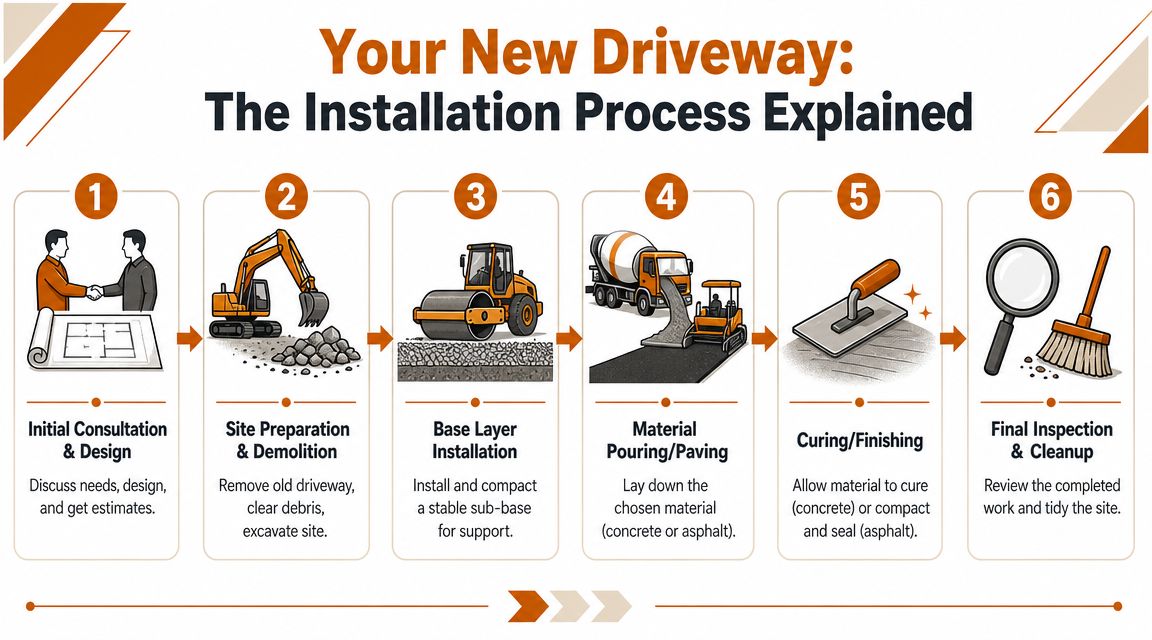
Here's the visual overview first.
What happens before material goes down
Every solid driveway starts with planning, demolition, and earthwork. In these initial phases, long-term performance is won or lost.
A typical sequence looks like this:
Site visit and layout review
The contractor looks at the existing driveway, traffic pattern, drainage, tie-ins, and access to the property. Homes in Silver Springs or Homosassa may have different grading concerns than tighter suburban lots in Belleview or The Villages.Removal of the old surface
If there's an existing failed driveway, it gets broken up and hauled away. Cleanup matters here because leftover weak material can compromise the new installation.Excavation and grading
The site is shaped so water moves away from structures and doesn't collect on the finished driveway. In Florida, poor grading shows up fast after storms.Sub-base prep and compaction
This is the support system for the driveway. If the base is soft, uneven, or loosely compacted, the surface above it won't stay right for long.
Good driveway work starts below finished grade. That's the part homeowners can't see, and it's usually the part that decides whether the surface lasts.
A lot of schedule questions come up during this phase. Weather can slow excavation, grading, and final placement. Rain doesn't just affect appearance. It affects the condition of the soil, access for equipment, and timing for material placement.
For homeowners trying to understand timing after a concrete pour, this article on how long concrete takes to cure helps explain what happens after installation.
A short video can also help homeowners picture the workflow on site:
Pouring paving finishing and curing
Once the base is ready, the surface material goes in.
For concrete, the crew places the slab, finishes the surface, forms edges, and cuts joints in the right locations. The finish shouldn't be judged only by smoothness. It should also be judged by clean transitions, proper slope, and controlled joint layout.
For asphalt, the crew places and compacts the mat to create a uniform surface with the correct pitch and edge support. A neat-looking top layer still depends on what happened below it.
Before the crew leaves, the site should be cleaned, transitions checked, and the homeowner should understand when the driveway can be used normally. Good contractors also explain what early curing or settling observations are normal and what should be reported.
Understanding Driveway Costs in Marion and Citrus County
Driveway pricing gets frustrating when homeowners are given numbers without context. A quote can look high until you understand what's included. It can also look low because key work was left out.
Use benchmarks the right way
National benchmarks are helpful as a starting point, not as a final price. According to Thumbtack's driveway contractor pricing guide, asphalt driveways average about $3 to $5 per square foot, and concrete driveway resurfacing generally ranges from $3 to $10 per square foot. The same guide notes that a typical 500-square-foot concrete resurfacing project can run from $2,000 to $5,000.
Those numbers are useful for one reason. They help homeowners spot quotes that seem incomplete or unrealistically broad.
What changes the final quote locally
In Marion County, FL and Citrus County, FL, the final number usually moves based on conditions at the site rather than just on square footage.
The biggest price drivers are usually:
Existing driveway condition
A straightforward install on a clean, stable site is different from a project with removal, washout, or deep base correction.Drainage work
If water has to be redirected or slopes need to be reworked, that adds labor and equipment time.Access to the project area
A wide-open lot in Dunnellon is one thing. A tighter site in an established neighborhood can take more coordination.Material and finish choices
Standard concrete and standard asphalt don't carry the same look, maintenance path, or installation details.Edge conditions and tie-ins
Garage entries, sidewalks, curbs, and aprons can make a project more involved than the square footage alone suggests.
A fair estimate should describe the scope clearly. Homeowners should be able to see whether demolition, grading, compaction, drainage adjustments, forming, finishing, and cleanup are included. If they aren't spelled out, ask.
The lowest driveway quote is often the one that assumes the fewest problems. That's risky in Florida soil and Florida weather.
Navigating Permits and Site Preparation
Many homeowners think a driveway job begins with demolition. In reality, it often begins with a permit question.
When permits enter the job
A lot of people searching driveway installation near me are really asking, Do I need a permit for this? In many U.S. markets, permits can be required for new curb cuts, apron work, or changes that affect drainage, as explained in this driveway permit and drainage overview.
That's especially relevant in local work because driveway projects can affect more than your own lot. If the job changes how water leaves the property or connects to the street, local review may come into play.
One county example shows how seriously access can be regulated. In Gunnison County, Colorado, a driveway access permit is required when driveway access is constructed in the county, and a state permit is needed when the driveway connects to certain roads, according to Gunnison County's driveway access rules. The point for Florida homeowners isn't that the same rule applies here. It's that driveway work often involves roadway access and compliance issues, not just paving.
Why grading matters as much as paving
In Central Florida, site preparation and drainage control can be as important as the finished material.
Flat lots can fool homeowners into thinking water will “find its way out.” Sometimes it doesn't. It sits. It creeps toward the garage. It runs toward a neighbor's side yard. It softens edges and exposes weak spots in the base.
When reviewing a project in Ocala, Crystal River, or Lecanto, a contractor should be checking:
- Where runoff goes after a hard rain
- Whether the driveway pitch sends water toward the house
- How the new surface ties into sidewalks, curbs, and aprons
- Whether right-of-way work needs separate approval
This is one of the least discussed parts of driveway replacement, but it's one of the most important. A driveway can be finished beautifully and still perform poorly if the slope is wrong.
Hiring the Right Concrete and Asphalt Expert
The contractor you hire matters as much as the material you choose. A good driveway installer should be able to talk comfortably about sub-base prep, drainage, access, joints, scheduling, and realistic expectations for the site.

Questions worth asking before you sign
A homeowner in Inverness or Hernando should ask the same core questions as a homeowner anywhere else, but local experience makes the answers more useful.
Ask things like:
Are you licensed and insured?
This should be easy for a contractor to answer clearly.How do you evaluate drainage on my lot?
If the answer is vague, that's a concern.What tells you this driveway needs replacement instead of resurfacing?
You want a reasoned diagnosis, not a reflexive upsell.What does your site prep include?
Quality is frequently a differentiator.How do you handle timelines and weather delays?
Reliable scheduling matters in Florida.
For a deeper screening checklist, homeowners can review these questions to ask a concrete contractor.
What a solid local contractor should be ready to discuss
A legitimate contractor serving Marion County and Citrus County should be ready to explain the scope in plain language. That includes what gets removed, how the base is prepared, how runoff is handled, and what the homeowner should expect during and after installation.
Riverside Sealing & Striping, LLC is one local option for homeowners who need concrete driveway removal and replacement, new driveway installation, and related concrete or asphalt surface work in Central Florida. The company operates as Concrete and Asphalt Experts in Marion and Citrus County, and homeowners should expect that same broad, dual-material understanding from any contractor they interview.
A no-pressure site visit is usually the best next step. Not because every driveway needs immediate replacement, but because a real evaluation answers more than an online estimate ever can.
Frequently Asked Questions About New Driveways
How long before I can use a new driveway
That depends on the material, weather, and site conditions. Concrete needs curing time, and asphalt needs time to settle and stabilize after placement. Your contractor should give use guidelines specific to your project instead of a one-size-fits-all answer.
What maintenance matters most in Florida
Florida driveways deal with sun, rain, and water movement. For concrete, keeping an eye on drainage, joint condition, and edge stability matters. For asphalt, maintenance is more ongoing, and many owners eventually pair driveway work with related surface care such as sealcoating on other paved areas.
Will a new driveway improve curb appeal
Yes, in a very practical way. A fresh driveway changes how the entire front of the property reads from the street. On homes in Belleview, Beverly Hills, and The Villages, it often makes the house look better maintained even when nothing else has changed.
A worn driveway pulls attention away from the house. A clean, properly built one frames it.
Should I choose concrete or asphalt if I plan to stay in the home
Choose the material that fits how you want to live with the driveway. If you want a bright, durable surface with more finish flexibility, concrete is often attractive. If you want a lower-entry option and you're comfortable with ongoing maintenance, asphalt can be a practical fit.
The bigger issue is still the same one covered earlier. Whatever material you choose, it has to sit on a properly prepared base with the right grading for the lot.
If you're comparing quotes or trying to decide whether your driveway in Marion County or Citrus County needs repair, resurfacing, or replacement, Riverside Sealing & Striping, LLC offers free, no-pressure on-site consultations for homeowners across Central Florida. A professional evaluation can help you sort out drainage, material options, site prep needs, and the most practical path forward for your property.