
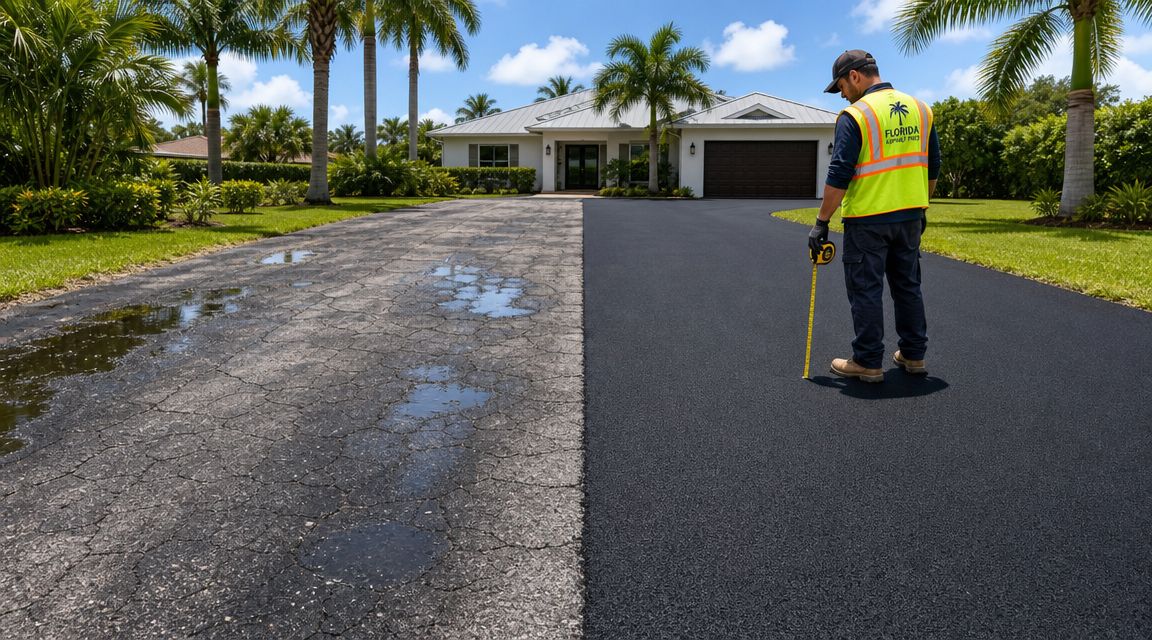
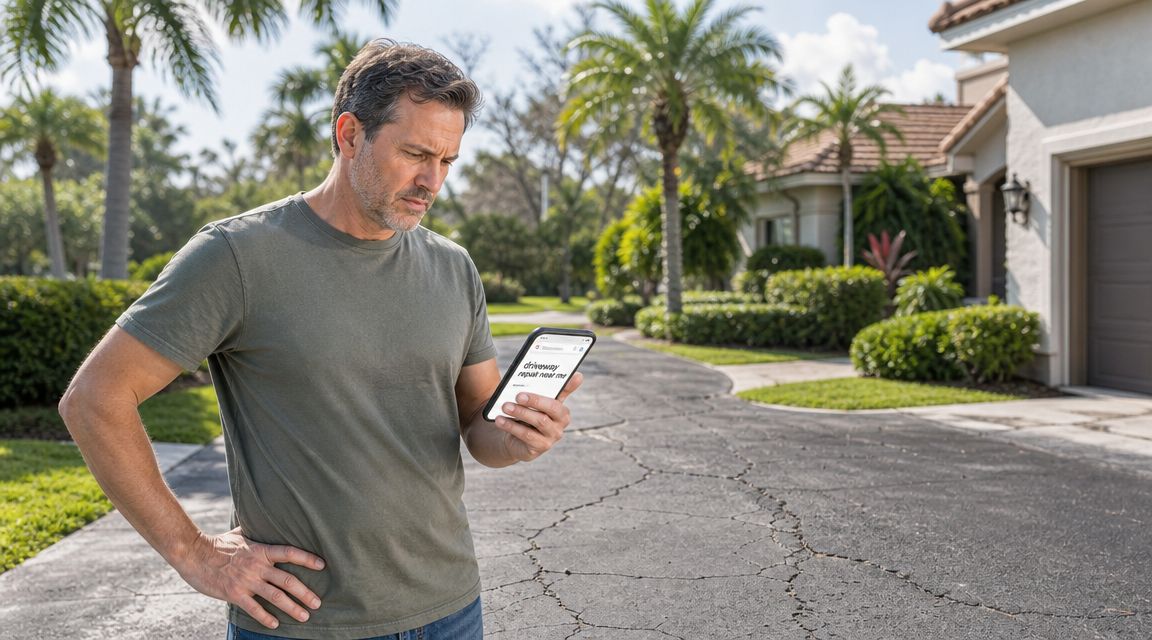
A lot of homeowners in Ocala, Belleview, Homosassa, and nearby communities end up in the same spot. You notice a crack that wasn't there last season, a corner that's sunk a little, or a rough patch that holds water after every hard rain. So you search driveway repair near me and get flooded with pages telling you someone can fix it fast.
The harder question is the one most of those pages skip. Should you repair it, resurface it, or replace it? In Central Florida, that decision matters more than people think because heat, heavy rain, and soil movement can turn a surface problem into a base failure.
Your Guide to Driveway Repair in Marion and Citrus County
A homeowner in Silver Springs might see a straight crack running across a concrete driveway and assume it just needs filler. Someone in Dunnellon might notice an asphalt edge breaking apart and think a small patch will handle it. Sometimes that's true. Sometimes it isn't.
The problem is that online advice often jumps straight to price or booking. It rarely helps you decide when repair is still sensible and when replacement is the smarter long-term move. That gap matters in Florida, where soil movement and intense weather can cause base failure underneath the surface, making a cosmetic fix temporary, as noted by Concrete Network's discussion of driveway failure and replacement decisions.
Practical rule: If the damage keeps returning in the same area, the surface usually isn't the real problem.
For homeowners in Marion County, FL and Citrus County, FL, that distinction can save a lot of frustration. A well-chosen repair can buy useful life and improve appearance. A poorly chosen repair just delays the bigger job and adds cost later.
This guide is built for local conditions in places like Summerfield, Inverness, Crystal River, Lecanto, Hernando, Beverly Hills, and The Villages. The goal is simple. Help you read the signs, understand the repair options for both concrete and asphalt, and make the call that protects your property instead of just covering up the damage.
Decoding the Damage Signs on Your Florida Driveway
Not all cracks mean the same thing. Before you decide on a fix, you need to understand what the driveway is telling you.
Small cracks and surface wear
Hairline or narrow cracks in concrete, or light surface cracking in asphalt, usually point to early wear. Sun exposure, oxidation, shrinkage, and normal age all play a role. In Central Florida, UV exposure hardens asphalt over time, and heavy afternoon rain works into weak spots fast.
If the slab or pavement is still level and firm, these are often maintenance issues rather than structural failures. On asphalt, that may mean crack filling and seal coating. On concrete, it may mean localized crack repair or surface treatment if the slab below is still stable.
Wide cracks, repeated patch failure, and separation
A wider crack, a crack that keeps opening back up, or two sides of the driveway moving apart usually means more is happening below the surface. On concrete, that can point to settlement or slab movement. On asphalt, it often shows up where the base has softened, shifted, or washed out.
If you're seeing the same area patched more than once, don't focus on the filler. Focus on why that area keeps failing. Homeowners often start noticing this after a rainy stretch in places like Ocala or Inverness where water moves under the driveway edge or collects near low spots.
For a closer look at what different cracking patterns can mean, this guide on why a driveway starts cracking is useful background.
Alligator cracking and potholes in asphalt
Alligator cracking is the web-like pattern you see when asphalt breaks into small interconnected pieces. That's not a cosmetic problem. It usually means the pavement has lost support under traffic.
Potholes tell a similar story. Water gets into cracks, the base weakens, vehicles flex the damaged area, and the surface breaks apart. By the time potholes show up, simple top-layer treatment usually isn't enough.
When asphalt starts breaking into a pattern instead of a line, the failure is usually structural.
Sinking, rocking, and uneven panels
Concrete driveways in Homosassa, Beverly Hills, and other parts of Citrus County often show trouble as uneven panels, settled corners, or slabs that rock slightly under load. That kind of movement points to voids, soft spots, or poor support below the slab.
Watch for these signs:
- Water ponding after rain: Low spots hold moisture and speed up base problems.
- Trip edges between panels: Differential settlement often gets worse with time.
- Driveway edges crumbling first: Edge failure can signal erosion or weak support along the sides.
- Garage approach dropping: This area takes repeated wheel loads and often shows movement early.
Once you know what type of damage you have, the repair choice gets much clearer.
Comparing Your Driveway Repair Options
There are three common paths. Patching, resurfacing, and full replacement. The right one depends less on what looks bad from the top and more on whether the structure underneath is still sound.

Patching and crack filling
This is the lightest repair level. It works best for isolated cracks, small surface defects, and limited areas of damage where the surrounding driveway is still stable.
For asphalt, patching can handle a small pothole or localized failed section if the contractor removes weak material and rebuilds the area properly. For concrete, small crack repair may improve appearance and limit water intrusion, but it won't correct movement in the slab.
Patching is the wrong choice when damage is widespread, the driveway is uneven, or the same area has already failed before.
Resurfacing or overlay
Resurfacing adds a new top layer over an existing driveway. It can make sense when the driveway has broad surface wear but the underlying structure still has enough integrity to support the new layer.
On concrete, resurfacing is typically considered when the slab is mostly intact but looks worn, stained, or lightly cracked. On asphalt, an overlay may help when the surface has aged out but the base remains stable.
Homeowners need honest evaluation. Resurfacing can look great, but it won't solve a failing base.
Full replacement
Replacement is the right call when the damage comes from below. If the driveway is settling, heaving, breaking apart across large sections, or losing support under traffic, replacement usually brings better long-term value than repeated repair attempts.
For asphalt, structural integrity depends on the section below the surface. Residential guidance commonly calls for at least 4 inches of compacted gravel, topped by asphalt layers totaling roughly 2 to 3 inches for a lighter residential standard, with heavier use sometimes needing more, according to this asphalt thickness and base guidance. If that base has failed, patching the top just creates a weak point.
Riverside Sealing & Striping works on both concrete and asphalt surfaces, which matters because the right recommendation should come from the condition of the driveway, not from a contractor who only installs one material. If you're still deciding between materials for a replacement, this comparison of concrete driveway vs asphalt driveway helps frame the trade-offs.
Driveway Repair Methods at a Glance
| Repair Method | Best For | Typical Lifespan | Relative Cost |
|---|---|---|---|
| Patching / Crack Filling | Minor isolated defects and early damage | Shorter-term solution | Lower |
| Resurfacing | Worn surface over a stable base | Mid-range solution | Moderate |
| Full Replacement | Structural failure, settlement, widespread damage | Longest-lasting solution | Highest |
A repair that doesn't address the failed support underneath usually won't stay repaired for long.
Estimating Driveway Repair Costs in Central Florida
Price matters, but it only helps if you connect it to the right repair method. A cheap patch on the wrong driveway is expensive in the long run.
Published cost benchmarks give a good starting point. Concrete driveway repairs typically range from about $829 to $2,836, with an average near $1,810, while asphalt driveway repairs typically range from $1,070 to $4,020, with an average repair cost of $2,467 based on the cited national data from Angi and HomeAdvisor cost reporting. That same source also notes that minor crack filling can be under $200, while major resurfacing can exceed $5,000.
Why one estimate is much higher than another
Two driveways can look similar from the street and price very differently. In Marion County and Citrus County, the final number usually changes based on a few practical factors:
- Extent of failed area: A small localized repair is very different from widespread cracking or multiple settled sections.
- Material type: Concrete and asphalt require different equipment, prep, and finishing methods.
- Access to the work area: Tight approaches, landscaping, gates, or drainage issues can add labor.
- Base and subgrade condition: If soft spots, voids, or washout are present, proper repair takes more than surface work.
- Drainage correction needs: If water is causing the problem, ignoring it usually leads to repeat failure.
Local pricing habits in practice
Contractors also price by method and area, not just by driveway type. Colorado cost reporting from ProMatcher shows this pattern clearly, with asphalt repair around $2.25 per square foot for patching, ranging from $1.00 to $3.50, asphalt sealing around $0.34 per square foot, ranging from $0.22 to $0.45, and concrete repair often priced around $100 per hour plus materials or roughly $8 per square foot, with a range of $2 to $14 according to ProMatcher's driveway repair cost report. The exact local number in Central Florida will vary, but the structure is familiar. Small preventive work costs less. Large structural work climbs quickly.
That's why a solid estimate in places like Lecanto, Crystal River, Dunnellon, or The Villages should explain not just price, but also what's being removed, rebuilt, compacted, and finished.
DIY Driveway Repair vs Hiring a Professional
A homeowner can handle some very small maintenance tasks. Cleaning out a narrow crack and applying a store-bought filler may help slow water entry for a while. For isolated cosmetic issues, that can be reasonable.
But once the problem involves movement, settlement, potholes, repeated cracking, or broad surface failure, DIY usually turns into a short-term patch over a long-term problem.

Where DIY usually falls short
The hardest part of driveway repair isn't the visible surface. It's the prep underneath. For concrete repair or replacement, municipal concrete specifications stress the need to excavate to the right depth, remove soft or spongy material, shape the subgrade properly, and compact the base in measured lifts, as outlined in these concrete pavement repair and subgrade preparation specifications. If that work is skipped, the slab can settle and crack no matter how good the concrete looks on day one.
That matters in Central Florida because sandy soils, sudden downpours, and edge washout can leave hidden weak spots. A driveway can seem solid until traffic loads expose the voids.
Here's a practical video example homeowners often find helpful before deciding who should handle the work.
When hiring a pro makes more sense
A professional contractor brings more than labor. They bring diagnosis.
- They identify the failure type: Surface wear, base failure, drainage issue, or slab movement.
- They use the right repair scope: Not every driveway needs replacement, but some absolutely do.
- They have compaction and cutting equipment: That matters for edge quality, patch tie-in, and grade control.
- They control drainage and finished elevation: Water management is part of durability, not an extra.
Contractor view: The repair that lasts is the one that restores support, thickness, and grade. The one that fails is usually the one that only changes color on top.
Your Checklist for Choosing a Local Driveway Contractor
Hiring the right contractor matters almost as much as choosing the right repair method. In Ocala, Belleview, Crystal River, and Homosassa, homeowners should look for a company that can explain the cause of the damage, not just quote the surface fix.

Use this checklist before you sign anything:
- Verify license and insurance: Make sure the company is properly covered for residential work in Florida.
- Ask about local experience: Marion County, FL and Citrus County, FL have their own drainage, soil, and weather patterns.
- Request a detailed estimate: It should spell out removal, prep, base work, repair method, and finish.
- Look for both concrete and asphalt capability: Concrete and Asphalt Experts in Marion and Citrus County should be able to evaluate both materials impartially.
- Review the contract and warranty terms: Get the scope, timeline, and payment terms in writing.
If you want a stronger list of vetting questions before hiring, this guide on questions to ask a concrete contractor is worth reviewing.
A clear, no-pressure estimate is usually a good sign. So is a contractor who talks about drainage, compaction, and grade instead of only talking about appearance.
Your Driveway Questions Answered and Next Steps
How do I know if my driveway needs repair or replacement?
If the issue is minor and isolated, repair may be enough. If the driveway has widespread cracking, sinking, repeated patch failure, or obvious movement, replacement is often the better long-term choice.
Is concrete or asphalt better in Central Florida?
Both can work well when installed correctly. Concrete offers a durable finished surface for residential driveways. Asphalt is repairable and works well with ongoing maintenance. The right choice depends on traffic, appearance goals, maintenance expectations, and site conditions.
Will Florida rain make a recent repair fail?
It can, if the repair didn't address drainage or base problems. Water is one of the biggest reasons driveway repairs fail early.
Should I get multiple estimates?
Yes. A good estimate should explain what's causing the damage and exactly how the contractor plans to fix it. If one bid is much lower, check whether it leaves out prep, removal, or base correction.
When should I call a contractor?
Call when you first see movement, potholes, spreading cracks, pooling water, or edge breakup. Early action gives you more options.
A driveway in Summerfield, Lecanto, Inverness, or The Villages doesn't have to be perfect to be worth repairing. But it does need the right diagnosis. That's the key difference between a repair that buys time and one that wastes money.
If your driveway is cracking, sinking, or breaking apart in Marion County, Citrus County, or nearby Central Florida communities, Riverside Sealing & Striping, LLC offers free, no-pressure on-site evaluations for concrete and asphalt surfaces. If you want a clear recommendation on repair vs. replacement, along with a detailed estimate and reliable scheduling, reach out for a consultation.