
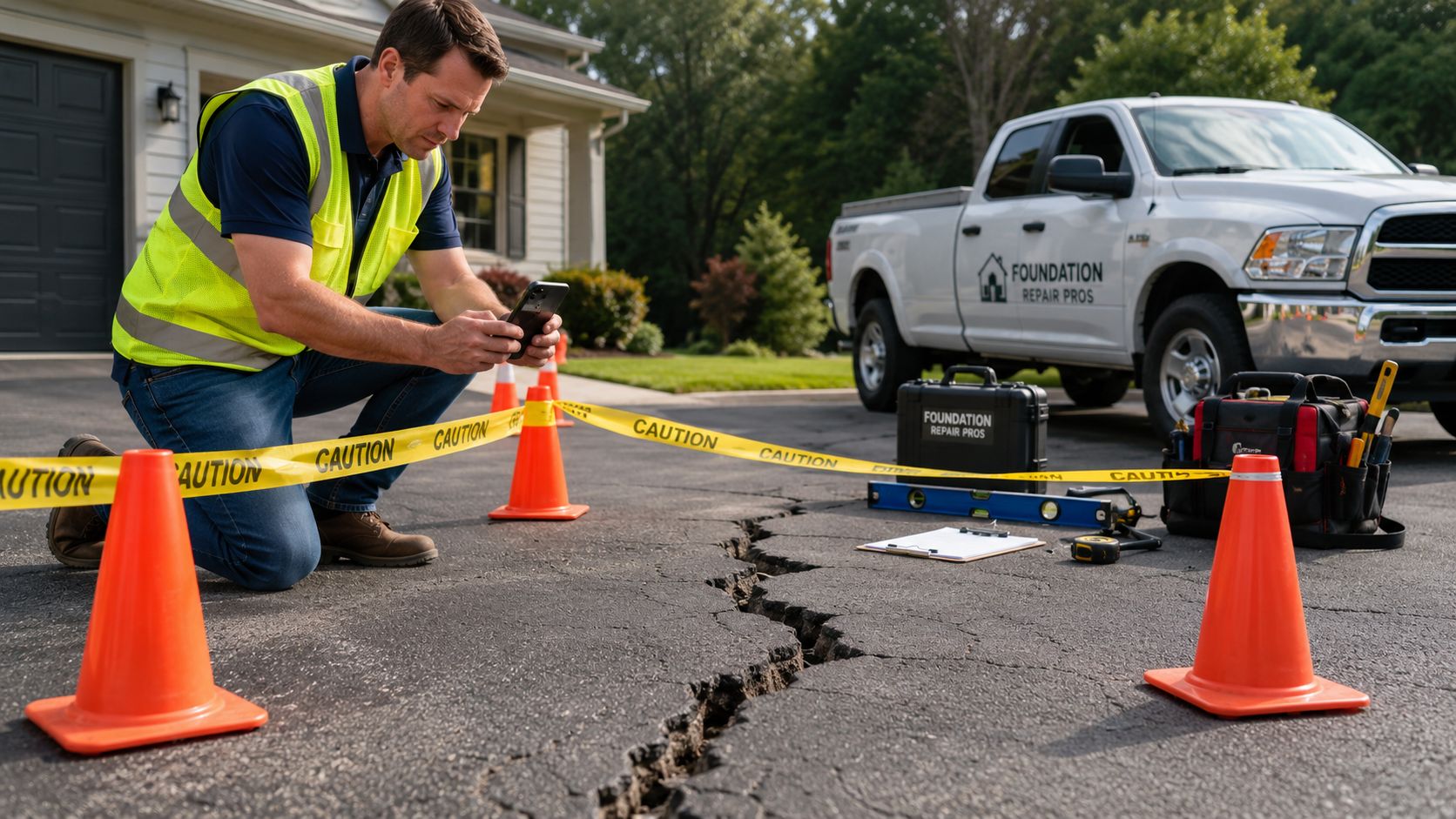
If you're staring at a broken sidewalk, a blown-out driveway edge, or an asphalt patch that just failed after the latest Florida rain, the first question is usually the hardest one. Is this a real emergency, or is it something that can wait until regular scheduling without making the problem worse?
That distinction matters in Marion County, FL and Citrus County, FL, where heat, heavy rain, and daily traffic can turn a small defect into a bigger liability fast. The right response is calm, practical, and specific, because emergency repair services are about safety first, not panic. For homeowners, HOAs, property managers, and commercial sites in Ocala, Dunnellon, Belleview, Silver Springs, Summerfield, Crystal River, Homosassa, Inverness, Lecanto, Beverly Hills, Hernando, and The Villages, the skill is knowing when to call now and when to plan the work properly.
Table of Contents
- Recognizing True Emergencies Versus Routine Maintenance
- Immediate Safety Actions and Temporary Stabilization
- Documenting Damage for Insurance and Repair Planning
- Evaluating and Contacting Emergency Repair Providers
- Understanding Costs and Payment Options
- Planning Permanent Repairs and Long-Term Maintenance
Recognizing True Emergencies Versus Routine Maintenance
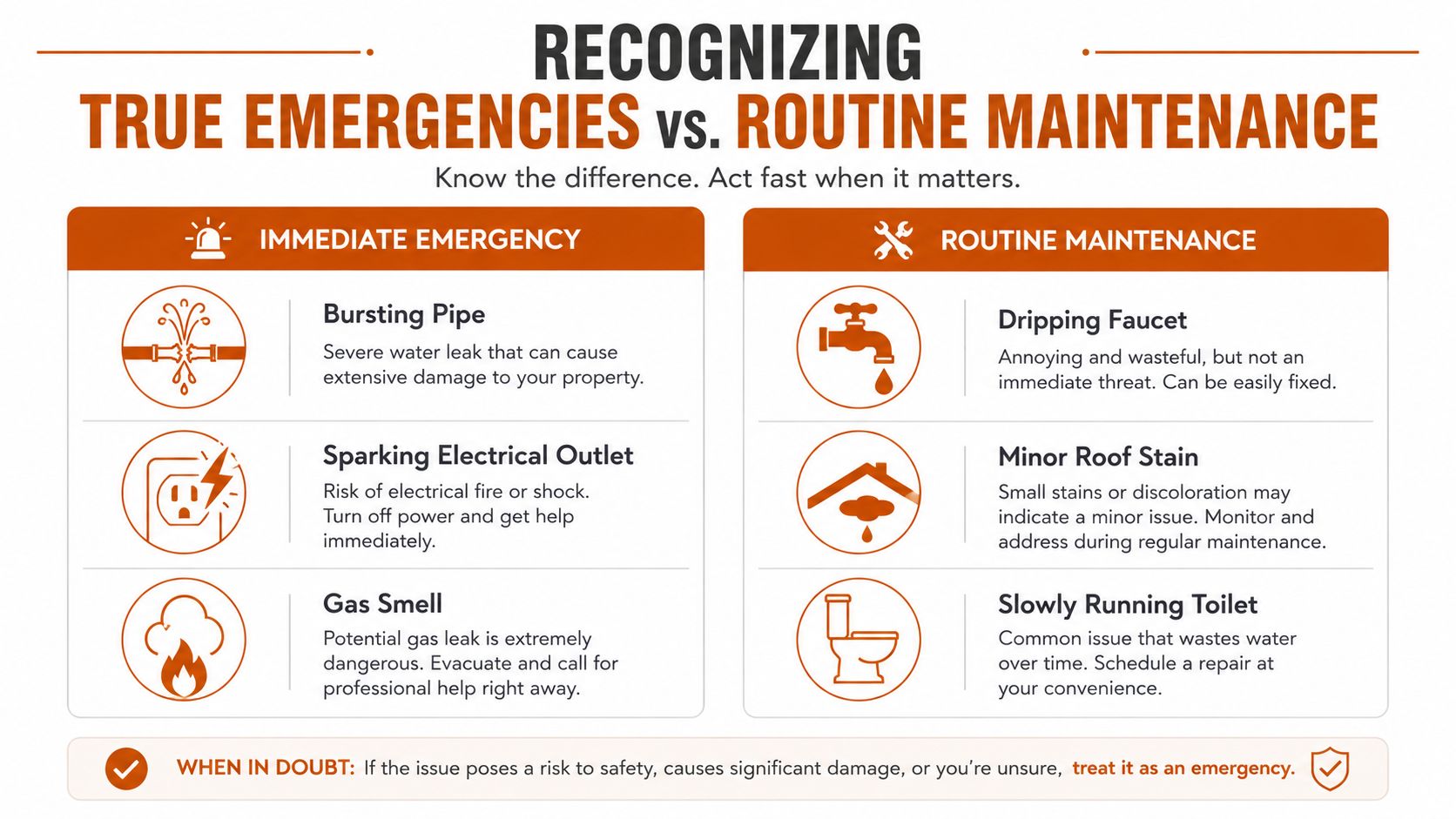
A cracked sidewalk at a storefront in Ocala can be annoying, but if it's creating a trip hazard on the main path, that's a different animal. A pothole in a parking lot might be a maintenance item until it starts blocking access, collecting water, or creating a direct safety problem. That's the line I use on real jobs, safety and access first, appearance second.
Under Queensland's tenancy law, emergency repairs include burst water services, serious roof leaks, gas leaks, dangerous electrical faults, flooding, serious storm damage, and any fault that leaves a property unsafe or insecure, or likely to injure a person or damage property Queensland legislation. That legal standard is broader than many people expect. It's not just about dramatic failures, it's about whether the condition creates immediate risk, access problems, or real liability.
The fast test I use on site
If the answer is yes to any of these, the issue deserves immediate attention:
- Someone could get hurt walking, driving, or working nearby.
- A vehicle, delivery truck, or emergency responder can't safely reach the area.
- The damage is getting worse because water, traffic, or heat keeps acting on it.
- A system failure has taken away a critical function, like power, drainage, or structural support.
By contrast, cosmetic scaling, shallow surface cracking, and worn striping are usually maintenance issues, not same-day emergencies. They matter, but they don't always justify emergency pricing or rushed decisions. The common mistake is treating every flaw like a crisis, then paying for after-hours response that could've been scheduled properly.
Practical rule: if the defect changes how people move through the property, treat it as urgent. If it only changes how the property looks, it's probably a planned repair.
For concrete and asphalt properties, the legal question and the practical question often overlap. A damaged driveway in The Villages, a broken sidewalk in Inverness, or a failing lot edge in Citrus County can cross from maintenance into emergency the moment it creates a trip hazard, blocks access, or exposes a structural edge. For water-related structural damage, a useful reference is this concrete damage guide, because water intrusion often turns an ordinary defect into a safety issue much faster than people expect.
Immediate Safety Actions and Temporary Stabilization
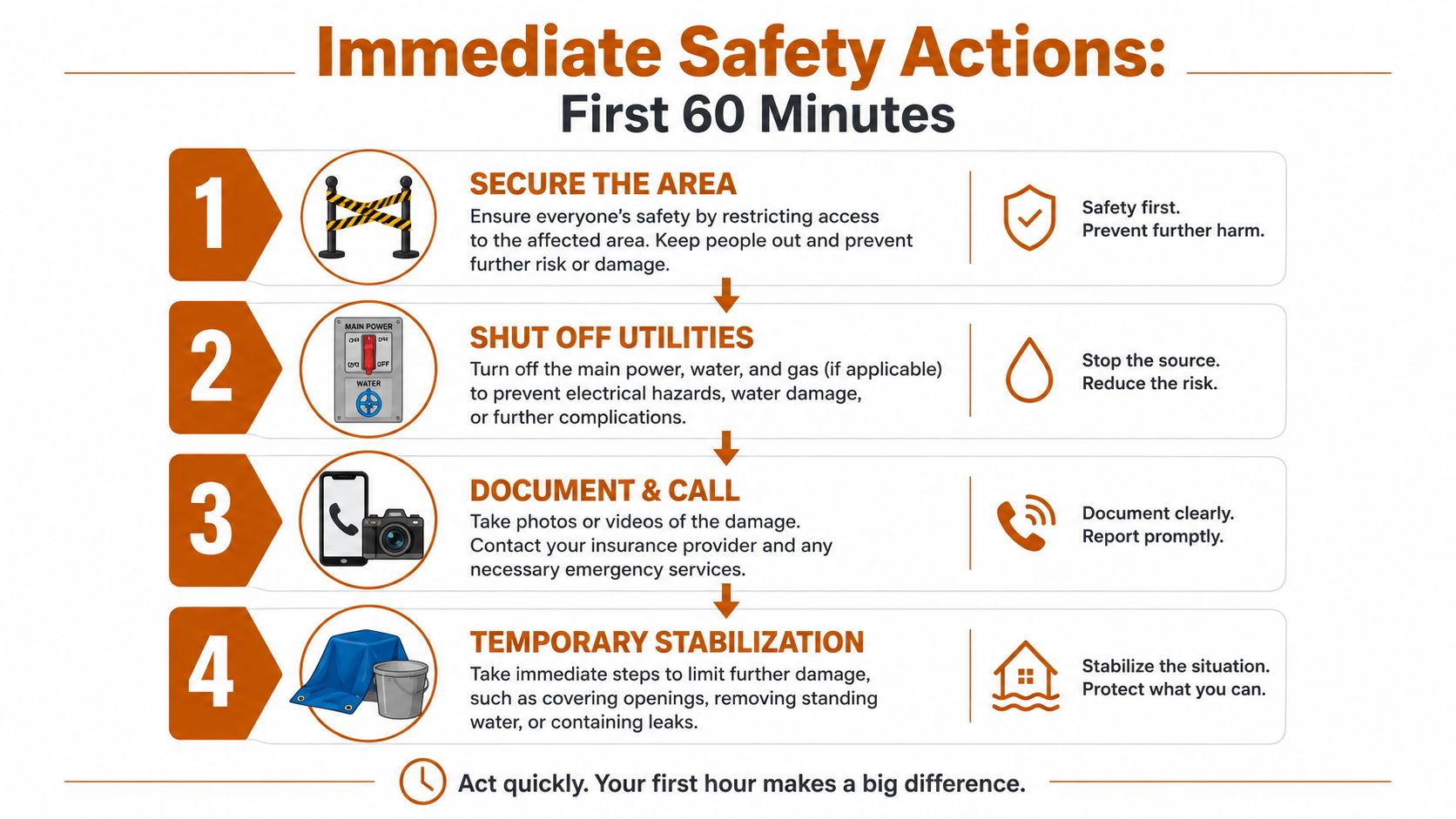
When a true emergency hits, the first move is not to patch it. It's to keep somebody from getting hurt while you buy time for a proper repair. I've seen property owners focus on the damage itself and miss the safer move, which is to isolate the hazard, control traffic, and stop conditions from getting worse.
The standard emergency workflow starts with hazard isolation, then rapid triage, then stabilization, then documentation, then permanent repair Emergency Restoration Authority. In water-loss situations, guidance commonly targets on-site dispatch within 1 to 4 hours for Category 3 contamination events, because delays can worsen secondary damage and make drying verification harder Emergency Restoration Authority. For property owners, the practical takeaway is simple, stabilize first, repair second.
What to do in the first hour
- Secure the area. Use cones, tape, barricades, or a physical barrier to keep people out of a broken sidewalk, collapsed slab edge, or unstable asphalt section.
- Shut off or isolate the hazard. If the issue involves utilities, use the safest available shutdown process. If it's structural, keep weight off the area.
- Redirect traffic. For commercial lots in Marion County, FL, reroute vehicles around the affected lane or entrance before someone tries to “just squeeze through.”
- Apply only temporary stabilization. That might mean a tarp, a board, a temporary cover, or a short-term support, depending on the damage.
Never treat a temporary patch as a finished repair. If the area is safe enough to use, it still may not be safe enough to leave alone.
For concrete, that might mean isolating spalled edges or loose sections so nobody catches a toe or wheel on them. For asphalt, it usually means keeping traffic off a pothole or broken seam until a permanent fix can be planned. In commercial settings around Crystal River, Homosassa, and Dunnellon, temporary control is often the difference between a manageable claim and a more expensive incident.
A good emergency response also leaves a paper trail while the site is still unchanged. That matters because conditions can shift quickly once rain, cleanup, or traffic starts affecting the area. If you wait too long, the original failure point gets harder to show, and the repair scope gets harder to defend.
Documenting Damage for Insurance and Repair Planning
Good documentation saves time later, and poor documentation costs money now. That holds whether you are dealing with an insurer, a property manager, an HOA board, or your own repair budget. Verbal descriptions usually do not carry enough detail to show what failed, where it failed, and how far the damage spread.
The most useful record starts with wide shots, then moves to close-ups, then adds context. Contractors estimate differently when they can see the full layout, drainage pattern, traffic path, and nearby structures. A close-up of a cracked corner tells only part of the story if nobody also sees the slab, the adjacent grade, or the entrance traffic that likely contributed to the problem.
What to capture before conditions change
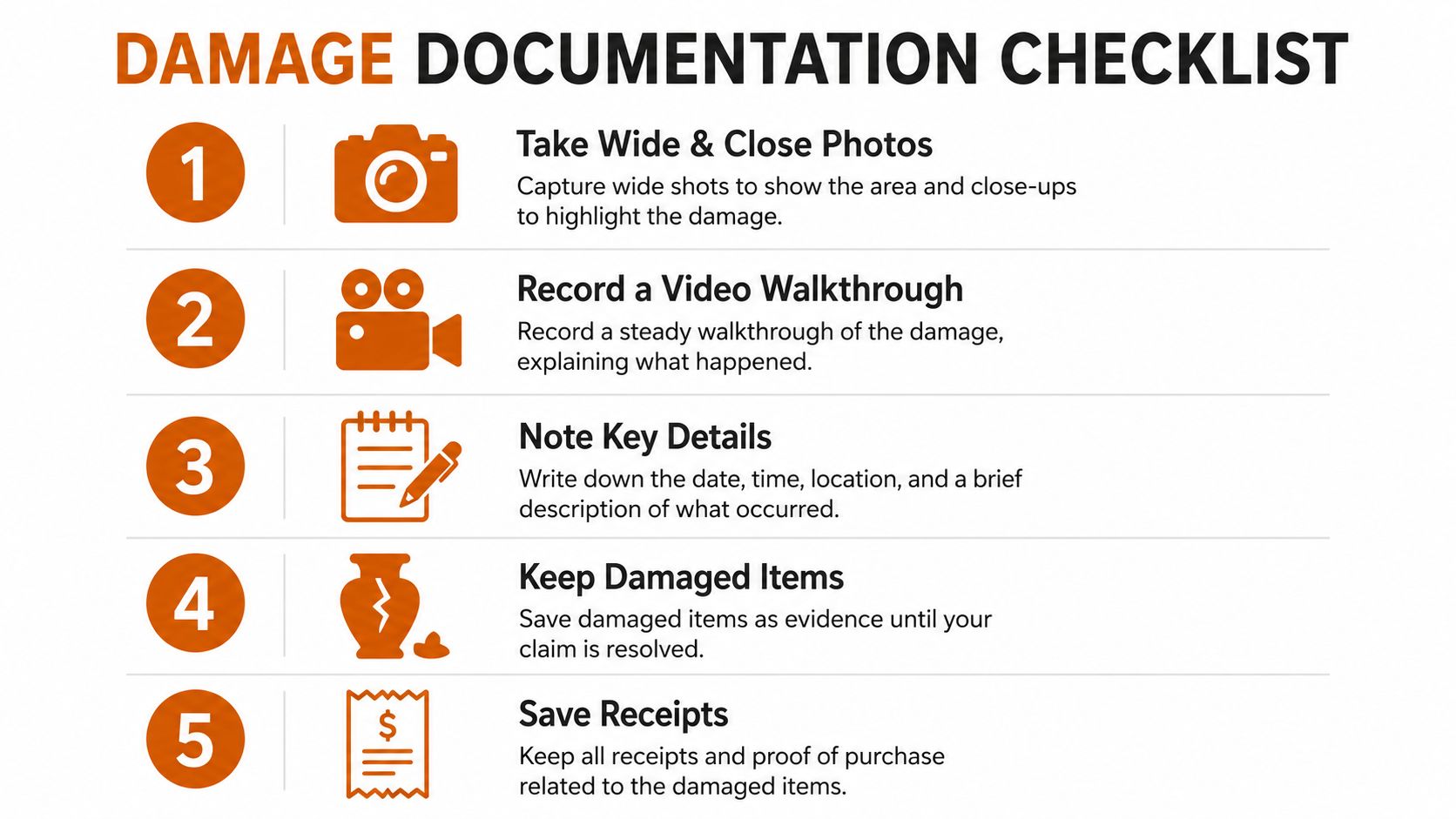
- Wide and close photos. Take one set that shows the entire affected area, then detailed shots of the break, crack, sink, or edge failure.
- A short video walk-through. Say what happened, where the damage is, and what parts of the site are unsafe.
- Written notes. Record the date, the weather, visible movement, water intrusion, and whether vehicles or foot traffic were involved.
- Damaged items. Keep broken fragments, dislodged pieces, or failed materials if they help show the extent of the problem.
- Receipts and temporary-repair costs. Save anything related to cones, tape, tarp, hauling, cleanup, or emergency labor.
That same discipline helps with concrete and asphalt jobs. If the repair started as a small crack and turned into a larger issue after stormwater got involved, the timeline matters. For property owners who want a cleaner paper trail, a bonded and insured contractor is easier to verify and easier to document for follow-up work.
Document the site before cleanup, not after. Once loose pieces are moved, the original failure is harder to prove and harder to price correctly.
For concrete service calls in areas like Belleview, Hernando, and Silver Springs, measurements matter too. Contractors need approximate lengths, widths, depth where visible, and whether the break is isolated or part of a larger failure pattern. For asphalt, note whether the problem is a pothole, edge breakup, or alligator cracking, because each one leads to a different scope. Better notes mean better estimates, and better estimates mean fewer surprises later.
Evaluating and Contacting Emergency Repair Providers
A contractor who does planned work well isn't automatically the right choice for emergency work. Emergency response requires different habits, faster communication, and a process for safety decisions under pressure. If a provider can't explain what they'll do first, that's usually a warning sign.
The best emergency repair crews work through a safety-first sequence, secure the area, isolate the system, diagnose the cause, execute the repair, then verify performance before re-entry Flyriver. That matters because the wrong first move can turn a manageable repair into repeat failure. The temporary fix is only useful if it leads to a documented permanent solution.
Questions worth asking on the first call
- Can you handle the type of damage I have right now? Concrete, asphalt, drainage, and utility-adjacent issues aren't the same.
- What's your response window? You need a real expectation, not a vague promise.
- Are you licensed and insured? Ask directly, and ask for proof.
- What's temporary and what's permanent in your plan? A good provider separates stabilization from final repair.
- Will I get a written scope or estimate? Emergency work still needs paper.
For Florida property owners, it also helps to verify whether the contractor can handle the site conditions you're facing. A company doing emergency lot or slab work in Dunnellon or Ocala should know how to protect adjacent pavement, existing concrete, and traffic flow while work is active. For extra screening, this bonded-and-insured contractor guide is useful because it reinforces the basic protection every property owner should expect before anybody starts cutting, patching, or replacing.
If a contractor pressures you to pay everything up front without giving you a scope, pause. Emergency does not mean unaccountable.
Reliable providers also explain what they need from you before arrival, such as access instructions, photos, hazard details, and whether anyone is on site to meet them. Unreliable ones tend to improvise after they show up, which wastes time and often leaves the root problem untouched. For HOA boards and commercial managers in Citrus County, FL, that difference becomes expensive fast.
Understanding Costs and Payment Options
Emergency work costs more because the contractor is moving schedule, crew time, material sourcing, and risk all at once. That doesn't mean every premium is fair, but it does mean the cheapest quote isn't automatically the best one. A rushed repair that fails in a week is usually more expensive than a proper stabilization followed by a permanent fix.
Pricing also shifts based on after-hours response, material availability, site access, and scope complexity. A simple temporary barricade and hazard isolation is one thing. Cutting out broken concrete, hauling debris, forming, placing, and curing a replacement section is something else entirely. The same is true for asphalt, where emergency patching may be fast, but a lasting repair still depends on proper prep.
Payment options that may be relevant
Emergency home-repair guidance notes that possible funding paths can include personal loans, contractor financing, HUD Title I loans, USDA Section 504 aid for eligible rural homeowners, local CDBG-funded repair grants, and FEMA disaster assistance for qualifying events NerdWallet. Those options are fragmented, with different rules and approval timelines. The practical issue is deciding what gets you safe now without locking you into a bad financial choice.
A useful way to think about it is speed versus total cost. If the damage creates a hazard, fast response may be worth the premium. If the issue is stable, contained, and not worsening, waiting for standard scheduling can preserve cash for the permanent repair itself.
The important part is not to confuse a temporary patch with a final solution. On concrete and asphalt properties, repeated stopgap fixes often add up to more labor, more disruption, and more downtime than one properly planned repair. That's why the best emergency decisions are made with the long game in mind.
Planning Permanent Repairs and Long-Term Maintenance
A temporary stabilization gets the site back under control, but it does not fix the cause of the failure. Permanent repair planning is where property owners protect the asset, whether that means a driveway in Summerfield, a sidewalk in Beverly Hills, or a parking lot in Marion County, FL. The goal is to stop the same problem from returning after the next cycle of heat, rain, and traffic.
For concrete, sound repair decisions follow a deliberate sequence. The U.S. Bureau of Reclamation's concrete repair process starts with identifying the cause, checking how far the damage extends, deciding whether repair is warranted, choosing the method and material, preparing the concrete, placing the repair, and curing it correctly USBR Concrete Repair Guide. Caltrans follows a similar order in the same guide, focusing on isolating the damaged area, removing defective material while keeping sound structural material in place, replacing what is needed, and curing properly. That is the difference between covering a symptom and correcting the failure.
What good long-term planning looks like
- Match the fix to the failure. A surface patch will not correct settlement, drainage problems, or base failure.
- Respect cure time and weather. Florida heat and rain can work against poor scheduling, especially on fresh concrete and hot asphalt.
- Solve the cause, not just the crack. Water intrusion, drainage, or edge loading often need attention too.
- Plan maintenance after the repair. Sealcoating, striping refreshes, and inspections help protect the finished work.
Site planning matters before any replacement or repair near utilities. Before concrete replacement, grading changes, or work along service runs, use proper underground utility location guidance so avoidable strikes do not turn a repair into a larger emergency underground utility location guidance. That matters on properties where the work zone sits near drains, lighting, or buried lines.
In Central Florida, the environment punishes shortcuts. Heat, UV, rain, and traffic all wear down weak repairs. The properties that stay ahead of the damage are the ones that treat emergency response as the first step in a longer maintenance plan, not the finish line.
If you've got a cracked driveway, a failing sidewalk, or asphalt damage that might be more than routine wear, get it looked at before it turns into a bigger safety issue. For property owners in Marion County, FL and Citrus County, FL, reach out to Riverside Sealing & Striping, LLC for a free, no-pressure consultation and a practical assessment from Concrete and Asphalt Experts in Marion and Citrus County.