
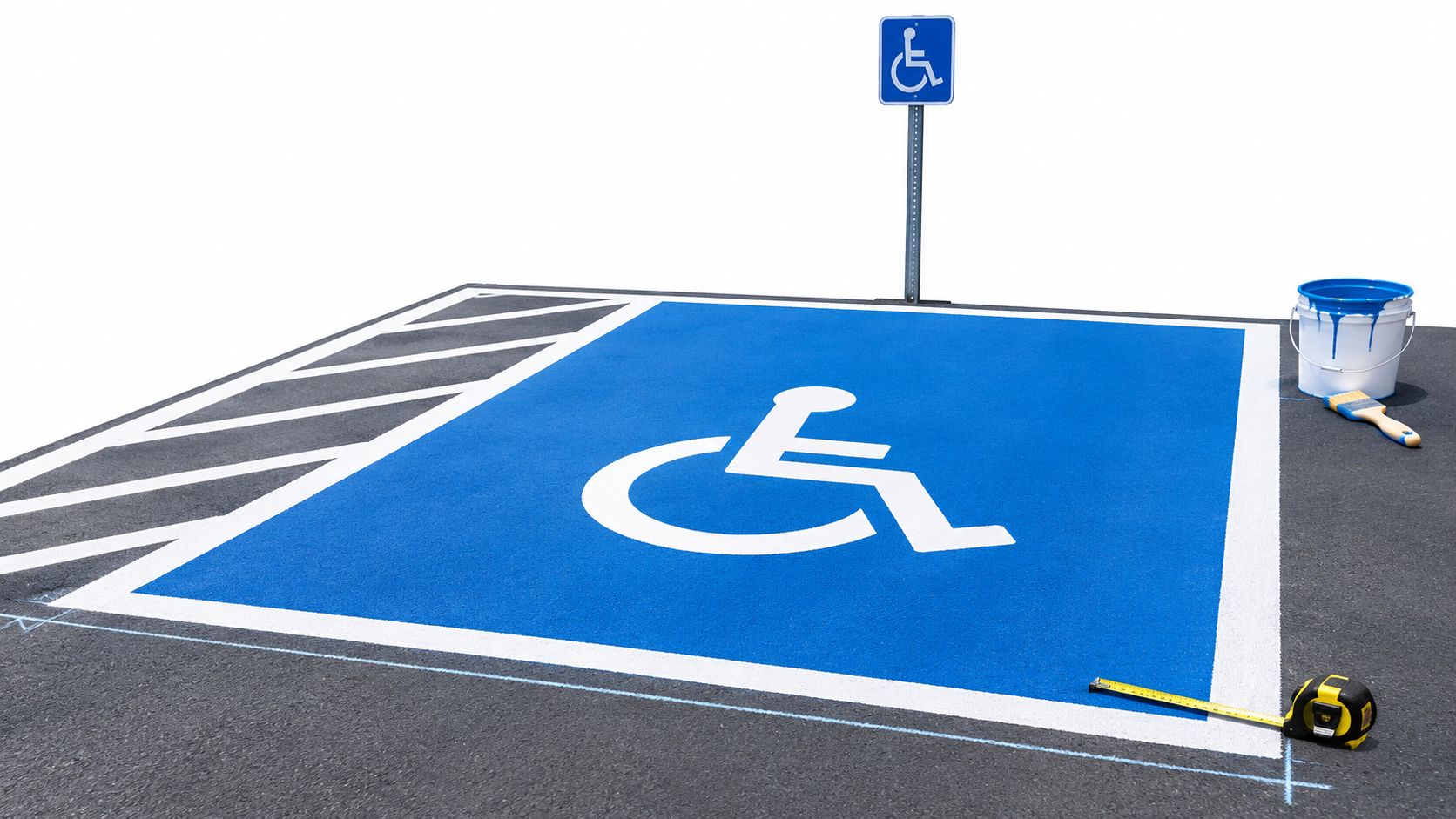
A property manager in Dunnellon can repaint a row of accessible stalls, watch the blue paint dry, and still face a failed inspection days later. The problem usually isn't effort. It's a layout that was never measured, an access aisle that doesn't connect correctly, a sign mounted too low, or a symbol that has faded into the asphalt.
Handicap parking pavement marking is a full-lifecycle responsibility. Geometry, surface condition, contrast, retroreflectivity, drainage, and repaint planning all affect whether an accessible stall remains usable and defensible. That matters at shopping centers in Ocala, churches in Belleview, offices near Silver Springs, and commercial properties throughout Marion County, FL and Citrus County, FL.
Table of Contents
- Why Handicap Parking Pavement Marking Matters More Than You Think
- ADA Dimensions Every Striping Contractor Must Follow
- How Many Accessible Stalls Your Lot Actually Needs
- Color, Contrast, and the International Symbol of Accessibility
- Florida Weather and What It Does to Pavement Markings
- Maintenance and Inspection Routines That Keep You Compliant
- Common Compliance Mistakes in Marion and Citrus County Lots
- When to Call a Local Striping Professional
Why Handicap Parking Pavement Marking Matters More Than You Think
The Dunnellon manager in that opening scenario made a common assumption: blue paint equals compliance. A fresh color improved the appearance, but it didn't correct the underlying layout. The inspector measured the stall and aisle, checked the route to the entrance, reviewed the sign, and looked at whether the markings clearly communicated where parking stopped and the access aisle began.
That distinction matters because accessible parking is regulated as a system. The ADA parking requirements from the U.S. Department of Justice address stall dimensions, access aisles, surface condition, signs, and accessible routes. A property can have a bright symbol and still create a real barrier for a wheelchair user transferring from a vehicle or traveling toward an entrance.
What inspectors actually look for
Paint color attracts attention, but field reviews focus on measurable conditions:
- Stall geometry: The space has to provide the required width and usable boundaries.
- Access aisle placement: The aisle must be beside the stall, clearly marked, and connected to an accessible route.
- Surface condition: Cracks, loose asphalt, ponding water, and abrupt changes can interfere with mobility.
- Sign visibility: Reserved-space signs must be positioned where drivers can identify the restriction.
- Route continuity: The path to the entrance must remain free of curbs, stairs, and obstructions.
Complaint-driven inspections often begin with an everyday problem. A resident in The Villages may report that a van aisle is blocked. A customer at a Crystal River retailer may find that a curb ramp opens into a striped area occupied by a vehicle. An HOA member in Summerfield may notice that a symbol has nearly disappeared after repeated maintenance work.
Practical rule: A handicap parking pavement marking job isn't finished when the paint looks new. It's finished when the entire accessible route works as laid out.
Florida properties also need to account for state and local requirements that may be more specific than the federal baseline. The safest approach is to measure the lot, verify the current jurisdictional requirements, and preserve the layout documentation before repainting.
ADA Dimensions Every Striping Contractor Must Follow
A crew should never lay out accessible stalls from memory. Start with the site measurements and the applicable standard, then mark the stall, aisle, route, and sign locations before applying paint.
The federal baseline identifies a standard accessible space as at least 96 inches wide. The adjacent access aisle must be at least 60 inches wide, remain the same length as the stall, and connect directly to an accessible route. The U.S. Access Board parking guide explains that these dimensions are measured to the centerline of the markings.
Van-accessible arrangements require closer attention. A van stall is commonly configured with an 8-foot access aisle, while the stall itself must provide the required van-accessible width. The verified dimensions identify a van-accessible stall as at least 132 inches wide with an adjacent aisle of at least 60 inches, depending on the layout used. Don't assume that a standard car stall can just be relabeled for van use.
Measure the entire route, not just the rectangle
The ADA guidance on restriping parking spaces says accessible parking must be on the shortest accessible route to an accessible entrance. That route must be at least 3 feet wide, firm, stable, slip-resistant, and free of curbs or stairs.
| Stall Type | Stall Width | Access Aisle | Notes |
|---|---|---|---|
| Standard accessible stall | At least 96 inches | At least 60 inches | Aisle must connect to an accessible route |
| Van-accessible configuration | At least 132 inches in the identified configuration | Typically 8 feet for van access | Verify the complete layout and jurisdictional requirements |
Mark the stall boundaries and aisle edges to the centerline of the striping. Check whether wheel stops, planted islands, drainage structures, light poles, or curb ramps intrude into the usable area. A sign in the right place won't rescue a space whose aisle is pinched by a ramp or whose route ends at a curb.
For a practical layout reference, property managers can review this guide to ADA handicap parking space requirements. Use it as a planning aid, then confirm the requirements that apply to the specific property.
How Many Accessible Stalls Your Lot Actually Needs
The number of accessible spaces depends on the total number of parking spaces. It isn't a decorative choice and shouldn't be copied from the previous layout without recounting the lot.
Under the verified ADA guidance, a lot with 1 to 25 spaces requires at least 1 accessible space. A lot with 151 to 200 spaces requires at least 6 accessible spaces. Federal requirements continue to increase the minimum for larger lots, and the required count must be evaluated against the complete facility rather than one convenient row.
Use the current count
A property manager should count every parking space serving the facility, including spaces that may sit behind a separate building or on another portion of the site. A restriping project often fails because the contractor receives an old drawing, a partial aerial image, or a verbal instruction such as “put back what was there.”
| Total Parking Spaces | Required Accessible Stalls | Of Which Van-Accessible |
|---|---|---|
| 1 to 25 | At least 1 | Verify the applicable facility requirement |
| 151 to 200 | At least 6 | Include the required van-accessible provision |
| Larger lots | Federal minimum continues to increase | Confirm the current count and van requirement |
The table shows why a simple paint estimate can be misleading. The contractor must count the lot, determine the facility type, identify the accessible entrance, and then reserve the right number of stalls and aisles in usable locations.
Medical and rehabilitation facilities can carry separate, higher requirements. Outpatient clinics deserve the same caution, especially when the property includes treatment rooms or mobility-focused services. Florida and local authorities may layer additional rules on top of the federal baseline, so a property manager in Lecanto, Inverness, or Hernando should verify the applicable requirements before approving a final layout.
A counted layout also helps with future maintenance. When the original drawing identifies each accessible stall, the crew can repaint the intended geometry instead of preserving an error that has become familiar.
Color, Contrast, and the International Symbol of Accessibility
The phrase “paint it blue” oversimplifies accessible parking. The federal ADA Standards don't specify one required paint color or one required pavement-marking method. The Access Board explains that states and local authorities may establish more specific practices, including white retroreflective markings, blue backgrounds, and “No Parking” legends.
That creates three common approaches in Central Florida:
| Scheme | ADA Stance | Inspector Recognition | Best Use |
|---|---|---|---|
| White-only stripes and symbol | May satisfy the federal baseline where permitted | Clear when contrast is strong and local rules allow it | Jurisdictions that don't require a blue field |
| White stripes with blue interior field | Supports strong visual identification | Usually quick to recognize | Properties following a familiar local convention |
| Blue stall with white borders | Must still preserve clear geometry and symbol contrast | Highly visible when maintained correctly | Locations where the authority having jurisdiction accepts or expects it |
A blue field can improve recognition, but color alone doesn't establish compliance. The symbol needs to be centered, legible, and applied to a sound surface. Access aisles should remain clearly distinct from parking areas, and each aisle should carry the required “No Parking” marking where applicable.
Contrast matters after installation
Fresh blue paint can look excellent on a cloudy morning and appear washed out after months of sun and rain. White markings can also lose their edge when dirt, tire residue, or surface dust fills the texture of the asphalt. Retroreflective materials and contrasting colors help, but they don't eliminate the need for inspection.
Under older sodium-vapor lighting, a saturated field and bright white border may read differently than they do under LED fixtures. The field test is simple: walk the lot in daylight and after dark, view the stall from the drive aisle, and confirm that the symbol and boundaries remain immediately understandable.
Property managers planning the stencil work can also review how to paint handicap parking spaces. The useful takeaway is that a stencil supports consistency, but it can't correct a poorly measured stall or a deteriorated substrate.
Florida Weather and What It Does to Pavement Markings
Central Florida gives pavement markings a demanding environment. Strong sun breaks down coatings, afternoon rain tests adhesion, standing water attacks weak edges, and traffic repeatedly abrades the areas where tires turn and stop.
A marking that looks acceptable in Ocala may lose contrast sooner when it sits in an exposed row with no shade. A stall beneath trees faces a different problem. Leaves, pine debris, and organic residue collect around the symbol and hold moisture against the pavement. When a crew paints over contamination, the new coating may peel even though the color is initially strong.
Material selection changes the maintenance result
Standard traffic paint can work when the surface is clean, dry, and properly prepared. High-use accessible stalls may justify a more durable formulation, such as a chlorinated-rubber or thermoplastic system, when the owner values longer legibility and the substrate is suitable. The trade-off is higher preparation and installation demands.
Retroreflectivity also depends on more than the product label. Surface texture, application thickness, dirt, lighting, and wear all affect nighttime visibility. A blue field may appear to fail before a white border because large colored areas show fading and contamination quickly, but the correct response is inspection rather than assuming every stall needs the same coating.
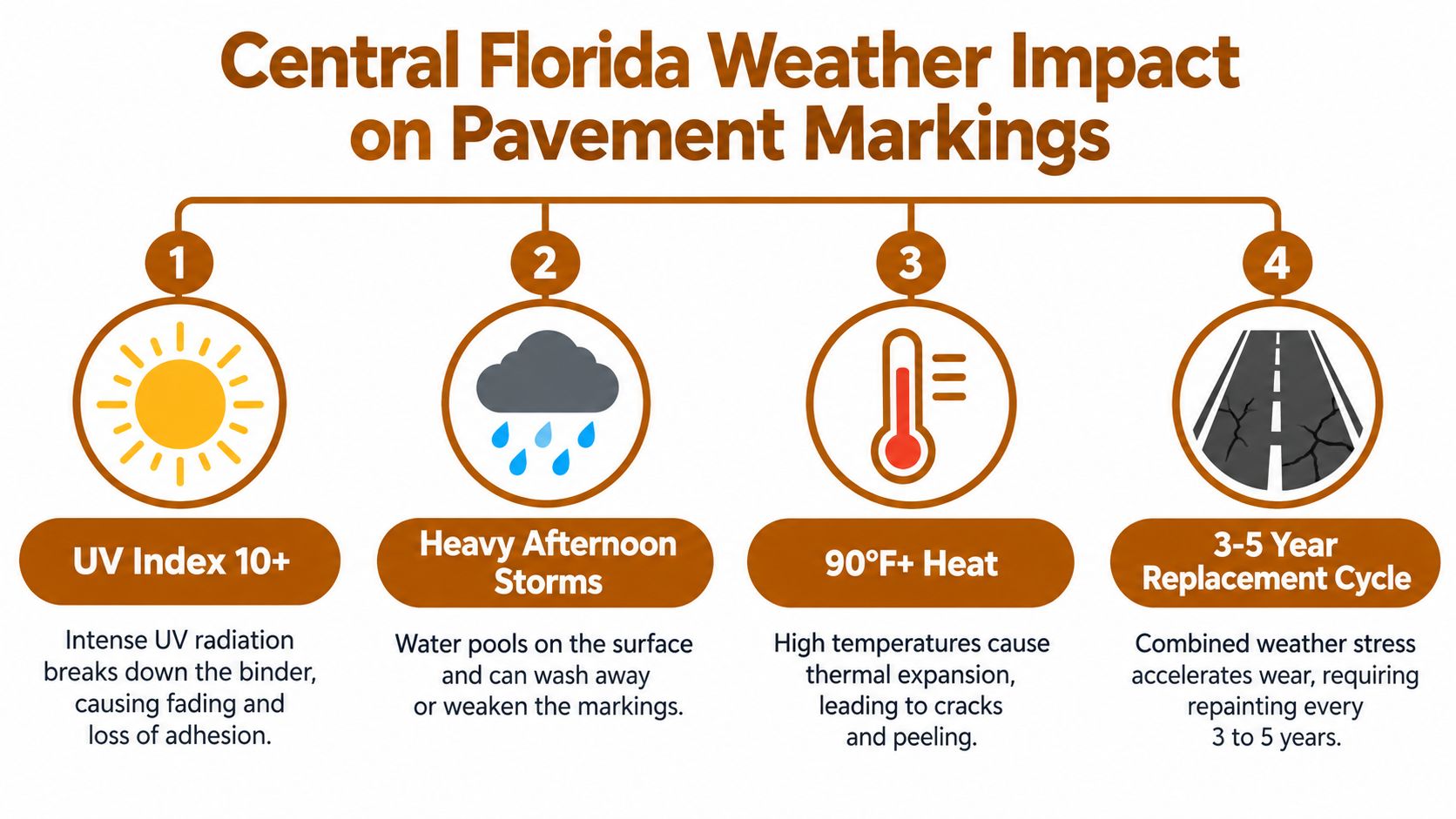
Schedule work only when the pavement is dry and the coating can bond properly. A contractor should account for humidity, overnight moisture, rain in the forecast, and the time needed before vehicles return. Opening the lot too quickly can drag fresh edges, transfer paint to tires, and create touch-up work that a better schedule would have prevented.
Maintenance and Inspection Routines That Keep You Compliant
A property manager doesn't need to wait for a complaint to find a failing accessible stall. A quarterly walk-through gives the team a chance to catch fading, damaged symbols, blocked aisles, and route problems before a customer or inspector reports them.
Begin with a visual review from the drive aisle. Look for missing sections of the border, a symbol that no longer reads as a wheelchair, and hash marks that have become disconnected. Then inspect the pavement itself. Cracks, spalling, loose aggregate, and ponding water can undermine an otherwise correct marking.
Keep a simple field record
Use the same checklist each time so changes are easy to identify:
- Marking condition: Record fading, peeling, edge loss, and areas where the symbol is incomplete.
- Aisle clarity: Confirm that the full access aisle remains visible and isn't being used for parking or storage.
- Sign placement: Verify that reserved-space signs remain secure, visible, and mounted at least 60 inches above the ground, as specified in the verified ADA guidance.
- Route condition: Walk from each accessible stall to the entrance and look for obstructions, curbs, stairs, and surface hazards.
- Documentation: Photograph each stall, note the inspection date, and keep repair invoices with the original layout drawing.
Repainting is usually the appropriate remedy when the symbol is no longer legible, the border no longer defines the stall, or the blue and white areas no longer provide clear contrast. Patching a small damaged section can leave a mismatched symbol and an uneven edge, particularly when the underlying asphalt has failed.
A maintenance file won't make a noncompliant layout acceptable, but it shows that the property manager is monitoring conditions and responding to defects. For HOAs, churches, schools, and commercial sites in Marion County, FL, and Citrus County, FL, that record also helps different managers preserve the same layout instead of improvising at every service visit.
Common Compliance Mistakes in Marion and Citrus County Lots
Local lots often develop problems through small, well-intended changes. A handyman paints over a faded stall, a paving crew shifts a curb ramp, or a manager adds a sign without checking the aisle. The result can look organized while still preventing proper use.
The most frequent issue is a narrow or poorly aligned access aisle. A standard accessible stall needs an adjacent aisle of at least 60 inches, while van-accessible configurations typically need an 8-foot aisle. The fix isn't another coat of paint. It requires measuring the whole stall-and-aisle assembly and confirming that the aisle reaches the accessible route.
| Common Mistake | Correct Fix |
|---|---|
| Access aisle is too narrow or stops short | Re-measure the aisle, mark its full length, and connect it directly to the accessible route |
| Curb ramp or wheel stop intrudes into the aisle | Relocate the obstruction or revise the layout so the usable aisle remains clear |
| Van-accessible space is not identified clearly | Confirm the van configuration, aisle dimensions, sign, and pavement markings together |
| Blue field has faded until it resembles gray pavement | Clean and evaluate the marking, then repaint with a contrasting system suited to the surface |
| Symbol is incomplete or poorly centered | Remove loose material, use a proper stencil, and reapply the full symbol on sound pavement |
| Sign is missing, damaged, or mounted too low | Install a secure reserved-space sign at the required height and visible position |
| Drainage creates ponding at the stall or route | Correct the grade or pavement defect before applying a new marking |
| Curb cut is present but not clearly connected to the stall | Rework the layout so the aisle and accessible route communicate continuously |
A faded sign can be as serious as faded paint at night. The same applies to a symbol applied over cracked asphalt. New material follows the condition of the substrate, so repainting without surface preparation often produces a short-lived result.
Managers in Dunnellon, Ocala, Crystal River, Homosassa, Beverly Hills, and The Villages should also watch for maintenance work that blocks the aisle temporarily. Cones, dumpsters, pallets, and parked service vehicles can make a compliant layout unusable even when the permanent markings are correct.
When to Call a Local Striping Professional
Schedule an on-site review when drivers can no longer identify the accessible stalls quickly, the blue field has faded into the surrounding pavement, or the wheelchair symbol is chipped and incomplete. Also call when a van-accessible space has lost its aisle markings, signs lean or rust, or a pavement repair has changed the original dimensions.
A qualified contractor brings more than a spray machine. The crew should understand accessible-space layout, use calibrated striping equipment, select materials appropriate for hot and wet Florida conditions, and know how to preserve a layout across future maintenance cycles. The contractor should also be willing to identify conditions that paint alone won't fix, such as a damaged curb ramp, an obstructed route, or pavement that needs repair first.
Check the scope before booking
Ask for a written scope that identifies:
- The layout: Stall widths, aisle dimensions, symbol locations, sign work, and any route-related corrections.
- The preparation: Cleaning, removal of failing material, pavement repairs, and drying requirements.
- The materials: Product type, color, contrast approach, and expected maintenance considerations.
- The documentation: Before-and-after photographs, a marked layout drawing, and an invoice tied to the completed work.
- The contractor: Current license and insurance information, relevant references, scheduling expectations, and any workmanship or paint warranty.
For commercial properties comparing providers, commercial parking lot striping near you should include more than a low repainting price. The useful comparison is whether the contractor measures the site, explains the trade-offs, and leaves the property with a layout that can be maintained.
Riverside Sealing & Striping, LLC provides concrete work, asphalt sealcoating, and professional parking lot striping for properties across Marion County, FL, Citrus County, FL, and surrounding Central Florida communities. Request a free, no-pressure on-site estimate for your handicap parking pavement marking project from the Dunnellon-area team through Riverside Sealing & Striping, LLC.