
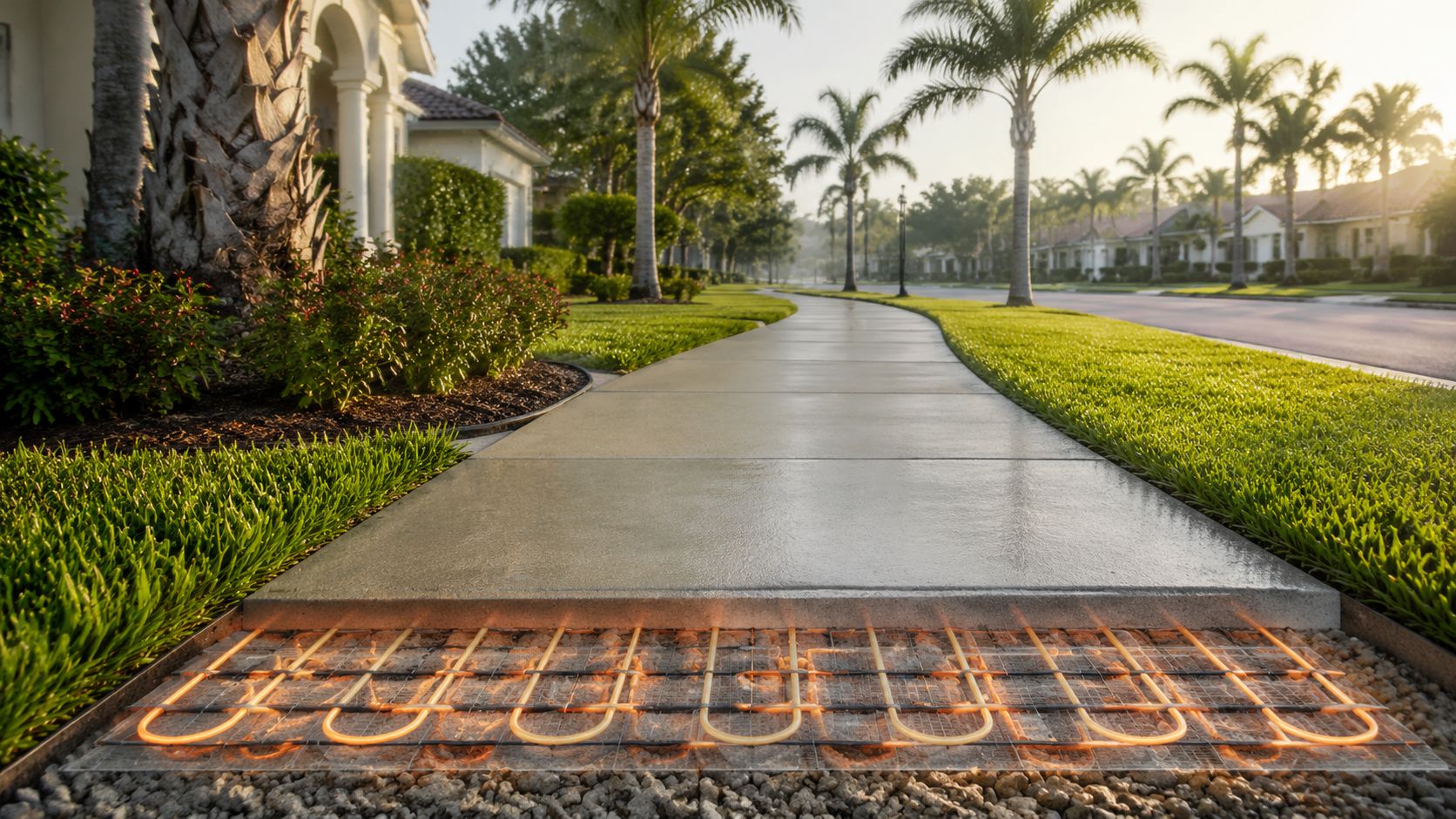
A frosty morning in The Villages can turn a clean sidewalk into a liability fast, and the same thing can happen at an Ocala shopping center, an HOA entrance, or a church walkway in Citrus County when the temperature dips just long enough to leave a slick patch behind. That's why heated sidewalk installation is worth a real look in Central Florida, even if snow isn't part of everyday life. For property owners in Marion County, FL and Citrus County, FL, the question usually isn't whether the system can melt ice, it's whether the safety, convenience, and maintenance benefits justify the project.
Table of Contents
- Are Heated Sidewalks a Smart Choice for Central Florida?
- What Is a Heated Sidewalk and How Does It Work?
- Electric vs Hydronic Systems A Detailed Comparison
- The Heated Sidewalk Installation Process Step by Step
- Real Costs and ROI for Heated Sidewalks in Florida
- Why Partner with a Local Concrete Expert for Your Project
- Frequently Asked Questions About Heated Sidewalks
Are Heated Sidewalks a Smart Choice for Central Florida?
A heated sidewalk can look like a luxury item until one cold morning turns a wet entrance into a slip complaint, a maintenance call, or a conversation with the insurance carrier. That is a real concern for HOAs in The Villages, storefronts in Ocala, and community facilities in Crystal River or Inverness that still need safe walking surfaces even when cold weather only shows up a few days a year.
The broader market has moved beyond novelty. A 2024 market study valued the global heated pavement system market at $4.1 billion and projected it to reach $8.9 billion by 2033, with an 8.7% CAGR over the forecast period (marketintelo.com). That level of activity shows heated pavement has become part of mainstream infrastructure planning, not just a niche residential add-on.
For Central Florida, the decision looks different than it does in colder states. You are not buying this to manage constant snow buildup. You are buying it to cut winter service headaches, improve accessibility, and keep entrances usable when a cold snap hits a busy sidewalk in Belleview, Summerfield, Dunnellon, or Homosassa. It also makes more sense on properties with steady foot traffic, where one fall creates more risk than a seasonal utility bill.
Practical rule: if a walkway serves a higher-traffic entrance, or if an HOA board is worried about winter liability, heated concrete works as a safety feature first and a comfort feature second.
Cost and payback are where the decision gets real. A heated sidewalk has to earn its place through fewer slip incidents, less manual ice response, and less pressure on staff or vendors to react on short notice. On the installation side, the system needs to fit the slab design, drainage, and local use pattern, which is why a contractor who understands both concrete and asphalt work, like Riverside Sealing & Striping, LLC, can help sort out whether the project makes sense before anyone commits to a pour.
What Is a Heated Sidewalk and How Does It Work?
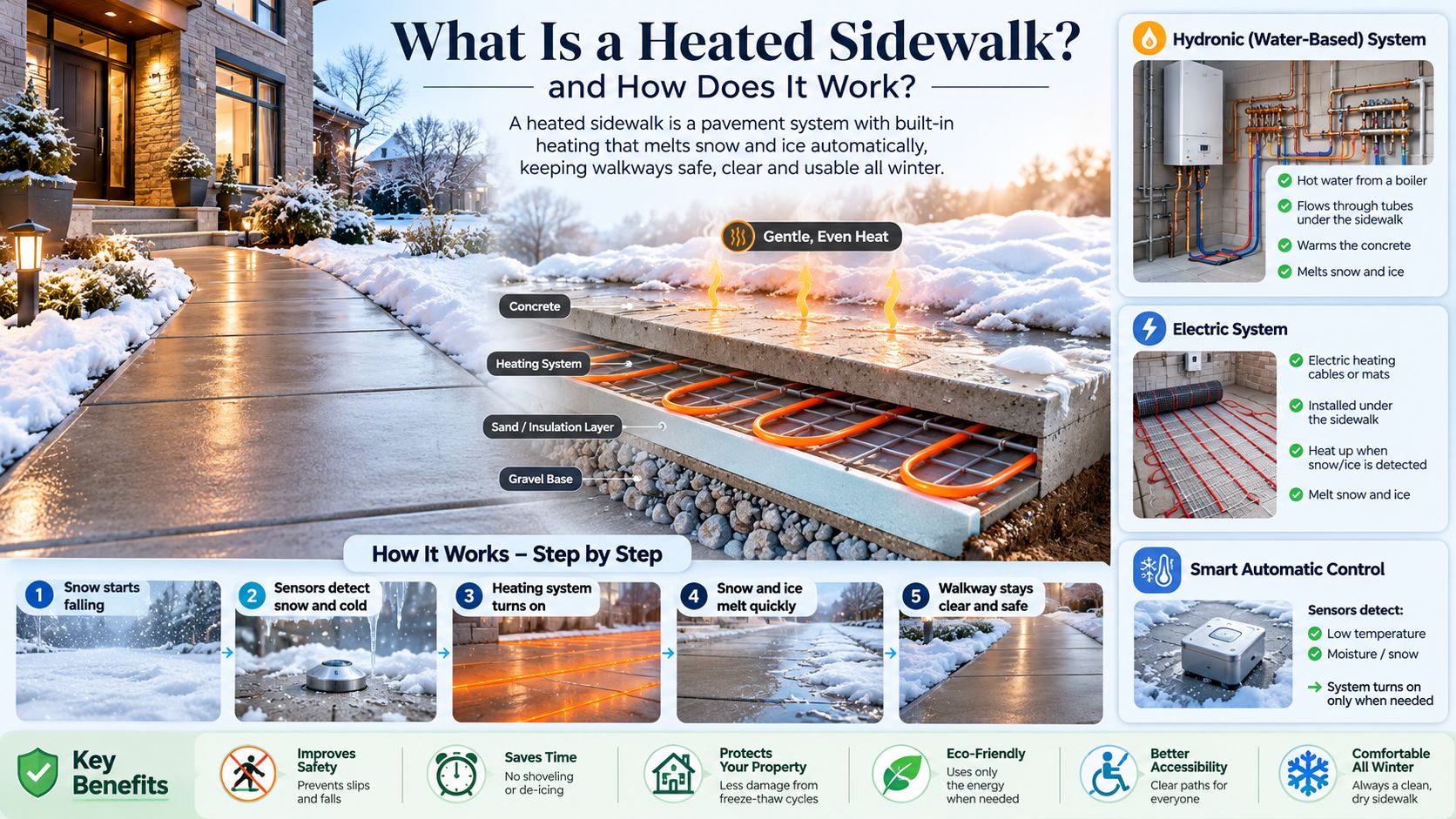
A heated sidewalk is a radiant heat system built under the walking surface so the slab can warm up enough to melt snow, frost, or ice before it sticks. The easiest way to think about it is as an electric blanket for concrete, except the goal isn't comfort, it's a safer, more usable walking surface.
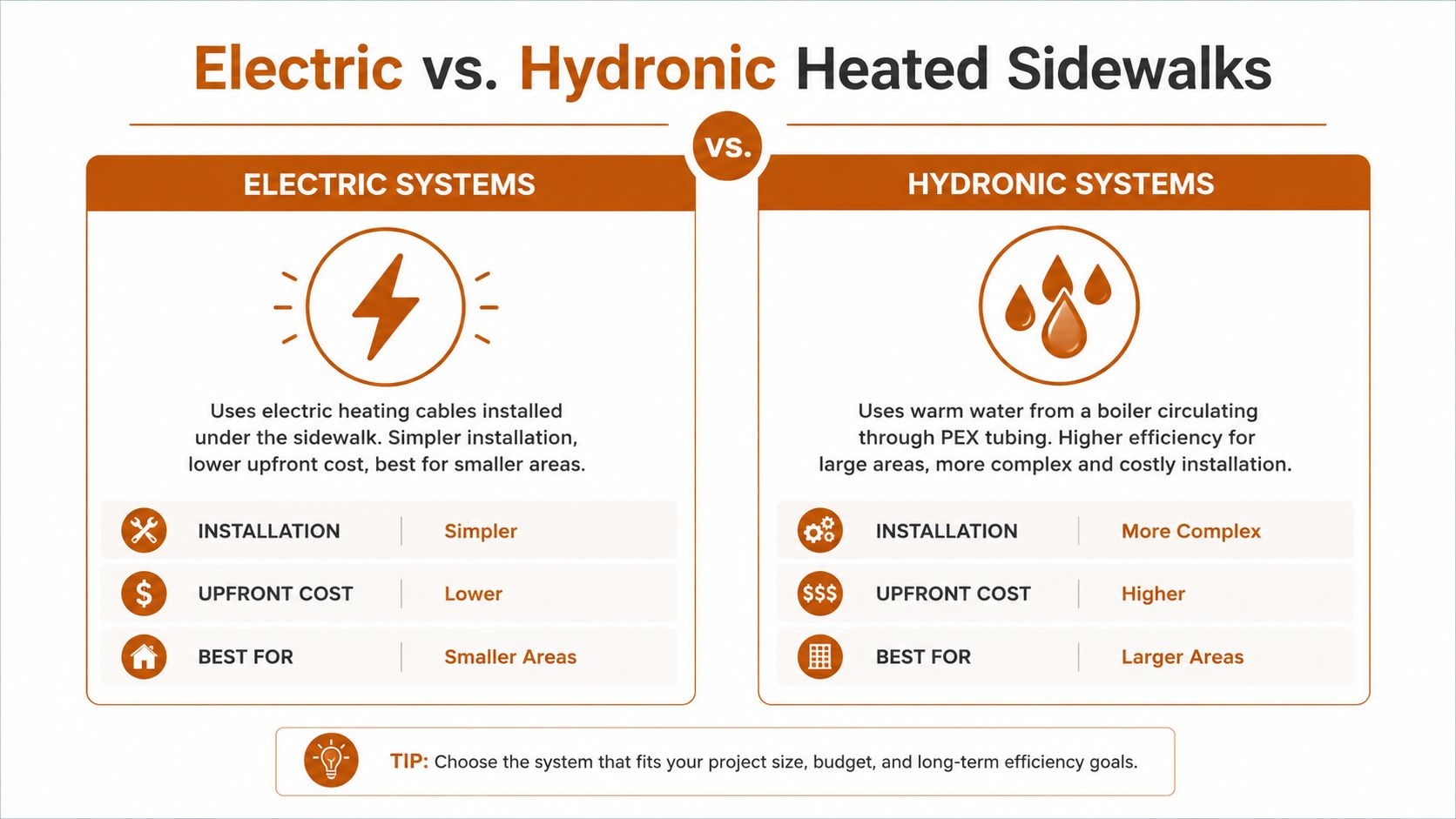
Industry sources describe two main system types. Electric resistance cables or mats generate heat directly under the slab, while hydronic tubing circulates warm fluid through embedded lines beneath the surface (engineerfix.com). Both systems do the same basic job, but they get there differently. Electric systems are usually simpler in layout, while hydronic systems are more involved and depend on boiler-style heat delivery.
The practical detail that matters is placement. Neutral technical guidance says snow-melt cable systems are typically embedded about 2 to 3 inches below the finished surface, because that depth keeps the heat close enough to work without being too shallow or too slow to respond (tracertech.com). If the element sits too deep, the slab takes longer to warm. If it sits too close to the surface, you can end up with uneven spots or ice strips.
For a concrete contractor, the big takeaway is simple. This isn't an add-on you can treat casually after the slab is already in place. The heating system has to be planned with the pour, the thickness, and the finish work from day one, which is why heated sidewalk installation belongs with a crew that understands concrete placement, not just electrical components.
Electric vs Hydronic Systems A Detailed Comparison
A heated sidewalk in Central Florida still has to be chosen with the site in mind. A short residential walk in Beverly Hills or Summerfield does not ask the same thing of a system as a longer commercial entry in Lecanto, and the better fit depends on how much surface you are trying to heat, how often it needs to run, and how much coordination the job allows.
Upfront installation cost
Installed cost depends on more than the heating element itself. One industry guide places heated walkway installation around $22 to $34 per square foot when demolition, new concrete, heating components, and labor are included, while another estimates $10 to $25 per square foot with an average total project cost of $8,500 (warmlyyours.com). Another installer resource puts installation in a broader range of roughly $6 to $20 per square foot, with the final figure moving higher or lower based on system choice and material decisions (engineerfix.com).
For larger projects, industry guidance shows why estimates vary. Equipment package estimates for heated driveway and walkway systems can vary by square footage, control package, and whether the project is planned around a new pour or a retrofit, which is why comparing only the cable or tubing price gives a false picture. The cost sits in the whole assembly, the slab prep, the controls, and the concrete work around it (warmup.com).
Electric systems are usually the simpler build for a smaller sidewalk. Hydronic systems usually cost more to install because they bring in tubing, fluid movement, and more equipment coordination, which adds labor and planning.
Operating cost and usage
Operating cost is where Central Florida owners need to think beyond the first invoice. In a mild-winter area, the system may not run often, but the job still has to justify itself on safety, access, and reduced manual clearing. One buying guide estimates electric systems can cost about $0.50 to $1.15 per hour per 100 square feet, while hydronic systems can run roughly $3.55 to $6 per hour (warmup.com).
That same cost spread is part of the reason electric often fits smaller walks and targeted problem spots better. Another guide says electric annual utility costs may add $100 to $650, while seasonal operating costs can land around $0.18 to $0.35 per square foot (warmlyyours.com). For a homeowner in Ocala or an HOA in The Villages, that may be acceptable if the goal is to keep a known trouble area clear and reduce slip complaints. For a larger commercial entry or a broad public-facing walk, the trade-off shifts because the system may need to cover more square footage and stay ready longer.
If the sidewalk crosses utilities or sits near planned trenching, the layout work matters before anyone pours concrete. A local contractor should confirm underground conflicts with a utility location service for underground lines so the heating layout does not fight existing site conditions, especially on managed properties in Marion and Citrus counties.
Practical rule: smaller sidewalks usually favor electric systems, larger commercial areas often lean hydronic, and the right answer depends on how much pavement you are actually heating.
Best use case
For a homeowner in Hernando or a small HOA entry in Silver Springs, electric usually wins on simplicity. The system is easier to fit into a smaller slab, and that matters when the goal is dependable walkability instead of heating a wide expanse of concrete.
Hydronic can make more sense where the covered area is larger and the operation is tied to repeated access, visitor traffic, or liability concerns. In those cases, the extra equipment can be easier to justify if the property manager wants broader coverage and is already planning the project around a new slab or major rebuild. That is why the decision should be made with the actual slab layout in front of you, not with a one-line sales pitch.
The Heated Sidewalk Installation Process Step by Step
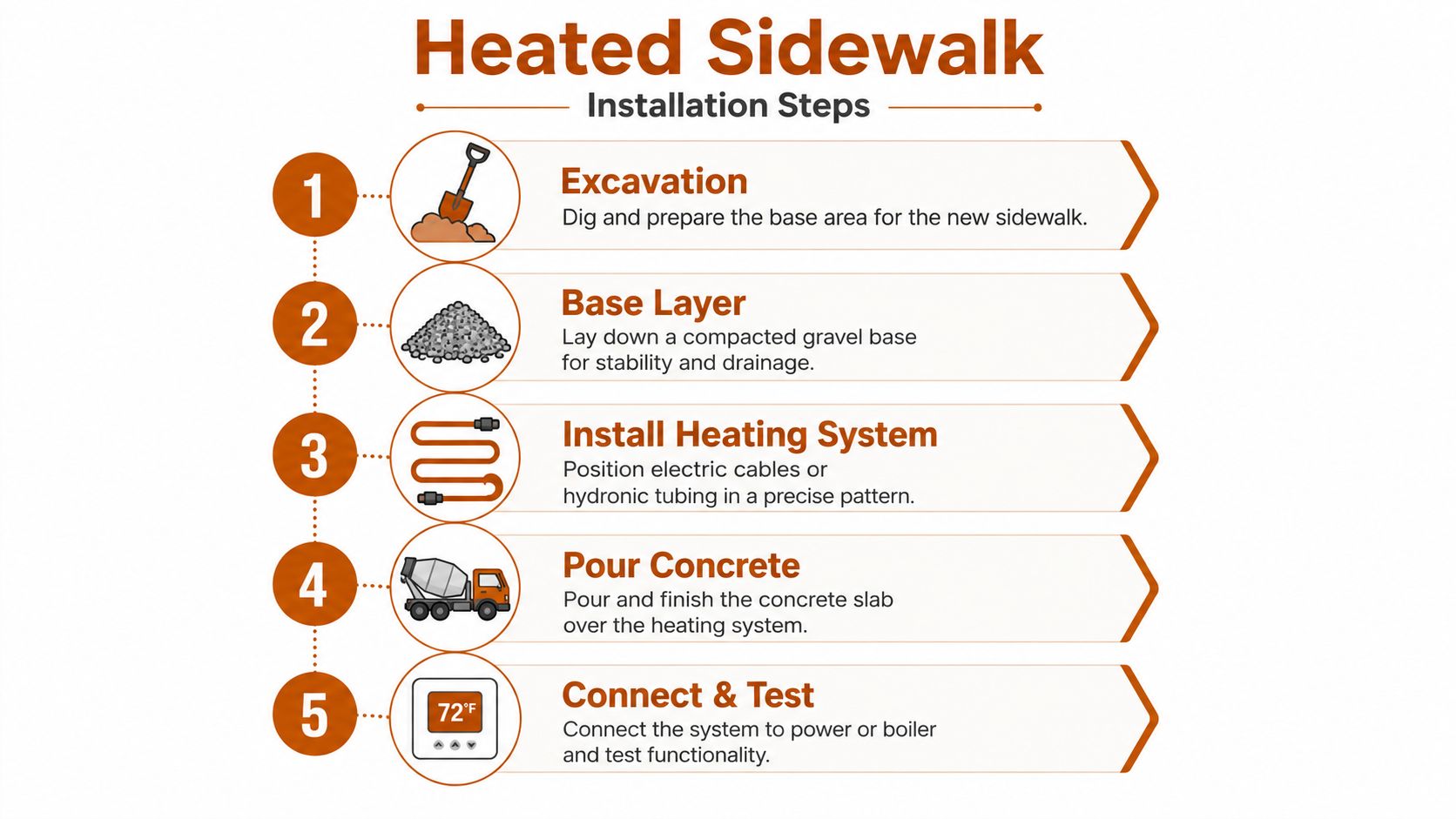
A heated sidewalk only performs as well as the slab beneath it. If the base is soft, uneven, or allowed to cure badly, the heating system can still end up underperforming or failing early.
1. Excavation and base preparation
The first job is to remove weak material and build a base that stays put. For that reason, the work starts below the slab, not with the heating cable. Good practice calls for compacted subgrade, a base that matches the use of the pavement, and a flat finish that keeps the concrete from bridging over soft spots. The underground utility location step belongs here too, because a heating layout should be checked against existing lines before anyone starts cutting or digging.
That preparation matters because a slab that shifts later can stress the embedded system. On a walk that needs to stay serviceable for an HOA, a medical office, or a commercial entry in Marion or Citrus County, the grading and compaction work is what protects the rest of the investment.
2. Heating system layout
The heating element has to be placed at the right depth and spacing. Manufacturer guidance for snow-melt cable calls for installation a few inches below the finished surface, with spacing set close enough to avoid cold strips but not so tight that the load and material cost climb without reason (tracertech.com).
That spacing decision matters more than people expect. Too wide, and parts of the sidewalk stay cold. Too tight, and the system does more work than the site needs, which is a poor trade in a mild-winter market like Central Florida.
3. Electrical or hydronic connection
Before the system gets buried, installers test the cable and confirm it is behaving the way it should. Technical guidance also calls for coordination with the site's electrical plan, and that means checking panel capacity, routing, and any nearby site work that could interfere with the install (rochestercp.com).
For a new slab, the heating system stays off until the concrete has cured enough to handle the load. That is one of those details that sounds small until a rushed startup causes a problem under finished concrete. On larger jobs, the utility coordination should be handled before the pour, especially if the site already has trenching, conduit, or other buried work in the area.
4. Concrete placement and cure
Concrete placement is where a lot of heating projects succeed or fail. The slab has to be placed cleanly, consolidated well, and protected while it cures so the embedded system stays where it belongs. A Federal Highway Administration report says concrete should not be allowed to become surface dry while transitioning from plastic to hardened states, and if moist curing is used, moisture should be maintained for at least 7 days (rosap.ntl.bts.gov).
That cure schedule helps control shrinkage and reduces the chance of cracking around the heating components. In practice, I treat this like any other precision concrete job, because it is one. A well-built base, a clean pour, and patient curing will do more for long-term performance than any thermostat setting after the fact.
Real Costs and ROI for Heated Sidewalks in Florida
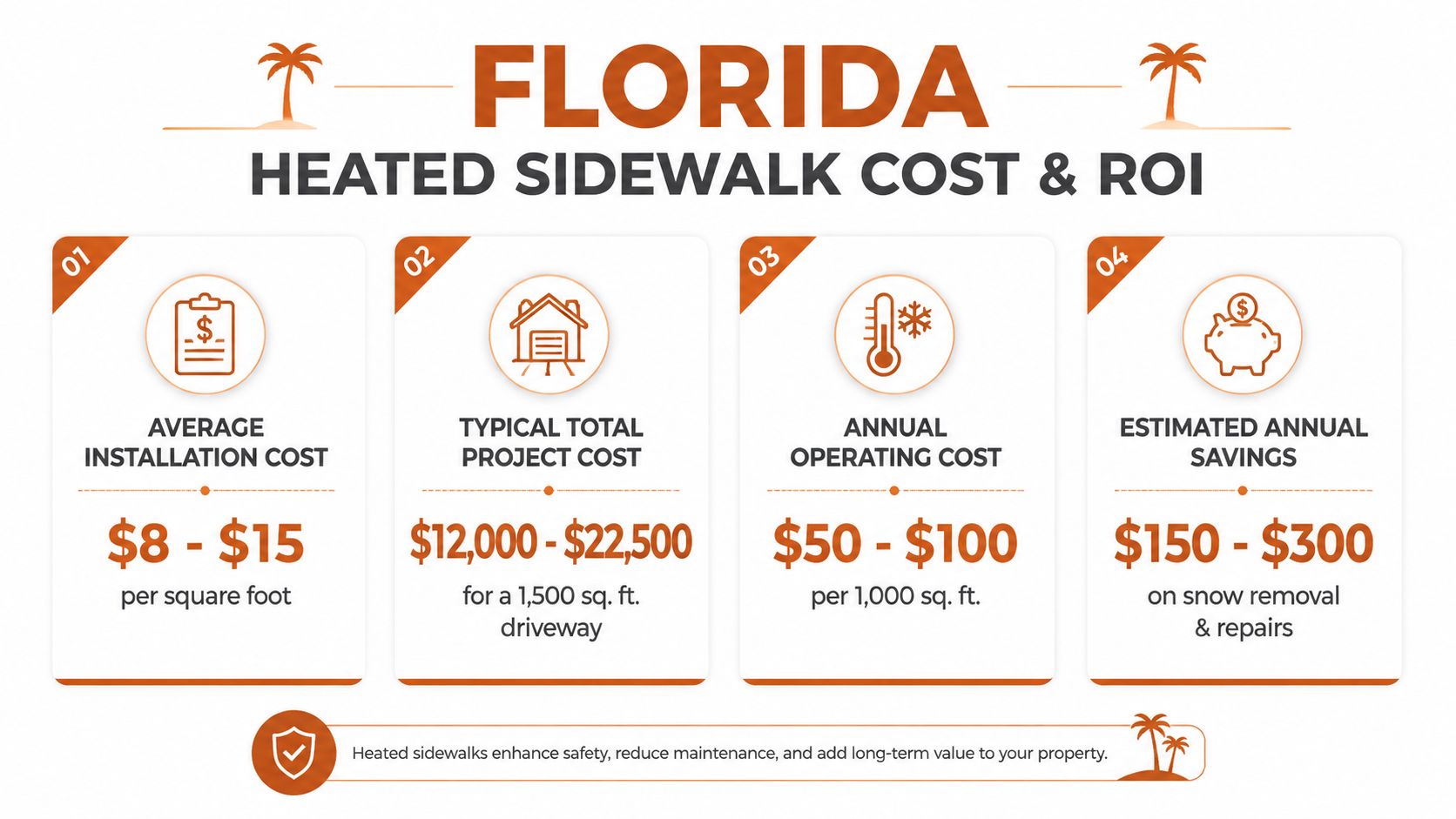
The money question is the right one. In Florida, a heated sidewalk is not about chasing snow removal savings, it is about whether the system pays for itself through fewer slip claims, fewer access complaints, and a safer entrance when a hard cold snap rolls through.
What the numbers suggest
Installed cost guides for heated walkway projects vary a lot, and that usually reflects the type of system, the slab work involved, and whether the sidewalk has to be removed and replaced. The broader cost range is useful as a planning check, but the real budget in Ocala, The Villages, or Inverness depends on site conditions, electrical access, and how much of the existing walk has to be rebuilt. For a plain sidewalk replacement baseline, this concrete sidewalk installation cost guide helps show what the slab work costs before any heat is added.
That context matters because most Florida projects are tied to other work. If the walk already needs replacement, the heating system is easier to justify than if you are cutting into a sound slab just to add heat. On a commercial entry or HOA common path, the added cost can make more sense when the project is already in the budget for safety, drainage, or accessibility reasons.
Operating costs are usually limited because the system should run only during weather events or other short-use periods. In a mild-winter market, that means the energy expense is tied to occasional use, not constant operation. The practical question is whether the system sees enough benefit in those few cold periods to offset the installed cost and the ongoing power use.
Where ROI actually comes from
The return in Central Florida is not built on snowplow savings. It comes from reducing slip exposure, lowering the need for temporary de-icing measures, and keeping entrances usable when the temperature drops enough to create wet, slick surfaces. On an HOA property, that can reduce complaints and help the board show a more careful approach to common-area safety. On a retail, medical, or office entrance, it can support easier access and a cleaner first impression.
In Marion County and Citrus County, that matters more than people expect. A bad fall can create a claim, disrupt a property manager's week, and bring attention to a walk that only had a problem for a short time. A heated sidewalk does not need to run often to have value if it prevents one incident at the wrong time.
A system can also help with appearance. A sidewalk that stays clear during a cold event looks maintained, which matters for communities that care about presentation as much as function. That is one reason some property owners compare the project against the cost of regular concrete work, then decide whether the heat is worth adding during the same slab replacement cycle.
Why Partner with a Local Concrete Expert for Your Project
A heated sidewalk is only as good as the concrete around it. That's why a contractor who understands both concrete construction and pavement maintenance is the right starting point, not an electrician working in isolation.
The hidden issues are usually under the slab. Base prep has to be right, the slab has to be thick enough for the application, and the finish has to support drainage so water doesn't sit where it can freeze or track indoors. The heating element also needs to be protected during the pour, which is why experience with placement, consolidation, and curing matters so much.
For a project in Marion County, FL or Citrus County, FL, local experience matters for another reason. A sidewalk in Ocala near heavy foot traffic doesn't need the same design as a residential path in Dunnellon, and a common-area route in The Villages may call for tighter attention to accessibility and schedule coordination. That kind of judgment comes from working on real slabs, not just reading product literature.
If you're vetting a contractor, the questions should be direct. Ask who handles excavation, who manages the concrete finish, how the system is tested before concealment, and how the crew handles curing around embedded heat. A good checklist is worth keeping handy, and this guide to questions to ask a concrete contractor is a practical place to start.
Riverside Sealing & Striping, LLC brings concrete and asphalt work together under one roof, which helps when a property needs sidewalks, approach areas, or adjacent pavement work planned as one job. The company is licensed and insured, works with reliable scheduling, and offers free, no-pressure on-site consultations for property owners who want a clear scope before moving ahead.
Frequently Asked Questions About Heated Sidewalks
Can a heated sidewalk be added to existing concrete?
Sometimes, but retrofits are usually harder than a new pour. The slab has to be evaluated for thickness, condition, and how the heating element would be embedded without creating a failure point. In many cases, replacement is the cleaner option if the concrete is already cracked, settled, or too thin for a reliable installation.
Do heated sidewalks need special maintenance?
The surface itself is still concrete, so normal cleanup and inspection matter most. The heating system should be checked for electrical or hydronic issues if performance changes, but the bigger maintenance risk is usually the slab, not the heat source. If the base moves or the concrete cracks badly, the embedded system can be affected too.
Are heated sidewalks worth it in Marion or Citrus County?
They can be, especially for higher-traffic entrances, HOA common areas, and commercial properties where one slippery morning can become a safety issue. In mild-winter parts of Central Florida, the payoff comes more from convenience, access, and liability reduction than from heavy snow management.
Do local projects need permitting or utility coordination?
That depends on the property, the scope, and how the electrical work is handled. A contractor should check the local requirements before any excavation starts and make sure the layout works with the slab design and utility location. Getting that right early saves headaches later.
What kind of properties are the best fit?
Homes with premium walkways, HOA entrances, churches, retail fronts, and professional offices are the most common fit. In places like Ocala, Belleview, Crystal River, Lecanto, or Hernando, the strongest use case is usually a walkway that gets a lot of foot traffic and needs to stay safe without constant manual service.
If you're weighing a heated sidewalk installation for a home, HOA, or commercial property in Marion County, FL or Citrus County, FL, Riverside Sealing & Striping, LLC can help you evaluate the concrete, the layout, and the practical fit for your site. Visit Riverside Sealing & Striping, LLC to request a free, no-pressure consultation and get a recommendation based on your walkway, not a generic sales pitch.