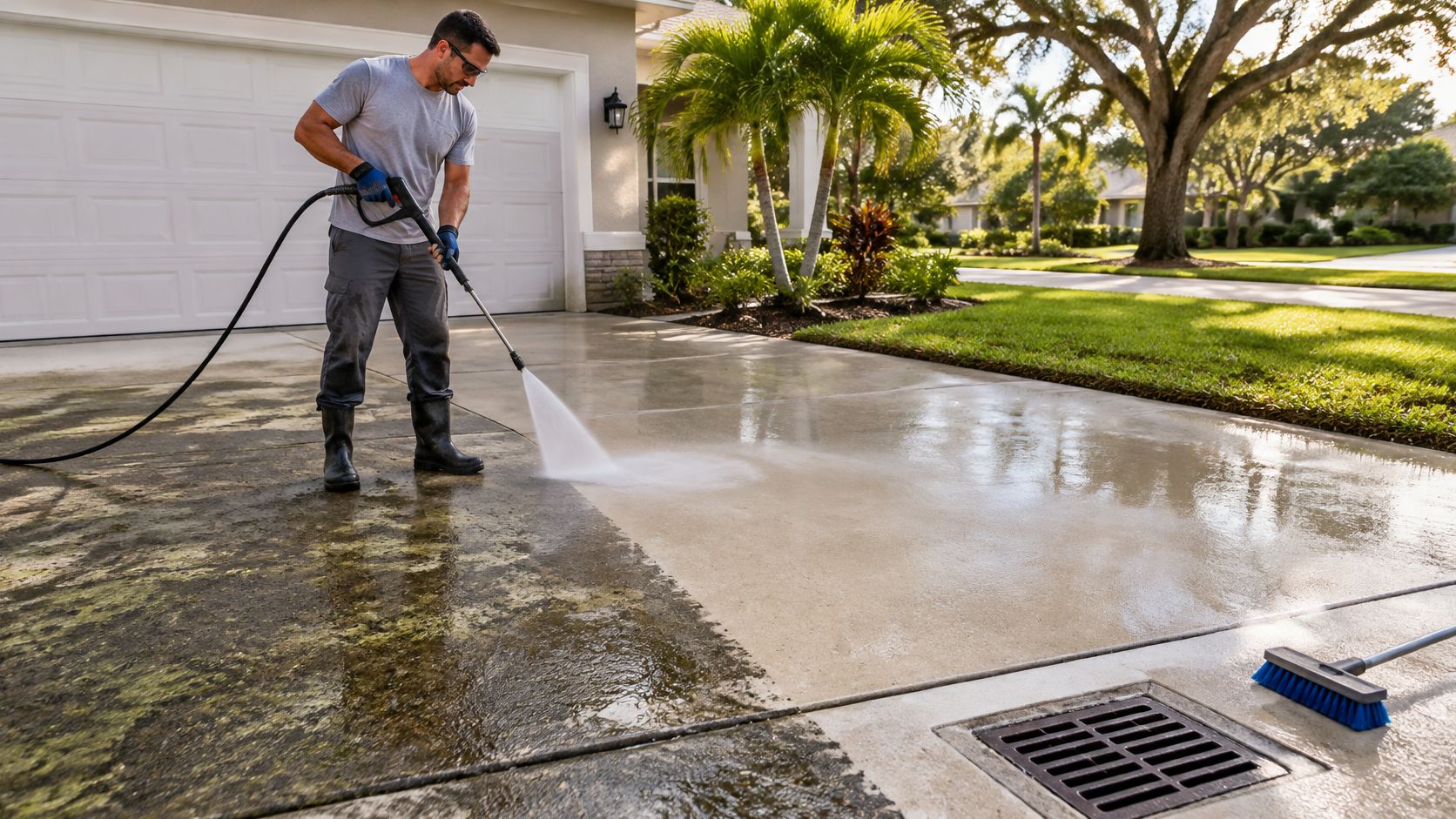
You've moved the car and found a dark oil patch, green growth along the shaded edge, and dirty streaks where the sprinklers hit the driveway. The pressure washer looks like the quickest fix, but spraying before checking the concrete and drainage can turn a cleaning job into permanent surface damage or contaminated runoff.
Learning how to clean a concrete driveway starts with choosing the mildest effective method and deciding where the dirty water will go. For homeowners in Marion County, FL, and Citrus County, FL, that means planning around Central Florida heat, sudden rain, oak debris, and the condition of the slab.
Table of Contents
- Choose Pressure Washing or Manual Scrubbing for Your Slab
- Runoff-Safe Steps for Cleaning Your Driveway
- Stain Removal for Oil, Mildew, Grease and Rust
- How Often to Clean and Seal a Driveway in Florida
- How Florida Heat, Rain and Traffic Affect Driveways
- Clean It Yourself or Call a Professional
- Frequently Asked Questions About Cleaning a Concrete Driveway
- Conclusion and Next Steps
Choose Pressure Washing or Manual Scrubbing for Your Slab
Central Florida driveways face intense sun, summer storms, and fallen leaves. Start with dry removal and gentle scrubbing. Pressure washing is a targeted tool for sound concrete, not the automatic first step.
Inspect the slab before renting equipment. Look for flaking, loose stones, worn sealer, and cracks with crumbling edges. Lightly draw a flat-head screwdriver across an inconspicuous spot without digging into it. If paste chips away or aggregate loosens easily, switch to brushing and have the deteriorated surface assessed.
Cleaning methods compared for residential concrete driveways
| Method | Best for | Typical setup | Main risk | Runoff load |
|---|---|---|---|---|
| Dry sweeping and vacuuming | Loose dirt, leaves, sand, grit | Stiff push broom or suitable shop vacuum | Airborne dust from aggressive sweeping | None |
| Manual scrubbing with brush and cleaner | Light grime, fresh stains, older or fragile slabs | Long-handled nylon brush, diluted concrete cleaner, controlled hose rinse | Slow on large areas | Low |
| Pressure washing with a broad fan tip | Heavy grime and organic buildup on sound concrete | Adjustable washer, broad fan nozzle, water-recovery equipment | Surface wear from close or stationary spraying | High |
| Pressure washing with a zero-degree tip | Not recommended for ordinary driveways | Concentrated pencil stream | Gouging, cut paste, permanent scarring | High |
Match the spray to the surface
There isn't a universal safe pressure setting for residential concrete. Pressure, flow, nozzle pattern, distance, and surface strength work together. A broad fan spreads the force; a concentrated stream can cut through the cement paste and expose the stones beneath.
The San Francisco Public Utilities Commission's pervious-concrete specification uses a controlled pressure-washing test to evaluate aggregate loss. That's a material acceptance procedure, not a homeowner cleaning setting.
Practical rule: If cleaning removes concrete instead of dirt, stop. More pressure won't correct a weak surface.
After dry preparation, make your first wet application a small test patch in a low-visibility corner. Keep the wand moving at a consistent distance, then let the patch dry. Check for wand lines, missing surface cream, altered texture, or lifting aggregate before continuing.
Runoff-Safe Steps for Cleaning Your Driveway
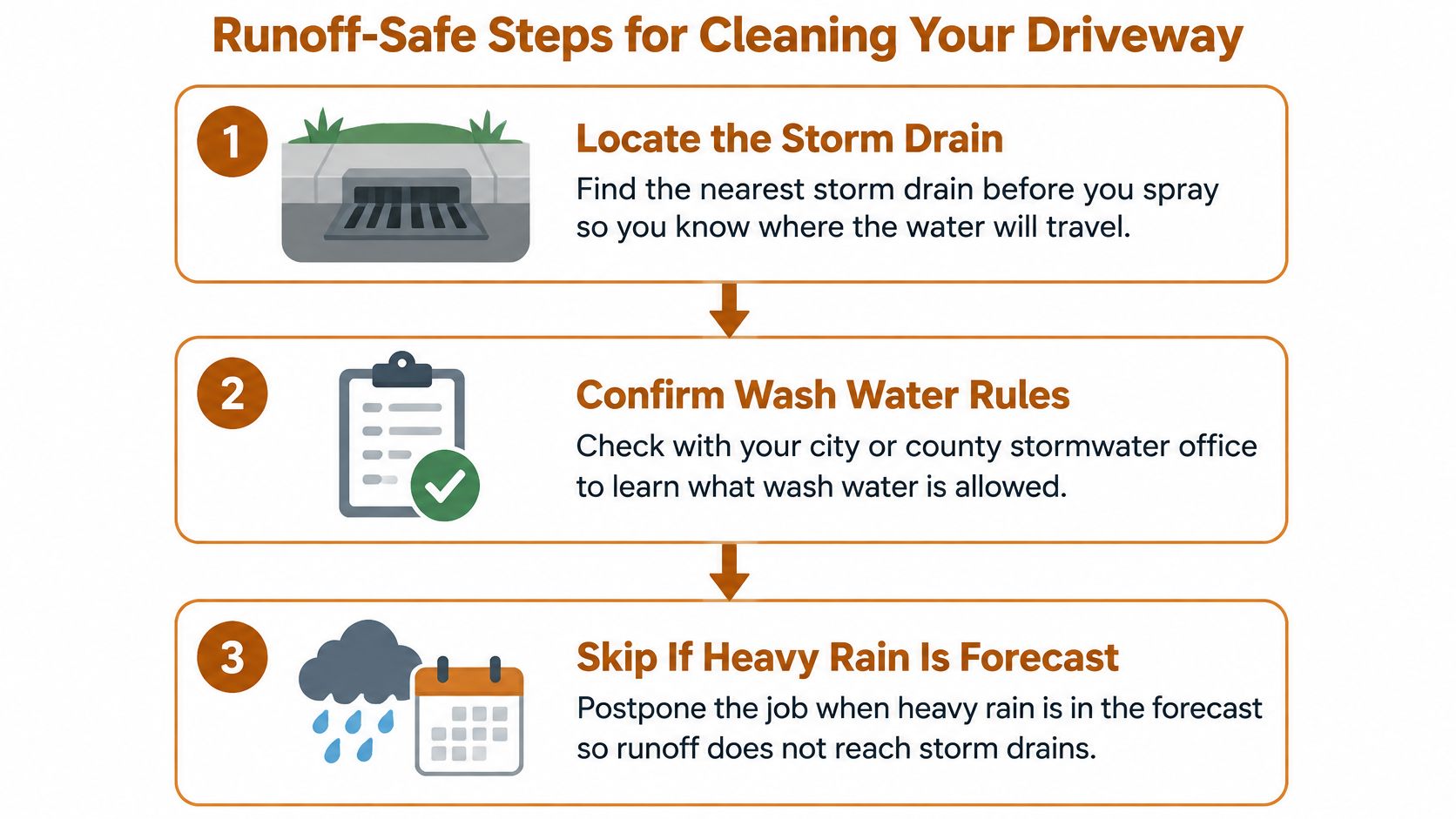
Locate the nearest storm drain before connecting the hose. Follow the driveway's slope toward the street, ditch, swale, or catch basin. Then ask your city or county stormwater office how contaminated wash water must be collected and disposed of.
Postpone cleaning when heavy rain is approaching, drains are already flowing, or you can't keep wash water on the work site. Fresh liquid oil needs dry cleanup before any washing. A drain mat alone isn't a disposal plan, especially if water can flow around it.
Use these checks before setting up the washing equipment.
Prepare containment before cleaning
Gather a stiff broom, nylon brush, bucket, pump sprayer, liquid-rated wet vacuum, drain mats or sandbags, rubber boots, gloves, and eye protection. Keep electrical connections away from standing water and follow the vacuum's instructions for liquid pickup.
The City of Austell's pavement-maintenance guidance prioritizes dry cleaning and containment rather than discharging polluted wash water into storm drainage. Separately, the EPA's pressure-washing guidance for lead-renovation work requires intact containment and proper wastewater disposal within that regulated scope. Its containment principle is useful, but those renovation requirements aren't a blanket rule for every residential driveway.
If the nearby inlet is blocked or damaged, arrange appropriate storm drain maintenance rather than washing debris toward it.
Follow a controlled cleaning sequence
- Sweep and vacuum first. Collect leaves, sand, loose grit, and soil. Don't turn removable debris into dirty slurry.
- Absorb fresh oil. Cover it with sand or cat litter, work the absorbent in with a stiff broom, and collect it in a sealable container for approved disposal.
- Set the barriers. Protect nearby drains and establish a recovery point. Leave room to collect water before it overtops the barriers.
- Work during cooler conditions. Pre-wet only when the cleaner calls for it. Avoid ponding, and don't apply cleaner to concrete so hot that it dries immediately.
- Test, then work in manageable sections. Use a concrete-compatible cleaner at its specified dilution. Treat only as much area as you can scrub and recover before it dries.
- Agitate the grime. Use a stiff nylon brush, working from the higher area toward the recovery point.
- Rinse deliberately. Use overlapping passes and a steady nozzle distance. Keep the spray away from damaged joints and crumbling edges.
- Recover the wastewater. Use the wet vacuum and containment barriers to keep it off the street. Stop washing when recovery can't keep pace.
- Inspect after drying. Check for remaining stains before deciding whether another targeted treatment is worthwhile.
Confirm the disposal route before filling a recovery tank. Sanitary-sewer disposal needs approval; hauling may be necessary for some waste. Don't assume a lawn, ditch, or gravel area is an acceptable substitute.
Biodegradable doesn't mean drain-safe. The Fairfax County pressure-washing guidance explains why detergent water and dislodged pollutants must stay out of storm drains. The disposal method matters more than the environmental wording on the bottle.
Stain Removal for Oil, Mildew, Grease and Rust
Oil behaves differently from ordinary dirt because concrete is porous. It can penetrate below the visible surface, where a quick rinse won't reach it. The National Park Service's oil-contamination guidance recommends the mildest effective cleaning method and warns that excessive pressure can remove concrete and leave permanent scarring.
Use the table after absorbing free oil, or when dealing with older marks. Keep each treatment separate, recover the rinse water, and never combine cleaning chemicals.
Driveway stain removal by stain type
| Stain | First step | Cleaning method | Avoid |
|---|---|---|---|
| Fresh oil or grease | Apply sand or cat litter promptly, then collect it | Stiff nylon brush and concrete-compatible degreasing detergent; minimal rinse water | Plain-water flushing, gasoline, mineral spirits |
| Old oil stain | Apply a concrete-rated oil-removal poultice as directed | Repeated detergent scrubbing; professional extraction for deep contamination | Solvent soaking or acid treatment |
| Mildew or algae | Pre-wet if the product requires it | Detergent scrub or concrete-compatible oxygen-based cleaner, followed by controlled rinsing | Mixing bleach with ammonia or acids; aggressive blasting |
| Rust | Remove the rusty object and identify the source | Concrete-formulated rust remover, tested first | Undiluted acid left sitting |
| Tire marks | Sweep away loose rubber and grit | Detergent scrub with a gentle fan-pattern rinse | Metal scraping tools |
| Efflorescence, white chalky deposits | Dry-brush loose deposits | Concrete-compatible efflorescence cleaner with its specified rinse or neutralization procedure | Improvised strong-acid treatments |
Know when another treatment won't help
Older oil stains may need repeated applications or a poultice left to work for the product's specified dwell period. Don't improvise a solvent poultice. Deep staining may remain even after the removable contamination is gone, and chasing a perfect color match with pressure can leave a permanent depression.
The University of South Florida Water Atlas concrete-cleaning guide recommends detergent suds, brushing, rinsing, drying, and repeating when necessary. It also warns against gasoline, alcohol, mineral spirits, kerosene, and muriatic acid, which can create hazards or damage concrete.
For persistent vehicle-fluid marks, a dedicated driveway oil stain removal assessment can help distinguish remaining contamination from permanent discoloration.
Judge a stain treatment only after the test area dries. Wet concrete can hide uneven cleaning and make residual marks look darker.
How Often to Clean and Seal a Driveway in Florida
A Federal Highway Administration pavement review documents twice-yearly cleaning for a specialized Danish textured-pavement program using water recovery and recycling. That's a maintenance reference, not a residential driveway standard.
For a home, schedule cleaning around visible buildup, drainage, traffic, and surface condition. A shaded driveway can collect organic growth despite receiving little vehicle use, while a sunny driveway may stay relatively clean but show sealer wear.
Cleaning and sealing intervals for Florida driveways
| Driveway condition | Cleaning frequency | Sealing interval |
|---|---|---|
| Lightly used, shaded | Inspect seasonally; gently clean when growth appears | Reassess when water absorption or finish condition changes |
| Average residential, sun-exposed | Plan seasonal inspections and clean accumulated grime | Follow the existing sealer's maintenance requirements |
| Under oak trees or beside irrigation | Remove debris promptly; spot-clean recurring deposits | Assess after correcting recurring staining sources |
| Heavy vehicles or frequent fluid drips | Respond immediately to spills; inspect regularly | Check traffic wear and compatibility before recoating |
| Porous or exposed-aggregate surface | Use gentle, surface-specific maintenance | Obtain a surface-specific assessment before sealing |
These are planning guidelines, not code requirements or manufacturer-approved service intervals. A sealer's chemistry and the existing finish matter more than a calendar alone.
Inspect before adding sealer
Where a compatible sealer previously caused water to bead, faster absorption or dark damp patches can indicate wear. Sand rubbing loose underfoot is different: it may signal surface deterioration, which needs assessment rather than another coating.
The correct order is clean, remove residue, allow complete drying, then seal with a compatible product. New concrete and repairs must also satisfy their curing requirements. Cleaning an established slab doesn't restart concrete curing.
A concrete driveway sealing evaluation should identify the existing treatment and moisture conditions first. Don't seal over oil, white mineral deposits, or loose concrete, and don't apply a conventional film-forming coating to permeable concrete without confirming that it preserves drainage.
How Florida Heat, Rain and Traffic Affect Driveways
Across Marion County and Citrus County, driveway maintenance needs to account for both weather exposure and how the property is used. A clean driveway should also drain properly, without recurring puddles or contaminated runoff.
Standing water deserves attention alongside surface appearance.

Heat and sunlight affect cleaning and coatings differently. Hot concrete dries cleaner prematurely, while UV exposure can weather susceptible sealers and fade colored finishes. On exposed driveways in Ocala, Dunnellon, Belleview, and Silver Springs, work during cooler conditions and inspect the finish rather than automatically recoating it.
Summer rain can move loose residue off the property quickly. In Crystal River, Homosassa, and Inverness, removing dry debris before a storm is more useful than hosing it toward roadside drainage.
Match maintenance to the visible symptom
- Brown leaf outlines: Remove wet oak leaves and pine debris before prolonged contact leaves staining.
- Green shaded edges: Lots in Summerfield, Lecanto, Beverly Hills, Hernando, and The Villages may need attention where vegetation and irrigation keep concrete damp.
- White or orange deposits: Check sprinkler overspray and mineral staining before repeatedly treating the surface.
- Oil, rubber, and damaged edges: Vehicle traffic adds contamination; heavy trucks and RVs also warrant checking slab support and load suitability.
Concrete and asphalt need different treatments. Asphalt maintenance addresses weathered binder and surface wear; concrete cleaning must preserve the cement paste and finish. Neither pressure washing nor sealcoating repairs structural failure.
For an additional visual reference, watch the driveway-cleaning video below.
Clean It Yourself or Call a Professional
DIY cleaning makes sense when the slab is sound, stains are limited, and you can capture the wastewater. A broom, nylon brush, and suitable cleaner can handle routine maintenance without exposing the driveway to unnecessary force.
Professional help becomes worthwhile when the task changes from removing dirt to diagnosing damage. A clean but crumbling driveway still needs repair, and a bright surface won't correct settlement or poor drainage.
Use the condition of the slab to decide
- Choose DIY for manageable grime: Small areas, recent stains, intact concrete, and a workable containment setup are reasonable starting conditions.
- Request cleaning expertise for difficult contamination: Saturated oil, unknown coatings, extensive growth, and limited wastewater access complicate the job.
- Request a concrete evaluation for physical damage: Spalling, scaling, loose aggregate, displaced cracks, or recurring ponding may require repair or replacement.
- Coordinate larger properties: HOAs and commercial sites need pedestrian protection, vehicle access, wastewater handling, and a clear reopening plan.
A contractor should explain what cleaning can improve and what it can't repair before recommending equipment or chemicals.
Look for licensed and insured professionals with local Central Florida experience, reliable scheduling, and a written scope. Ask whether fast turnaround includes adequate drying time rather than just a faster wash.
For mixed concrete-and-asphalt properties, coordinate concrete work, asphalt sealcoating, and parking lot striping without treating them as interchangeable services. A no-pressure evaluation should separate immediate safety concerns from cosmetic improvements and identify where preventive maintenance can support long-term savings.
Frequently Asked Questions About Cleaning a Concrete Driveway
Can I use bleach on my driveway?
Don't mix bleach with ammonia or acids. These combinations can release dangerous gases. For routine organic staining, choose a concrete-compatible oxygen-based cleaner where appropriate, protect surrounding plants, and capture the rinse water. Check compatibility with any existing sealer.
Is biodegradable soap safe for storm drains?
No. The EPA's washing best-management guidance recommends avoiding detergents where possible and preventing detergent discharge. Even an environmentally preferable product becomes part of contaminated wash water once it picks up oil, sediment, and other residue.
How do I know whether my slab can take a pressure washer?
Look for sound, firmly bonded concrete rather than flaky paste or loose stones. A gentle screwdriver check can reveal obvious weakness, but it doesn't guarantee pressure-washing suitability. If the surface sheds material, use scrubbing and seek an assessment; otherwise, evaluate a small dried test patch before proceeding.
Can I seal right after cleaning?
Not while the slab is wet or contaminated. Allow it to reach the sealer manufacturer's required moisture condition, and satisfy curing requirements for new concrete or repairs. Applying sealer too soon can cause adhesion problems or an uneven finish, while residual stains may become harder to address afterward.
Conclusion and Next Steps
The best way to clean a concrete driveway is to protect the slab while removing what doesn't belong on it. Start dry, establish containment, test the proposed treatment, and match the cleaner to the stain rather than increasing pressure until something gives.
In Ocala, Dunnellon, and across Marion County and Citrus County, responsible maintenance includes the street and drainage system beyond the driveway. Plan around weather, inspect the dried result, and choose sealing based on surface condition and product compatibility.
If the concrete is scaling, settling, or badly contaminated, get an evaluation before spending more time on cleaning. Knowing whether you need maintenance, repair, or replacement is more valuable than another aggressive wash.
Riverside Sealing & Striping, LLC offers concrete driveway evaluation, repair, replacement, and sealing, alongside asphalt sealcoating and parking lot striping. As Concrete and Asphalt Experts in Marion and Citrus County, the licensed and insured local team provides free estimates and no-pressure on-site consultations to help you choose an appropriate cleaning or repair approach before work begins.