
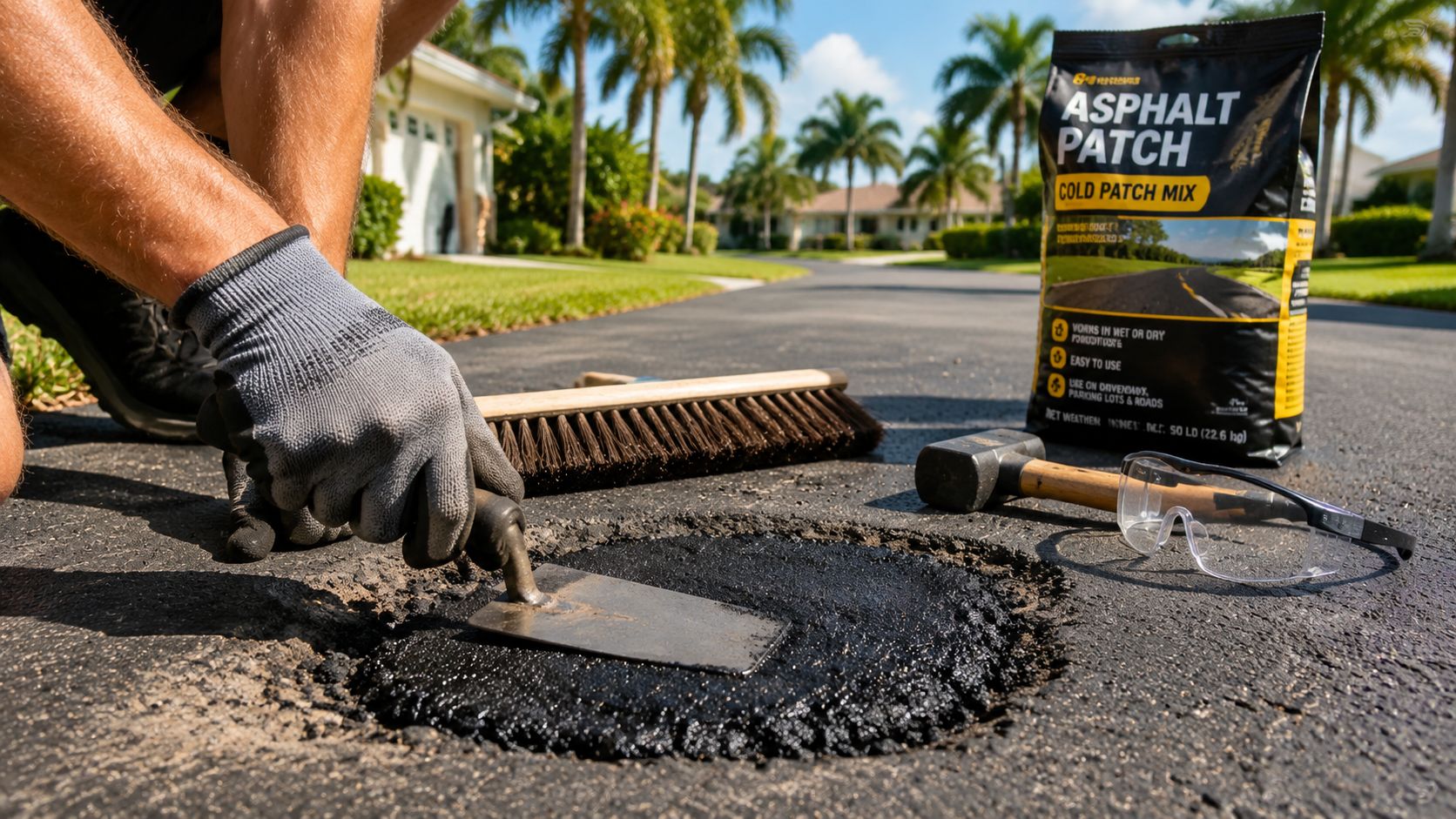
You walk out to the driveway after another hard Florida rain, and the same rough spot catches your eye again. Last month it looked like a crack. Now it's a pothole deep enough to hold water, chip a tire, and keep breaking wider every time someone rolls over it.
That's a common story in Marion County, FL and Citrus County, FL. A small failure in a driveway or parking area in Ocala, Dunnellon, Belleview, Summerfield, Crystal River, Homosassa, Inverness, Lecanto, Beverly Hills, Hernando, Silver Springs, or The Villages rarely stays small for long. Sun dries the asphalt out, rain gets under the surface, and traffic does the rest.
Knowing how to repair asphalt potholes the right way matters. For a minor, contained hole, a careful DIY patch can buy you time and restore a safer surface. But some potholes are really signs of a failed base, washed-out support, or broader pavement distress. In those cases, filling the hole is just hiding the problem for a short while.
Table of Contents
- That Small Pothole Is Only Getting Bigger
- Gathering Your Tools and Materials for the Job
- Your Step-by-Step Guide to a Lasting Asphalt Patch
- Why Florida Weather Is Your Pothole's Worst Enemy
- DIY Patch vs Professional Repair When to Call for Help
- Frequently Asked Questions About Pothole Repair
That Small Pothole Is Only Getting Bigger
A lot of potholes start the same way. Water gets into a crack, the edge weakens, a tire hits it, and one broken corner turns into a hole you feel every time you pull in. On a residential driveway in The Villages or behind a small shop in Ocala, that progression can move faster than most owners expect.
What makes people frustrated is that they already tried “fixing” it once. They dumped patch material into the hole, tamped it a little, and watched it loosen back up after the next storm. The patch didn't fail because asphalt repair is impossible. It failed because pothole repair is mostly about preparation, support, and compaction.
Practical rule: If you can still see loose edges, trapped moisture, or soft material under the hole, you're not ready to patch yet.
That's the difference between a repair that blends into the driveway and one that pops back out in the Florida heat. For property owners across Central Florida, the smart move is knowing which pothole is a realistic weekend fix and which one needs a contractor who handles both pavement and site conditions. That's where true Concrete and Asphalt Experts in Marion and Citrus County bring more value than someone who only looks at the surface.
Gathering Your Tools and Materials for the Job
Most failed DIY pothole repairs can be traced back to one problem. The person started with a bag of asphalt, but not with the tools needed to prep the hole correctly. If the material underneath is loose or the sides are ragged, the new patch won't lock in well.
For a standard driveway pothole in places like Belleview or Summerfield, keep the setup simple and purpose-driven.

What you need on site
- Square shovel for clearing out broken material and trimming the repair area.
- Stiff bristle broom to sweep out grit, dust, and loose aggregate.
- Cold chisel and hammer for cutting back weak asphalt at the edges.
- Hand tamper to compact each layer firmly.
- Cold patch asphalt for the fill itself.
- Safety glasses, gloves, and sturdy footwear to protect against sharp edges and flying debris.
Each tool has a job. The shovel and chisel aren't just for cleanup. They help create a repair area with straighter, firmer sides instead of crumbling edges that keep breaking away. The broom matters more than people think because dust and loose stone reduce bond.
Choosing materials without wasting money
Cold patch is the usual DIY choice because it's available locally and doesn't require paving equipment. For a small pothole, it's practical. For a larger failure, it can still work as a short-term measure if the base below is solid and the patch is compacted properly.
What you don't want to do is guess on depth, buy one bag, and then stop halfway through. Before you shop, clear the hole enough to see what you're dealing with. If you're trying to compare small DIY material decisions against a broader repair budget, this guide to asphalt patching cost helps frame when patching makes sense and when replacement or larger repair work starts to become the smarter spend.
Bring a tarp or sheet of plywood if you're staging tools on a finished driveway. It keeps patch material cleaner and prevents tracking loose asphalt around the property.
What many homeowners skip
Two items often get left out, and both affect how long the patch lasts:
- A way to dry the hole fully if there's trapped moisture.
- A bonding product or tack coat if the patching product instructions call for it.
That second point matters because a pothole patch needs to grab the existing pavement, not just sit inside it. If the product manufacturer recommends a primer or tack coat, follow that direction. The goal is not to fill a void. The goal is to create a compacted patch that acts like part of the pavement.
Your Step-by-Step Guide to a Lasting Asphalt Patch
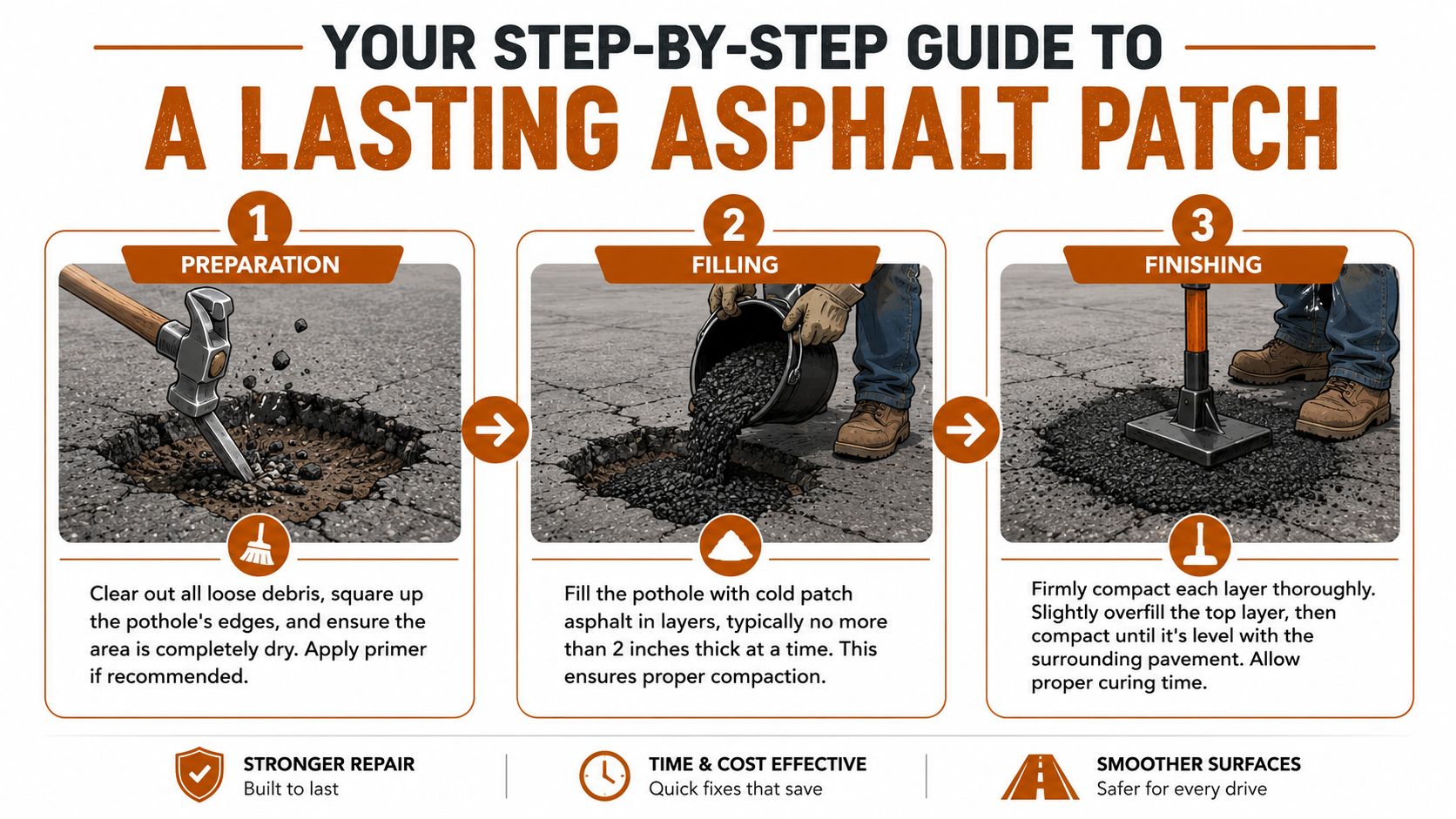
A pothole repair lasts or fails based on what happens before the first scoop goes in. Federal guidance is clear that crews should remove water and debris, square the patch area to vertical sides, apply tack coat to the sides and bottom, and compact the patch. It also says the finished repair should have a slight crown of 3 to 6 mm after compaction to help shed water, according to the FHWA pothole repair manual.
Use that as your standard, even on a driveway patch.
Start with the hole, not the bag of patch
Clean out everything loose. That includes stones, broken asphalt, dust, leaves, and standing water. If the pothole has soft edges, chip them back until you reach firmer pavement.
The reason for this step is simple. New patch material can't hold together if it's sitting against crumbling asphalt or over damp debris. A neat repair area with straighter sides gives the patch something solid to bear against under traffic.
A good prep sequence looks like this:
- Remove water first with a shovel, broom, or absorbent material.
- Cut back weak edges so the hole isn't feathered and ragged.
- Sweep the bottom and sides clean until loose particles are gone.
- Apply tack coat if your product or repair method calls for it.
If the hole keeps weeping moisture from below, stop there. That's often a clue the support underneath is still wet or compromised.
Here's a visual walkthrough of the process in action:
Build the patch in controlled lifts
A common mistake is filling the whole hole at once. That leaves the lower material loose while the top looks finished. For deeper repairs, staged placement works better.
Professional guidance for deeper repairs recommends placing material in about 2-inch lifts and compacting each lift before the next. Guidance also notes that deep patches should be built in two lifts if the repair exceeds 6 inches in thickness, and compaction of each lift is essential, as described in this Sakrete asphalt repair guide.
That matters in plain terms. If a pothole is deep, don't dump and tamp once. Rebuild it in layers so the patch has density all the way through, not just on top.
A practical approach:
| Repair condition | What to do |
|---|---|
| Shallow pothole | Fill and compact carefully, then check final height |
| Moderate depth | Add patch in lifts and tamp each one thoroughly |
| Deep failure | Rebuild in staged lifts and inspect for base problems before continuing |
Compact for density, bond, and drainage
Compaction is where many driveway patches are won or lost. Push down hard with the tamper. Work the edges first, then the center. Add material if compaction drops the level too far below the surrounding pavement.
You want the final patch slightly proud before final compaction so it finishes flush or just above the surrounding pavement. That small crown helps water move off the repair instead of sitting on it.
A pothole isn't repaired when it's full. It's repaired when the patch is dense, bonded, and shaped to shed water.
If the patch sits low, it becomes a bowl. In Florida, bowls collect water, and water starts the next failure cycle. If the patch sits too high, traffic can scuff it loose. The target is a firm, well-compacted surface that blends with the existing asphalt and doesn't trap runoff at the joint.
Why Florida Weather Is Your Pothole's Worst Enemy
Generic repair advice often treats weather like a side note. In Central Florida, weather is half the job. The same patch method that survives in a mild, dry spell can fall apart quickly in Ocala, Crystal River, or Homosassa if the repair goes in over moisture or during a bad weather window.

Heat hardens the lesson fast
Florida sun is hard on asphalt. Extended heat dries the surface, makes older pavement less forgiving, and exposes weak repairs fast. A patch that wasn't compacted well may look acceptable at first, then loosen under repeated traffic because the edges never bonded tightly.
That's why the timing of the repair matters. Guidance for durable pothole repair continues to emphasize that the hole must be free of water and debris, and that moisture exclusion and compaction quality are decisive factors for a patch that lasts, as outlined in this discussion of weather and pothole repair timing.
A patch installed under poor conditions can look fine on day one. Then a week of heat and rain tells the truth.
Rain exposes every shortcut
Heavy summer rain across Marion County, FL and Citrus County, FL is what separates a cosmetic patch from a durable one. Water finds every open joint, every low spot, and every soft edge. If the hole wasn't dry or the patch wasn't tight to the sides, water slips in and starts breaking support away underneath.
That's why I tell property owners from Inverness to Silver Springs to judge the repair window as much as the repair method. If the hole is damp, if rain is coming, or if water keeps returning to the same spot, waiting for a better window often saves effort.
For ongoing care after the patch, routine surface protection matters too. This guide on how to maintain an asphalt driveway is useful for homeowners trying to slow down the next round of cracking and moisture intrusion.
Don't patch just because you have time on Saturday. Patch when the hole is dry, the surface is stable, and the weather gives the repair a fair chance.
DIY Patch vs Professional Repair When to Call for Help
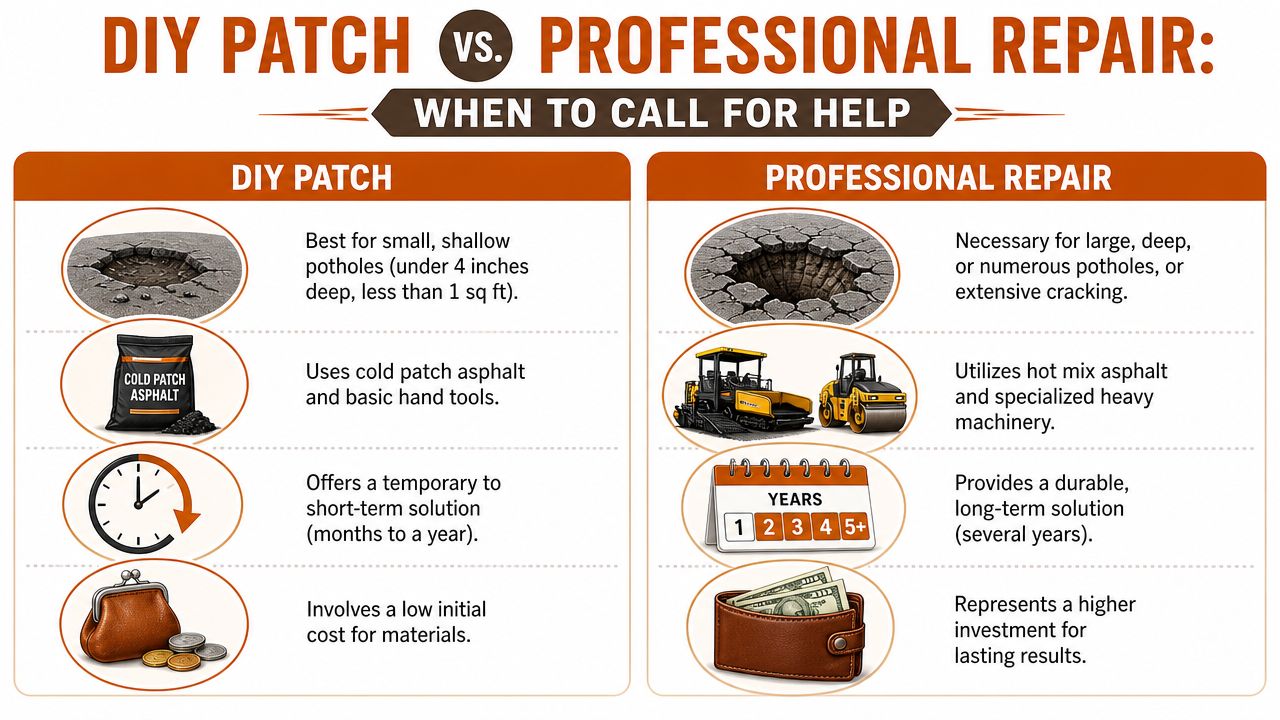
Some potholes are fair DIY work. Others are warnings. The hard part for most owners isn't learning how to place cold patch. It's recognizing when the hole points to deeper pavement failure.
When a DIY repair makes sense
A homeowner patch is reasonable when the problem is isolated and the surrounding pavement is still sound. Think one pothole in an otherwise stable driveway in Beverly Hills or a small low spot near a garage apron in Hernando.
DIY usually makes sense when:
- The hole is contained and the surrounding asphalt isn't heavily cracked.
- The edges can be cut back to solid pavement without the repair area spreading far wider.
- The base feels firm and doesn't pump water or feel spongy underfoot.
- You can work in dry conditions and take the time to compact properly.
In that situation, a cold patch can be a practical maintenance move. It may not be the same as a full hot asphalt repair, but it can restore function and buy time if the structure below is still intact.
When the pothole is telling you something bigger
The warning signs are usually visible if you slow down and look beyond the hole itself. If the asphalt around it is cracked like reptile skin, if the repair area keeps spreading, or if the hole feels soft below the surface, the issue often sits under the top layer.
Professional guidance is direct here. For deep patches exceeding 6 inches, the repair should be built in compacted 2-inch lifts. A 10-inch-deep failure should not be filled in one pass, and if the base is unstable, the patch may fail even when the top is compacted well, according to this overview of deep asphalt pothole repair practice.
That's where professional repair changes the outcome. A contractor can cut back to sound pavement, rebuild the failed section properly, and address support issues instead of burying them.
Use this quick decision guide:
| Sign you see | What it usually means |
|---|---|
| One small hole, firm surroundings | DIY patch may be worth doing |
| Repeated failure in the same spot | Water intrusion or weak base is likely |
| Soft, sunken, or pumping area | Base support needs attention |
| Broad cracking around the pothole | Surface patch alone probably won't last |
This is also where being a full-service contractor matters. On many Central Florida properties, asphalt distress connects to drainage, edge breakdown, or adjacent hardscape movement. Concrete and Asphalt Experts in Marion and Citrus County can look at the whole area, not just the hole. That matters on mixed-surface properties in Dunnellon, Lecanto, and Summerfield where a driveway, sidewalk edge, or parking area all influence how water moves.
Riverside Sealing & Striping, LLC is one local option for that kind of evaluation. The company handles asphalt maintenance along with concrete work, which is useful when a pothole sits next to failing aprons, sidewalks, or other site features that affect the repair.
Frequently Asked Questions About Pothole Repair
Can I repair a pothole myself?
Yes, if it's a small, isolated pothole and the surrounding asphalt is stable. The key is doing the prep work often rushed through. Clean the hole, remove weak edges, make sure it's dry, place the material in sensible lifts if depth requires it, and compact thoroughly.
Why did my last pothole patch fail so fast?
Usually for one of four reasons: the hole was still damp, the edges were loose, the patch wasn't compacted enough, or the base underneath was already failing. In Florida, moisture and poor compaction show up quickly.
If you patch over a bad foundation, the patch is only renting that spot for a while.
Should the patch sit flush with the driveway?
It should finish tight and even with the surrounding pavement, with a slight crown rather than a dip. A low patch collects water. Water is what starts the next failure.
Can I patch a deep pothole with one full bag at once?
That's not the right approach for a deeper failure. Deep repairs need staged filling and compaction so the bottom of the patch isn't left loose under a thin crust. If the hole is especially deep or the support below looks washed out, it's time to have it evaluated.
When should I skip DIY and call a professional?
Call for help when the pothole keeps returning, the area around it is broadly cracked, the pavement feels soft, or the repair area is tied to drainage trouble. That applies to residential driveways and commercial lots alike in Marion County, FL and Citrus County, FL. If you own a home in Ocala or Crystal River, or manage property in Inverness or The Villages, it's usually cheaper in the long run to fix the underlying issue once than to keep buying patch.
If you're dealing with a pothole that keeps coming back, or you want an honest opinion on whether it's a DIY fix or a larger pavement issue, Riverside Sealing & Striping, LLC offers free, no-pressure consultations across Central Florida. As Concrete and Asphalt Experts in Marion and Citrus County, the team handles both asphalt maintenance and concrete work, which helps when the underlying problem goes beyond the surface patch.