
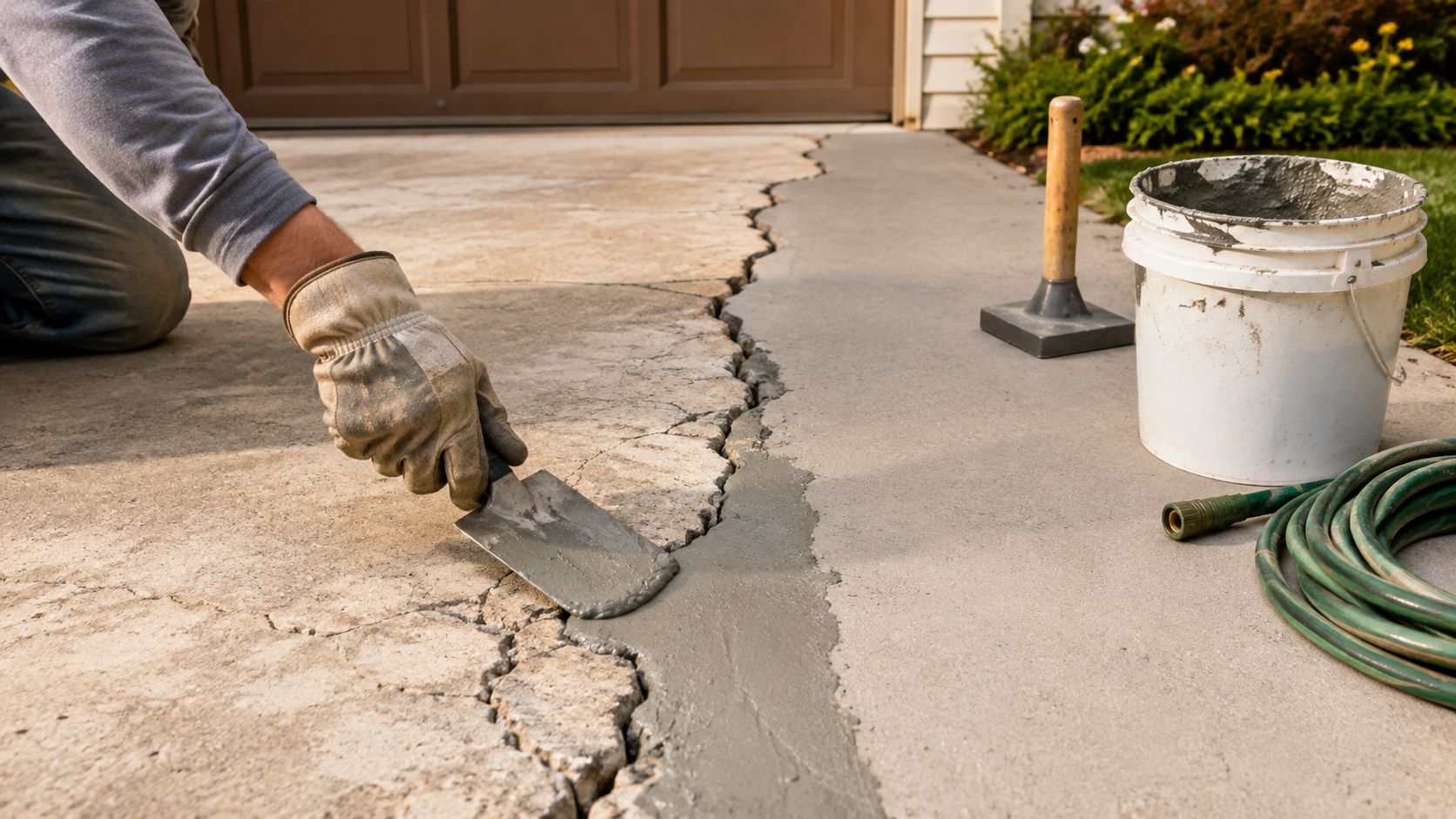
You're probably looking at a crack, a soft edge, or a pothole and thinking the fix should be simple. In Marion County, FL, and Citrus County, FL, that's usually how the trouble starts, a summer storm pushes water into a weak spot, the sun bakes it, and the next thing you know the same driveway in Ocala, Dunnellon, Belleview, or Inverness is breaking apart faster than it should. How to repair driveway damage the right way starts with the cause, not the patch.
For homeowners in Central Florida, the wrong repair wastes time and money. A driveway can look like it needs filler when the underlying problem is drainage, a tired base, or settlement near a downspout, and that's why some patches peel out, sink again, or crack right beside the old repair. When you diagnose first, you make a Saturday fix that has a chance of holding up through heat, rain, and traffic from places like The Villages, Crystal River, Homosassa, Lecanto, Beverly Hills, Hernando, Silver Springs, Summerfield, and nearby neighborhoods.
Table of Contents
- Why Your Driveway Failed Before You Even Grab the Filler
- Diagnosing the Damage in Four Practical Steps
- Repairing Concrete Cracks, Spalling, and Small Potholes
- Patching Asphalt Cracks and Potholes the Right Way
- Concrete Versus Asphalt Repair Cost and Time Compared
- How Central Florida Weather Shortens Driveway Life
- When to Stop Patching and Call a Professional
- Frequently Asked Questions
Why Your Driveway Failed Before You Even Grab the Filler
A homeowner in Ocala notices a hairline crack after a hard rain, buys filler, and seals it over the weekend. A few months later, the same spot opens again, and the edge near the garage starts sinking. That's a common pattern, because the visible crack is often the last symptom, not the first cause.
Surface damage isn't the same as base failure
Surface damage is the easy part. A narrow crack, small spall, or isolated pothole can often be repaired cleanly when the slab underneath is still stable, which is why crack filling and patching exist at all. But if the driveway is moving, holding water, or hollow underneath, the patch is just dressing a larger problem.
Practical rule: If the crack keeps returning in the same place after rain, start looking at grading and drainage before you buy more patch material.
There are really three failure types to sort through. Surface failure is limited to the top layer, structural failure means the concrete or asphalt itself has broken down, and subgrade failure means the soil or base underneath has shifted or washed out. The last one is the one that usually fools homeowners, because the top still looks patchable even though the support below isn't there anymore.
A quick reference point helps. The average single driveway is about 220 square feet (Angi), so even a small repair can materially affect the total budget. That's why diagnosis comes before material shopping.
What to look for before you spend a dollar
If the driveway has a soft edge near a downspout, pooled water after storms, or a slab that sounds hollow when tapped, the problem may be below the surface. In that case, a filler-only approach can fail fast. A cleaner fix might involve lifting, rebuilding edges, or correcting the drainage path first, not just smearing patch over the top.
The same caution applies to uneven sections and crumbling corners. Independent repair guidance points out that poor grading, clogged drainage, and voids under the slab often drive repeated damage, especially in wet climates like Central Florida, where afternoon storms show weaknesses quickly. For a broader look at crack causes, this driveway cracking guide is a useful local reference.
Diagnosing the Damage in Four Practical Steps
Start with a slow walk, not a bucket of patch. Bring a screwdriver, a flashlight, and a garden hose, then look at the driveway like you're checking a roof leak, because the point is to find where water goes and what the slab is doing under load.
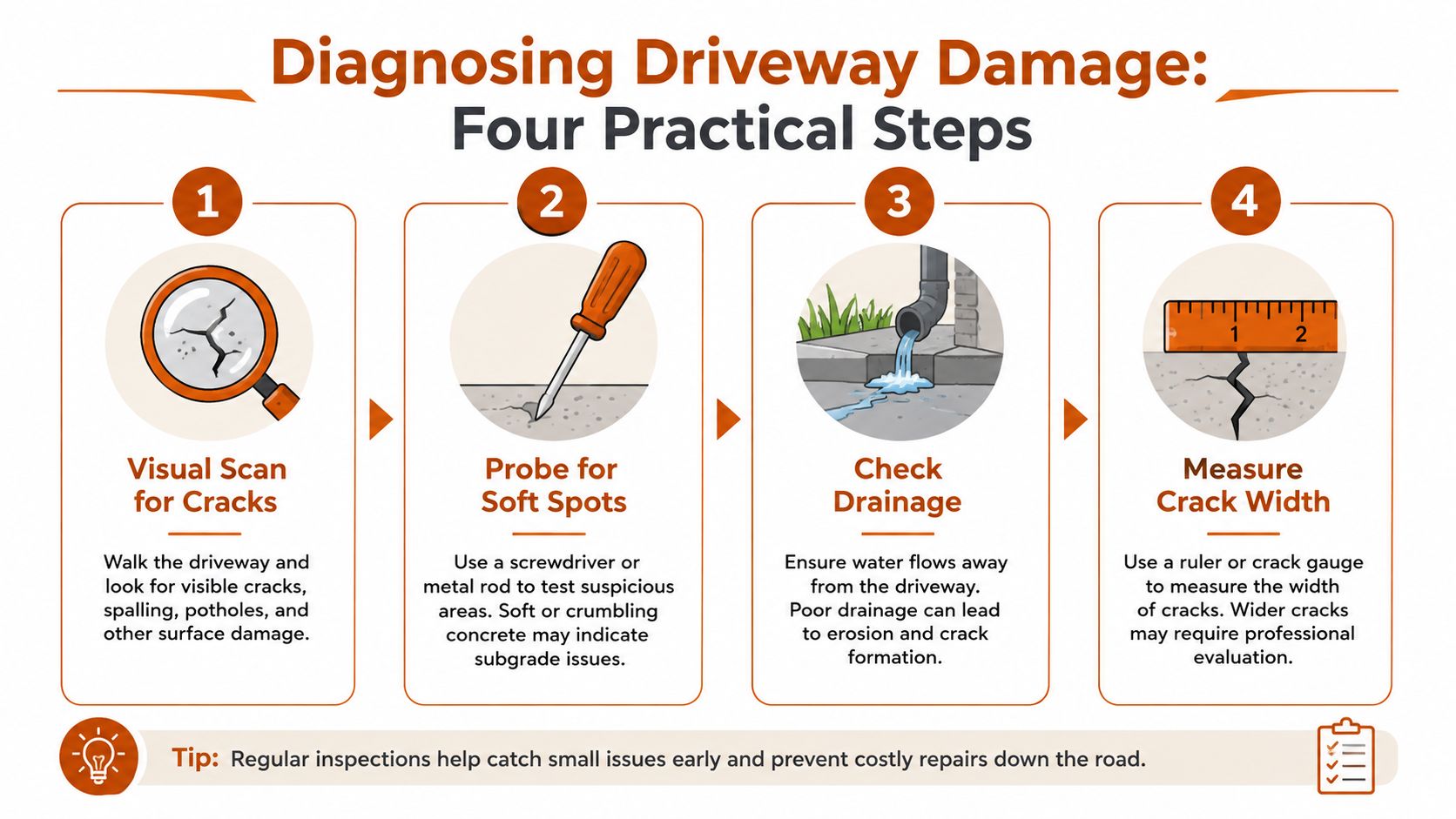
Step 1, measure the crack and the edge
Look at width, length, and whether the crack is straight or branching. Narrow cracks under about a quarter inch are usually a different problem from broken corners or long, widening seams, and that distinction matters when you choose a repair method. Write down where each crack starts and stops, because that tells you if one area is moving or the whole slab is.
Step 2, probe for soft spots and hollow sounds
Press the screwdriver near the edge and tap the surface lightly. A firm slab feels solid, while a hollow or soft section can signal delamination or a void underneath. Photograph anything that flexes, flakes, or crumbles, since those clues help a contractor tell the difference between patchable damage and support failure.
Step 3, check where the water goes
Run the garden hose and watch whether water leaves the slab or sits against it. If water is running back toward the garage, or if it collects near a crack, the driveway's slope or drainage may be wrong. That's the kind of detail homeowners in Dunnellon, Crystal River, and Summerfield often overlook until the same spot fails again after the next storm.
Step 4, note settlement near structures and drains
Look closely beside downspouts, expansion joints, and the street edge. Settlement there often means the base has washed out or the soil has loosened, which changes the repair from a surface job to a support problem. If you see dropped corners, stepping at the joints, or a gap under the slab, record it before you buy material.
A written inspection is more useful than a guess. Once you know whether you're dealing with a shallow surface defect or a moving base, the repair choice gets much clearer.
Repairing Concrete Cracks, Spalling, and Small Potholes
Concrete repairs go better when the damaged material is removed back to sound edges first. Loose flakes, crumbling corners, and dusty surfaces keep patch products from bonding, so the prep work matters just as much as the filler.
Hairline cracks and narrow openings
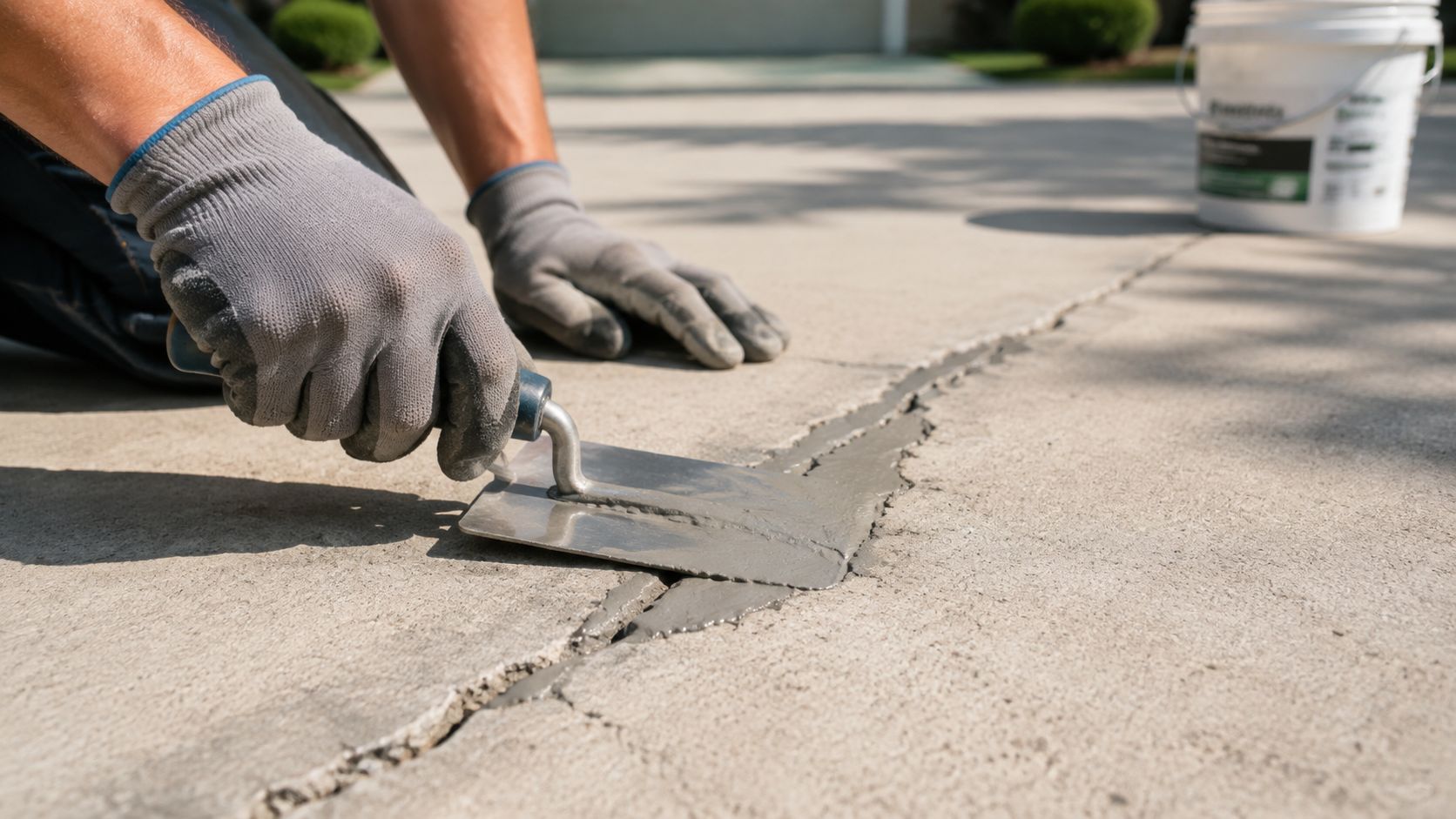
For small cracks, widen the opening to at least 1/4 inch before patching, because that gives the repair material enough surface area to bond properly. This is often called keying, and the crack should be cleaned with compressed air after brushing out the dust. For hairline defects, a repair mix may use one part Portland cement, two parts sand, and three parts gravel (RFMA PDF), which gives a practical blend for filling small voids before finishing and sealing.
For deeper cracks, undercutting helps the patch lock in mechanically. Insert a foam backer rod where needed so the sealant doesn't stick to three sides, then slightly overfill the joint and smooth it flush once the product sets. That detail keeps the repair from tearing loose as the slab expands and contracts.
Spalling and small potholes
Surface flaking needs a different touch. Remove all loose or crumbling concrete with a wire brush, then wash the area with a pressure washer and let it dry. A bonding agent helps the new material grab onto the old slab, and a rapid-set patch can be forced deep into the void to eliminate air pockets.
A damp broom finish is worth the extra minute. It restores slip resistance and helps the repaired area blend with the rest of the slab.
For larger defects and broken edges, cut a clean boundary with a diamond-blade saw so the patch has straight sides instead of ragged break lines. Expert repair guidance also recommends sealing only after the repair has fully cured, since sealing too early can trap moisture and weaken adhesion. If the damage is concentrated at an edge or corner, this crumbling-edge repair guide gives a good sense of when rebuilding the section is smarter than cosmetic patching.
Patching Asphalt Cracks and Potholes the Right Way
Asphalt moves differently from concrete, so the repair has to fit the material. In Central Florida heat, the surface softens a bit, then shifts again when rain gets into a weak spot. A patch that is too loose, too thin, or poorly compacted usually fails by wrinkling, separating, or popping out.
Start by sweeping the area clean, pressure-washing if the crack or pothole is packed with dirt, and pulling any weeds that have rooted in the break. Dust, loose stone, and plant roots keep the new material from bonding. Then fill the crack a little high, since asphalt filler settles as it cures.
Why compaction decides whether the patch lasts
A pothole patch has to tie into the damaged area, not just sit in the hole. Cut or square up the edges where needed so the patch can grip mechanically, then pack the material hard with a tamper or roller. Weak compaction is one of the fastest ways to see the same pothole again, because traffic works loose material apart and opens the repair back up.
The order of the cleanup and packing matters more than speed. A patch can look finished on top and still fail if the bottom is soft or the edge profile is sloppy. That is why the repair depends on the prep underneath the patch, not just the last pass over the surface.
Sealcoat timing after the patch
Sealcoat only after the patch is clean, dry, and cured. Give it a dry window before traffic returns, and if rain moves in before the patch has set, wait. For homeowners who want a clear step-by-step look at the process, this asphalt pothole repair guide is a useful companion.
If you plan to seal the driveway afterward, let the repaired spot fully cure first. Sealing too soon can trap moisture and weaken the bond at the edges. That extra patience usually pays off in a patch that holds together through summer heat and afternoon storms.
Concrete Versus Asphalt Repair Cost and Time Compared
A driveway repair call usually comes down to three questions, what failed, what the surface is made of, and whether the base still holds. If the ground under the patch is sound, repair is usually the smarter spend. If the slab or pavement has settled, crumbled, or lost support, the material choice matters less than fixing the cause first.
For homeowners in Marion County, FL, Citrus County, FL, and nearby places like Dunnellon or Crystal River, the better repair is the one that matches the failure, not just the one that looks cheapest on paper.
| Repair Type | Typical Cost | Time to Complete | Best For |
|---|---|---|---|
| Concrete crack filling | $0.50 to $3 per linear foot (Angi) | A few hours, plus cure time | Narrow cracks and small surface defects |
| Concrete resurfacing | $3 to $5 per square foot | Usually a full workday, then curing | Sound slabs with worn surfaces |
| Pothole repair | $100 to $400 | Often a same-day job | Isolated holes and broken spots |
| Slab raising or leveling | $3 to $25 per square foot | Depends on access and lift method | Sunken sections with a stable slab |
| Damaged slab replacement | $6 to $14 per square foot | Longer tear-out and rebuild process | Sections that can't be saved |
| Average concrete driveway repair | $830 to $2,837, average around $1,811 | Usually far less than replacement | General repair planning |
| Average concrete driveway replacement | About $6,400 | Longer than repair | Driveways past the repair stage |
The fundamental split is between repair and replacement. This driveway cost breakdown shows the same basic pattern for homeowners comparing materials, repair costs less up front, while replacement carries the heavier labor and disposal work. Once a driveway has enough structural damage, patching only buys time.
Asphalt repair is usually handled differently. Small repair jobs often run $1,200 to $2,000 and are commonly finished in 2 to 4 hours for standard work (FinModelslab). If the damage stays local and the base is still firm, patching makes sense before the weak spot spreads.
The practical choice is simple. Concrete often gives you a wider range of repair options, from crack filling to slab lifting, while asphalt usually rewards fast patching before the broken area grows. Either way, a driveway with good support under it is worth repairing. A driveway with a failed base needs more than surface work, no matter which material you start with.
How Central Florida Weather Shortens Driveway Life
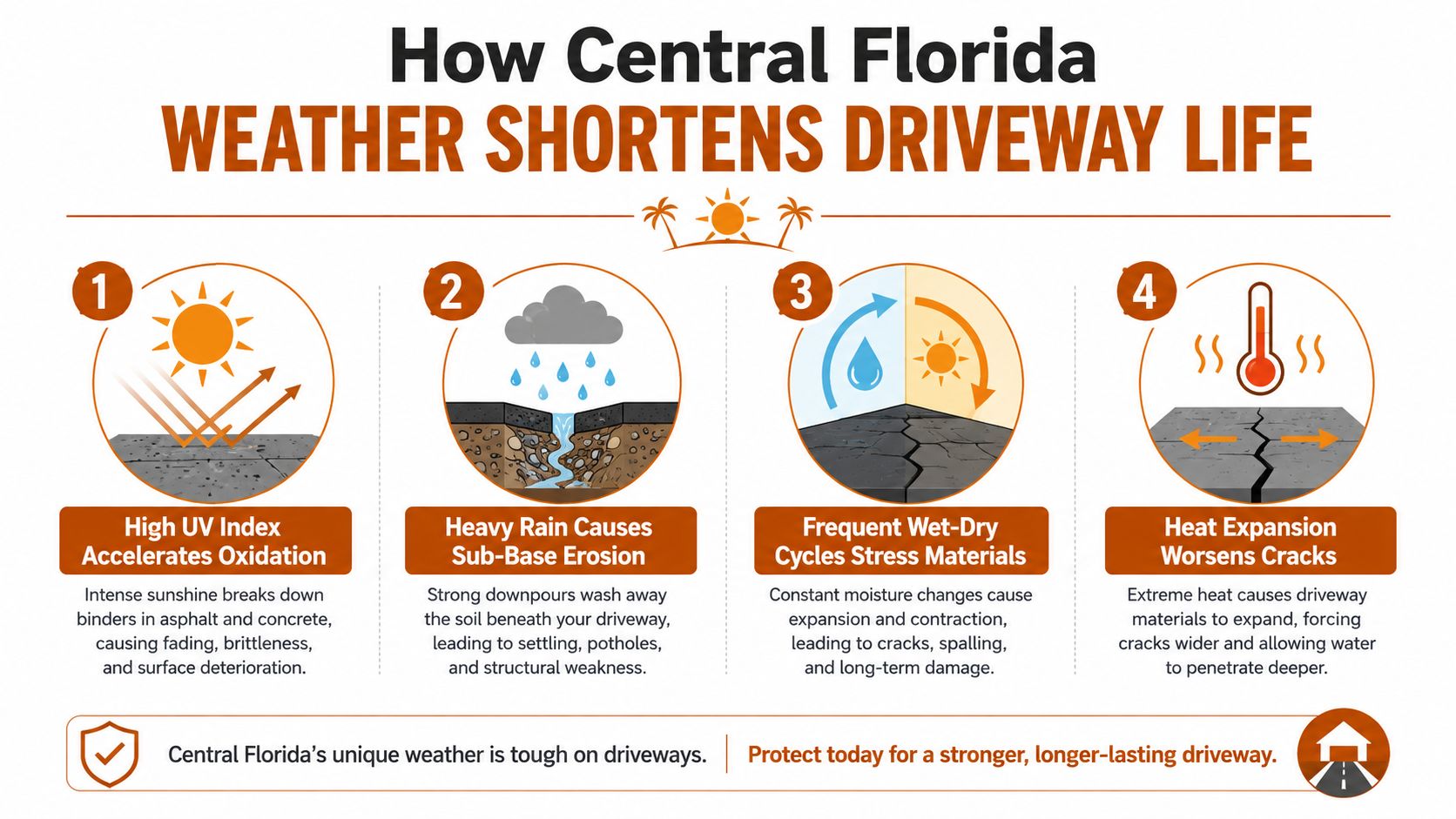
Central Florida is hard on driveways because heat, rain, and ground conditions attack the surface from different angles. In Marion County, FL and Citrus County, FL, the same driveway can face intense UV, quick wet-dry swings, and sudden downpours that push water into weak seams before they're sealed.
Sun, rain, and sandy soils all matter
Asphalt doesn't like prolonged UV exposure, because the binder ages and the surface gets brittle. Concrete doesn't like standing water or subgrade washout, because once moisture finds a path under the slab, the edge can start breaking down. In places like Ocala, Belleview, Inverness, Hernando, and The Villages, sandy soils and drainage issues can make settlement show up earlier than homeowners expect.
Local takeaway: If water stays near the driveway after a storm, the repair schedule has to include drainage, not just patch material.
Hurricane-season downpours can make small defects worse fast. Water that slips into a crack can erode the support below it, and repeated wet-dry cycles keep opening the same weak point. That's why local maintenance usually leans harder on edge checks, drainage fixes, and timely sealing than a generic national guide might suggest.
Why local timing beats generic advice
A driveway in Crystal River or Homosassa can't be treated the same way as one in a drier climate. Heat and rain shorten the practical window between first damage and bigger failure, so homeowners do better with regular inspections and earlier repairs. If you wait too long, the work shifts from patching to rebuilding, and that's a much larger project.
For an at-a-glance visual on the climate factor, use this guide.
When to Stop Patching and Call a Professional
Some driveway damage is still a repair job. Some of it has already crossed into rebuild territory, and that's where homeowners save money by being honest about the condition instead of trying one more tube of filler. Crumbling edges that have lost a few inches of material, slabs that have dropped noticeably, or long cracks that keep opening after rain usually need more than a surface patch.
A professional evaluation matters most when settlement is active. If a section near the garage, street, or downspout keeps moving, the repair has to address the support below the surface. Patching over movement doesn't stop movement, it just hides it for a little while.
Repair, lift, resurface, or replace
Resurfacing only makes sense when the slab is structurally sound. If the concrete is stable but worn, resurfacing can restore the surface. If the section is sunken but otherwise intact, slabjacking or poly leveling may correct the height without full demolition. If the edges are crumbling back to weak material, or the crack runs the full length and keeps widening, replacement may be the cleaner long-term choice.
Independent repair guidance also points out that drained-out bases, settlement, and sinking edges are not cosmetic problems. Those conditions can come from the ground itself, which means the right fix is often a support solution, not a filler. That's the point where a contractor's judgment is worth more than another Saturday experiment.
What a good local estimate should answer
A licensed local contractor should tell you whether the driveway is repairable, whether lifting makes sense, and whether replacement will save money over time. In Dunnellon, Marion County, and Citrus County, Riverside Sealing & Striping, LLC handles those kinds of decisions with clear timelines and no-pressure on-site estimates, and the same team also works on concrete removal and replacement when a slab is beyond patching. That matters when you'd rather get a straight answer than spend money twice.
If you're in Ocala, Belleview, Silver Springs, The Villages, Lecanto, or anywhere nearby, a careful evaluation can tell you whether you're looking at a quick fix or a structural problem. That keeps the repair honest, and it keeps the budget under control.
Frequently Asked Questions
How soon can a repaired crack be sealed
Wait until the repair has fully cured. For asphalt, a practical guide is roughly 24 to 48 hours of dry time before use or sealing (VFPaving). For concrete, sealing should come after the repair has cured, not before, because early sealing can trap moisture and weaken the bond.
Will resurfacing work on a driveway with active cracks
Only if the slab is still structurally sound. Resurfacing is for worn but stable concrete, not for slabs that are still moving or settling. If the base is failing, the cracks will come back through the new surface.
What should a small pothole patch cost in Marion County
Use the national unit-cost range as a planning guide, because small pothole repair commonly falls between $100 and $400 (Angi). Final pricing still depends on access, material type, and whether the damage is isolated or tied to a larger base issue.
How can I tell if an uneven slab is a base problem
Look for hollow sounds, recurring settlement near water flow, and edges that keep dropping after rain. If the slab moved because the soil or base washed out, filler won't hold it in place. That's the situation where lifting or replacement usually makes more sense than patching.
Is repair really cheaper than replacement
Yes. Average concrete driveway repair is about $1,811, while full replacement averages about $6,400 (FinModelslab). That gap is why early maintenance usually wins when the slab is still salvageable.
If your driveway in Marion County or Citrus County is cracked, sinking, or breaking at the edges, Riverside Sealing & Striping, LLC can evaluate whether a repair, lift, resurfacing, or replacement makes the most sense. Visit Riverside Sealing & Striping, LLC to request a free, no-pressure estimate and get a clear plan before the next storm makes the damage worse.