
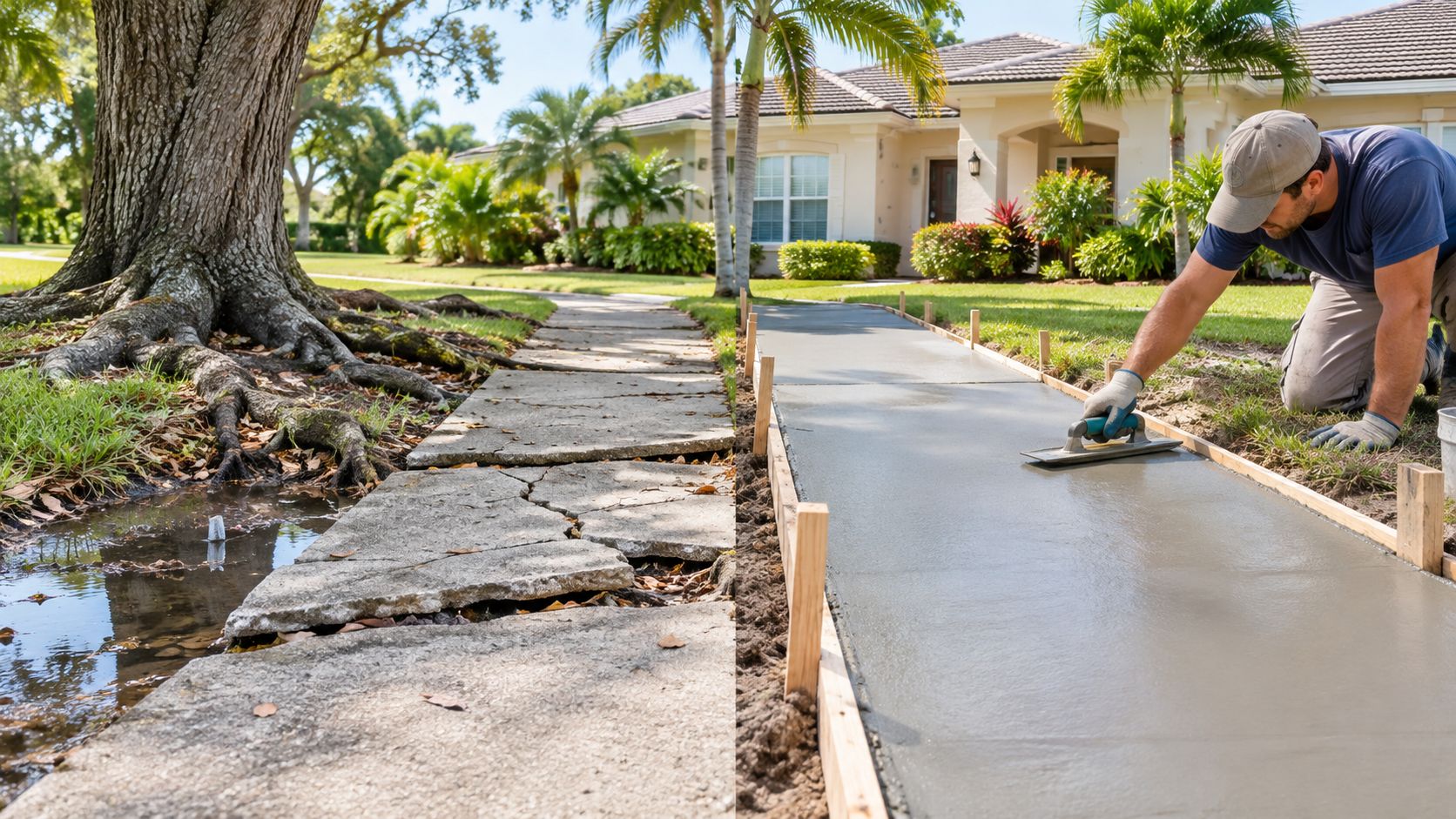
A lot of homeowners in Dunnellon, Ocala, Crystal River, and Inverness start researching how to replace a sidewalk after the same kind of bad morning. You step outside after a summer storm, see water sitting on the walk, notice one panel has lifted, and realize it's not just ugly anymore. It's a trip hazard.
In Marion County, FL and Citrus County, FL, sidewalk replacement is rarely just a matter of pouring new concrete where the old slab used to be. Central Florida soil moves. Tree roots push. Heavy rain finds weak spots fast. If the walk sits near a driveway, a city sidewalk, or a right-of-way, permits and accessibility rules can turn a simple panel swap into a bigger repair.
A lot of DIY articles fall short. They'll tell you how to mix concrete, but they won't tell you when drainage, ADA slope limits, or a municipal cost-share program should change your decision before demolition even starts. That's the practical side homeowners in Belleview, Summerfield, Homosassa, Lecanto, Beverly Hills, Hernando, Silver Springs, and The Villages need.
For property owners, HOAs, churches, and small commercial sites, the smartest approach is simple. Diagnose the failure first. Then decide whether the right fix is patching, lifting, partial replacement, full replacement, or waiting for a city program. That's how Concrete and Asphalt Experts in Marion and Citrus County look at it in the field.
Table of Contents
- Why Sidewalks Fail in Central Florida
- Permits, Utility Locates, and ADA Scope Checks
- Should You DIY, Hire Out, or Wait for the City
- Demolition and Subgrade Preparation
- Forming, Pouring, Jointing, and Finishing
- Curing, ADA Slopes, and Drainage Details
- When to Call a Central Florida Concrete Pro
Why Sidewalks Fail in Central Florida
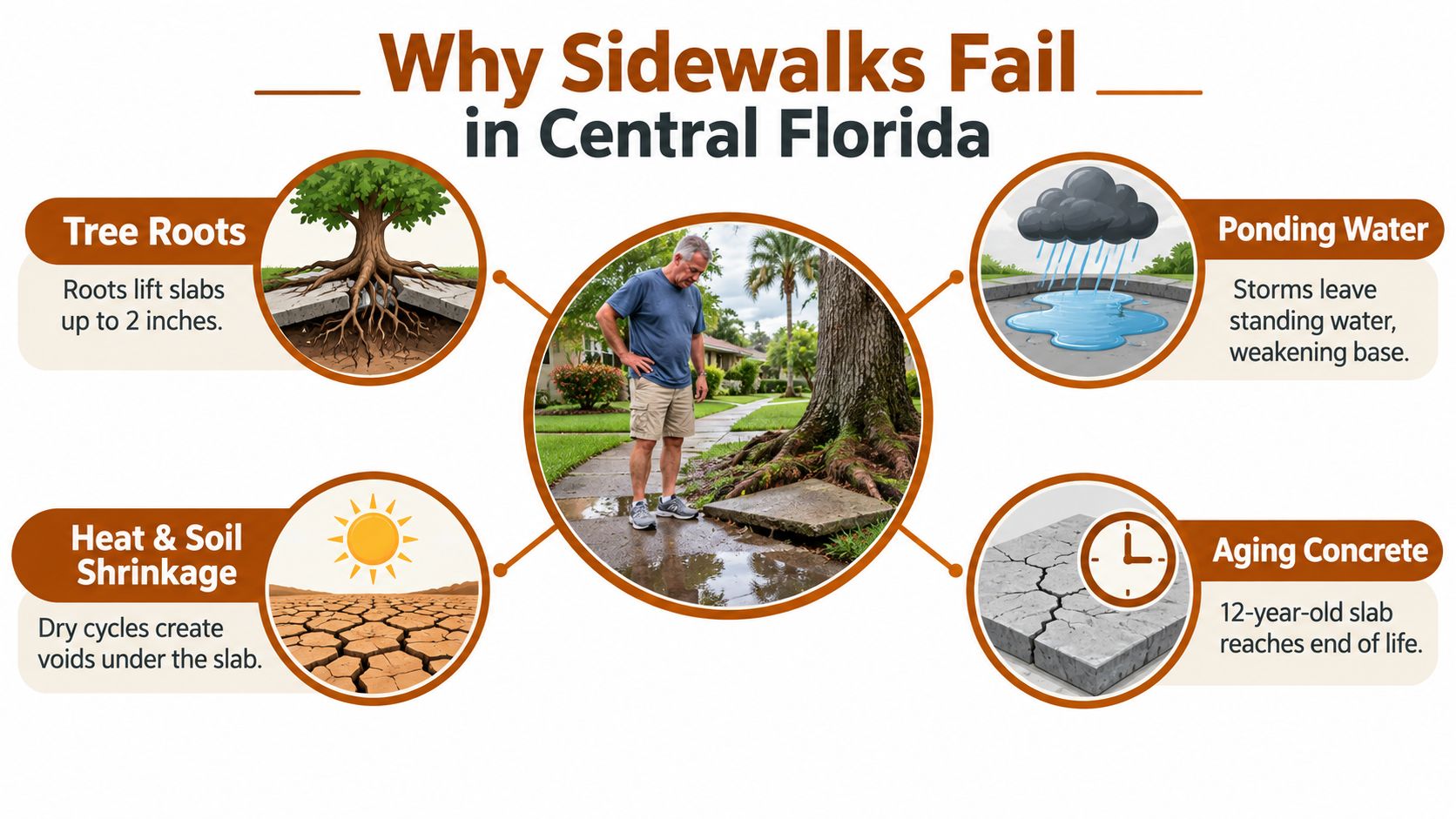
A lot of sidewalk failures around Ocala, Dunnellon, Crystal River, and Inverness start the same way. One panel settles, the next one lifts, and after a hard summer rain the low spot stays wet long after the yard dries out. By the time a homeowner notices the trip edge, the concrete problem usually has a soil and drainage problem under it.
What the damage pattern usually means
In Central Florida, I look at the base before I blame the concrete. Sandy soils drain fast, but they also shift fast if the subgrade was thin, poorly compacted, or washed out along the edge. The slab can end up spanning a small void. Then you get rocking panels, corner cracks, or a section that sounds hollow when you tap it.
Roots leave a different signature. Oaks usually push from one side and create a clear lift at a joint. Wider root systems can raise several panels gradually, which is why some walks look more like a wave than a single trip lip. If the root stays and the slab gets replaced in the same footprint, the new section often heaves again.
Water is the other big one here. Roof runoff, downspouts, overspray from irrigation, and low grading keep the soil cycling from wet to dry. In Florida, that repeated movement is hard on flatwork. It also matters for replacement decisions because standing water near a sidewalk can turn a simple panel swap into a drainage correction, and if grades are off enough, ADA slope issues can get pulled into the scope.
Heat and humidity create their own set of problems. Crews working in hot weather sometimes finish too soon, add water at the surface, or miss the curing window because the slab looks damp in humid air. The result is a weak surface that dusts, crazes, or wears early even if the slab underneath is still structurally decent.
Practical rule: Match the repair to the failure pattern. Settlement points to base work. Root heave points to root conflict and layout choices. Ponding points to drainage and slope, not just bad concrete.
Replacement is not always the first move
Some sidewalks need full replacement. Others can be ground at a small lip, mud-jacked or foam-lifted if the slab is otherwise sound, or replaced one panel at a time. The right call depends on what caused the movement, how much of the walk is affected, and whether the repair could trigger accessibility corrections if it sits in a public-facing route or near the right-of-way.
Age matters, but it is not the whole story. Sidewalks are often treated as long-term assets, and public works reserve planning commonly assumes they should last for decades under normal conditions, as noted in the earlier ICPI sidewalk life-cycle report. If a walk is failing much sooner, I would not treat that as bad luck. I would look for compaction problems, drainage concentration, root pressure, or finishing and curing mistakes.
If your damage came from root heave, this guide on repairing sidewalks raised by tree roots is a useful starting point before you commit to demolition.
Permits, Utility Locates, and ADA Scope Checks
A sidewalk replacement can look simple until the city inspector asks who approved work in the right-of-way, or the new panel creates a cross-slope problem at the driveway tie-in. That is where small jobs turn into expensive do-overs in Central Florida.
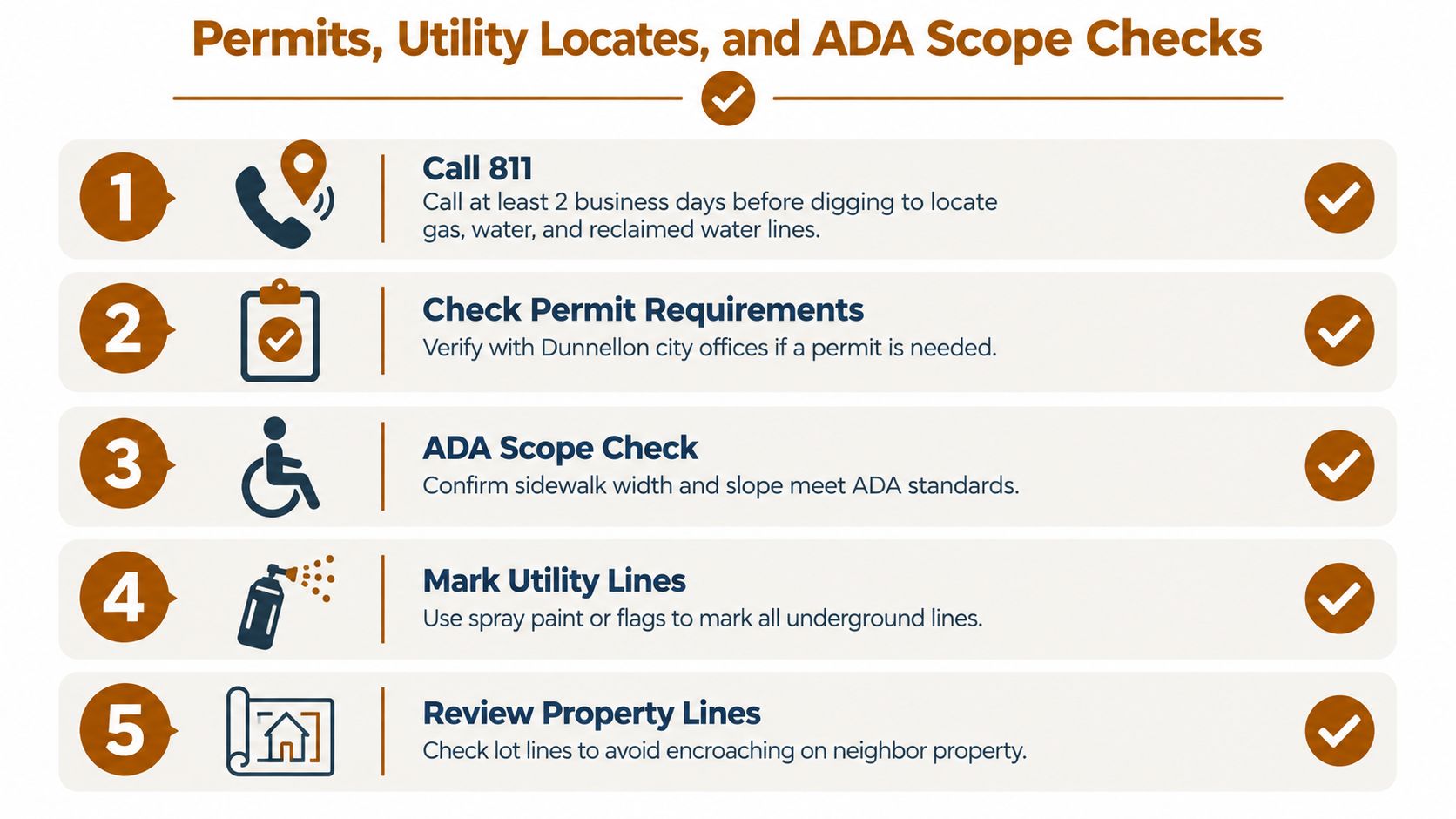
The pre-job sequence matters because each step affects the next one. Call 811 before anyone sawcuts or digs. Then check with the local building or public works office to see whether the walk sits in a right-of-way, easement, or city-maintained corridor. In some Central Florida neighborhoods, you also need HOA notice or architectural approval, even for plain gray concrete.
Do not price the job until you check access and slope.
A lot of owners plan for a straight remove-and-replace. That works only when the existing walk already fits the site and the governing agency agrees with the scope. If the panel ties into a driveway, crosses a drainage path, or sits on a route the public uses to reach the street, replacement can trigger ADA corrections beyond the broken section. That is the part many DIY guides skip.
For accessible routes, the main checks are width, running slope, cross slope, and surface texture. If the walk is steep enough to be treated as a ramp, the requirements change. FDOT's ADA guidance is a good practical reference for Florida work because it addresses sidewalk width, driveway transitions, and finish expectations in public settings, including broom-finished concrete and minimum clear widths in common sidewalk conditions: FDOT ADA brochure.
Here is the trade-off I explain at kitchen tables all the time. Replacing one bad panel may keep the invoice smaller today. Regrading a longer run to fix slope, driveway flare, or drainage can cost more up front, but it often avoids a failed inspection or a complaint after the new concrete is in.
City responsibility is worth checking early too. Some municipalities handle sidewalk repairs themselves, split costs with the owner, or require you to use their standard details if the work is near the street. Ask that question before you order concrete. It can change who pays, who pulls the permit, and whether your scope stays private or becomes public-facing.
If you are not sure what is below grade before demolition, review this guide on underground utility location for sidewalk and concrete work. Shallow service lines, irrigation, and reclaimed water runs are common surprises in this part of Florida.
Should You DIY, Hire Out, or Wait for the City
A homeowner in Central Florida usually reaches this section after one ugly surprise. Someone trips on a lifted panel, the city leaves a notice, or a small crack turns into a section that holds water after every storm. At that point, the decision is not just who can pour concrete cheaper. It is who can replace the walk without triggering bigger slope, drainage, or public right-of-way problems.
The right choice depends on three things. First, is the damage limited to one private panel or does it tie into a longer run? Second, will the replacement pull you into ADA corrections beyond the broken spot? Third, does your city already have a repair list, assessment process, or cost-share program that changes the math?
Sidewalk Replacement Options Compared
| Option | Cost per sq ft | Time Required | Risk Level | Warranty |
|---|---|---|---|---|
| Full DIY | Lower out-of-pocket if the scope stays small and private | Usually slower and labor-heavy | High | Usually none |
| Partial DIY with pro finish | Mid-range | Moderate | Medium | Limited, depends on scope |
| Full professional replacement | Higher upfront | Usually faster and more predictable | Lower | Often available |
| Municipal program or assessment route | Owner share may be reduced in some programs | Depends on city schedule | Low to medium | Typically tied to the public program |
What each path really looks like
Full DIY fits a narrow set of jobs. A short section behind the front walk line can be manageable if it is clearly private, flat, and not tied into a driveway, curb ramp, mailbox approach, or drainage swale. The savings are real, but so is the risk. In our soil, a panel can look fine the day you broom it and still end up holding water or settling at one corner after a few hard summer rains.
DIY also gets harder fast once the replacement affects pedestrian access. If fixing one panel means changing grades on the next two, or if the walk is part of the usual route from the driveway to the front door, the job stops being a simple tear-out and pour. It becomes a layout and compliance job.
Partial DIY with a pro finish is often the best compromise for a handy homeowner. Demo, haul-off, and some rough digging can be done by the owner. Then a concrete crew sets final grade, forms it correctly, places the mix, cuts joints, and finishes the surface. That split can save money without gambling on the parts that are hardest to fix after the concrete sets.
This option only works if everyone is clear on responsibility before the job starts. If the owner leaves the subgrade uneven or digs too deep at one end, the finisher inherits a bad setup. Good crews will either correct it for extra cost or walk away.
Full professional replacement usually makes the most sense when the walk ties into public infrastructure or drainage. Multiple panels, root heave, washout at one edge, ponding near the house, or a sidewalk that crosses a driveway are all cases where experience matters. So does documentation. If an inspector, HOA, tenant, or city reviewer asks who set the grades and who approved the scope, a licensed contractor gives you a cleaner answer.
Waiting for the city can be smart, or it can waste a season
Some owners rush into private replacement when the city was already the better first call. Municipalities handle sidewalk repairs in different ways. Some repair only certain public segments. Some assess the owner later. Some split the cost. Some require city details and inspection if the work sits near the street, even if the owner pays for it.
That matters because a city program can change both scope and timing. If the municipality already plans to replace a longer run, patching one panel yourself may turn into wasted money. If the city is months out and the trip hazard is at your front walk, waiting may leave you with a safety issue and a notice that still needs attention.
Chicago's 2025 shared cost sidewalk program overview shows how cities may reduce owner cost or control the repair path. Local programs in Central Florida will differ, but the lesson is the same. Ask before you commit.
For owners in Ocala, Dunnellon, or unincorporated Marion County, I would ask these questions early:
- Is this sidewalk in a public right-of-way or fully on private property?
- Is there an open notice, repair cycle, or planned street project that includes this segment?
- If I replace one panel, will the city require adjoining work to meet current slope or width standards?
- Does the municipality offer a cost-share, reimbursement, or approved-contractor process?
A cheap answer at the start can become an expensive one later. If one broken panel triggers adjacent ADA corrections or regrading to keep water moving away from the house, the lowest bid or the DIY route often stops being the lowest-cost decision.
Demolition and Subgrade Preparation
A lot of sidewalk jobs are won or lost before any new concrete shows up. In Central Florida, I see the same pattern over and over. The slab gets blamed, but the problem is underneath it. Sandy subgrade washes, roots lift one edge, or water cuts across the walk and leaves a void under the panel.
Remove the old slab with control
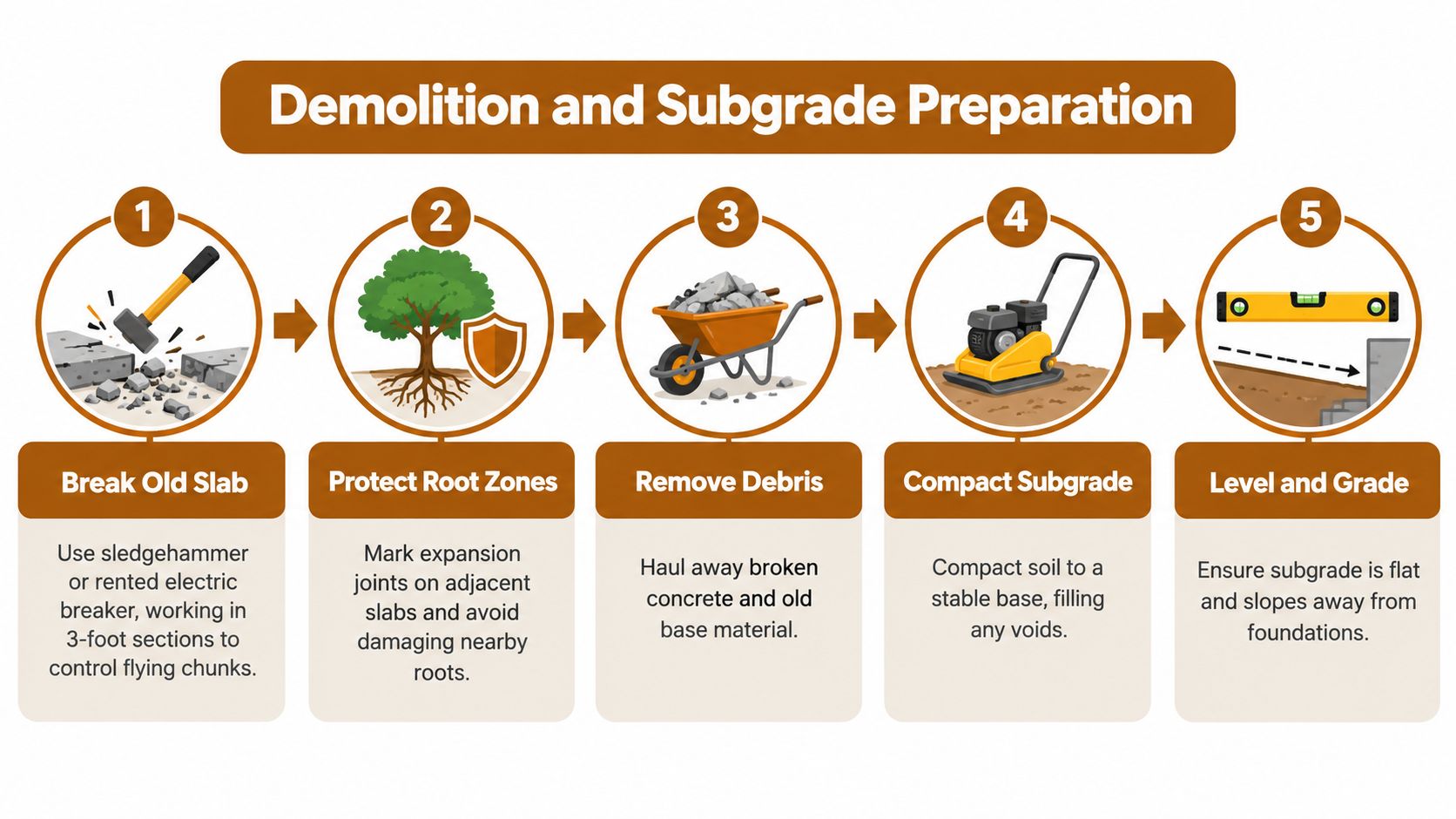
Breakout needs to be deliberate. A sledge works on small residential panels. A rented electric breaker makes sense on thicker sections, driveway crossings, or panels tied tight against older concrete. Start at a free edge or sawcut the limits first if you need to protect adjacent work that will stay.
Clean edges matter here. If the replacement ties into an existing walk, porch, or driveway, keep those tie-in faces as straight and solid as possible so the new section can sit flush. Sloppy demolition often creates chipped edges that turn into a lip later, and that can become an ADA problem if the walk is in a public-facing route or connects to the frontage sidewalk.
Roots deserve a hard look before you cut anything. A small feeder root near the edge is one thing. A large structural root from an oak is another. Cutting the wrong root may buy a flatter sidewalk for a year and create a tree problem after that. In some yards, the better repair is a longer replacement, a slight reroute, or root pruning only after an arborist weighs in.
Excavate for the grade you actually need
After demolition, remove loose concrete, old base, organic material, and any soft sand until support is uniform. Then check depth against the finished elevations, not just the old slab thickness. If the old sidewalk held water or settled below the lawn, copying it exactly repeats the same failure.
One municipal specification requires 4-inch sidewalks and 6-inch thickness where the sidewalk crosses driveways according to the Cayce sidewalk specification. Local requirements may differ, especially where work ties into public walk or curb ramps, but the practical point is simple. Dig to fit the slab and base while still leaving room to hit final slope and keep water moving.
In Florida, that usually means paying close attention to where stormwater goes after an afternoon downpour. If runoff from the yard, roof, or driveway crosses the walk, fix that in the dirt. Concrete will not solve a drainage layout problem by itself.
Compact the subgrade and build the base in lifts
Loose sand can look fine in the morning and pump underfoot after rain. Compact the exposed subgrade before any base goes down. If the plate compactor leaves the area stable and uniform, keep going. If a spot stays soft, dig it out and rebuild it. Pouring over a weak pocket is how a new panel starts cracking early.
A field sequence that works well looks like this:
- Strip out weak material: Remove roots, debris, old stone, and soft sand until the bottom is consistent.
- Compact the native subgrade: Run a plate compactor across the full footprint, not just the center.
- Add base in lifts: Crushed concrete or clean stone should go in thin layers and be compacted as you build up.
- Check grade with a string line and straightedge: The base should already reflect the drainage plan before forms are set.
This part takes longer than homeowners expect. It is also where the job gets its service life.
For homes in Lecanto, Homosassa, Hernando, and low pockets near Crystal River, I watch for washout patterns, sprinkler overspray, and downspout discharge near the walk. Those are the jobs where a sidewalk replacement can trigger extra grading work if you want it to last. If the route falls under city review or connects into a required accessible path, this is also the stage where small grade corrections can prevent bigger ADA slope problems after the pour.
Forming, Pouring, Jointing, and Finishing
Pour day gets expensive fast when the forms are off by even a little. A sidewalk can look straight from the street and still hold water at the porch, miss an ADA tie-in, or create a lip where it meets the driveway. Those are avoidable mistakes if line and grade are set before the truck arrives.
Set forms to the finished elevation, not just the outline
Straight 2×4 forms are standard for residential sidewalk replacement, but the job of the form is to hold elevation and cross slope. In Central Florida, I want the forms checked with a string line, level, and a long straightedge before any concrete shows up. Sandy subgrades make it easy for a stake to loosen or roll slightly, especially after afternoon rain.
Pay close attention where the new walk ties into existing concrete, porch slabs, and driveway aprons. If the replacement connects to a route the city treats as part of an accessible path, the form height at those tie-ins matters more than homeowners usually expect. A clean edge is not enough. The finished surface has to transition without creating a trip edge or pushing the cross slope out of tolerance.
Place concrete fast enough to stay ahead of the weather
For sidewalk work, concrete is typically placed in one continuous lift at the planned thickness, then struck off, floated, jointed, and finished without unnecessary delay. Florida heat, wind, and low afternoon humidity can pull moisture off the surface faster than many DIY guides admit. Add a summer shower ten minutes after finishing, and timing gets tight.
That is why crew sequence matters. One person placing, one striking off, one watching edges and grade, and one staying ahead on finishing is a practical setup on a small residential walk. If the crew stops to fix layout problems after discharge starts, surface quality usually drops and cold joints become a risk.
Curing starts right after finishing. Federal curing guidance notes that wet curing materials are commonly kept in place for at least 7 days, and that curing compound needs prompt application to limit early moisture loss according to the FHWA concrete curing guidance. In this climate, that is not paperwork talk. It is what helps the slab gain strength instead of drying out on top before it has a fair chance to hydrate.
Joint for the crack you know is coming
Concrete cracks. Good jointing decides where.
Expansion joint material belongs where the sidewalk bears against fixed concrete, such as a driveway, curb, porch, or another slab that is not going to move the same way. Contraction joints go between those points to create controlled weak planes. If they are too far apart, too shallow, or added too late, the slab will pick its own crack line.
Municipal details vary, but the basic rule stays the same. Keep panel sizes reasonable, isolate rigid tie-ins, and tool or saw contraction joints to the depth required by the local standard. One Florida public works specification calls for contraction joints at one-quarter of slab depth according to the North Port sidewalk standard.
Finish for traction, not shine
A medium broom finish is still the right call for most residential sidewalks here. It gives better footing during summer rain, handles sprinkler overspray better than a slick troweled surface, and looks appropriate on a neighborhood walk.
Overfinishing causes problems. Working excess water or paste to the surface can weaken the top layer and leave a dusty or scaling finish later. In humid Florida conditions, the slab may look ready for the broom while the surface is still too green underneath, so patience matters as much as speed.
Curing, ADA Slopes, and Drainage Details
A sidewalk can look good the day it is poured and still give you trouble by the first wet season. Around Central Florida, the slabs that hold up are the ones that cure evenly, shed water without washing out the base, and stay inside ADA tolerances after the forms come off.
Cure it for Florida weather, not for a brochure
Hot sun, afternoon storms, and sandy subgrade change the curing plan. Concrete needs to hold moisture long enough to build strength at the surface instead of drying too fast and chalking or craze-cracking on top. On small residential walks, that usually means applying curing compound promptly or keeping the surface damp in a controlled way, not hosing it down at random and not leaving it to bake.
Timing matters. If rain is coming a few hours after the pour, protect the finish without marking it up. If the slab dries too fast on a breezy afternoon, the top can tighten before the body of the slab does. That is when you start seeing a weak surface that looks fine at handoff and wears early under foot traffic, mower wheels, and sprinkler overspray.
Slope has to work for both water and access
The field mistake I see most is adding extra pitch because the yard holds water. That can move runoff off the slab, but it can also create an accessible-route problem that did not exist before the replacement. Once you touch a walk in the public path of travel, you need to know whether the work stays a simple panel swap or starts pulling ADA corrections into the job scope.
For plain-language context, review these ADA sidewalk requirements before you lock in layout and tie-in heights.
The target is simple to say and easy to miss in the field. Keep cross slope within accessible limits, keep the running slope consistent with the route you are tying into, and check width at the narrowest point, not the widest. If the sidewalk ties into a driveway, curb ramp, or city walk, measure from finished surface to finished surface. Do not assume the old grade was acceptable just because it had been there for years.
| Measurement | Practical limit to verify in the field | Practical check |
|---|---|---|
| Running slope | Keep it within sidewalk range. If it gets too steep, ramp criteria may apply | Check in the direction of travel with a level and repeated measurements |
| Cross slope | Keep side-to-side fall within accessible tolerance | Set a level across the walk and measure drop over the full width |
| Clear width | Maintain the required unobstructed route through the narrowest point | Measure between fixed obstructions, not just form width |
| Driveway bypass area | Confirm enough passable width where the walk wraps or crosses | Measure the actual walking path after tie-ins are complete |
Drainage failures usually start beside the sidewalk
Water ruins more sidewalk replacements from the edges than from the top.
A downspout dumping at one corner, a low lawn trapping runoff against the slab, or an irrigation head hitting the same edge every morning can soften support and start settlement. In sandy Florida soils, that process can be gradual for months and then obvious all at once after a stretch of heavy rain. The slab did not fail because concrete is weak. The support under one side changed.
Check three things before calling the job done:
- Downspouts discharge away from the walk
- Irrigation heads are adjusted so they are not soaking one panel edge
- Adjacent grade carries water past the sidewalk instead of under it
If the site cannot drain without making the walk too steep side to side, stop and reconsider the whole area. That is the point where a small replacement can turn into a drainage correction, a swale adjustment, or a conversation with the city about right-of-way work or cost-share responsibility.
When to Call a Central Florida Concrete Pro
A lot of homeowners can handle a straight, isolated panel if the site is simple, the forms are short, and the finish does not have to match public walk perfectly. The job changes fast once the sidewalk ties into a driveway apron, a city right-of-way, a curb ramp, or a low area that already holds water after summer rain. At that point, the concrete work is only part of the problem.
Call a contractor early if the issue looks bigger than one broken panel. In Central Florida, that usually means repeated settlement, tree roots lifting more than one section, washout along the edge, or a walk that no longer fits accessible slope limits after you replace one piece. A homeowner can pour concrete. Correcting grade, drainage, and tie-ins is where experience starts to matter.
Signs the job has outgrown DIY
Get a pro involved when you see any of these conditions:
- The sidewalk connects to a driveway, curb ramp, swale, or public sidewalk
- More than one panel has dropped or rocked, which usually points to base loss instead of isolated surface damage
- Roots are lifting the walk and the fix may require rerouting, root pruning decisions, or layout changes
- The city, county, or HOA has already cited the sidewalk
- The replacement could trigger ADA review because you are altering a meaningful stretch of the pedestrian route
- Water crosses the walk or disappears under one edge during heavy rain
Those are not paperwork details. They affect scope, liability, and whether the repair lasts more than a season or two.
What a useful site visit should include
A good contractor should walk the whole area, not just measure the broken square footage. On a proper visit, I want to know where the water comes from, where it leaves, how the new concrete has to tie into existing elevations, and whether the work stays private or enters public right-of-way. In Florida, sandy soil can look stable on top and still be loose under the slab edge, especially near downspouts, irrigation overspray, or old trench lines.
Ask the contractor to address these points in plain language:
- Removal limits
- Subgrade repair or added base, if needed
- Slab thickness
- Joint spacing and layout
- Finish type and slip resistance
- Cure plan for hot, humid weather
- Permit responsibility
- Utility locate responsibility
- ADA slope checks at tie-ins
- Warranty terms
If the quote says only “replace sidewalk” with one price, it leaves too much unanswered.
That applies whether you hire a small local flatwork crew, a larger site contractor, or a company such as Riverside Sealing & Striping, LLC for sidewalk removal and replacement work.
City timing and ADA scope can change the best decision
If the sidewalk sits near the street or inside a public easement, check with the city before you spend money. Some municipalities handle certain sidewalk repairs themselves, split costs under local programs, or fold replacement into a larger accessibility or corridor project. Waiting a few weeks can make sense if the city is already planning adjacent work. Paying privately for one section and then having nearby grades changed later is a frustrating way to buy the same fix twice.
ADA scope matters here too. Once a sidewalk repair reaches certain tie-ins or affects the accessible route in a meaningful way, the work can expand beyond a simple panel swap. A contractor who works in Central Florida should be able to tell you when the job still looks like basic replacement and when it starts becoming an access, drainage, or right-of-way coordination issue.
One outside example of how cities frame this work appears in Madison's sidewalk replacement guidance, which explains project scheduling and accessibility considerations during public sidewalk work, as summarized by HomeGuide's sidewalk repair cost and ADA overview. The takeaway for homeowners is simple. Public sidewalk work often follows city priorities, budget cycles, and accessibility obligations, not your preferred calendar.
Typical Central Florida Sidewalk Replacement Costs 2024
| Job Scope | DIY Cost / sq ft | Pro Cost / sq ft | Typical Total |
|---|---|---|---|
| Small isolated residential panel | Varies by materials, tools, haul-off, and permit needs | Varies by access, prep, and finish | Best priced by on-site evaluation |
| Multi-panel walkway replacement | Varies widely | Varies widely | Depends on drainage, roots, and layout |
| Sidewalk crossing driveway or right-of-way tie-in | Higher complexity | Higher complexity | Usually needs field review |
| HOA, church, or commercial walkway section | Often impractical for DIY | Scope-dependent | Usually quoted after inspection |
Get two or three written bids. Verify license and insurance. Ask for recent local jobs, especially ones with similar drainage, tree, and right-of-way conditions in Ocala, Dunnellon, Inverness, Lecanto, or nearby Central Florida communities.
If you need help figuring out whether your sidewalk should be lifted, patched, or fully replaced, Riverside handles on-site evaluations for homeowners and property managers across Marion County, FL, Citrus County, FL, and surrounding Central Florida areas. Riverside Sealing & Striping, LLC provides concrete sidewalk removal and replacement, ADA-minded layout review, and practical recommendations without a high-pressure sales pitch.