
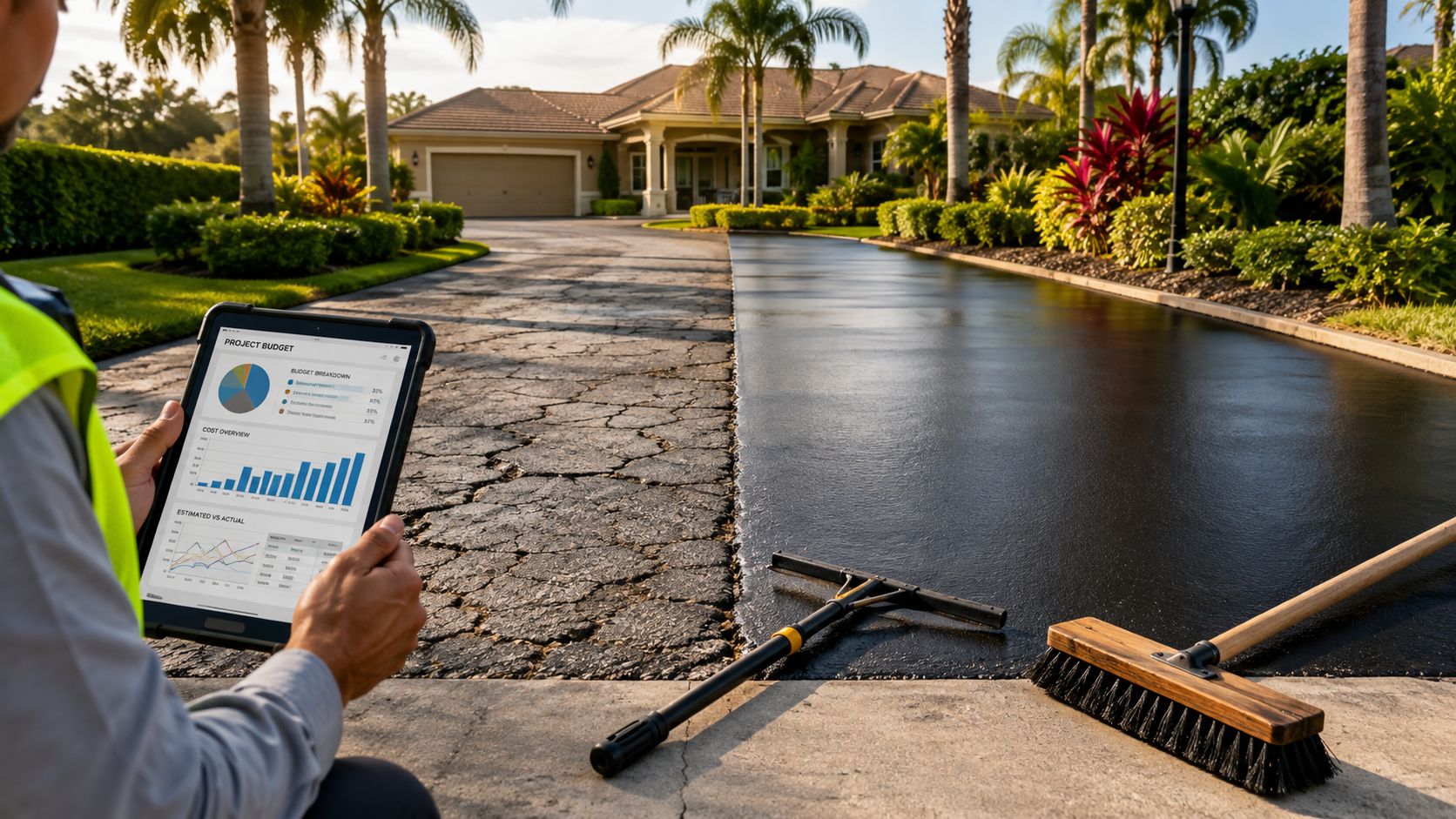
A dollar deferred today can become four to five dollars in future repair needs for roads and bridges, according to an IMF infrastructure discussion. On some infrastructure, waiting can push the eventual bill as high as 18 times the preventive-maintenance cost, as reported in a World Bank-published source. For pavement owners in Central Florida, that's the difference between scheduling a manageable treatment and paying for extensive reconstruction after water, heat, and traffic have weakened the surface and its base.
Maintenance cost reduction isn't about ignoring problems or choosing the cheapest proposal. It's about identifying deterioration early, comparing concrete and asphalt options over their useful life, and spending before a small defect becomes structural damage. That approach matters across Marion County, FL, Citrus County, FL, Ocala, Dunnellon, The Villages, and surrounding communities.
Table of Contents
- Why Deferred Maintenance Destroys Your Pavement Budget
- Building a Preventive Maintenance Schedule for Florida Properties
- Lifecycle Cost Analysis for Repair Versus Replacement Decisions
- How Central Florida Weather Accelerates Pavement Deterioration
- Budgeting for Pavement Maintenance and Calculating ROI
- When to Hire a Professional Concrete and Asphalt Contractor
Why Deferred Maintenance Destroys Your Pavement Budget
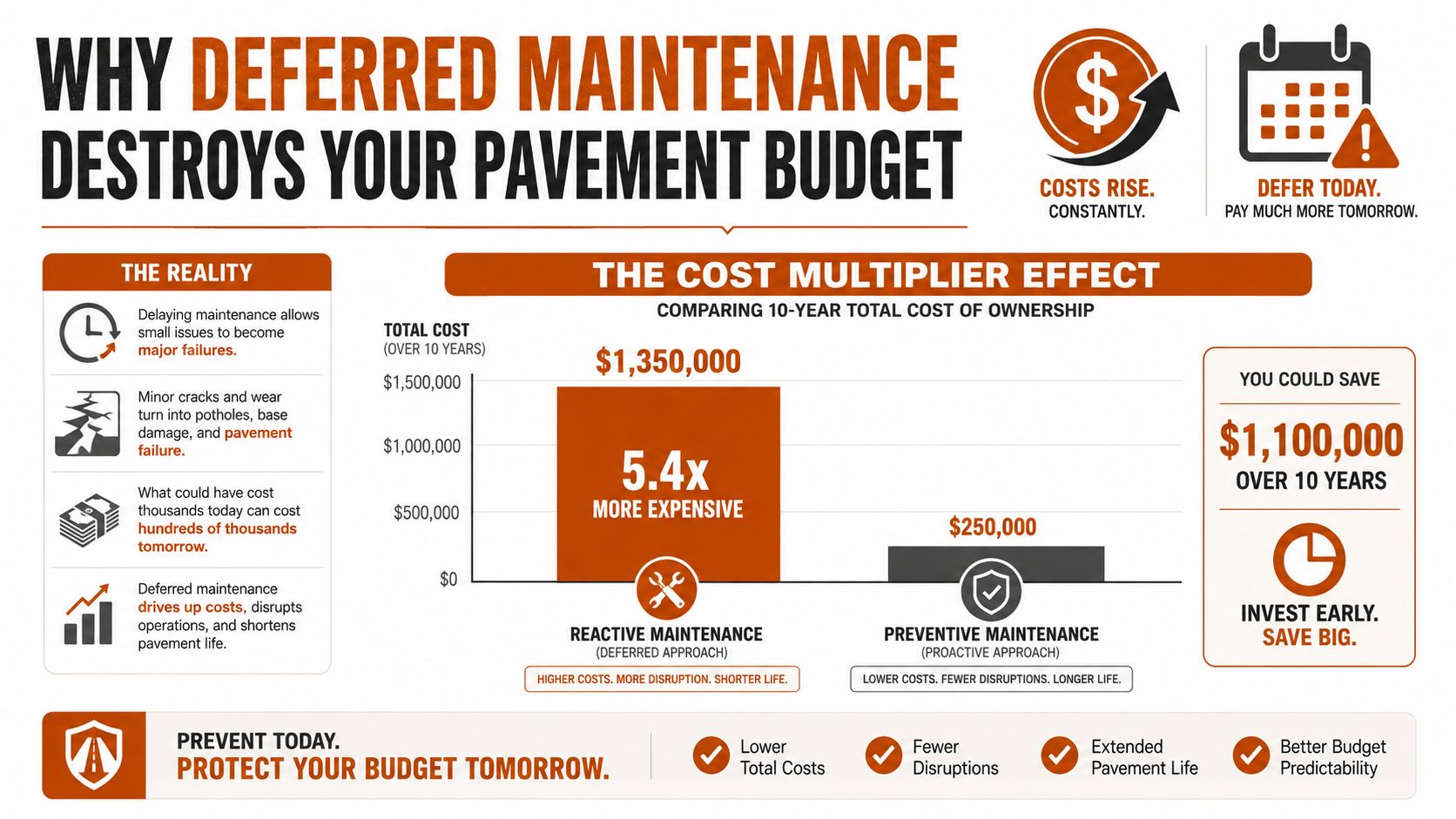
$1 of deferred maintenance can create an additional $4 to $5 in future repair needs for roads and bridges, according to the IMF infrastructure reference. The same reference describes early airfield pavement maintenance as potentially equivalent to spending $4 to $5 later. A World Bank source reports that delaying road maintenance for three years can raise costs to six times the original preventive-maintenance cost, while a five-year delay can raise the cost to 18 times the preventive cost.
Pavement usually gives owners warning before it fails. Asphalt may show oxidation, hairline cracks, or isolated raveling. Concrete may develop open joints, minor spalling, or cracks that seem manageable. The surface can remain usable while water reaches the layers below, weakens the base, and turns a small repair into structural work.
The Florida version of the problem
Central Florida's UV exposure dries and weakens asphalt binders. Heavy rain enters cracks, moves fines from vulnerable areas, and reveals drainage or base problems. Traffic then pounds those weakened spots, especially at entrances, loading areas, turning lanes, and frequently used driveways.
A sealcoat, crack repair, joint treatment, or drainage correction often costs less than patching after failure. Preventive work preserves the surface while the underlying structure remains serviceable. Once base failure or widespread breakup appears, surface treatments cannot correct the full problem.
Practical rule: Shift the budget discussion from minimum annual spending to maximum condition preservation. Fund the work that keeps water out and the pavement structurally sound.
Maintenance can consume a substantial share of production budgets. One widely cited estimate places maintenance costs at 15% to 40% of total production costs, while NIST's 2021 discussion noted that U.S. Census data recorded $50 billion in machinery maintenance and repair spending in 2016. The same budgeting pressure applies to pavement portfolios.
For homes, HOAs, retail properties, churches, and commercial sites, the practical test is timing. Spend while treatment can protect sound pavement. Waiting until water, traffic, and Florida heat have reached the base removes the lower-cost options and makes reconstruction far more likely.
Building a Preventive Maintenance Schedule for Florida Properties
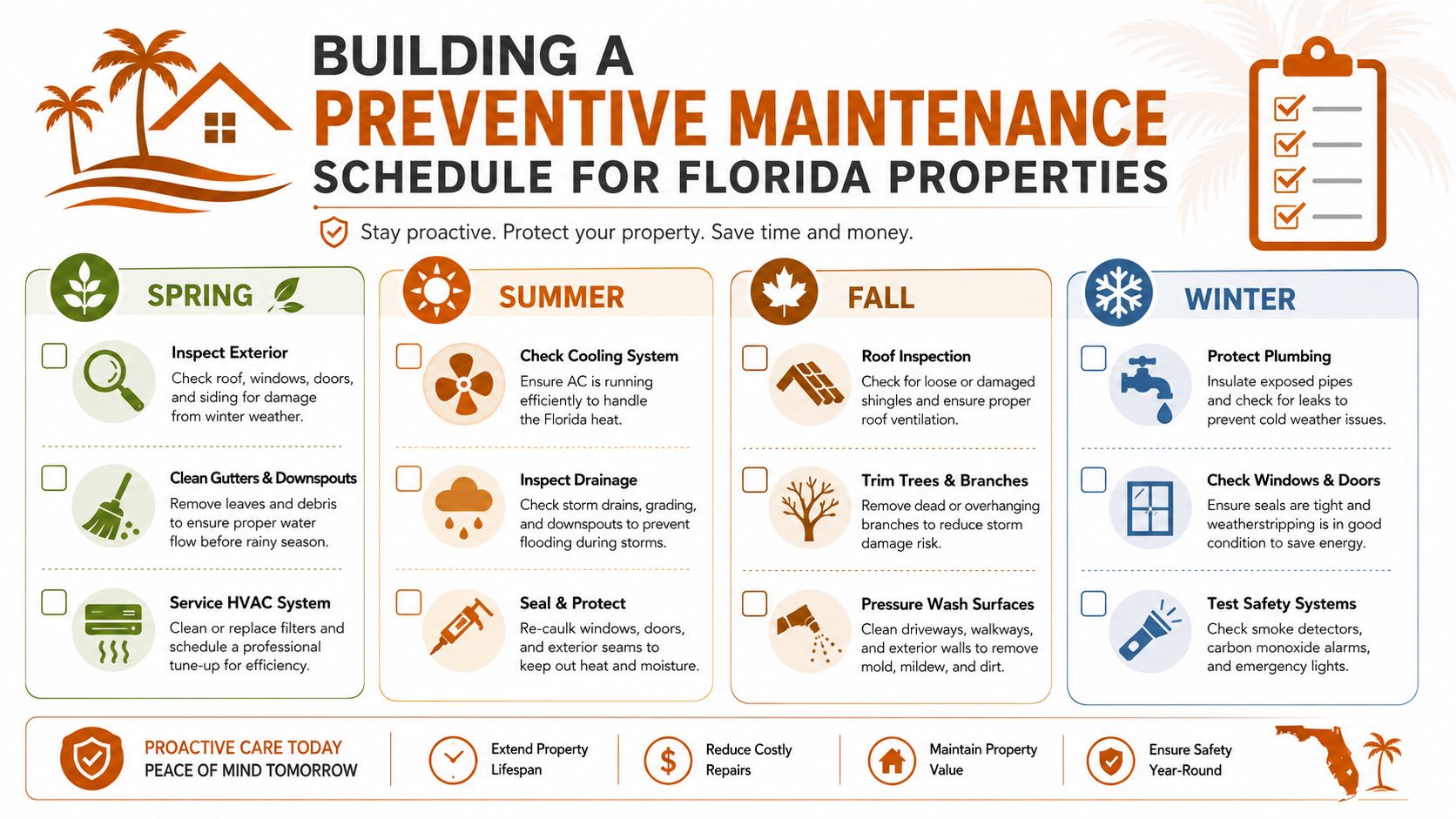
A useful schedule follows the weather and the surface type. Asphalt needs protection from UV and water intrusion, while concrete maintenance centers on joints, drainage, cracking, and localized surface deterioration. The calendar below gives property owners in Ocala, Dunnellon, Crystal River, and nearby areas a workable starting point.
Spring
Spring is the inspection season. Walk the entire property after the heavier wet-weather periods and mark cracks, depressions, ponding, loose aggregate, open concrete joints, and areas where vegetation is entering pavement gaps.
- Inspect asphalt: Identify cracks that need sealing before rain carries water into the base.
- Check drainage: Clear outlets, swales, and inlets so water doesn't remain against pavement edges.
- Review concrete: Look for joint separation, trip hazards, and early spalling around walks, slabs, and driveways.
Summer
Summer heat and UV exposure place the greatest stress on asphalt surfaces. Schedule asphalt sealcoating only when the contractor confirms that weather and surface conditions support proper curing. Property owners comparing treatment timing can review this practical guide to how often to sealcoat asphalt.
Concrete deserves a close look during the same period. Keep joints clean, watch for standing water, and address small failures before repeated wetting and drying enlarges them. Don't use sealant to hide movement or structural settlement. A professional needs to determine whether the joint, slab, or supporting base is the actual source of the problem.
Fall
Fall is the time to prepare for the next cycle of rain and traffic. Refresh worn pavement markings where visibility has declined, and inspect entrances, fire lanes, accessible spaces, and directional markings. For commercial properties, striping should support safe circulation rather than only improve appearance.
Winter
Central Florida winter is often the most practical season for planning larger work. Review work orders, photographs, invoices, and recurring problem areas. Then rank projects by safety risk, drainage exposure, traffic importance, and the likelihood that delay will increase the repair scope.
A written schedule helps owners separate routine maintenance from capital work. It also gives an HOA board or property manager a defensible reason for completing work before deterioration becomes visible to every resident or tenant.
Lifecycle Cost Analysis for Repair Versus Replacement Decisions
The lowest immediate bid can become the highest long-term expense. A lifecycle cost analysis compares the full cost of an option with the service it delivers, including preparation, drainage work, disruption, and the maintenance needed afterward.
For a property owner, the review should answer four practical questions:
- What will the treatment cost, including preparation and related drainage work?
- How much useful service can the treatment provide?
- What is the cost per year or unit of service?
- Does the work correct the cause of deterioration, or only cover the visible symptom?
A cracked concrete driveway in Belleview may need joint repair or localized replacement when the slab remains stable and water is controlled. A deteriorating asphalt parking lot in Inverness may suit patching or an overlay if its base remains sound. Widespread failures, poor drainage, or repeated temporary repairs point toward removal and replacement, which can deliver better lifecycle value even when the initial invoice is higher.
Florida's UV exposure and heavy rain make this distinction especially important. A small crack left open can admit water, weaken supporting material, and turn a limited repair into base work or full-depth replacement. Preventive spending has the strongest return while the surrounding pavement still provides stable support.
The comparison below is a decision framework, not a list of universal prices. Actual costs depend on access, thickness, preparation, drainage, reinforcement, disposal, and site conditions.
Repair vs Replacement Cost Comparison
| Intervention | Typical Cost Range | Expected Service Life | Best For |
|---|---|---|---|
| Localized concrete repair | Site-specific | Condition-dependent | Isolated cracks, spalls, or damaged sections with a stable surrounding slab |
| Concrete removal and replacement | Site-specific | Condition-dependent | Broad deterioration, settlement, unsafe sections, or failed support |
| Asphalt patching | Site-specific | Condition-dependent | Limited surface or base failures where surrounding pavement remains sound |
| Asphalt overlay | Site-specific | Condition-dependent | Worn asphalt with adequate structure and corrected underlying defects |
| Asphalt removal and replacement | Site-specific | Condition-dependent | Extensive cracking, structural failure, poor drainage, or repeated patching |
Owners should document repair history before approving another patch. Review photographs, prior work orders, recurring crack locations, and areas that pond after rain. A proposal covering drainage correction, base evaluation, and a realistic maintenance plan gives a clearer cost picture than a low bid that leaves the failure mechanism untouched.
For a focused comparison of asphalt options, review asphalt overlay versus replacement. Lifecycle analysis helps prevent short-term decisions from creating a repeating cycle of emergency work, disruption, and escalating repair scope.
How Central Florida Weather Accelerates Pavement Deterioration
Florida pavement has to manage heat, UV exposure, moisture, vegetation, and traffic at the same time. Asphalt absorbs solar heat, and repeated exposure can dry and oxidize the binder that holds the aggregate together. As the surface loses flexibility, small cracks become more likely to widen under traffic.
Concrete responds differently. Daily temperature changes create expansion and contraction, placing stress on joints and already weakened sections. If joints are open or water reaches the supporting material, slabs can settle, break at edges, or develop uneven transitions. Those changes matter on sidewalks, driveways, patios, and accessible routes.
Summer rain exposes the next weakness. Water follows cracks, low spots, pavement edges, and poorly sealed joints. Where drainage is inadequate, the supporting base can lose stability, and vehicles amplify the movement. Vegetation also finds favorable conditions in damp pavement gaps, particularly around properties with landscaped edges or neglected joints.
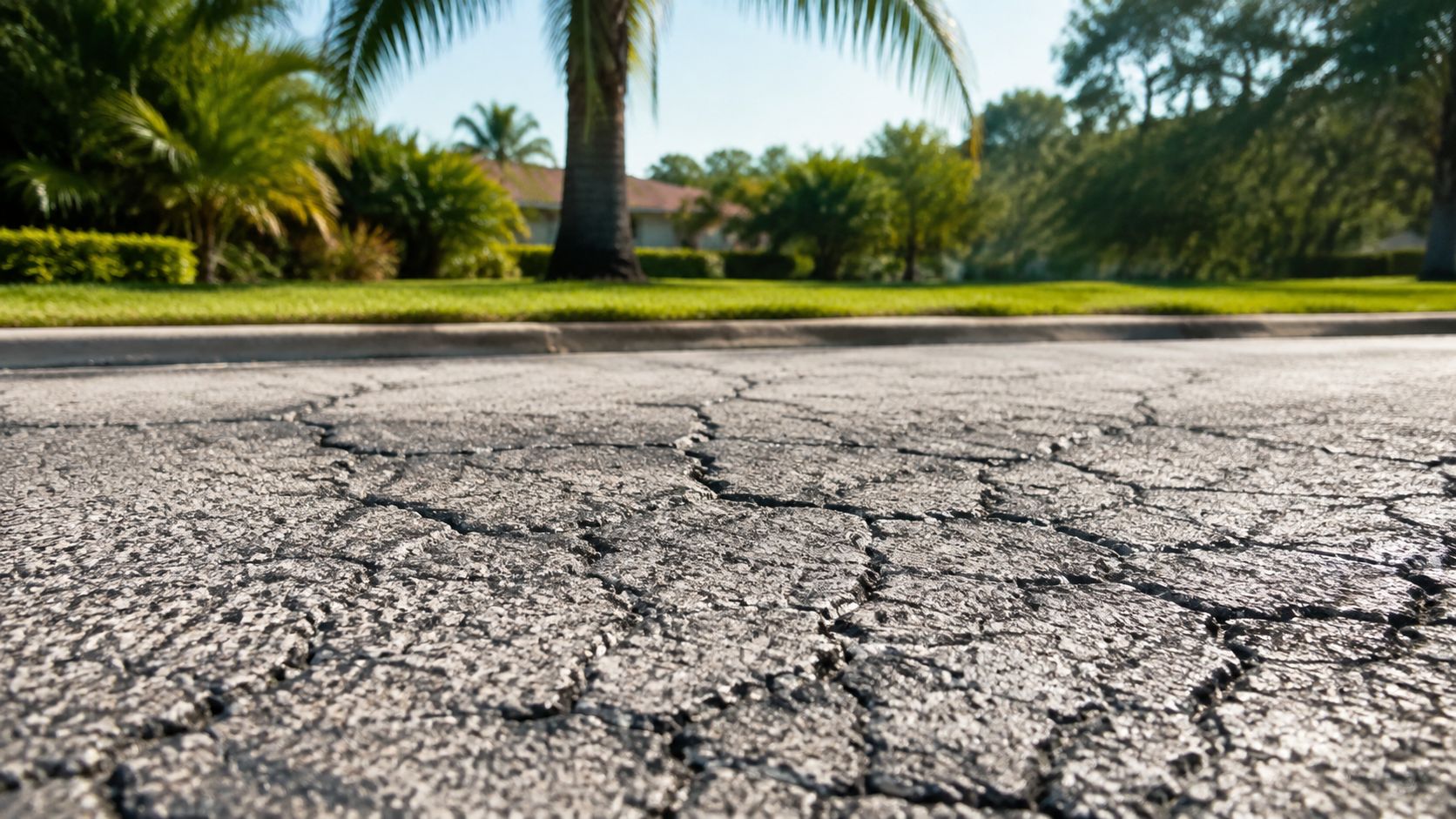
The visible warning signs vary by location. Properties in The Villages and Summerfield may see concentrated wear at busy entrances, neighborhood streets, and parking areas. Homosassa, Lecanto, and Beverly Hills properties must manage heavy rain and planted edges, while Silver Springs and Hernando sites can face similar problems where water remains near pavement or traffic repeatedly loads a damaged area.
The practical point is simple. Florida conditions shorten the time between a cosmetic defect and a functional problem, so inspections need to focus on water movement, crack patterns, joint condition, and base stability, not just surface appearance.
Budgeting for Pavement Maintenance and Calculating ROI
Property managers and HOA boards can justify preventive work with a budget built from 12 months of work-order data. Separate planned work, reactive repairs, materials, access costs, and disruption. The facility maintenance benchmarking guidance recommends tracking planned versus reactive work, cost per square foot, staffing efficiency, and work-order history before changing the process.
Build the budget around decisions
Track every pavement area separately. A retail lot, residential driveway, concrete sidewalk, and asphalt travel lane face different loads and need different treatment decisions.
- Record area and condition: Measure each surface and classify defects by severity and location.
- Separate planned from reactive spending: Include patching, emergency access, repeated mobilization, cleanup, and related repairs.
- Calculate cost per performance unit: Compare treatment cost with the service-life extension or usable condition it preserves.
- Show the avoided escalation: As documented earlier in this article, every deferred dollar can generate $4 to $5 in future repair costs. Use that documented multiplier to explain the budget logic, not to promise a guaranteed project return.
Florida's UV exposure and heavy rain make timing especially important. A small crack or open joint can allow water into the supporting material, particularly around properties with planted borders or neglected joints. Early sealing or localized repair may protect the base, while waiting can shift the project into broader removal and reconstruction.
A pavement management system organizes inspections, photos, treatment history, and upcoming work into a capital plan. For Silver Springs, Hernando, and other Central Florida communities, that record helps decision-makers approve work based on condition and risk instead of waiting for complaints or visible failure. The pavement management system should support the budget, not replace field judgment.
Data identifies patterns. A qualified contractor still confirms whether a surface treatment, repair, overlay, or replacement fits the actual condition, drainage, traffic, and exposure. That review is where owners can separate spending that prevents a larger bill from spending that only postpones it.
When to Hire a Professional Concrete and Asphalt Contractor
Routine observation and cleaning are reasonable owner responsibilities. Structural cracking, settlement, widespread alligator cracking, drainage failures, concrete replacement, commercial traffic areas, and accessibility concerns deserve a professional assessment.
A qualified evaluation should address more than the top layer. The contractor should inspect the base where appropriate, study drainage and ponding, identify whether cracks are structural or surface-level, and review traffic patterns. Commercial properties also need a review of accessible parking dimensions, access aisles, slopes, surface condition, and markings. ADA guidance requires an accessible car space to be at least 96 inches wide with a 60-inch access aisle, while van-accessible layouts must use either 132 inches with a 60-inch aisle or 96 inches with a 96-inch aisle, as explained in the ADA restriping guidance. Accessible parking spaces and aisles must also have a maximum slope of 1:48, about 2 percent, with firm, stable, and slip-resistant surfaces, according to ADA parking requirements guidance.
Ask for a written scope, preparation details, material specifications, drainage recommendations, schedule, and exclusions. Price matters, but a proposal that omits the cause of failure can create a cheaper invoice and a more expensive ownership experience.
Riverside Sealing & Striping, LLC is a licensed and insured Central Florida contractor offering concrete driveway, patio, slab, sidewalk, asphalt sealcoating, parking lot striping, and ADA-compliant improvement work. For properties in Marion County, FL, Citrus County, FL, Ocala, Dunnellon, Belleview, Crystal River, Inverness, or The Villages, a free, no-pressure on-site evaluation can help determine whether preventive maintenance or more extensive work makes financial sense.
Riverside Sealing & Striping, LLC can assess your concrete and asphalt surfaces, identify the maintenance work that should happen now, and separate it from repairs that can be scheduled later. Visit Riverside Sealing & Striping, LLC to request a free estimate and discuss a practical maintenance plan for your property.