
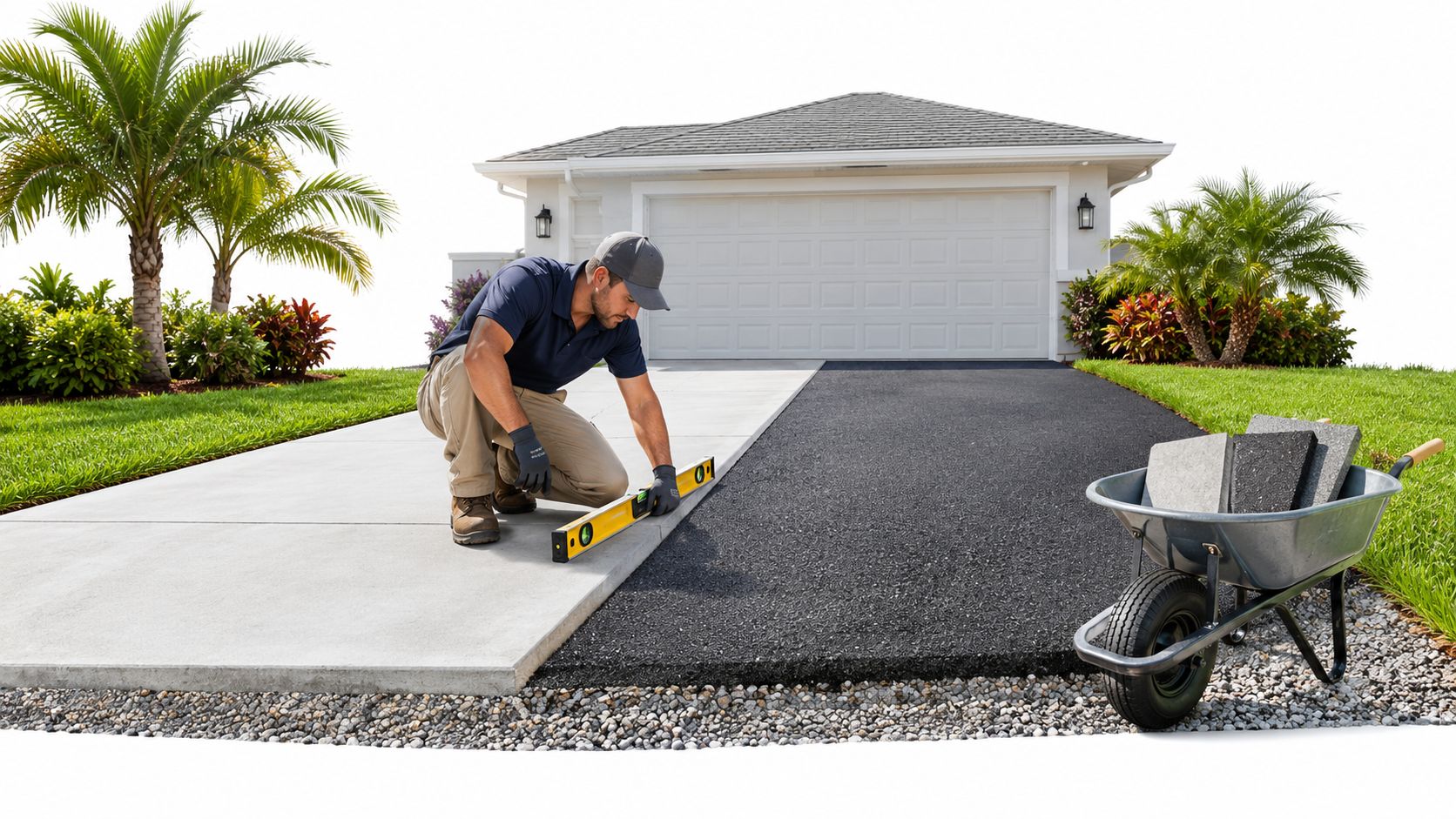
Asphalt usually lands around $5,200 to $7,400 for a new driveway, while concrete often falls around $3,000 to $6,400+ depending on size, finish, and site conditions. In Central Florida, the better long-term value usually comes down less to sticker price and more to lifespan, drainage, maintenance, and how the driveway is built from the ground up.
If you're looking at a cracked apron in Ocala, a stained old drive in Dunnellon, or a surface that's sinking near the garage in Homosassa or Inverness, you're in the same spot a lot of homeowners hit after years of hard sun, heavy rain, and daily traffic. A driveway takes a beating in Marion County, FL and Citrus County, FL. It bakes in summer heat, sheds water fast during storms, and shows every shortcut a contractor took underneath the surface.
That's why new driveway installation isn't just a cosmetic upgrade. It's a structural exterior project. The right material can serve you well for years. The wrong one, or the right one installed poorly, starts giving trouble far too early.
Homeowners in Belleview, Silver Springs, Summerfield, Crystal River, Lecanto, Beverly Hills, Hernando, and The Villages also tend to ask the same thing first. Should I choose concrete or asphalt? The honest answer is that both can work. The better choice depends on your budget, how long you plan to stay in the home, your tolerance for ongoing maintenance, and what your lot does with water when one of those afternoon Florida storms rolls through.
Table of Contents
- Introduction to New Driveway Installation in Central Florida
- Concrete vs Asphalt for New Driveway Installation
- Site Preparation and Drainage for Central Florida Driveways
- Permitting, HOA Rules, and Local Requirements in Marion and Citrus Counties
- Project Timeline and How to Choose a Contractor
- Maintenance Strategies for Concrete and Asphalt Driveways
- Making Your Decision and Next Steps
Introduction to New Driveway Installation in Central Florida
A worn driveway usually doesn't fail all at once. It starts with shallow cracks, rough edges, standing water, or a low spot you notice every time it rains. Then the driveway starts dragging down the look of the whole property, even if the house itself is in good shape.
In Central Florida, that decline tends to move faster when water keeps getting under the surface or when the base wasn't compacted properly to begin with. The top layer gets most of the attention, but the hidden decisions underneath the driveway matter more than most homeowners realize.
Why this choice matters more in Florida
Heat and rain expose weak work quickly. A driveway in Marion County, FL or Citrus County, FL doesn't get the same kind of stress as one in a mild, dry climate. In places like Ocala and Crystal River, surface temperature, runoff, subgrade stability, and edge support all affect how the finished driveway holds up.
Practical rule: A clean finish won't save a bad base. Most driveway failures start below the surface, not on top of it.
That's also why broad national advice often misses the point for local homeowners. Material choice matters, but so do grading, thickness, joint layout, reinforcement, and whether the contractor knows how to handle Florida drainage without guessing.
What homeowners usually get wrong
A lot of people focus only on the bid total. That's understandable, because driveway replacement isn't a small purchase. Published 2025 to 2026 U.S. pricing puts a new asphalt driveway at about $5,258 on average, with a typical range of about $3,128 to $7,391 and $7 to $15 per square foot including labor, while concrete averages about $6,400 and can range from $1,600 to $32,000 depending on project conditions, design, thickness, and layout, according to 2025 to 2026 driveway cost benchmarks from NerdWallet.
But that first number doesn't tell the whole story. A driveway is a long-lived exterior asset. The better question is what works on your property and what it will cost to keep it performing in Florida weather.
A local installer who handles both materials has an advantage. Concrete and Asphalt Experts in Marion and Citrus County should be able to explain trade-offs clearly instead of trying to force every property into one product line.
Concrete vs Asphalt for New Driveway Installation
Concrete and asphalt both have a place in Central Florida. The problem is that homeowners are often given one-sided advice by companies that only install one of them. If you want a fair answer, you have to compare them under real conditions in Ocala, Dunnellon, Belleview, and the surrounding area.
Early in the decision process, a visual side-by-side helps:
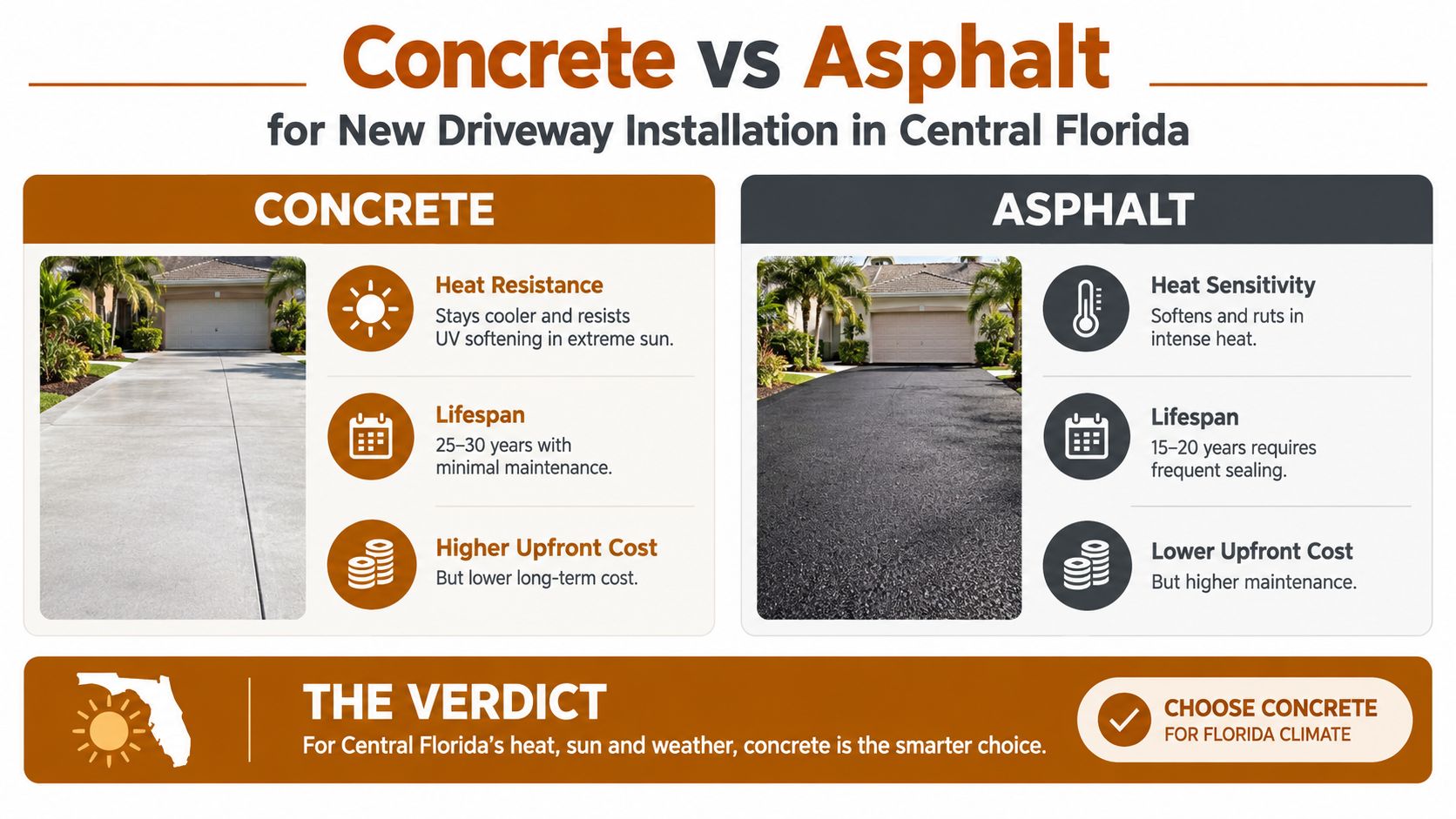
Lifespan and long-term value
The biggest practical difference is service life. Current home-improvement and industry sources place asphalt driveways at about 15 to 20 years with routine sealing, while concrete is commonly estimated at 25 to 50 years, with several sources narrowing typical concrete life to roughly 30 to 40 years under proper installation and care, according to this lifespan comparison for driveways.
That gap matters. The same source notes one industry association finding that concrete can last 50% to 60% longer than asphalt on average, and reports a 600-square-foot concrete driveway at about $93.86 per year over a 35-year life versus $125 per year for asphalt over a 20-year life in its annualized comparison.
Concrete often costs more up front on many projects, but it doesn't automatically cost more over the life of the driveway.
In Florida, that longer cycle is one reason many homeowners lean concrete when they plan to stay in the home and want fewer replacement decisions down the road.
How each material handles Florida conditions
Concrete generally holds its shape well in harsh sun. It doesn't soften the way asphalt can during long stretches of heat. It also gives you more finish options if curb appeal matters. Broom finish is the workhorse, but decorative work can make sense on homes in The Villages, Summerfield, or higher-visibility properties in Beverly Hills and Lecanto.
Asphalt has its own strengths. It's often chosen when a homeowner wants a clean blacktop look, a faster initial install path, or a lower entry price on a straightforward layout. The trade-off is maintenance. Sealcoating, crack repair, and edge monitoring matter more over time.
A balanced side-by-side looks like this:
| Concrete vs Asphalt Driveway Comparison | ||
|---|---|---|
| Factor | Concrete | Asphalt |
| Lifespan | Typically longer service life under proper installation and care | Shorter service life and more dependent on routine sealing |
| Heat response | Holds up well in intense sun | More prone to softening in high heat |
| Appearance options | Plain, broom finish, and decorative options | Clean blacktop appearance |
| Maintenance style | Joint monitoring, cleaning, optional sealing | Sealcoating, crack filling, edge maintenance |
| Best fit | Long-term ownership, curb appeal, lower replacement frequency | Lower initial spend, simple layouts, owners comfortable with upkeep |
Video walk-throughs can also help homeowners understand how these surfaces differ in the field:
For a deeper side-by-side material breakdown, this guide on concrete driveway vs asphalt driveway options is a useful next read.
What actually decides success
Material alone doesn't decide whether a driveway lasts. Installation quality does. Poor joint spacing in concrete leads to ugly random cracking. Weak base prep under asphalt leads to rutting, edge failure, and water problems.
That's why the better question isn't “Which material is best?” It's “Which material fits my property, and can the contractor build it correctly for Central Florida?”
Site Preparation and Drainage for Central Florida Driveways
Most driveway problems in Florida start with water. If a contractor doesn't control drainage and compact the base correctly, the finish material won't save the job. That's true for concrete and asphalt alike.
Here's what proper prep should look like before anyone pours or paves:
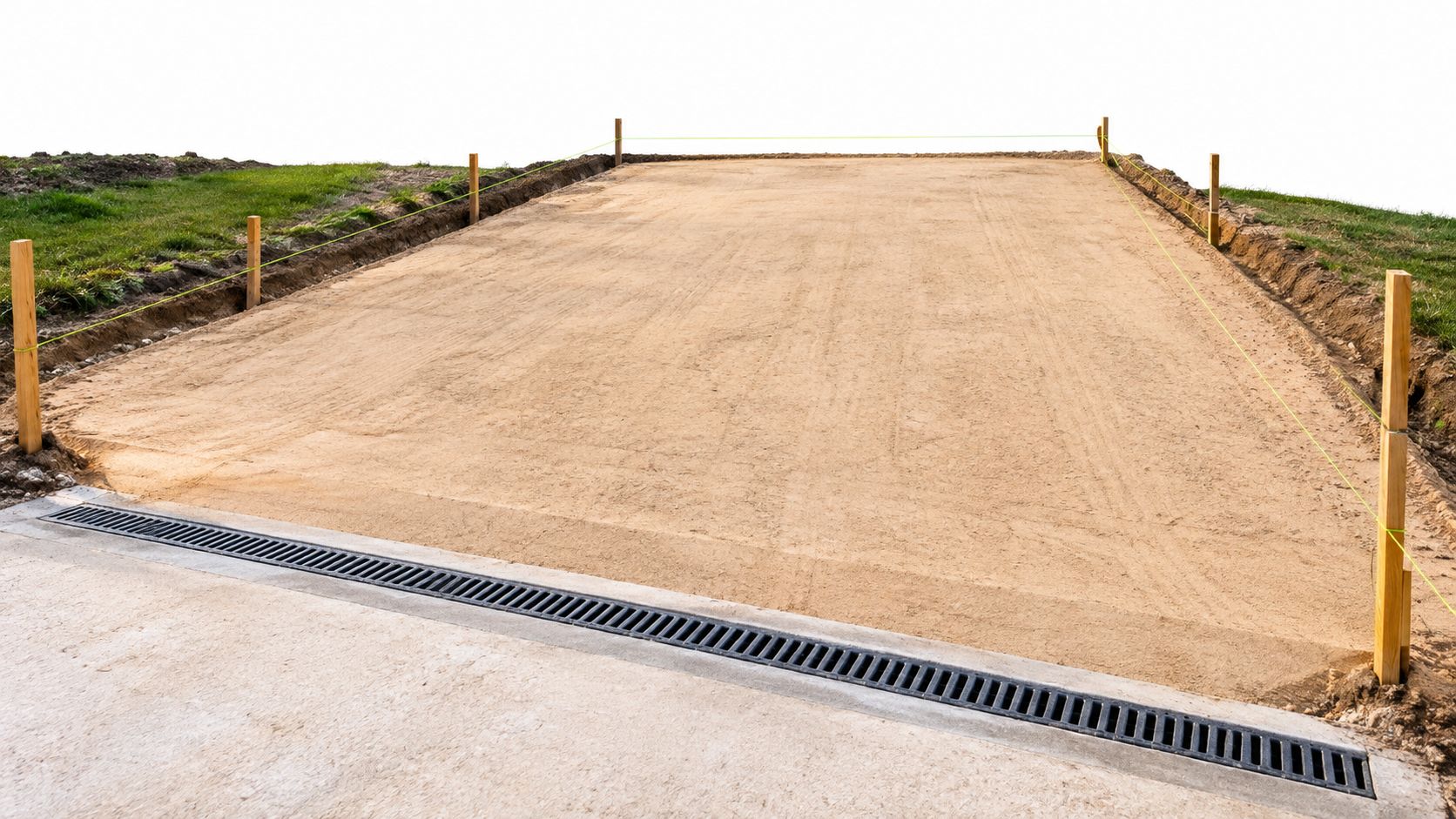
Start with excavation and a stable base
The old surface has to come out cleanly if you're replacing an existing driveway. After that, the subgrade needs to be shaped, compacted, and checked for soft spots. In Central Florida, sandy areas can seem firm until they get saturated. That's when shortcuts show up.
For residential concrete driveways, a common build-up is a 4 to 6 inch compacted granular base, and some guidance notes that soft soils may call for 8 inches or more of base material, according to this driveway base guidance.
Most homeowners won't watch compaction work closely, but they should ask about it. If the answer is vague, that's a red flag.
Thickness, reinforcement, and load planning
Residential concrete driveways are commonly built at 4 to 6 inches thick, and most codes require at least 4 inches on a well-graded, compacted gravel subbase, according to Concrete Network's driveway thickness guide. For passenger vehicles, 4 inches is the basic slab thickness, while heavier-use driveways often move to 5 inches or more with steel reinforcement. Guidance also notes that wire mesh is more appropriate around 4 to 5 inches, while rebar is typically favored at 5 inches and above, based on residential concrete thickness and reinforcement recommendations.
The mix matters too. Residential driveway concrete is commonly specified with a 3,500 to 4,000 PSI mix, often paired with a 4 to 6 inch slab thickness for passenger-vehicle use, according to this concrete slab thickness and PSI guide.
A homeowner with a boat, work truck, or repeated delivery traffic should bring that up before the quote is written, not after the forms are set.
Drainage details that prevent future trouble
Drainage is where local experience shows. In Ocala, Silver Springs, Hernando, and Homosassa, some lots shed water easily. Others trap it near the house or garage apron. The driveway needs positive slope away from structures, and some properties benefit from swales, drain inlets, or French drains where runoff has nowhere else to go.
Water doesn't need a dramatic low spot to cause damage. Repeated saturation at the edge of a driveway is enough to weaken support over time.
Permeable pavement is also worth mentioning for the right site. Independent lifecycle analyses show porous asphalt can have lower maintenance burdens than conventional impermeable pavement, and when stormwater treatment or drainage costs are included, permeable options can become more economical over 20- to 30-year horizons in some markets, according to the NYC lifecycle cost analysis on permeable pavement.
If drainage is a concern on your lot, this guide to concrete driveway drainage covers the warning signs and common fixes in more detail.
Permitting, HOA Rules, and Local Requirements in Marion and Citrus Counties
A lot of driveway projects stall before the first machine arrives. Not because the owner changed their mind, but because nobody checked the paperwork side early enough. In Marion County, FL and Citrus County, FL, permit requirements can vary by municipality, location, and project scope. HOA approval can slow things down just as much.
What homeowners should verify first
For a new driveway installation, homeowners should confirm whether the work counts as new construction, expansion, apron modification, or replacement in kind. That distinction can affect whether a permit is required and what plans have to be submitted.
Inspections often focus on practical issues like:
- Property line alignment so the driveway stays within approved boundaries
- Drainage direction to make sure runoff isn't sent toward neighboring lots or structures
- Apron and right-of-way work where the driveway meets the road
- Accessibility considerations when sidewalks, crossings, or shared-use areas are involved
If you're in or near The Villages, Summerfield, Silver Springs, or a deed-restricted neighborhood in Inverness or Beverly Hills, check HOA rules before scheduling demolition. Some associations want finish samples, width confirmation, a site sketch, or a written timeline.
A simple local checklist before you call
A little prep makes the estimate process faster and more accurate.
| Central Florida Driveway Permit and HOA Checklist | |
|---|---|
| Step | Details |
| Measure the footprint | Note approximate driveway length and width |
| Photograph problem areas | Include cracks, ponding, apron damage, and garage connection |
| Check HOA documents | Look for material, color, width, and approval requirements |
| Confirm lot constraints | Identify gates, trees, utilities, drainage paths, and easements |
| Ask about permit handling | Find out whether the contractor submits paperwork or if you must do it |
The smoothest projects usually start with a homeowner who already has photos, rough measurements, and HOA paperwork in one folder.
Why local experience helps
A licensed and insured contractor with regular work across Ocala, Dunnellon, Crystal River, and Lecanto usually knows where projects get hung up. That doesn't eliminate permitting, but it does reduce surprises. It also matters when sidewalks or shared access areas need to stay practical and code-conscious for residents, guests, or delivery traffic.
For homeowners, the best move is simple. Get the requirements straight before choosing material, not after the contract is signed.
Project Timeline and How to Choose a Contractor
Most driveway jobs feel longer than they are because several different stages happen around the installation day. The driveway itself might go in quickly. Scheduling, approvals, weather, prep, and curing are what stretch the calendar.
This visual gives a good high-level view of the sequence:
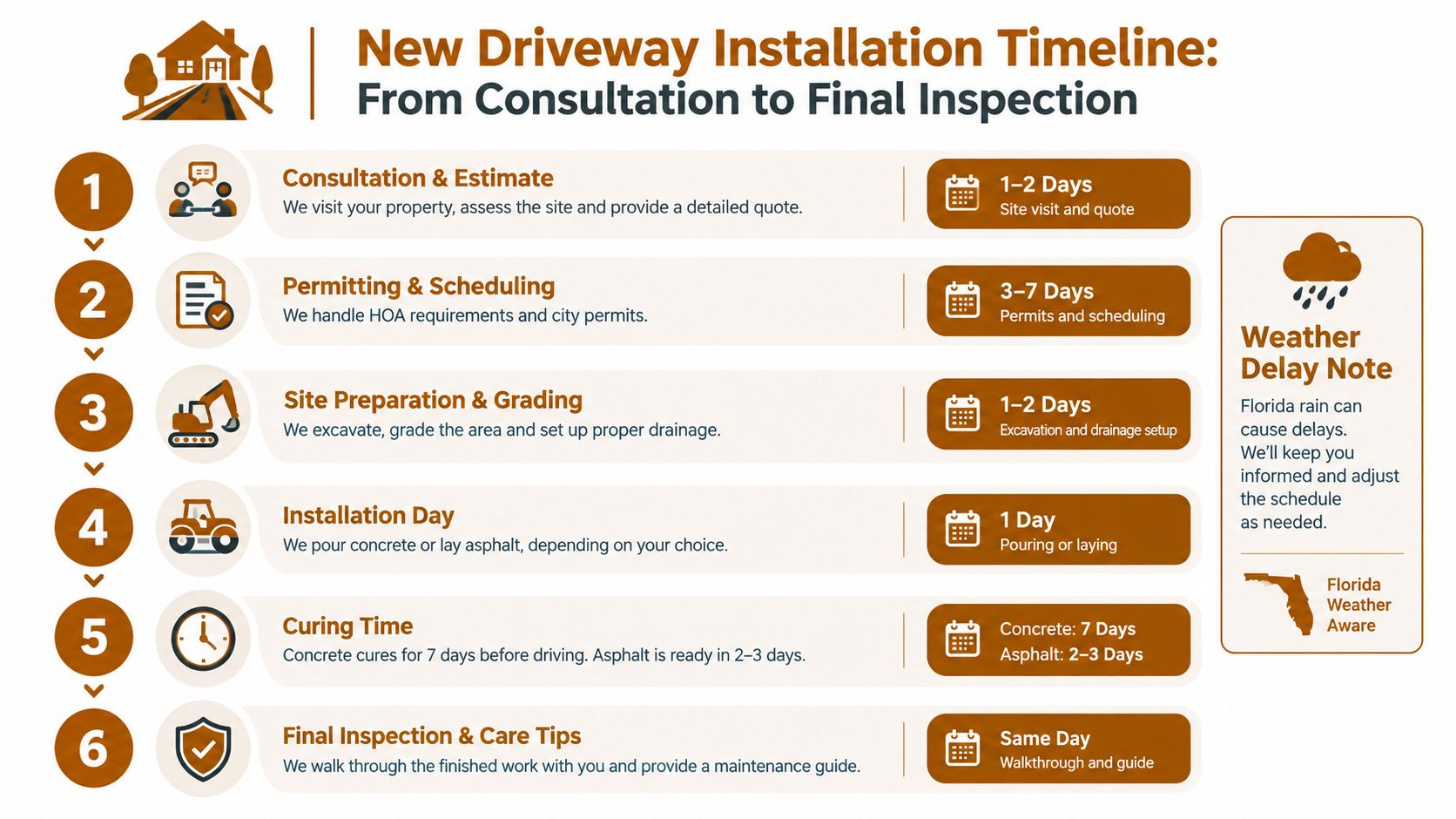
What the timeline usually looks like
The front end starts with the site visit, measurements, and quote. After that comes any permit or HOA approval needed for the property. In rainy periods, scheduling can shift because base prep and grading need dry enough conditions to do the work right.
Once the project is cleared to move, the sequence usually follows this pattern:
Consultation and field review
The contractor looks at slope, access, drainage, existing damage, and whether the property is better suited for concrete or asphalt.Paperwork and scheduling
Permits, HOA items, and utility awareness get handled before demolition starts.Removal and site prep
Existing material comes out if needed. The crew grades the area, compacts the base, and forms the layout.Installation day
Concrete is poured and finished, or asphalt is laid and compacted.Curing and initial protection
This part gets overlooked by homeowners in a hurry, but it matters as much as the pour or paving itself.
The exact number of days depends on weather, site conditions, and local scheduling. In summer, sudden downpours can interrupt prep even when the forecast looked fine the night before.
Questions that separate good contractors from risky ones
A clean estimate isn't enough. Homeowners in Belleview, Hernando, or The Villages should ask direct questions and expect direct answers.
- Are you licensed and insured? Ask for current proof, not a verbal yes.
- Do you install both concrete and asphalt? That helps expose whether you're getting a real recommendation or a sales preference.
- Who handles permits and approvals? Clarify responsibility before work begins.
- What thickness, base prep, and reinforcement are included? The quote should spell this out.
- How do you handle drainage on my lot? If the answer is generic, keep looking.
- Do you provide written warranty terms? Verbal promises aren't enough.
One local option homeowners evaluate is Riverside Sealing & Striping, LLC, a family-owned contractor in Dunnellon that handles concrete work and asphalt maintenance in Marion and Citrus counties. The useful standard to apply isn't the name. It's whether the contractor offers clear specifications, reliable scheduling, and experience on both sides of the concrete-asphalt decision.
For a sharper screening process, this list of questions to ask a concrete contractor is worth reviewing before you compare bids.
Maintenance Strategies for Concrete and Asphalt Driveways
A driveway lasts longer when the owner treats maintenance as part of the installation decision, not as an afterthought. Concrete and asphalt age differently in Central Florida, so they need different habits.
Asphalt maintenance that actually matters
Asphalt asks for more attention over its service life. In Marion County, FL and Citrus County, FL, the combination of UV exposure, summer rain, oil drips, and standing water can wear the surface faster if cracks and surface drying are ignored.
The basics are simple:
- Sealcoat on schedule to protect the surface from sun, water, and vehicle fluids
- Fill cracks early before water reaches the base
- Watch the edges because unsupported edges often fail before the center does
- Keep drainage open so runoff doesn't sit where the pavement is weakest
For commercial or larger residential properties, natural service add-ons include asphalt seal coating and, where needed, fresh parking lot striping to keep surfaces protected and usable.
Concrete upkeep that pays off
Concrete needs less routine intervention, but it still shouldn't be ignored. Joint lines should stay clean and intact. Surface stains should be handled before they set deep. On some properties, sealing makes sense to reduce absorption and keep the finish looking sharper.
Field note: On concrete, small maintenance issues usually stay small if the joints are doing their job and water is moving away from the slab.
The main things to watch are:
- Joint condition so controlled movement happens where it should
- Drainage behavior after heavy rain
- Surface cleanliness around vehicles, planters, and irrigation overspray
Think in ownership cycles, not repair moments
A lot of bad maintenance decisions happen because the owner reacts only when damage becomes visible. It's cheaper and easier to protect what's sound than to rebuild what has already failed.
For homeowners in Ocala, Crystal River, and Inverness, the practical question is this. Do you want a surface that asks for more regular upkeep, or one that usually costs more to install but asks less of you year to year? That answer should line up with the material choice you made at the start.
Making Your Decision and Next Steps
The best driveway choice in Central Florida usually comes down to four things. Your starting budget, how long you expect to own the property, how much maintenance you're willing to stay on top of, and how your lot handles water.
Concrete makes sense for many homeowners who want longer service life, a clean finished look, and fewer replacement cycles. Asphalt still fits some properties well, especially when the layout is simple and the owner understands the maintenance commitment that comes with it. In both cases, the hidden work matters most. Base prep, drainage, slab or pavement design, and jobsite discipline are what separate a driveway that ages well from one that starts giving trouble early.
That's especially true across Marion County, FL and Citrus County, FL, where weather is hard on exterior surfaces. A contractor working in Dunnellon, Ocala, Belleview, Summerfield, Crystal River, Homosassa, Lecanto, Beverly Hills, Hernando, and nearby areas should be able to read the site, explain the trade-offs plainly, and build for Florida conditions instead of using a one-size-fits-all approach.
For homeowners, the next steps are straightforward:
- Measure the area so quotes start with a realistic footprint
- Photograph drainage concerns after a rain if possible
- Gather HOA documents if you live in a managed community
- List vehicle loads if you have heavier traffic than a standard passenger-car driveway
- Schedule a site evaluation before deciding strictly on price
A good estimate should tell you more than a total. It should explain what's being built, how water will be handled, what thickness and reinforcement are included, and what kind of care the surface will need after installation. That's the standard to look for from any licensed and insured contractor serving Central Florida.
Riverside Sealing & Striping, LLC provides new concrete driveway installation, damaged driveway removal and replacement, asphalt maintenance, and related site prep services for property owners across Marion and Citrus counties. If you want a practical recommendation based on your lot, drainage, and long-term budget, visit Riverside Sealing & Striping, LLC for a free estimate and no-pressure consultation.