
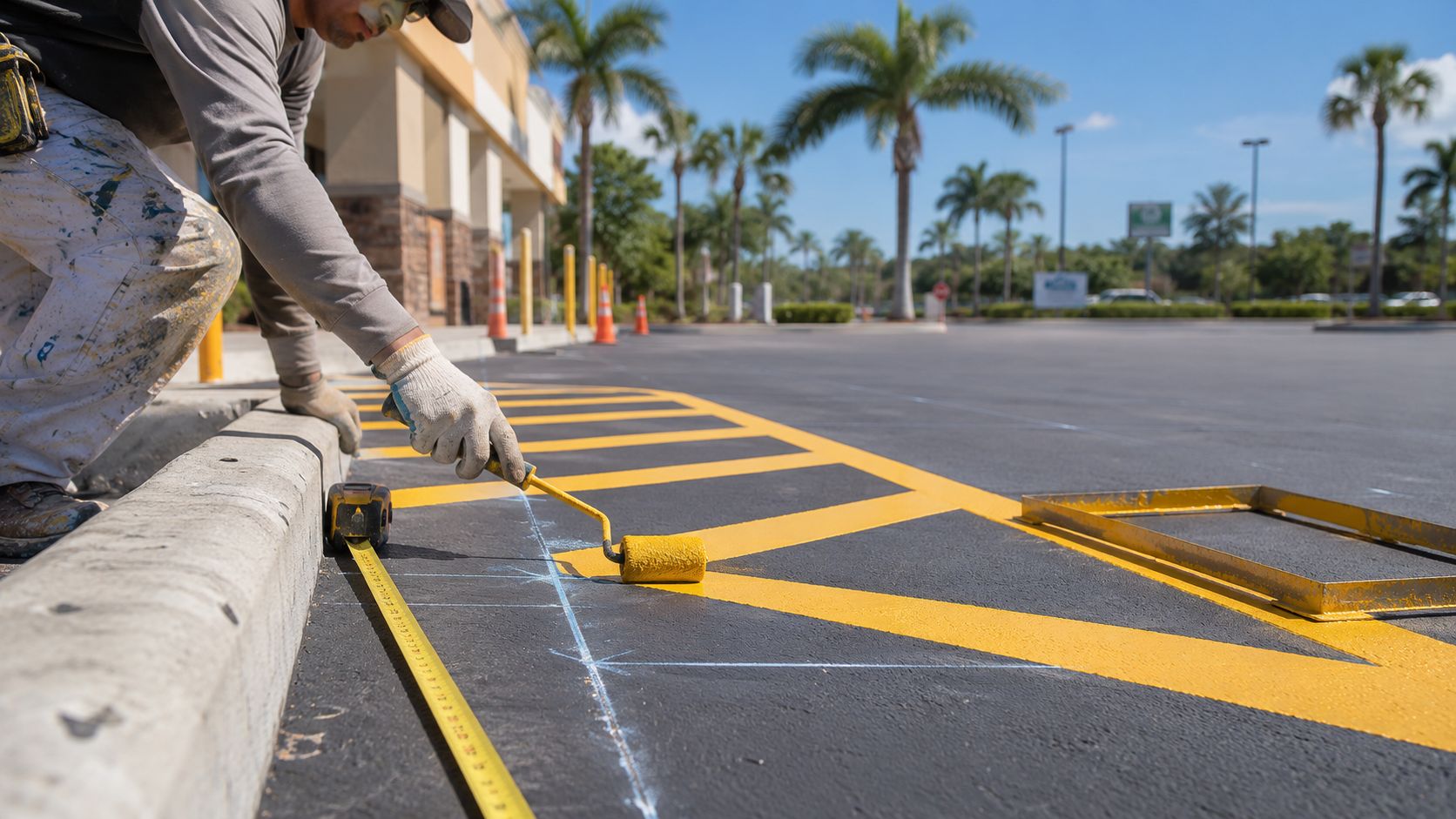
If you're managing a shopping center in Ocala, an HOA in The Villages, a church in Inverness, or a mixed-use property in Crystal River, this problem usually shows up the same way. Drivers start ignoring a faded yellow zone, delivery vehicles creep into fire access areas, and suddenly a simple paint job turns into a compliance and liability issue.
In Central Florida, no parking zone striping doesn't last on looks alone. Heat, UV, rain, standing water, traffic, sealcoating schedules, and the surface underneath all affect how long markings stay readable and enforceable. Property managers in Marion County, FL and Citrus County, FL need a plan that works on both asphalt and concrete, because many sites have both.
For commercial properties, local experience holds particular importance. A contractor who understands pavement maintenance but also understands concrete transitions, sidewalks, curbs, loading areas, and ADA paths of travel is in a better position to deliver markings that hold up and support compliance. That's why the strongest results usually come from Concrete and Asphalt Experts in Marion and Citrus County instead of a one-trade-only crew.
Table of Contents
- Initial Planning and Regulatory Assessment
- Layout Measurements and Surface Preparation
- Selecting the Right Paint and Stencils for Florida
- Signage ADA Compliance and Overall Safety
- When to Hire a Professional Concrete and Asphalt Expert
- Frequently Asked Questions About No-Parking Zones
Initial Planning and Regulatory Assessment
Why the planning stage matters
Most striping problems start before the first line is sprayed. If the zone is in the wrong place, too narrow, poorly tied into circulation, or missing related signs, repainting it won't fix the underlying problem. Good planning protects your budget because rework is always more expensive than getting the layout right the first time.
That matters even more in Florida because visibility standards can force action earlier than many property managers expect. Many jurisdictions, mirroring trends in Florida municipal audits, enforce strict visual visibility thresholds, often 75% minimum, and Florida's UV exposure can shorten compliance windows to under 18 months according to this Florida striping guide on visibility thresholds. A zone can still look "mostly there" to a property owner and still be a problem.

Practical rule: If drivers have to guess whether an area is restricted, the marking is already too weak.
What to assess before layout begins
Start with vehicle movement, not paint color. Walk the site and mark every place where parking creates a real operational conflict.
Use a simple field checklist:
- Fire access points: Look for hydrants, fire lanes, service entrances, and any choke point where a stopped vehicle blocks emergency access.
- Pedestrian conflict areas: Check storefront walkways, crosswalk approaches, curb ramps, and loading areas where parked cars cut off visibility.
- Delivery behavior: Watch where box trucks, vendors, and rideshare drivers stop. That behavior usually reveals where no-parking zones need to be tightened or expanded.
- Mixed surfaces: Note where asphalt meets concrete, where old patches exist, and where previous repairs may affect line straightness or paint adhesion.
In Ocala, Belleview, Silver Springs, Summerfield, Dunnellon, Inverness, Lecanto, Beverly Hills, Hernando, Homosassa, and Crystal River, local enforcement priorities can differ. The practical move is to verify municipal code expectations before layout day, especially if the site includes ADA spaces, fire access, or circulation changes.
For managers reviewing accessibility-related striping at the same time, this ADA parking lot striping requirements guide is a useful companion reference.
A one-size-fits-all layout rarely works in Marion County, FL or Citrus County, FL. Retail centers, churches, medical offices, HOAs, and industrial yards all use their lots differently, so the striping plan has to match how the property functions.
Layout Measurements and Surface Preparation
Getting the layout right on the ground
Once the plan is set, the field layout has to be precise. On a commercial property, drivers read pavement markings fast. If the hatching is crooked, the spacing wanders, or the stencil is oversized, the restriction loses clarity and enforcement gets harder.
For no-parking markings, line width and pavement message standards need to stay consistent with recognized traffic control guidance. The FHWA Manual on Uniform Traffic Control Devices is the baseline reference crews use when setting pavement marking dimensions and application standards.
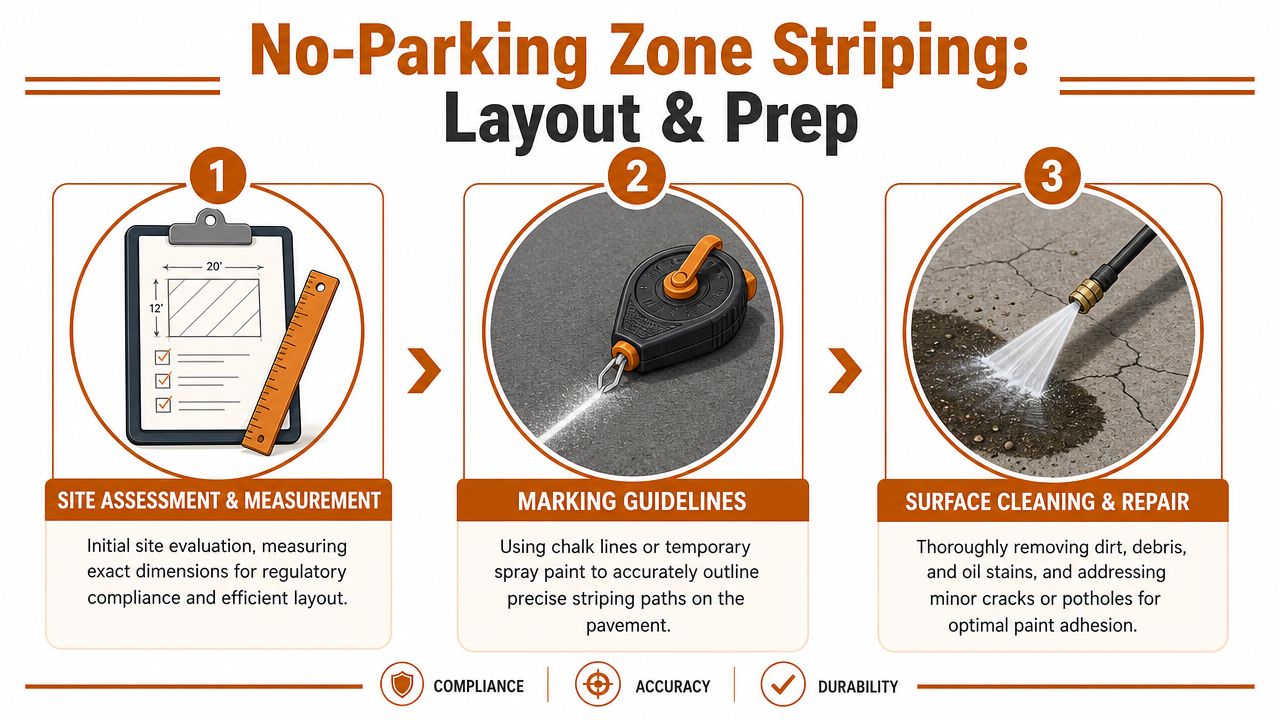
Good crews do not start with paint. They start with control points. On Florida sites, that matters even more because many lots have patched asphalt, concrete aprons, and curb transitions that can pull a line off track if the layout is rushed.
A practical field sequence looks like this:
- Confirm the zone limits: Set the start and end points from fixed site features such as hydrants, curb returns, ramps, bollards, or access aisles.
- Snap control lines first: Use chalk lines, string lines, and measuring marks to keep diagonal striping parallel and readable from the drive lane.
- Dry-fit stencil placement: Position "NO PARKING" stencils before spraying so the message lands centered and faces approaching traffic correctly.
- Check surface transitions: If the marking crosses from asphalt to concrete, adjust the setup before production so spacing and alignment stay uniform.
For a practical overview of field setup and striping sequence, this guide on how to stripe a parking lot is a useful reference.
A quick visual can help you see the sequence in action:
Prep work that makes paint last
Surface prep decides how long the striping stays legible. In Central Florida, intense UV, frequent rain, heat buildup, and windblown grit wear markings faster than many managers expect. Paint that looks sharp on day one can start failing early if it was applied over dust, chalky oxidation, curing residue, or trapped moisture.
I see the same problem across retail centers, medical offices, and HOAs. The striping itself gets blamed, but the actual issue is often the surface underneath.
Asphalt and concrete need different prep because they fail in different ways:
| Surface | What usually causes trouble | Better approach |
|---|---|---|
| Asphalt | Dust, oxidation, old sealer buildup, loose aggregate | Blow off debris, clean contamination, and verify the surface is dry before application |
| Concrete | Smooth finish, curing residue, dust, and moisture trapped in pores | Clean thoroughly, let the surface dry fully, and test adhesion before full production |
Concrete usually needs more attention than managers expect. Dense broom-finished pads, loading areas, and curb-side aprons can hold moisture below the surface even when they look dry. Asphalt brings a different trade-off. It often accepts paint more easily, but old sealcoat, brittle patches, and raveling edges can shorten the life of the line.
Fresh paint won't overcome a dirty surface. It only hides the problem until traffic exposes it.
Prep also includes minor repairs in the striping path. Shallow potholes, edge breakup, failed patches, and active cracks distort line edges and make stencil work look uneven. On mixed-surface properties, a contractor who understands both asphalt and concrete can fix the substrate correctly before striping starts, which gives the markings a better chance of staying compliant and visible through Florida weather.
Selecting the Right Paint and Stencils for Florida
How the main striping materials compare
The best striping material for a Florida property depends on traffic, budget, downtime tolerance, and the surface you're painting. A church lot in Hernando doesn't need the same product strategy as a retail center in Ocala or a busy commercial property in The Villages.
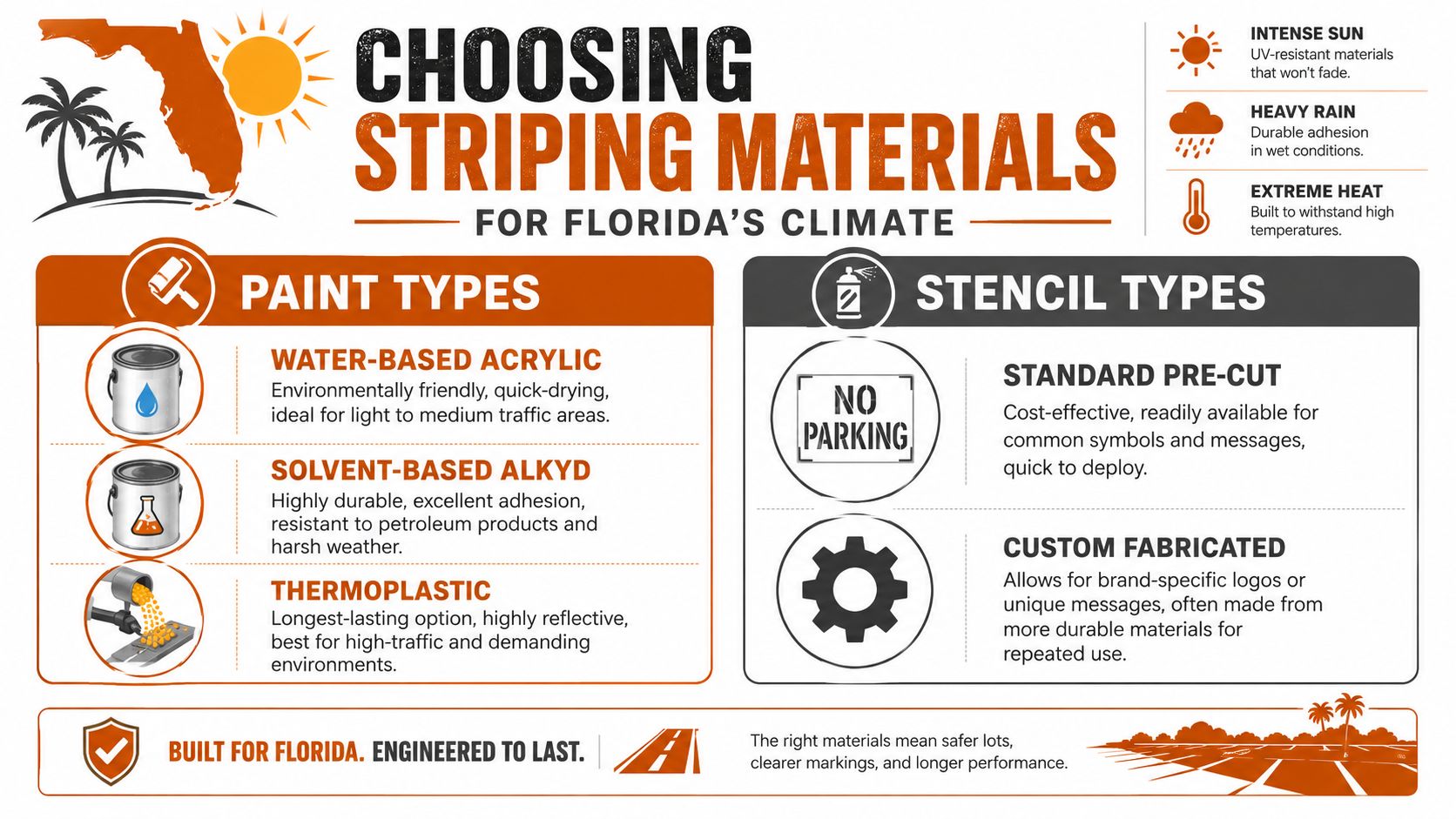
Here is the trade-off most managers face:
| Material option | Where it works well | Where it falls short |
|---|---|---|
| Water-based acrylic | Light to medium traffic areas where fast drying and easier cleanup matter | Can wear faster in harsh, high-turnover sections if prep or timing is poor |
| Solvent-based alkyd | Areas exposed to heavier wear, petroleum drips, and rougher service conditions | Odor, handling requirements, and site conditions can make application less forgiving |
| Thermoplastic | High-demand areas where longer service life and stronger presence are priorities | Higher upfront cost and not always the practical choice for every private lot |
For most private commercial lots in Marion County, FL and Citrus County, FL, the right answer isn't "most expensive is best." The right answer is the product that fits the traffic pattern, drying window, and surface condition. On a small office property in Beverly Hills or Lecanto, a well-prepped acrylic application can perform well. On a harder-used service drive or loading edge, a tougher system may make more sense.
Stencil choices that affect readability
A no-parking zone isn't just yellow hatch marks. If the zone needs text, stencil quality changes the final result more than many buyers expect.
Pre-cut standard stencils work well for common messages such as NO PARKING. They're efficient, familiar to crews, and usually the most practical option for routine jobs. Custom fabricated stencils are better when a property needs repeated specialty wording across multiple areas.
The stencil has to match the pavement texture. Rough asphalt can let paint bleed under a lightweight stencil if it isn't weighted down properly. Smooth concrete can produce a much sharper edge, but only if the surface is clean and the stencil sits flat.
A few field-tested rules help:
- Use thicker stencil stock when the pavement has a coarse texture.
- Anchor the stencil tightly so wind doesn't lift corners during spray passes.
- Avoid overloading the gun because heavy passes create fuzzy edges and pooling.
- Check sightlines from a driver's angle instead of judging the message only while standing over it.
On Florida lots, the winning material isn't the one that looks best for one week. It's the one that still reads clearly after heat, rain, and traffic cycles.
A dual-discipline contractor offers a distinct advantage. If part of the property includes concrete loading pads, sidewalks, curbs, or approach slabs, and another part includes asphalt parking fields, the application approach needs to change with the surface. That's why experienced property managers often look for Concrete and Asphalt Experts in Marion and Citrus County instead of hiring separate trades that don't coordinate well.
Signage ADA Compliance and Overall Safety
A driver pulls into a busy Florida retail center during a summer storm, sees faded diagonal striping, misses the sign, and stops in the access aisle for "just a minute." That is how enforcement problems start, and it is also how accessibility routes get blocked. Paint has to communicate fast from a driver's seat, in glare, rain, and heavy traffic.
Signs carry part of that load. Pavement markings carry the rest.
On larger properties in Ocala, Inverness, and Crystal River, that coordination matters even more because visitors often do not know the site. A striped area near a hydrant, service lane, curb ramp, or main entrance should read clearly before the vehicle comes to a stop. If the restriction is not obvious from the layout alone, install signage that states it plainly.
Areas that often need both striping and signs include storefront corners, loading approaches, dumpster enclosures, narrow drive aisles, and shared parking fields where older markings may already confuse drivers. I also tell property managers to check sign visibility after landscaping grows in and after light poles, bollards, or delivery traffic change the sightlines.
Where ADA risk gets overlooked
ADA-related no-parking striping cannot be treated like a cosmetic touch-up item. Access aisles, curb ramp approaches, and adjacent striped zones protect the usable width a person needs to unload, turn, and reach the accessible route. If those markings fade or get blocked, the parking space may still exist on paper while failing in actual use.
The legal exposure is real. The U.S. Department of Justice explains that civil penalties under the ADA can apply in enforcement actions, with higher penalties for subsequent violations, in its ADA update on penalty amounts. Property owners still carry that risk even when a contractor caused the layout or visibility problem.
The safer approach is to review the area as a functioning route, not just a painted box on pavement:
- Keep access aisles readable: Diagonal striping next to accessible spaces needs strong contrast and enough coverage to stay visible after Florida sun and standing water wear it down.
- Match signs to the pavement message: Drivers should understand the restriction from both the sign and the surface marking, especially in mixed asphalt and concrete areas where reflectivity and color can read differently.
- Follow the path of travel: Check the stall, the aisle, the curb ramp, the sidewalk connection, and the entrance approach. A compliant stall does not solve much if the concrete transition is heaved, slick, or poorly sloped.
- Inspect both surface types: Asphalt parking fields and concrete walks fail in different ways. A contractor who works on both can spot fading, adhesion loss, ponding, and trip hazards before they turn into a compliance issue.
If a person using a wheelchair or walker cannot unload because the striped aisle is faded, blocked, or draining poorly, the site is not working safely.
For commercial centers, schools, churches, and HOA properties across Marion County, FL and Citrus County, FL, safety includes more than line placement. It includes sign placement, curb ramp condition, pedestrian route continuity, and how well the markings hold up under Florida UV and rain. That is one reason many property managers review a contractor's process for both pavement types before hiring. A good starting point is this checklist of questions to ask a concrete contractor when site access, walkways, and parking surfaces all affect compliance.
When to Hire a Professional Concrete and Asphalt Expert
What DIY usually misses
DIY no-parking zone striping looks cheaper at the start because the materials seem simple. The problem is that most of the cost isn't in the paint itself. It's in the layout accuracy, surface prep, traffic control, equipment handling, and avoiding mistakes that force rework.
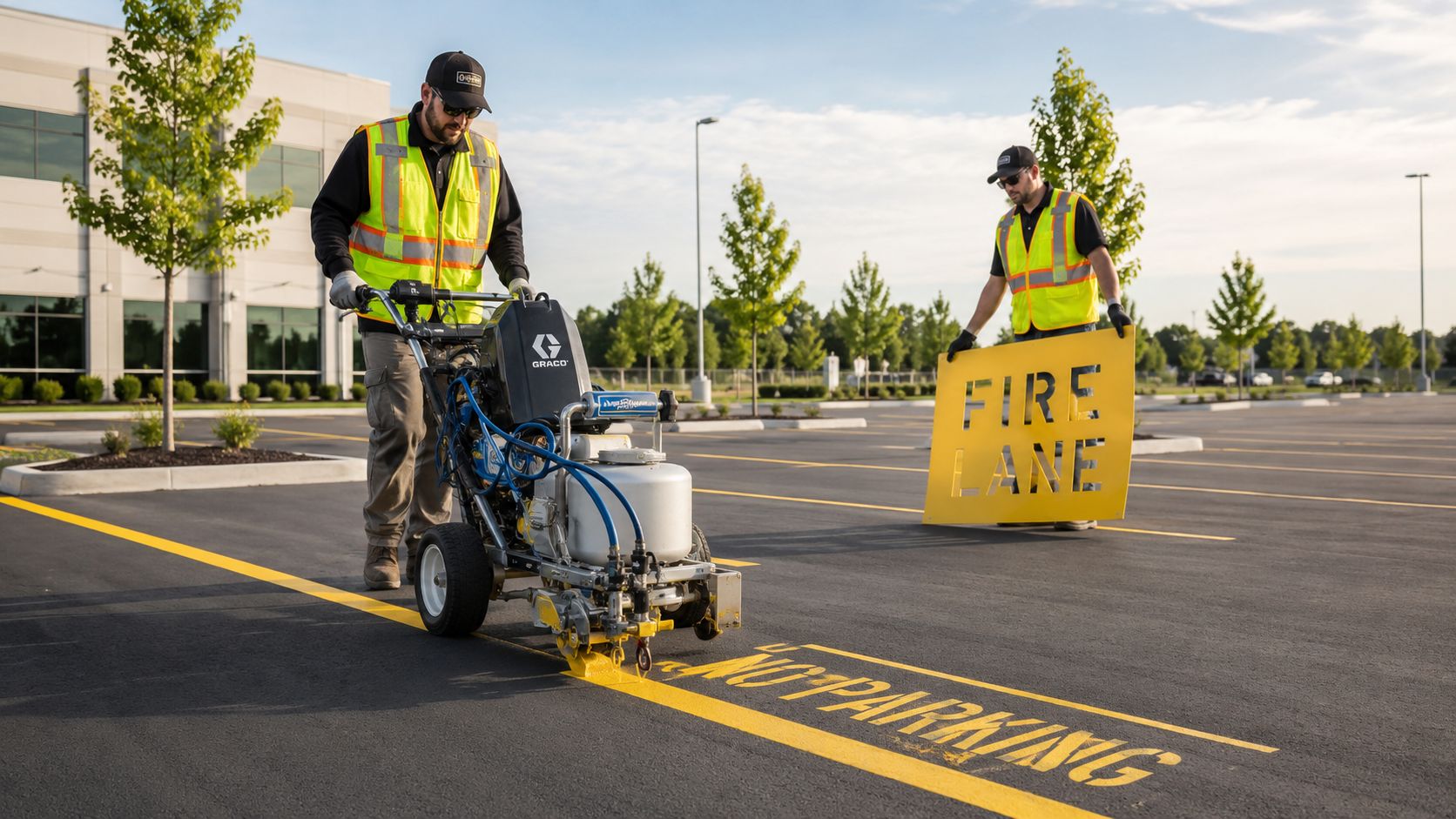
Florida pricing gives a useful benchmark. Re-striping existing lines typically costs between $0.20 and $0.50 per linear foot in Florida, while a full layout with new handicap spaces and directional arrows can range from $500 to over $1,500 based on this Florida parking lot striping cost guide. On paper, that can make small touch-up work look easy to self-perform. In practice, one bad layout or adhesion failure can wipe out the savings.
Common DIY misses include:
- Poor sequencing: Painting before the pavement is fully dry or before repairs are finished.
- Weak edge control: Uneven diagonals, blotchy lettering, and overspray onto curbs or sidewalks.
- No traffic plan: Letting cars roll across fresh paint because the area wasn't staged correctly.
- Misreading the full scope: Treating striping as separate from ADA, concrete transitions, or sealcoating schedules.
Why dual-surface expertise matters
Many commercial sites around Dunnellon, Summerfield, Belleview, Silver Springs, Homosassa, and The Villages aren't asphalt-only. They may include concrete dumpster pads, sidewalks, loading aprons, curb ramps, and entry approaches attached to asphalt parking fields. A contractor who only thinks in terms of striping equipment can miss how those materials behave differently.
A better hire understands the full pavement system:
| Site condition | Why it matters for striping |
|---|---|
| Concrete curbs and ramps | These affect visibility, drainage, and ADA usability around the zone |
| Asphalt wear patterns | Oxidation, patching, and sealcoat timing affect adhesion and appearance |
| Mixed-surface transitions | The line has to stay readable and consistent where materials change |
Licensed and insured contractors also reduce risk in ways that don't show up in a paint estimate. They tend to schedule around weather better, carry the right application equipment, and document the work more clearly. If you're screening companies, these questions to ask a concrete contractor are also useful for evaluating broader site and surface expertise.
For property managers, the long-term win is reliability. Fast turnaround matters, but not if the zone fades early, fails inspection, or has to be redone after adjacent concrete or asphalt work. The strongest results usually come from Concrete and Asphalt Experts in Marion and Citrus County who can tie the whole site together.
Frequently Asked Questions About No-Parking Zones
How often should no-parking zones be restriped in Florida
A zone can look acceptable in January and be hard to read by late summer. In Florida, strong UV, frequent rain, heat, and turning traffic wear markings faster than many property managers expect, especially on entrances, fire lanes, loading areas, and other high-conflict spots.
There is no single private-lot schedule that fits every site. The right timing depends on sun exposure, pavement condition, traffic volume, drainage, and whether the markings sit on asphalt, concrete, or both. On asphalt, oxidation and sealcoat timing affect how well paint holds. On concrete, surface density and moisture can change adhesion and appearance. I usually tell managers to inspect no-parking zones as part of routine property walks and repaint before the message becomes debatable to a driver.
If the striping controls access for emergency equipment or keeps vehicles out of a safety area, treat fading as a liability issue, not a cosmetic one.
Do all no-parking zones need the words no parking painted in them
Some do, some do not.
Yellow diagonal striping often communicates the restriction clearly by itself, but text helps when drivers may misread the space, especially in shared commercial centers, loading areas, and curbside zones with irregular geometry. On sites with hydrants, fire lanes, or mixed-use traffic, adding NO PARKING usually improves compliance because the marking leaves less room for argument.
Hydrant clearance rules should also be checked against local and fire code enforcement expectations. Florida public guidance commonly reflects a no-parking clearance around fire hydrants, and many owners use both striping and signs to make that restriction obvious. For a state reference on fire safety requirements, review the Florida State Fire Marshal resources.
Can you stripe over old faded markings
Yes, if the existing layout is still correct and the surface is stable.
Problems start when crews paint over a bad pattern, offset lines that should have been removed, or markings sitting on failed pavement. That leaves ghosting, double lines, and a zone that looks sloppy from the first day. On older Florida lots, I also watch for areas where ponding water, surface raveling, or chalky concrete will shorten the life of a quick repaint.
A site check should answer three questions. Is the layout still right. Will the new coating bond properly. Will the old marking still show through after repainting. If any of those answers are no, removal, surface prep, or layout correction usually makes more sense than a simple restripe.
Should restriping be coordinated with sealcoating or concrete work
Yes. It should be planned together.
Sealcoating changes the surface and requires fresh striping after the coating cures. Concrete replacement can change curb alignment, ramp edges, drainage flow, and the usable width of a no-parking area. If the lot has both asphalt and concrete, the contractor needs to understand how each surface accepts paint, how water moves across the transition, and how to keep the finished zone readable from end to end.
That is a practical reason to hire a company that works on both materials instead of treating striping as a standalone task. On many Central Florida commercial properties, the longest-lasting result comes from handling pavement repairs, surface prep, and marking layout as one coordinated job.
For property owners in Marion County, FL, Citrus County, FL, and nearby communities like Ocala, Dunnellon, Inverness, Lecanto, Crystal River, Homosassa, and The Villages, a professional evaluation can help you decide whether your lot needs a simple restripe, an ADA update, or a broader maintenance plan. Riverside Sealing & Striping, LLC is a family-owned team of Concrete and Asphalt Experts in Marion and Citrus County providing parking lot striping, asphalt sealcoating, concrete work, and site-specific guidance for commercial and residential properties. If you'd like a free estimate or a no-pressure consultation, visit Riverside Sealing & Striping, LLC.