Published estimates put many small parking lot restriping jobs at $500–$1,000, with an individual 18-foot stall line often priced at $5–$20, according to HomeAdvisor's 2025 cost guide. A 30–50 space restripe often costs $500–$1,200, based on HomeGuide's 2024 cost notes. These ranges are starting points, not a reliable per-space rate for every lot.
The same estimated footage can produce very different bids. A 2024 public bid tabulation priced 4,700 linear feet of stall markings from $0.65 to $5.50 per linear foot, for totals of $3,055 to $25,850. One bidder quoted $2.00 per foot, or $9,400, in the Choice One Engineering bid tab. These procurement figures are benchmarks, not retail prices for Marion County or Citrus County.
A per-space average hides what each contractor includes. One bid may bundle setup and layout into its rate; another may price footage cheaply, then list preparation, paint, and minimum charges separately. For a useful comparison, check what work each total covers. A scoped estimate based on linear feet and the lot's specific markings gives a clearer basis for comparing bids.
Table of Contents
- Parking Lot Line Painting Cost Ranges
- How Contractors Estimate a Lot
- What Changes the Price and What a Complete Quote Lists
- ADA Spaces Arrows and Line Removal
- Paint Life Under Central Florida Sun and Rain
- Sample Prices for Local Property Types
- Frequently Asked Questions Before You Book the Crew
Parking Lot Line Painting Cost Ranges
Start with the published bands, then throw out the idea that every stall costs the same.
HomeAdvisor's 2025 cost guide puts typical parking-lot striping projects at $500–$1,000, with an individual 18-foot parking-stall line at $5–$20. A church lot in Beverly Hills with faded but correctly placed lines can sit in that small-job band. A retail pad in Summerfield with arrows, a fire lane, and worn accessible symbols will not, even if the stall count looks modest.
Why a per-space average misleads
Contractors do not all load the same work into the stall rate. One crew folds mobilization, layout, and a minimum charge into a higher unit price. Another quotes cheap footage and lists traffic control, removal, and symbols on later lines. The public-bid spread above is the cleanest proof. Identical estimated stall footage produced totals that differ by more than twenty thousand dollars because bidders priced setup, prep, paint, and minimums differently.
Marion County and Citrus County lots use the same units: stalls, linear feet, and each specialty marking. Travel from Dunnellon out to Lecanto, a failing surface, or a minimum charge moves the invoice. None of that shows up if you multiply spaces by one national rate.
Count three things before you compare anyone's number. Count the stalls. Measure total linear feet, including stall lines, stop bars, and crosswalks. Then list extras that are not stall lines: accessible symbols, access-aisle hatching, arrows, curb paint, fire lanes, and any old lines that must come off.
Practical rule: If two quotes do not list the same footage and the same extras, they are not bids on the same job.
The table is a working range for budgeting, not a guaranteed invoice. A site walk still replaces every row.
| Scope | Reported range | What the number usually covers | What it leaves out |
|---|---|---|---|
| Small restripe project | $500–$1,000 | Modest existing layout | Heavy removal, redesign, many symbols |
| One 18-foot stall line | $5–$20 | Standard stall stripe | Arrows, ADA symbols, fire lanes |
| Medium lot, 30–50 spaces | $500–$1,200 | Restriping an existing layout | A full redesign |
| New layout versus restripe | 20%–50% higher | Measuring and a new plan | Nothing if the old layout is traced |
| Public bid, per linear foot | $0.65–$5.50 | 2024 bid tab, 4,700 ft of stall markings | A universal Central Florida rate |
| Same 4,700 linear feet, bid totals | $3,055–$25,850 (one bid at $2.00 per foot, $9,400) | Identical estimated quantity | Proof of local retail pricing |
How Contractors Estimate a Lot
You can rebuild almost any quote if you follow the same order the crew uses. The walkthrough on how to stripe a parking lot is the field sequence. The estimate is the math version of that sequence.
- Count the stalls and sort them. Mark standard stalls, accessible stalls, and van-accessible stalls. A Silver Springs office and a Lecanto clinic can have the same stall count and very different accessible work.
- Turn stalls into footage. Multiply stall count by stall-line length. Say a 40-stall lot uses 18-foot lines. That is 720 linear feet of stall stripe before any extras. Double lines, a nose bar, or an angled stall change that product, so do not treat 18 feet as automatic.
- Add extras as their own counts. Fire lanes, stop bars, crosswalks, arrows, accessible symbols, and curb paint are footage or unit items. They are not absorbed into the 720.
- Apply the quoted rate to total footage. As an illustration only, the public-bid spread of $0.65 to $5.50 per foot puts 720 feet at about $468 to $3,960 before extras. That range is a benchmark, not a Marion County price list.
- Add mobilization and the minimum charge. Truck, crew, and setup cost about the same on a tiny lot as on a medium one. Those fixed costs are why a handful of stalls can still land near the $500 project floor.
- Add a new-layout premium when the old lines are wrong. Tracing faded paint is faster than measuring a redesigned drive aisle. Redesign is its own labor block.
- Add removal, traffic control, and concrete the layout depends on. Grinding conflicting lines, cones at a live entrance, and a cracked sidewalk or ramp are priced apart from paint. Concrete driveways, patios, and walkways are a different scope from the stripe.
- Divide the installed total by expected months of visible service. A cheaper gallon that disappears in a season can cost more per month than a coating that holds.
A one-line price per space skips steps 3, 5, and 7. Those three steps are where most surprise charges hide.
What Changes the Price and What a Complete Quote Lists
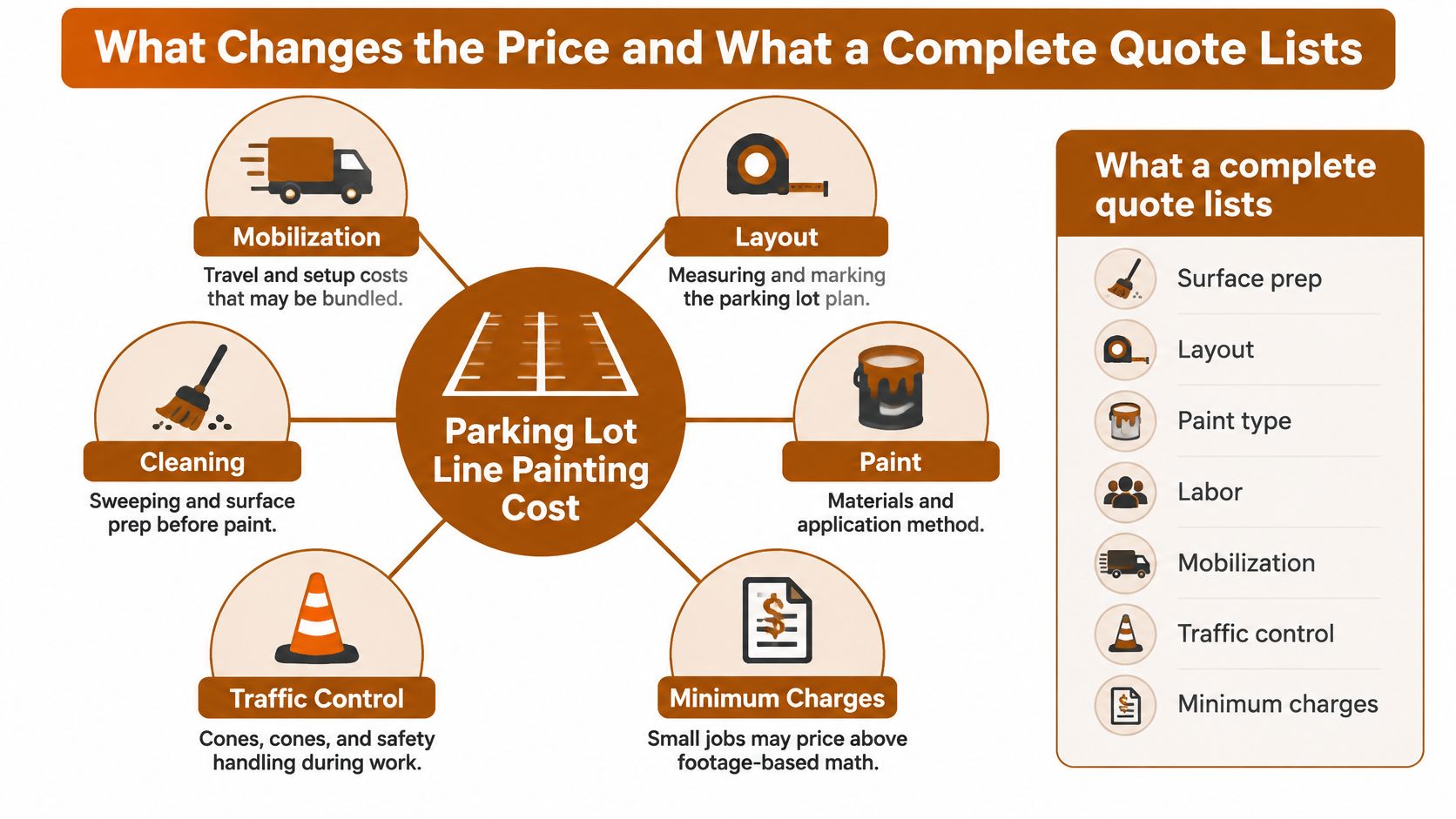
Price gaps are usually a measuring problem. Two honest crews can look far apart because one bundled cleaning and the other billed it, or because one included a night shift and the other assumed a clear lot at dawn.
Drivers to match before you compare bids
Check these items on every proposal. If a line is missing, ask for it in writing rather than assuming it is “included.”
- Total linear footage: The base quantity. Without it, unit prices cannot be checked.
- Stall count and dimensions: Standard stalls, accessible stalls, and van stalls listed separately.
- Symbols, aisles, arrows, and curbs: Wheelchair symbols, hatch marks, directional arrows, and curb paint.
- Fire lanes, stop bars, and crosswalks: A public bid tabulation priced stop lines, crosswalk lines, and double-yellow centerlines as distinct items, so a low stall rate can hide the job.
- Removal: Conflicting or ghost lines that must be ground off or covered before the new layout.
- Trace or redesign: Following the old plan is cheaper than changing circulation.
- Surface condition: Oil, failing sealer, or loose paint changes prep time.
- Traffic control: Cones, flagging, and phased work while a store or church stays open.
What belongs on the written quote
A complete quote names each item, names the material, and states the expected maintenance interval. It says how long cars must stay off fresh lines. It says whether sealcoating happens first, because paint on a failing asphalt film will not last. A one-line price per space, with none of those rows, is not comparable to a line-item bid.
Florida rain and afternoon heat also shape the schedule. Crews often split a lot so lines can cure before the next row of cars returns. A church or school in Homosassa may need night or off-peak work, and that labor is a real line, not a courtesy.
In Marion and Citrus County, confirm the commercial crew is licensed and insured and that the work can be scheduled around business hours. As Concrete and Asphalt Experts in Marion and Citrus County, Riverside Sealing & Striping measures on site and puts each item in writing so the invoice matches the quote. We meet you at your property, at a time that works for you, for a free consultation on concrete, asphalt sealcoating, or striping. The visit is for scoping, not a hard close.
ADA Spaces Arrows and Line Removal
Accessible markings are not ordinary stalls with a different color. Each one adds layout the stall rate does not cover, and a restripe that copies a short stall just locks the error in for another season.
The ADA restriping guidance allows a van space either as a 132-inch stall beside a 60-inch access aisle or as a 96-inch stall beside a 96-inch aisle. In both layouts the aisle runs the full length of the space, stays tied to the accessible route, and is marked so drivers do not park in it. Van spaces, their aisles, and the routes serving them also need at least 98 inches of vertical clearance. That clearance is what surprises people at covered walkways, garages, and loading canopies.
Sizes, counts, and measurement
A standard accessible car space is at least 96 inches wide with an access aisle at least 60 inches wide. The U.S. Access Board parking guide also requires a firm, stable, slip-resistant surface, with slope no steeper than 1:48 (about 2.08%) in any direction. Identification signs are a separate install: the bottom of the sign must be at least 60 inches above the ground.
Widths are measured to the centerline of the marking. Where no adjacent space or aisle exists, the full width of the line may count, per the Access Board's chapter 5 measurement rule. A stripe that looks centered can still leave a stall short if someone measures from the wrong edge of the paint.
Two spaces may share one aisle. That aisle still cannot overlap the drive path. Handicap spaces run roughly one per 25 spaces, and the count rises as the lot grows. Arrows, stop bars, crosswalks, fire-lane lettering, stall numbers, and curb paint should be their own line items. Our striping work covers precision layout, handicap markings, arrows and symbols, and high-visibility traffic paint. When the walking route is cracked or too steep, ADA parking lot striping requirements sit next to sidewalk repair: grading, drainage, anti-slip surfaces, and restoration are concrete work, priced outside the paint.
| Item | Minimum planning size | Why it costs more than a stall line |
|---|---|---|
| Standard accessible space | 96-inch space with 60-inch aisle | Stall lines plus a striped aisle and symbol |
| Van-accessible option A | 132-inch space with 60-inch aisle | Wider stall and hatch markings |
| Van-accessible option B | 96-inch space with 96-inch aisle | Very wide no-parking aisle |
| Shared access aisle | One aisle serving two spaces | Must stay clear of the drive path |
| Wheelchair symbol and sign | Sign bottom at least 60 inches high | Paint plus a separate sign install |
| Accessible-space count | 1 for 1–25 stalls; 2 for 26–50; 3 for 51–75; 4 for 76–100 | Count rises with lot size |
| Arrows, stop bars, crosswalks, fire lanes | Priced per marking | Not absorbed in a stall rate |
| Removal of old lines | Only where lines conflict | Grinding or covering before the new layout |
Remove or black out a wrong layout before any new paint. Fresh paint over a conflicting stripe only makes the error darker.
Paint Life Under Central Florida Sun and Rain
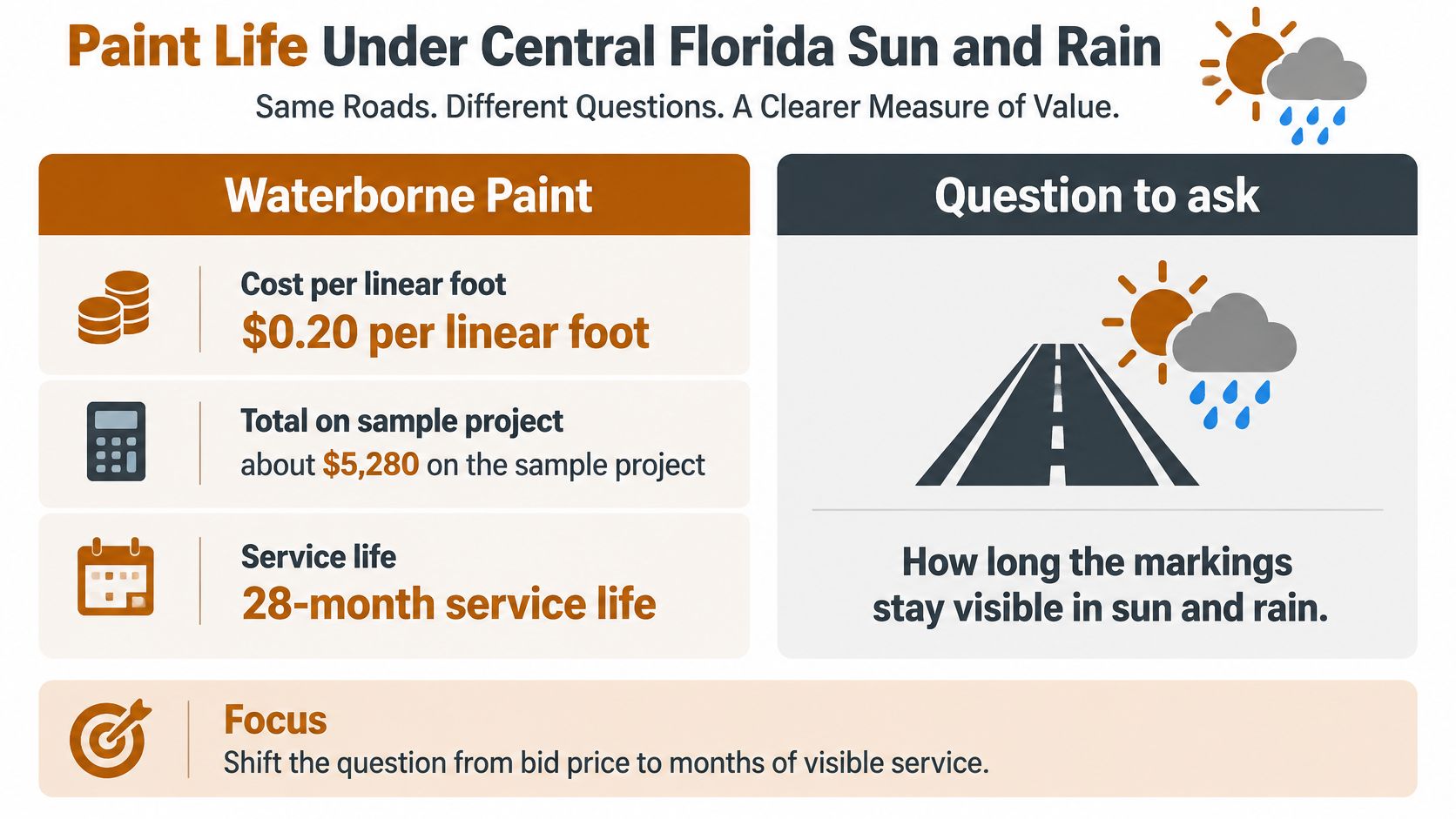
The better question is not “what is the cheapest gallon.” It is “how many months will a driver still see the line.”
Highway benchmarks, not local invoices
FHWA's pavement-marking selection model prices material, project cost, service life, and annualized cost together. In one benchmark, waterborne paint was modeled at $0.20 per linear foot, about $5,280 on the sample project, with a 28-month service life. High-build paint was modeled at $0.36 per foot, about $9,504, with a 29-month life, per the FHWA pavement-marking selection chapter. Nearly identical life means the higher material is not automatically the better buy. Divide installed cost by expected months and compare that figure.
Those highway numbers are benchmarks. They are not Marion County or Citrus County retail prices. They do explain why a busy Crystal River shopping lot and a quiet Hernando office should not buy the same specification.
What sun, rain, and traffic do to a line
Waterborne paint is the lowest-cost option, and FHWA reports that 89% of state agencies use it because it is the least expensive marking material. Central Florida heat, UV, summer downpours, and turning traffic in Ocala and The Villages still wear lines faster than a mild climate would. Wet-weather sight distance is part of the value. New markings can be detected from roughly 112–125 feet in wet conditions, while old markings may be detected from only 89–108 feet, according to FHWA pavement-marking research. Beads with a refractive index around 1.9 perform best when dry. Wet pavement may need an index near 2.4.
Ask for higher-visibility paint, thermoplastic, or a better bead package where night use, faster drive aisles, fire lanes, or crossings justify it. Brighter paint alone does not guarantee fewer crashes. FHWA notes that detection distance tracks retroreflectivity, and that no direct link has been established between small visibility gains and crashes. Wider lines can help lane-keeping in low contrast, while proof of longer detection distance is inconclusive, per the FHWA benefits synthesis.
| Option | Modeled installed cost | Expected life | When it fits a local lot |
|---|---|---|---|
| Waterborne paint | $0.20 per foot; $5,280 sample | 28 months | Ordinary stalls with moderate traffic |
| High-build paint | $0.36 per foot; $9,504 sample | 29 months | Only if the spec truly lasts longer on that site |
| Higher-visibility or thermoplastic treatment | Higher upfront | Longer where the product is suited | Night aisles, wet crossings, fire lanes |
| Reflective beads | Part of the marking system | Performance depends on bead type | Wet lots need a higher-index bead than dry lots |
Sealcoating protects asphalt from water, fuel, oil, and UV, and our sealing work includes the stripe that follows. Seal first, then paint, so the new line is the top layer. A short guide to the best parking lot striping paint helps you match the coating to the aisle. Repaint when visibility falls below the performance threshold, not only when the color is gone.
Sample Prices for Local Property Types
Every dollar below is an illustration built from published ranges, not a bid. The site visit replaces it.
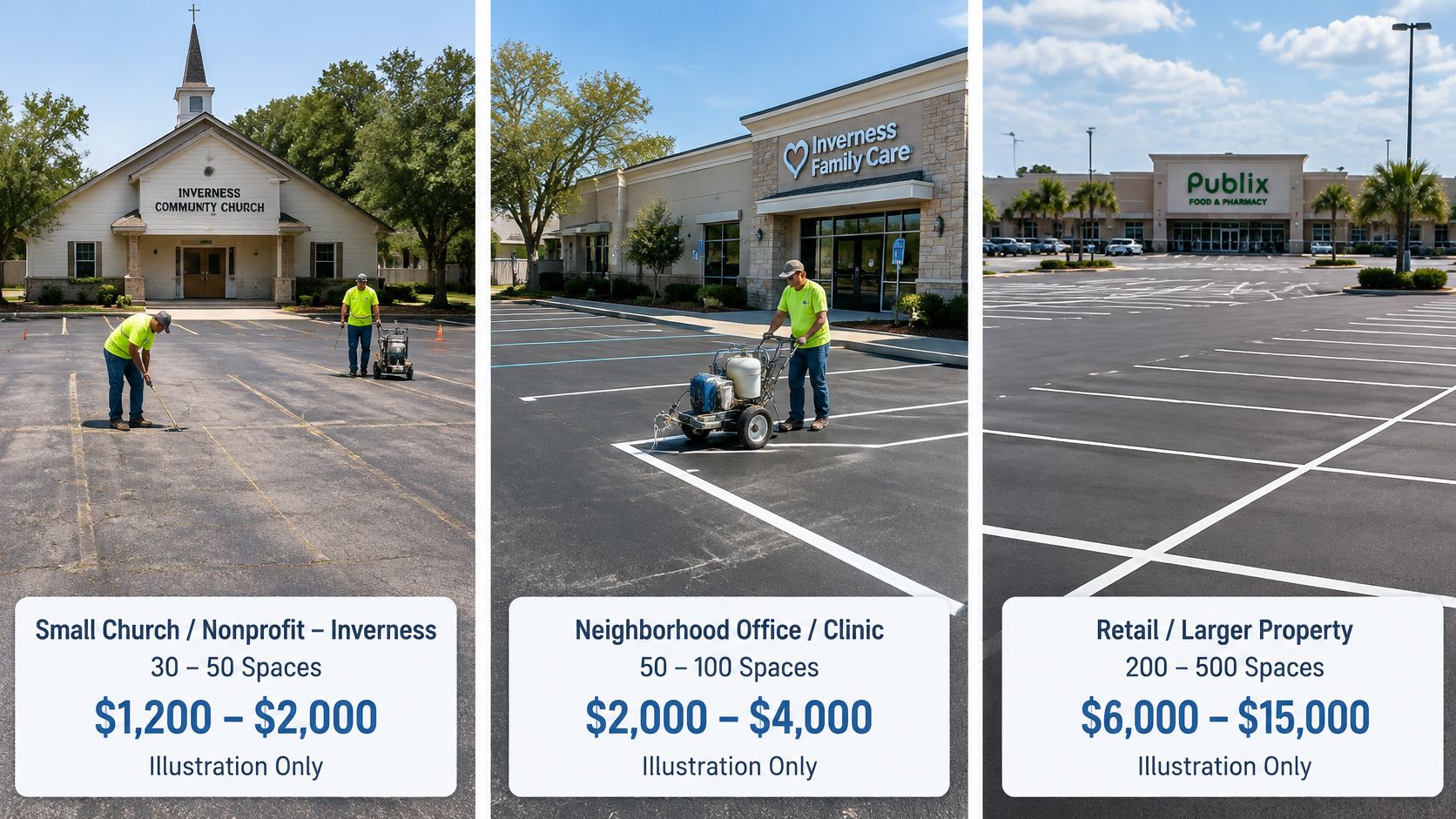
HomeGuide's 2024 cost notes put a medium lot of 30–50 spaces at $500–$1,200 on average when crews follow existing lines, and new layouts at 20%–50% more because measuring and redesign take longer than tracing faded paint.
A small church or nonprofit in Inverness. The layout is already right, lines are faded, and a few symbols need a refresh. That job can sit near the $500–$1,200 band if removal is light and the crew is not rebuilding circulation. Weekend access may add labor even when footage is modest.
A retail center in Ocala or Summerfield. Well over 50 spaces should not be forced into the medium-lot band. Scale it by linear feet, then add fire lanes, arrows, crosswalks, and the accessible spaces the count requires. A national per-stall average will understate that list.
An HOA in Dunnellon or Belleview. Asphalt stalls often meet concrete walkways. The paint number stays in the medium band only when the walking route is already compliant. If the drive aisle must be redesigned, apply the new-layout premium and add van-aisle hatching. A covered drop-off in Crystal River or Homosassa can add relocation cost if the van route lacks 98 inches of clearance. Schools and churches may pay more for after-hours scheduling even when the stripe itself is simple.
Treat each sketch as a budgeting envelope. Stall count starts the conversation. Footage, removal, accessible layout, and cure time finish it.
Frequently Asked Questions Before You Book the Crew
How often should lines be redone in Central Florida? There is no fixed year count. Schedule repainting from a visibility check, sooner on a busy retail aisle than on a lightly used lot in Beverly Hills or Hernando. If drivers cannot pick up the stall line in rain or at dusk, the paint has finished its service life even if some color remains.
Should sealcoating and striping be one visit? Seal first when the asphalt needs protection from water, fuel, and UV, then stripe so the new paint is the top layer. Confirm the concrete curbs, sidewalks, and any driveway apron the layout depends on are sound before the crew snaps lines. Painting a pretty stall up to a broken ramp does not fix the route.
Who should approve the work for an HOA, church, or tenant space? The party that controls the pavement should approve the layout, the accessible-space count, and access during curing. A tenant who only occupies one suite should not be the only signer on a shared lot.
Is a very small lot worth a minimum charge? Yes, when mobilization exceeds the paint cost. That is why a handful of stalls can still land near the $500 project floor. Paying the minimum is cheaper than living with a layout that is short, faded, or missing a van aisle.
Skip multiplying stalls by a national rate. Call Bert Counts from 7am to 7pm at 352-266-6062 for a free, no-pressure estimate, or send the project through the contact form. The visit covers both the asphalt markings and any concrete sidewalk or driveway repairs the layout depends on.
Riverside Sealing & Striping, LLC measures parking lot line painting cost by stalls, linear feet, accessible markings, and months of service, and we handle the concrete sidewalks and asphalt sealcoating that the layout depends on. We are based in Dunnellon and work across Marion County, Citrus County, and nearby Central Florida. Visit Riverside Sealing & Striping, LLC to request a free, no-pressure on-site estimate.