
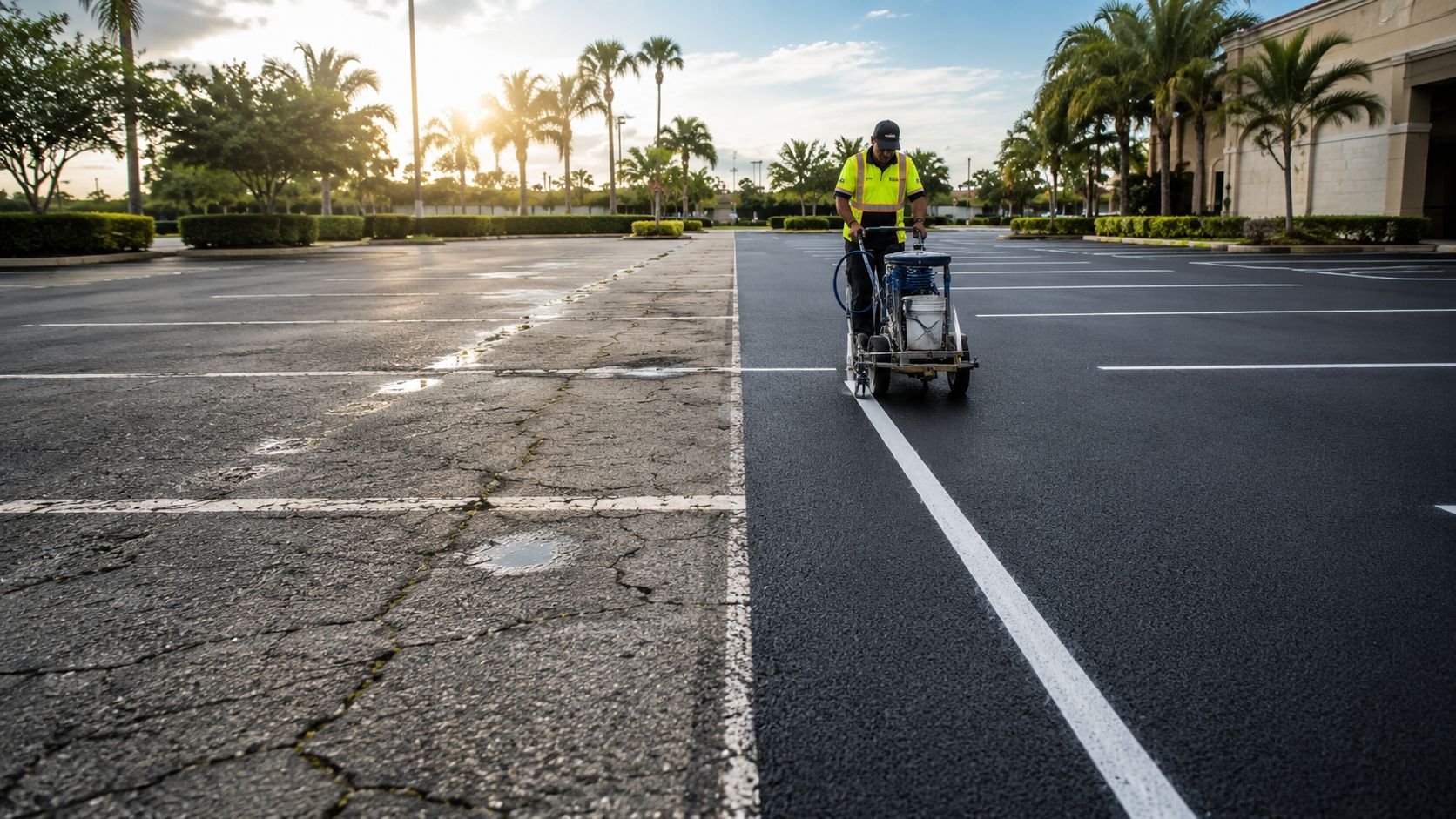
You walk the property before tenants arrive. In Ocala, that might mean spotting faded stall lines near the storefront. In Crystal River, it might mean water still sitting in low spots from yesterday's rain. Either way, the same thought usually follows: the lot doesn't look sharp, and worse, it may not be as safe as it should be.
That's when a lot of owners and managers start searching for Parking Lot Maintenance Near Me. The problem is that most results are too narrow. They talk about sealcoating or striping as if the lot is the only surface that matters. On real commercial properties in Marion County, FL and Citrus County, FL, the job is bigger than that. Parking stalls, handicap markings, curbs, ramps, sidewalks, and entry paths all work together.
In Central Florida, pavement doesn't fail in a neat, predictable way. Heat bakes the surface. UV dries it out. Rain pushes water into cracks. Traffic grinds the damage wider. Concrete sidewalks and ramps can become just as important as the asphalt itself, especially around retail centers, churches, HOAs, schools, and office properties in Dunnellon, Belleview, Lecanto, Inverness, and The Villages.
Good maintenance is part appearance, part risk control, and part long-term planning. The properties that stay in good shape usually have one thing in common. Someone catches small issues early and knows when a surface repair is enough, and when it isn't.
Table of Contents
- Is Your Parking Lot Sending the Right Message?
- Key Signs Your Pavement Needs Professional Attention
- The Four Pillars of Professional Parking Lot Maintenance
- The Financial and Safety Benefits of a Proactive Plan
- Navigating ADA Compliance in Marion and Citrus County
- Why Choose a Local Concrete and Asphalt Expert
- Frequently Asked Questions About Parking Lot Care
- How often should a Florida parking lot be sealcoated
- What's the best time to schedule parking lot maintenance
- Can faded striping be repainted without other repairs
- Do concrete sidewalks and ramps need to be included in parking lot maintenance
- What's the value of hiring one company for both concrete and asphalt work
Is Your Parking Lot Sending the Right Message?
A worn lot tells people something before they ever reach the door. Tenants notice it. Shoppers notice it. Insurance carriers and inspectors notice it too. On a busy property in Summerfield or Homosassa, faded markings and rough pavement can make a place look neglected even when the building itself is well maintained.
That first impression matters, but the bigger issue is what it usually signals underneath. A faded lot often means maintenance has been reactive instead of planned. Maybe the cracks were patched once and left alone. Maybe the striping was refreshed but the surface underneath kept breaking down. Maybe the concrete walk to the entrance was never included in the pavement budget.
A clean, clearly marked lot makes traffic flow better, reduces confusion, and gives people more confidence in the property.
Owners often call for one problem and end up finding three. They ask about sealcoating, then realize the handicap spaces are hard to read. They ask about striping, then notice the wheel stops, curbs, and sidewalks no longer match the condition of the lot. That's common across commercial sites in Beverly Hills, Hernando, Silver Springs, and Inverness.
The best results come from looking at the whole approach, not just one line item.
One search usually leads to several problems
When someone searches for Parking Lot Maintenance Near Me, they're usually not looking for theory. They want to know what's urgent, what can wait, and what work will hold up in Florida weather. That means evaluating:
- Surface wear: Gray, dry asphalt usually needs attention before cracking spreads.
- Water behavior: Standing water after rain often points to drainage or low-area issues.
- Traffic markings: Faded arrows, stalls, and fire lanes create confusion fast.
- Accessibility features: Striping, signage, ramps, and access paths all need to work together.
- Concrete condition: Curbs, sidewalks, and ramps affect safety just as much as the driving lanes.
That's why the strongest maintenance plans come from Concrete and Asphalt Experts in Marion and Citrus County. Commercial pavement isn't just blacktop. It's an entire site system.
Key Signs Your Pavement Needs Professional Attention
A lot of pavement problems are easy to miss until they become expensive. The safest habit is to walk the property and stop looking at it like a driver. Look at it like someone responsible for safety, drainage, and long-term upkeep.

In Central Florida, heat and UV open the door, then rain makes the damage worse. A lot in Belleview or The Villages can look mostly serviceable from the street and still be taking on water through open cracks and failing edges.
What to look for on asphalt
Start with the asphalt itself. The most common warning signs are visible if you slow down and check the travel lanes, parking stalls, and drive aisles on foot.
- Wide open cracks: Cracks wider than ¼-inch are considered critical repair candidates; sealing them immediately upon detection prevents water from reaching base layers, which otherwise leads to potholes and structural failure, according to ARC Florida's parking lot maintenance guidance.
- Alligator cracking: This webbed pattern usually means the surface is under stress and may have deeper support problems.
- Raveling: If the surface is losing aggregate and looks rough or grainy, the protective top layer is breaking down.
- Potholes or edge breakup: Once pieces start separating, traffic accelerates the damage.
- Faded striping: Drivers stop improvising only when they can clearly see where to go.
A useful reference is this parking lot maintenance checklist for routine site reviews. It helps managers catch the issues that usually get missed between major projects.
After the walk-through, it helps to see how these issues develop in the field:
Don't ignore the concrete around the lot
Parking lot maintenance doesn't stop at the asphalt. On many commercial properties in Marion County, FL and Citrus County, FL, concrete creates the final safety path to the building.
Check these areas closely:
- Curbs with breaks or spalling: Damaged curbs don't channel traffic or water the way they should.
- Sidewalk trip points: Height differences, broken panels, and loose edges become pedestrian hazards.
- Ramp deterioration: An access route is only as good as the ramp that connects it.
- Dumpster pads and loading areas: These concrete sections often take abuse and fail sooner than expected.
Practical rule: If the asphalt looks tired, inspect the concrete next to it. Both surfaces usually age together under the same traffic and weather.
That's one reason local property owners do better with contractors who understand both materials, not just one.
The Four Pillars of Professional Parking Lot Maintenance
A parking lot stays serviceable when the maintenance plan covers the whole system. Surface protection keeps water out. Striping controls how vehicles and pedestrians move. ADA markings have to remain clear enough to defend in the field, not just on a site plan. Concrete repair finishes the job because broken walks, ramps, and curbs still create safety and liability problems even if the asphalt looks decent.
Pillar one asphalt surface protection
Asphalt in Central Florida takes a steady beating from sun, heavy rain, standing water, oil, and slow traffic at entrances and drive aisles. Sealcoating and crack sealing address different problems, so they should never be treated as the same line item.
Crack sealing targets open joints and visible cracks before water gets below the surface. Sealcoating protects the top layer from oxidation and chemical exposure. Used at the right time, both services extend pavement life and delay larger repairs.
Used at the wrong time, they waste money.
If a lot still has good structure, preventive work makes sense. If the base is already soft, pumping moisture, or failing under traffic, a fresh black surface only hides the problem for a short time. I tell owners the same thing on site all the time: cosmetic improvement is not structural repair. The right call may be localized patching, drainage correction, or section replacement before any coating goes down.
Pillar two striping that controls traffic
Striping is operational maintenance. It affects how drivers enter, where they hesitate, how delivery trucks swing wide, and whether pedestrians can read the site quickly.
On busy retail pads, medical offices, churches, and HOA entrances, faded markings create small daily problems that turn into larger risk. Cars crowd access aisles. Fire lanes lose definition. Tenants start improvising their own traffic pattern. That usually leads to complaints, curb strikes, and harder enforcement.
Common striping work includes:
- Parking stalls: Keep spacing consistent and the lot usable.
- Directional arrows: Reduce confusion in drive aisles and at entrances.
- Fire lanes and no-parking zones: Make restricted areas obvious at a glance.
- Loading and curb markings: Separate regular traffic from service activity.
Property managers planning a restripe or layout correction can review this guide on how to stripe a parking lot correctly before approving the work.
Pillar three ADA upgrades that hold up
ADA work in a parking lot is not just paint. It is the condition, visibility, and usability of the accessible route from stall to entrance. That includes the markings, signage, access aisle clarity, nearby curb ramps, and the surrounding concrete condition.
Florida weather wears these areas faster than many owners expect. Rain, humidity, UV exposure, and turning tires fade paint and beat up transition points. A space can still be in the same location and still fall short if the markings are weak, the aisle is hard to read, or the route crosses damaged concrete.
That is why ADA maintenance needs field judgment, not a checklist alone. The question is whether a visitor can identify, use, and travel the route safely and clearly.
Pillar four concrete repair that completes the site
Concrete problems usually show up at the edges first. Curbs break down from traffic impact. Sidewalk panels lift or settle. Ramp edges spall. Dumpster pads and loading areas crack under repeated weight and abuse.
These issues affect more than appearance. They change drainage, create trip hazards, weaken transitions between parking and pedestrian areas, and make ADA corrections harder to hold over time. On many commercial properties, the concrete determines whether the parking lot feels maintained or patched together.
This is also where it pays to hire a contractor who handles both asphalt and concrete. A lot may need crack sealing in one area, a rebuilt curb in another, and a ramp or sidewalk correction to finish the route properly. Treating those as separate problems often leads to mismatched elevations, drainage mistakes, or phased work that costs more than it should.
| Service | Purpose | Frequency (FL Climate) |
|---|---|---|
| Sealcoating | Protect asphalt from UV, rain, and chemical exposure | Every 2 to 3 years on lots that still have sound surface condition |
| Crack sealing | Stop water from entering through open cracks | As soon as working cracks are found |
| Line striping | Improve traffic flow, safety, and visibility | Refresh as markings fade |
| ADA marking updates | Maintain accessible spaces and clear aisles | Review regularly, especially after wear or resurfacing |
| Concrete repair | Restore ramps, sidewalks, curbs, and related site features | As damage appears |
The Financial and Safety Benefits of a Proactive Plan
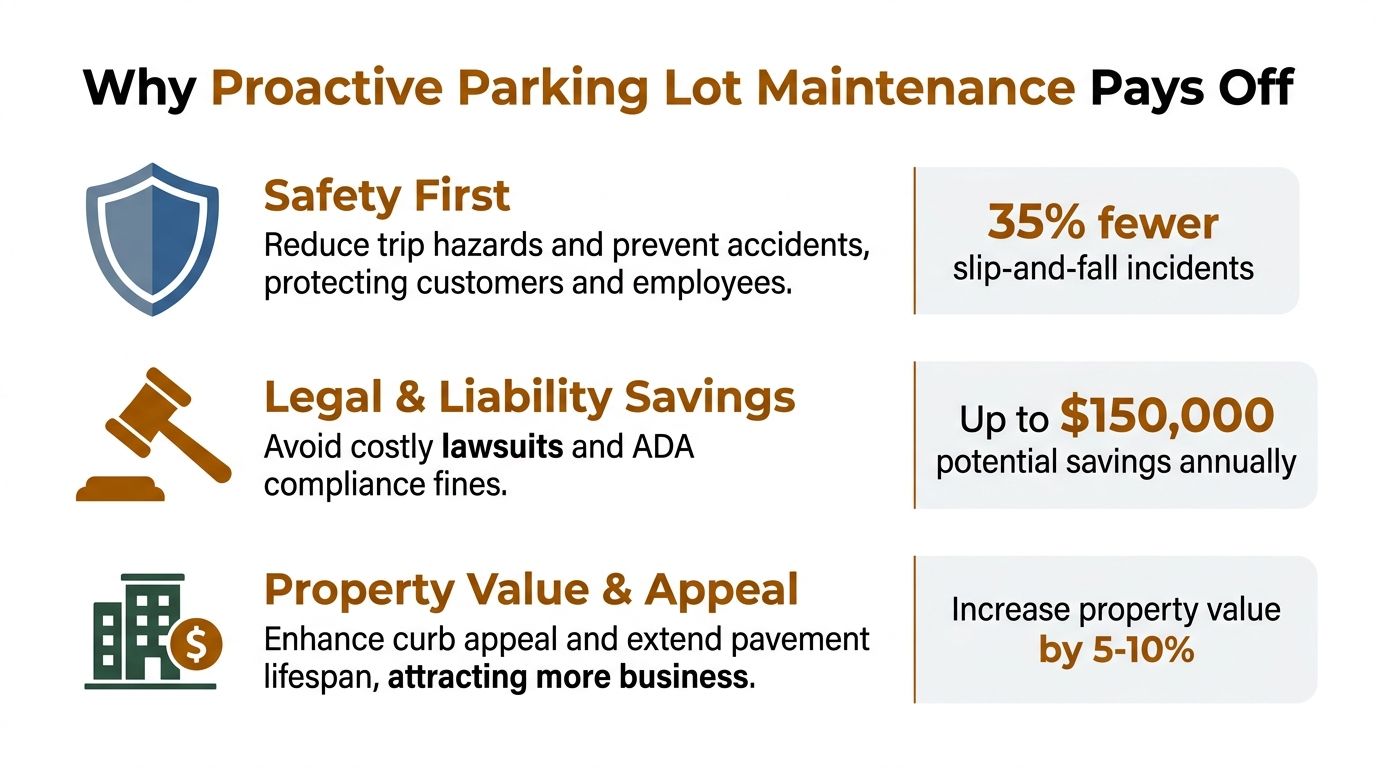
Reactive maintenance feels cheaper in the moment. It usually isn't. When owners delay repairs, they rarely preserve the lot in its current condition. They let water, traffic, and time turn one repair into several.
Small repairs stay small only when you act early
The best reason to maintain pavement early is simple. It keeps maintenance work in the maintenance category. Once the base starts failing, the conversation changes from preserving an asset to replacing one.
With consistent maintenance that includes sealcoating, crack sealing, and drainage management, an asphalt parking lot can last between 20 and 30 years before requiring full reconstruction, according to Neighbor's parking lot maintenance overview.
That's the long game property managers in Summerfield, Homosassa, and Crystal River should care about. A lot that stays serviceable longer gives you more flexibility with capital planning, tenant turnover, and phased site improvements.
Good maintenance buys time. Time is what lets owners schedule work on their terms instead of during a failure.
Appearance matters because behavior follows condition
People respond to pavement condition. Drivers hesitate in poorly marked lots. Pedestrians walk around broken areas and create informal paths. Tenants assume neglected parking means neglected property management.
A proactive plan supports more than surface life:
- Safer movement: Clear markings and sound walking surfaces reduce confusion.
- Better curb appeal: A maintained lot makes the building look cared for.
- Fewer emergency calls: Planned work is easier to schedule than urgent patching.
- More consistent budgeting: Smaller recurring work is easier to manage than surprise reconstruction.
That matters across mixed-use properties, medical offices, shopping centers, schools, and HOA common areas. On many sites, the pavement is the first maintenance item people judge and the last one owners want to replace unexpectedly.
Navigating ADA Compliance in Marion and Citrus County
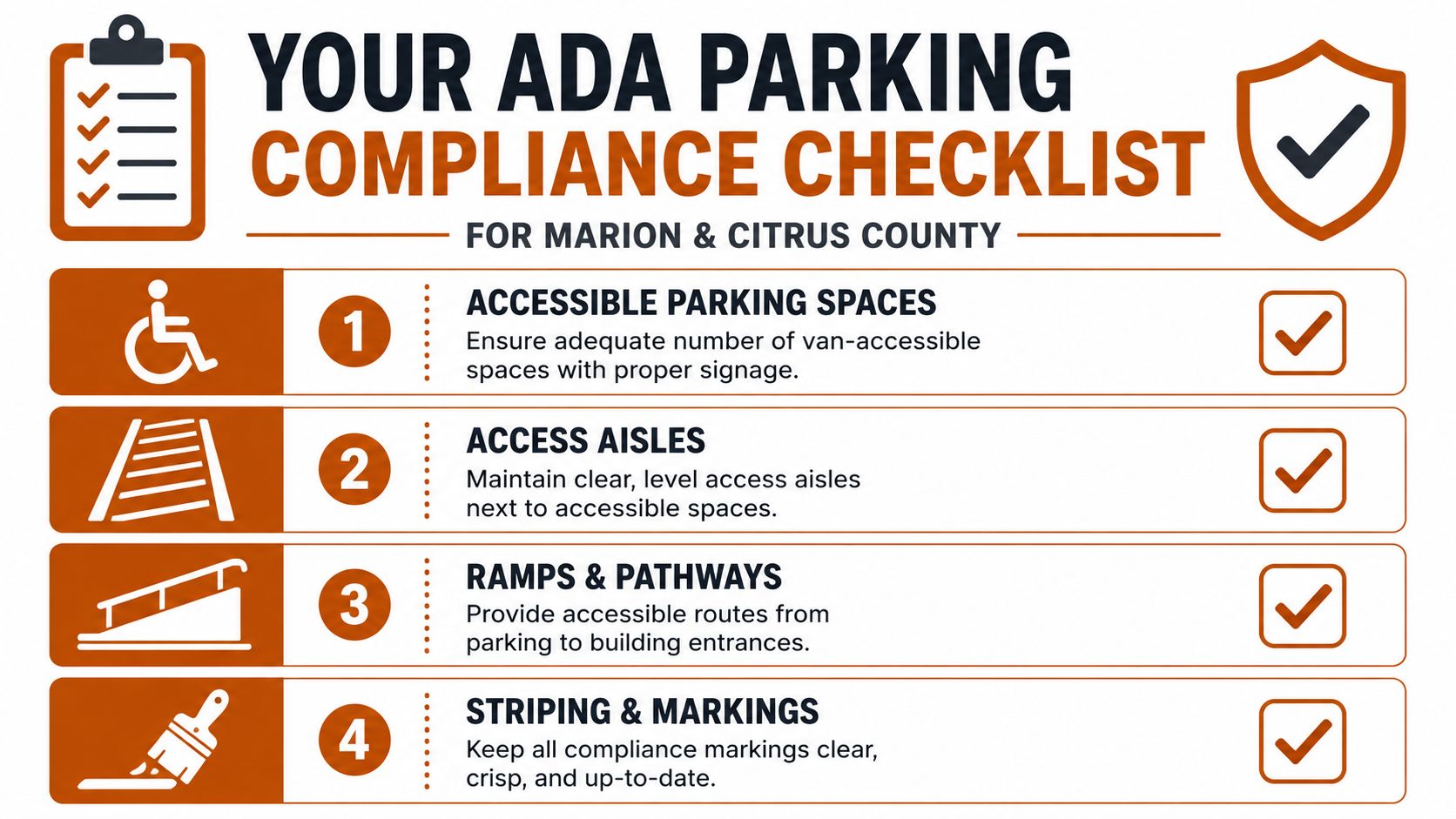
ADA parking compliance is where many generic parking lot maintenance pages fall short. They focus on striping as a cosmetic task when, on a commercial property, it's also a legal and operational one. In Central Florida, that gap gets expensive because weather wears markings down faster than many managers expect.
Why Florida weather creates a compliance problem
Humidity, rain, and oil runoff shorten the life of painted markings and make handicap spaces harder to read. That's a bigger issue than appearance alone. Data from the U.S. Department of Justice indicates that 42% of parking lot liability lawsuits in the last 12 months stem from faded or non-compliant handicap markings, a problem accelerated by humidity and rain in regions like Central Florida, as noted in this parking lot maintenance resource discussing ADA-related risk.
That matters for shopping centers in Ocala, churches in Dunnellon, offices in Inverness, and commercial properties in Lecanto or Beverly Hills. A handicap space that looked acceptable last year may no longer be clear enough today, especially if annual maintenance focused only on basic striping.
There's also an overlooked timing issue in wet-weather regions. Property managers often assume a general maintenance contract covers everything they need. It may not include the documentation and recertification attention required for handicap spaces in climates where markings fade faster.
What managers should check on site
ADA compliance isn't one painted symbol. It's a chain of connected elements that all need to be intact.
Walk the property and verify these items:
- Accessible spaces are clearly marked: The stall layout and wording must still be easy to identify.
- Access aisles remain visible: If the striped aisle is fading, the space stops functioning as intended.
- Routes to the entrance stay usable: Sidewalks, ramps, and transitions need to be in serviceable condition.
- Concrete features match the striping work: A compliant stall doesn't help if the ramp or walkway is broken.
For a closer review of required parking space features, this page on ADA handicap parking space requirements is a practical starting point.
Accessibility work fails when owners treat the paint as separate from the path. The striping, signage, ramp, and sidewalk all have to work together.
Why Choose a Local Concrete and Asphalt Expert
A property manager calls after a rainstorm because tenants are tracking water into the lobby, a delivery truck has started breaking the lot edge near the curb, and the newly painted handicap stalls already look uneven against cracked concrete. That job does not need three subcontractors arguing over scope. It needs one local crew that can diagnose the whole site and fix the parts in the right order.
In Central Florida, parking lots fail at the transitions first. Asphalt meets curb. Sidewalk meets ramp. Drainage meets traffic. If those areas are handled by separate trades with separate schedules, the owner often pays twice. One company patches asphalt, another replaces concrete, then the striping crew shows up before the surface is ready. The result is rework, tenant complaints, and a property that still looks neglected.
That is why local concrete and asphalt experience matters. A contractor who works regularly in Marion County and Citrus County can spot whether the underlying problem is surface wear, water movement, base failure, broken pedestrian concrete, or a combination of all four. That changes the repair plan. It also changes the budget, because a cheap surface fix on the wrong problem usually turns into a larger invoice within a season.
One site plan, not a patchwork of trades
A commercial property rarely needs just one maintenance item. It may need asphalt crack repair, sealcoating, curb work, sidewalk replacement, ramp correction, and fresh parking lot striping during the same service cycle.
Handled well, those tasks support each other. Handled poorly, they conflict.
A contractor who manages both concrete and asphalt work can sequence the site correctly. Concrete is repaired first where pedestrian access or curbs have failed. Asphalt repairs follow once edges, drainage points, and tie-ins are defined. Striping goes down after the surface is stable and clean. That order protects the finish and reduces call-backs.
It also lowers risk for the owner. If ADA stalls, access aisles, and pedestrian routes depend on both paving and concrete corrections, one accountable contractor is easier to manage than multiple crews with partial responsibility.
Local judgment saves money in Florida conditions
Florida schedules are not copy-and-paste from other states. Sun exposure, heavy rain, irrigation overspray, and year-round traffic change how long a repair holds and when work should be done. As noted earlier, sealcoating intervals in Florida are often shorter than owners expect. The right timing still depends on traffic volume, drainage, shade, and how much turning movement the lot gets at entrances and drive lanes.
Local field experience shows up in material choices and job timing. Some lots can wait on full resurfacing if crack repair, drainage correction, and restriping are handled early. Others should not be sealcoated yet because the surface defects underneath will telegraph right back through. That is the kind of call that protects long-term value.
Owners also have legal exposure tied to appearance and function. Faded ADA markings, trip hazards in concrete walks, and standing water near entrances are not just maintenance issues. They can become liability issues. A local contractor who handles both pavement and concrete can address those items as one property condition instead of treating each symptom separately.
The best hire is not the lowest bid. It is the contractor who can walk the site, explain what needs attention now, what can wait, and what will cost more if ignored through another Florida summer.
Frequently Asked Questions About Parking Lot Care
How often should a Florida parking lot be sealcoated
In Florida conditions, a common recommendation is every 2–3 years, depending on wear, traffic, and exposure. Lots with more sun, rain, and turning traffic may need closer monitoring.
What's the best time to schedule parking lot maintenance
Dry weather and a clean scheduling window help. The right timing depends on the work. Sealcoating, striping, crack sealing, and concrete repairs each have different prep and cure considerations, so it's best to plan before the lot becomes urgent.
Can faded striping be repainted without other repairs
Sometimes, yes. But repainting alone won't solve cracking, drainage issues, or broken concrete access paths. If the surface under the lines is failing, fresh paint only improves appearance for a short time.
Do concrete sidewalks and ramps need to be included in parking lot maintenance
They should be. The parking area and the pedestrian route work together. That's especially true for ADA access, trip hazard prevention, and overall property appearance.
What's the value of hiring one company for both concrete and asphalt work
It creates one scope, one schedule, and one standard of workmanship across the site. That usually makes planning easier for HOAs, retail properties, churches, schools, and managers handling multiple maintenance needs at once.
If your property in Marion County, FL, Citrus County, FL, or nearby Central Florida areas needs a clearer maintenance plan, Riverside Sealing & Striping, LLC offers free estimates and no-pressure consultations. As Concrete and Asphalt Experts in Marion and Citrus County, the team handles everything from asphalt sealcoating and parking lot striping to concrete sidewalks, ramps, curbs, patios, slabs, and driveway replacement. They're licensed and insured, locally experienced, and known for reliable scheduling, fast turnaround, and high-quality workmanship.