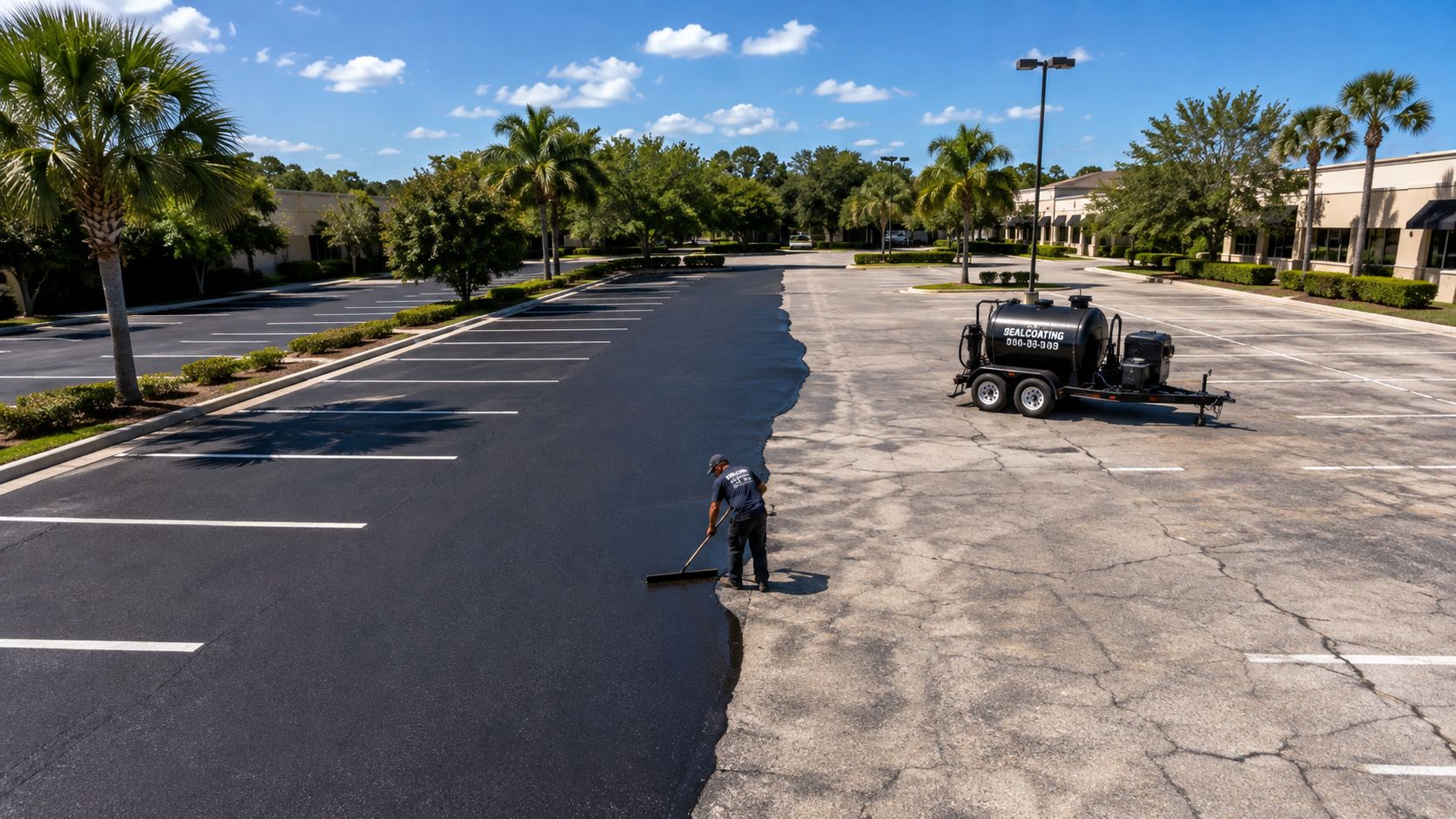
A five-year-old shopping center lot in Ocala can look acceptable in March, then appear tired by August. The pavement fades from black to gray, fine sand collects along the curbs, sprinkler overspray leaves damp edges, and hairline cracks begin to show around parking stalls and drive aisles. Property managers in Inverness, Crystal River, and throughout Central Florida see the same pattern.
Parking lot seal coating helps slow that decline, but only when crews apply it to sound asphalt, prepare the surface correctly, and schedule the work around Florida weather. In Marion County, FL and Citrus County, FL, the right maintenance plan must account for intense UV exposure, summer downpours, humidity, sand, oil drips, and steady vehicle traffic.
Table of Contents
- What Parking Lot Seal Coating Is and Why It Matters in Central Florida
- How Seal Coating Extends Pavement Life and Lowers Long-Term Costs
- The Seal Coating Process Step by Step
- DIY Versus Hiring a Professional Seal Coating Contractor
- How to Choose the Right Seal Coating Contractor in Marion and Citrus County
- Coordinating Seal Coating With Striping and Long-Term Lot Maintenance
- Common Questions About Parking Lot Seal Coating Answered
- How long does seal coating last in Ocala-area conditions?
- What temperatures and weather conditions are suitable?
- What happens if rain arrives within 24 hours?
- Does new asphalt need to cure before sealing?
- Can seal coating fix cracks and potholes?
- What should a warranty cover?
- Does seal coating satisfy stormwater or ADA requirements?
What Parking Lot Seal Coating Is and Why It Matters in Central Florida
Seal coating is a preventive surface treatment, not a structural repair. A crew spreads or sprays a thin protective layer of petroleum-based asphalt emulsion or another approved formulation across existing asphalt. The coating helps reduce exposure to ultraviolet light, oxygen, water, fuel, and surface wear. It doesn't rebuild a weak base, correct deep rutting, or restore pavement that has already failed.
The distinction matters in Central Florida. A lot near Silver Springs or Summerfield may receive strong sun throughout the year, afternoon thunderstorms during the warmer months, and sand tracked onto the surface from shoulders, unpaved edges, and landscaping. Sprinkler overspray can keep pavement damp near curbs, while fuel and oil drips attack exposed asphalt in busy retail areas.
The Florida asphalt paving resource provides useful context on how asphalt construction and maintenance fit together. Seal coating belongs near the preservation end of that lifecycle, before oxidation and water intrusion develop into larger failures.
Timing matters more than a dark finish
Most Florida parking lots benefit from resealing every 2 to 3 years, with higher-traffic or more weather-exposed properties needing a shorter interval, according to this Central Florida sealcoating guide. That schedule isn't a promise that every lot needs identical treatment. Pavement age, traffic patterns, drainage, previous applications, and surface condition all affect the inspection.
The Federal Highway Administration treats crack and fog seals as most appropriate when pavement remains in excellent to good condition. Those treatments can extend pavement life by 1 to 4 years, while stronger combinations of surface treatments may extend useful life by 3 to 7 years before larger rehabilitation becomes necessary, as described in the FHWA pavement maintenance resources.
Practical rule: Seal coating protects good asphalt. It can't turn failed asphalt back into good asphalt.
A sound lot in Dunnellon, Lecanto, or The Villages should be evaluated before the calendar determines the work. If the pavement has widespread alligator cracking, potholes, severe raveling, or ruts, repairs or resurfacing may provide better value than another surface coat.
How Seal Coating Extends Pavement Life and Lowers Long-Term Costs
A parking lot in Ocala can look sound in spring, then show faded asphalt, loose aggregate, and opening cracks after another summer of UV exposure and heavy rain. Seal coating does not rebuild weak pavement, but applied at the right stage, it slows the surface deterioration that leads to larger repair bills.
Asphalt loses flexibility as its binder oxidizes. A brittle surface allows water into small cracks and weak points, while traffic speeds up raveling and edge breakdown. A properly selected sealant reduces that exposure and gives owners more time before major rehabilitation is needed.
The Asphalt Institute describes seal coats as a way to slow oxidation, inhibit raveling, and help seal small surface cracks and voids on sound, low-traffic pavement. Its seal coat guidance also notes that sealing intervals depend on pavement condition and site conditions. In Marion and Citrus counties, Florida UV, sand, summer downpours, traffic, and drainage help determine whether a lot is ready for another application. Many properties in Ocala, Dunnellon, and Inverness settle into a 2 to 3 year reseal rhythm, but the inspection should control the schedule.
The comparison below uses the planning figures supplied for this article. These are budgeting assumptions, not a guaranteed quote for a specific property.
| Metric | Unsealed Lot | Sealed Every 2–3 Years |
|---|---|---|
| Surface condition | Oxidation and wear continue unchecked | Surface receives recurring preventive protection |
| Maintenance approach | Larger repairs arrive sooner when damage spreads | Minor deterioration is addressed before broader failure |
| Planning horizon | May require earlier rehabilitation | Preservation work can extend useful service life when pavement is still suitable |
| Example surface treatment cost | No recurring seal coat expense | $0.25–$0.50 per square foot, based on the supplied planning range |
| Example overlay cost | Full overlay may become necessary | A major overlay can be deferred when the structure remains sound |
For a 40,000-square-foot lot, the supplied seal-coat range equals roughly $10,000 to $20,000 per application, calculated from $0.25 to $0.50 per square foot. A full overlay at $1.50 to $3.00 per square foot would equal roughly $60,000 to $120,000 for the same area. Use these figures for early budgeting only. A site-specific estimate must account for preparation, repairs, access, and pavement condition.
Where the calculation stops working
Seal coating may be poor value when a lot has structural cracking, widespread depressions, unstable edges, or serious drainage problems. The coating can hide surface symptoms while the underlying failure continues. Milling, patching, base correction, or an overlay may be the responsible recommendation.
The practical lifecycle plan is direct: inspect early, repair localized defects, seal sound pavement, and keep water moving away from the lot. That sequence helps landlords, HOAs, churches, retail centers, and property investors delay major capital work instead of waiting for visible distress.
The Seal Coating Process Step by Step
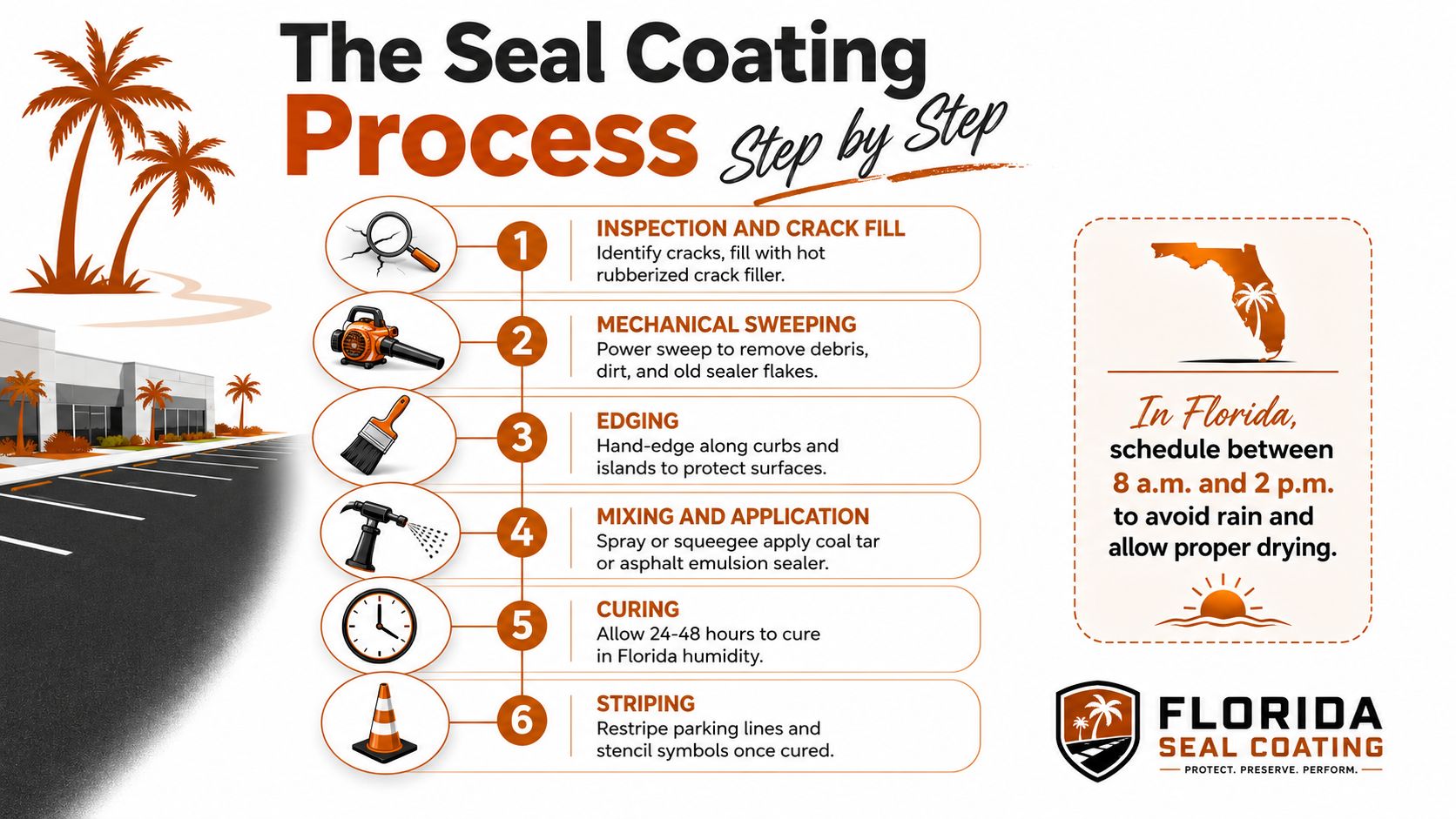
A professional crew starts with the pavement, not the sealer. The first visit should identify cracks, potholes, oil contamination, drainage trouble, loose aggregate, and areas where the asphalt has lost structural support.
Preparation determines the result
Cracks are cleaned and filled before the surface treatment. Oil spots may need a primer or specialized cleaning because ordinary sweeping won't remove contamination that prevents adhesion. Crews then mechanically sweep the lot, blow debris from joints and edges, and hand-edge around curbs, islands, wheel stops, sidewalks, and building entrances.
The two-coat application requires controlled material placement. A useful planning benchmark for two coats is about 0.25 gallons per square yard on average asphalt, according to this sealcoating coverage calculation guide. Actual spread depends on surface texture, porosity, mix design, and the product specification.
The first coat may be squeegee-applied where penetration and filling of surface texture matter. The second coat may be sprayed for a more uniform finish. A crew should follow the selected product's technical requirements rather than use one application method on every lot.
Weather controls the schedule
PennDOT guidance says air, pavement, and aggregate temperatures should be at least 60°F for seal-coat application, with seasonal work generally limited to a window from May 1 through September 15 or October 1, depending on location, as reported in this sealcoating research report. Another weather guide advises avoiding temperatures below 50°F and avoiding rain within 24 hours, with favorable conditions around 50°F to 90°F and a dry surface for at least a full day, according to these sealcoating weather considerations.
In Marion and Citrus counties, crews watch radar closely. If a pop-up storm threatens, they delay the application, protect material and equipment, and don't gamble on a wet film. The lot then needs its cure period before vehicles return, and striping follows only after the surface is ready.
For related crack preparation, property managers can review parking lot crack sealing services. The final walkthrough should confirm coverage, edges, drains, wheel stops, access routes, and the plan for parking lot striping.
DIY Versus Hiring a Professional Seal Coating Contractor
DIY seal coating can make sense for a small, simple residential area where the owner can control access, accept cosmetic variation, and spend time on preparation. A commercial parking lot creates a different set of problems. The surface is larger, traffic returns quickly, edges are more complicated, and one vehicle crossing tacky sealer can damage the finish.
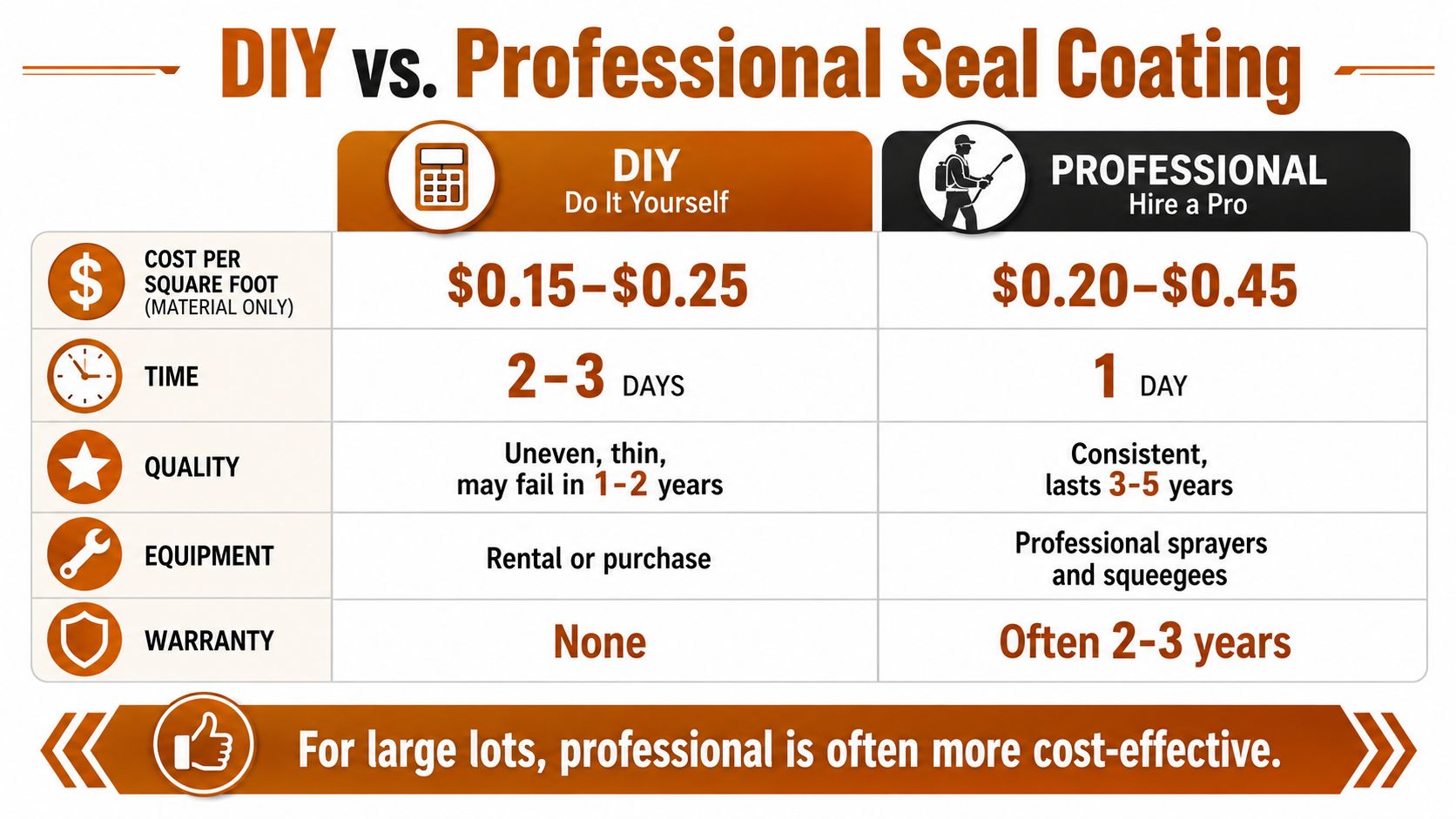
The supplied planning ranges place DIY material at $0.15 to $0.25 per square foot and professional application at $0.20 to $0.45 per square foot in Central Florida. Those figures don't include every preparation item, equipment cost, repair, traffic-control measure, or striping requirement. The material advantage of DIY can shrink once the owner rents a power broom, blowers, sprayers, barricades, and other equipment.
Coverage is where many DIY jobs fall short
A real two-coat film needs adequate material. The supplied professional planning benchmark is 40 to 50 gallons per 1,000 square feet, while a coverage guide gives about 0.25 gallons per square yard for two coats on average asphalt, depending on the surface. Bucket-and-squeegee applications often spread the material too thin, leaving weak coverage that wears quickly and may show lap marks.
A 20,000-square-foot lot also creates a scheduling problem. The supplied field estimate calls for four people, two coats, and a full day of cure before traffic. A property manager must close or phase the lot, coordinate tenants, protect the work from rain, and prevent residents or customers from driving across the wet surface.
Jobsite reality: The sealer is only one part of the project. Access control and surface preparation decide whether the application survives its first busy week.
Professional work may be the better choice for shopping centers, HOAs, churches, schools, and apartment communities because the contractor brings application equipment, crew coordination, repair judgment, and traffic planning. DIY remains reasonable when the area is small and the owner can keep it closed through the entire cure period.
How to Choose the Right Seal Coating Contractor in Marion and Citrus County
A low bid can leave out the preparation that makes seal coating work. Property managers should compare the scope, product, coverage, repairs, cure plan, warranty, and striping coordination instead of comparing only the final number.
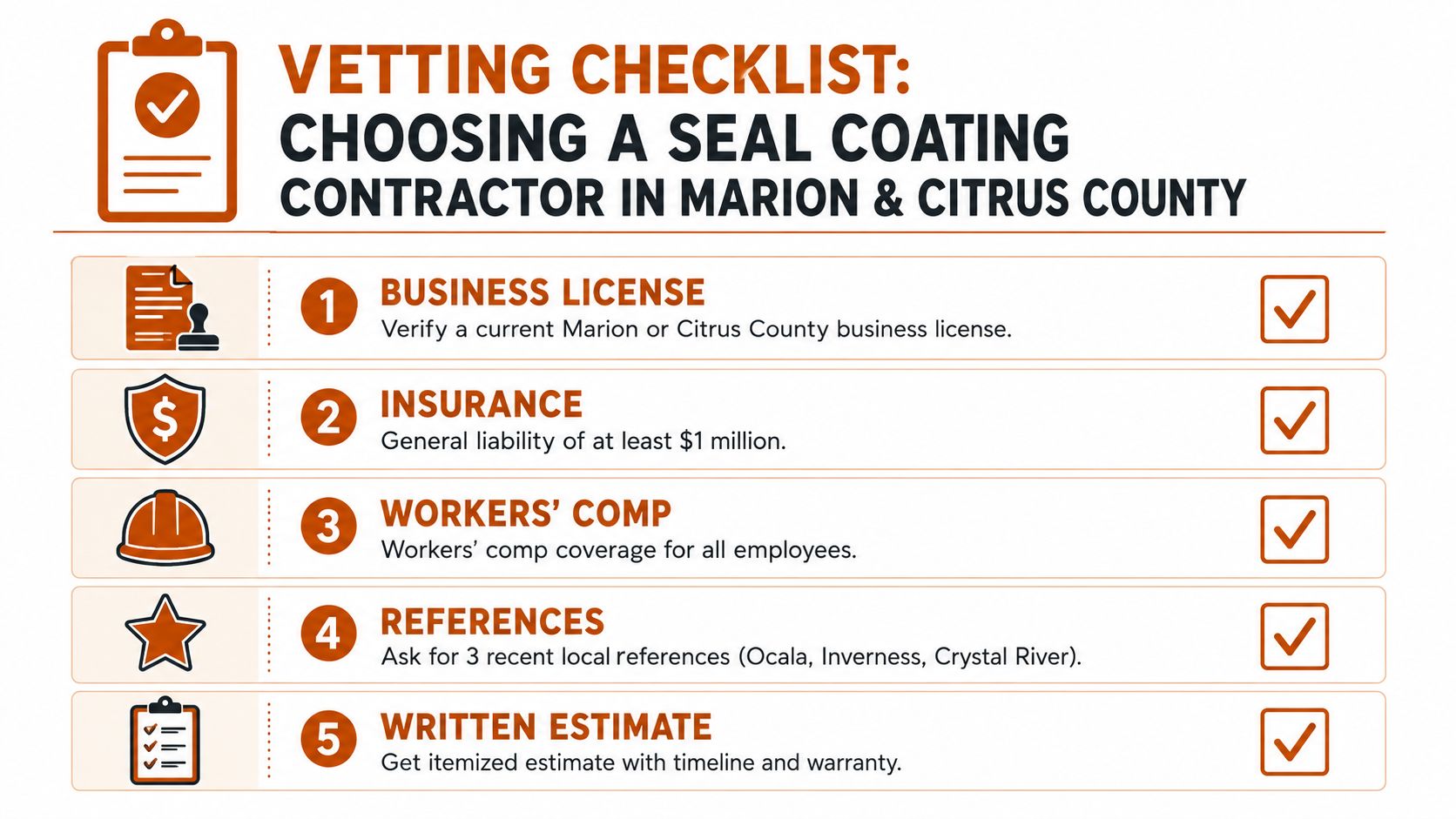
Ask for documentation before scheduling:
- Business license: Confirm the contractor's current local business credentials for work in Marion County, FL or Citrus County, FL.
- Insurance: Request proof of general liability insurance of at least $1 million, as specified in the supplied vetting criteria.
- Workers' compensation: Verify coverage for the crew, especially on commercial sites with active tenants and public access.
- Local references: Request recent references from areas such as Ocala, Inverness, or Crystal River.
- Written estimate: Require itemized preparation, crack filling, sealer application, traffic control, striping, timeline, and warranty terms.
The product discussion deserves care. Independent municipal specifications commonly call for a quick-setting or premium petroleum-based asphalt emulsion with at least 60% nonvolatile content. Some specifications also set density near 9.5 pounds per gallon and asphalt content at 25% to 35% of the nonvolatiles, as shown in the Los Altos seal-coat specification. Those benchmarks help buyers ask informed questions about film build, viscosity, runoff, and durability.
Compliance is now part of product selection
Coal-tar and high-PAH formulations carry regulatory and environmental concerns. Virginia banned the sale of sealants above 1% PAHs in 2024 and banned use or application in 2025. Ontario's 2025 regulations similarly restrict coal-tar and high-PAH sealants, according to this environmental forensics presentation. Local rules and product legality should be confirmed before purchase or application.
Red flags include door-to-door crews requesting deposits before measuring, verbal-only proposals, sealing over standing water, and refusing to explain how oil spots or failed areas will be handled. A reliable contractor should also explain whether sand will be added for traction on sloped drives and how existing striping will be restored.
For a local comparison point, review the scope described by asphalt seal coat contractors serving Central Florida, then ask every bidder the same questions.
Coordinating Seal Coating With Striping and Long-Term Lot Maintenance
Seal coating works best as part of a maintenance arc. Crack repair comes first, the surface treatment follows, and striping comes after the coating has cured. Treating those services as unrelated jobs can create avoidable scheduling conflicts, especially when a retail center, church, HOA, or apartment community must remain accessible.
A practical sequence is:
- Inspect the lot and document cracks, drainage, faded markings, and damaged areas.
- Clean and fill cracks, allowing the material to cure before the seal coat.
- Complete pothole repairs, localized patching, and oil-spot treatment.
- Apply the seal coat under suitable temperature and moisture conditions.
- Restripe after the cured surface can accept traffic-grade pavement paint.
- Recheck ADA stalls, access aisles, fire lanes, arrows, stop bars, and directional markings.
Crack sealing should be completed at least 30 days before seal coating under the supplied maintenance plan. Striping should follow a full 24-hour cure period, also based on the supplied project guidance. The exact cure time still depends on humidity, shade, surface temperature, product, and traffic.
A recurring calendar prevents emergency work
| Task | Frequency | Best Window | Bundled With Seal Coat? |
|---|---|---|---|
| Visual pavement inspection | Each spring | Before heavy summer weather | Yes, during the planning visit |
| Crack sealing | As needed | Dry, stable weather | Yes, but complete before coating |
| Seal coating | Every 24 to 36 months in Central Florida conditions | A dry weather window | Core service |
| Parking lot striping | Every other seal-coat cycle, or when markings fade | After the surface cures | Yes |
| Drainage and edge review | During each inspection | Before surface treatment | Often |
ADA spaces and fire-lane markings require more than painting over old lines. If the layout has shifted, the contractor should remeasure stalls, access aisles, symbols, and traffic paths rather than use faded markings as a template.
The supplied planning note estimates that bundling seal coating and striping under one contractor can save 10% to 15% compared with separate bids. That figure should be treated as a project-specific budgeting benchmark, not a guaranteed discount. The operational benefit is often just as important, because one schedule reduces the chance that fresh striping is delayed or traffic control is duplicated.
Common Questions About Parking Lot Seal Coating Answered
How long does seal coating last in Ocala-area conditions?
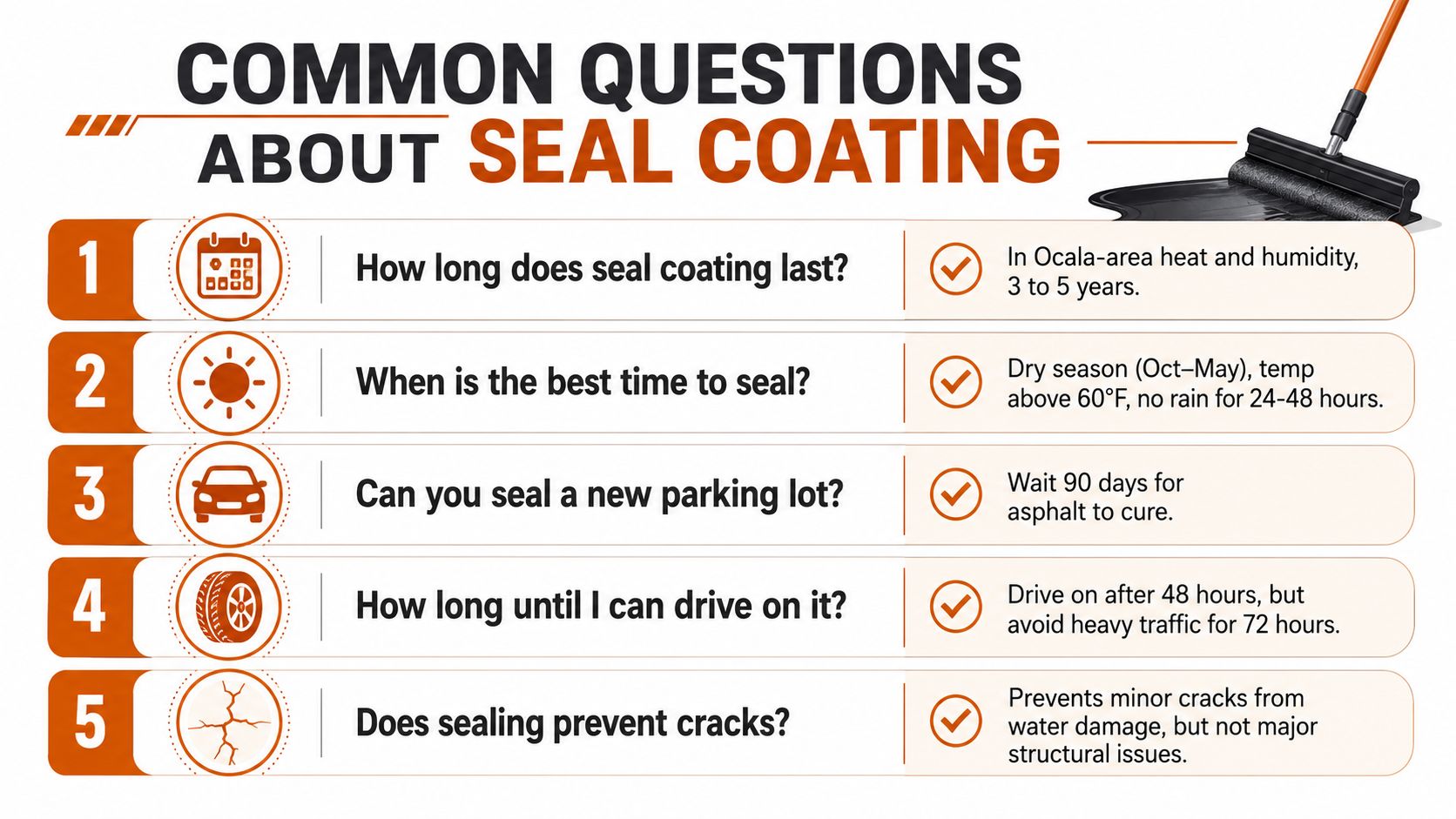
For lots in Ocala, Dunnellon, and nearby Marion County communities, plan on resealing every 2 to 3 years. Heavy traffic, Florida UV exposure, summer downpours, sand, and poor drainage can shorten that cycle. The pavement itself remains the better guide: gray, dry-looking asphalt, surface raveling, returning hairline cracks, or fading markings signal that an inspection is due.
What temperatures and weather conditions are suitable?
Application requires suitable temperatures and a dry surface. Field guidance commonly sets a minimum of 60°F for air, pavement, and aggregate, while other recommendations avoid application below 50°F. Avoid rain within 24 hours and do not coat damp asphalt. In Central Florida, the crew should check pavement temperature, confirm the surface is dry, and watch storm development instead of relying only on the morning forecast.
What happens if rain arrives within 24 hours?
Rain can dilute uncured sealer, disturb the finish, and weaken adhesion. A contractor should pause or postpone work when storms threaten. If rain reaches a fresh application, the crew needs to inspect the dried surface and explain whether it requires touch-up, more curing time, or corrective work.
Does new asphalt need to cure before sealing?
New asphalt needs time to develop a surface that will accept sealer. The supplied project guidance gives a general 30- to 90-day curing range, though the appropriate wait can be longer depending on the mix, weather, and pavement condition. Inspection matters more than applying sealer just because a calendar date has passed.
Can seal coating fix cracks and potholes?
Seal coating protects sound asphalt and can help cover small surface cracks and voids after proper preparation. It does not repair potholes, structural cracking, rutting, unstable bases, or drainage failures. Suitable cracks should be filled and potholes repaired before coating. If the base is moving, resurfacing or a deeper repair may be the appropriate project.
What should a warranty cover?
Request written workmanship terms covering preparation, application, exclusions, curing requirements, and the process for reporting premature failure. The supplied contractor-vetting criteria call for a written two-year workmanship warranty. That warranty does not replace a candid pavement inspection, particularly when existing defects are structural or drainage-related.
Does seal coating satisfy stormwater or ADA requirements?
Seal coating alone does not satisfy local stormwater or ADA obligations. Drainage, accessible routes, stall dimensions, access aisles, slopes, symbols, and fire-lane markings require separate review. Confirm project requirements with the appropriate local authority or a qualified accessibility professional before work begins.
For owners from Belleview and Silver Springs to Homosassa, Hernando, Beverly Hills, and The Villages, a site inspection helps distinguish routine seal coating from repair or resurfacing. Riverside Sealing & Striping, LLC provides parking lot seal coating, crack repair, striping, and ADA marking coordination in Marion County, Citrus County, and surrounding Central Florida communities. Request a free, no-pressure on-site estimate through Riverside Sealing & Striping, LLC to set the right maintenance sequence for the lot.