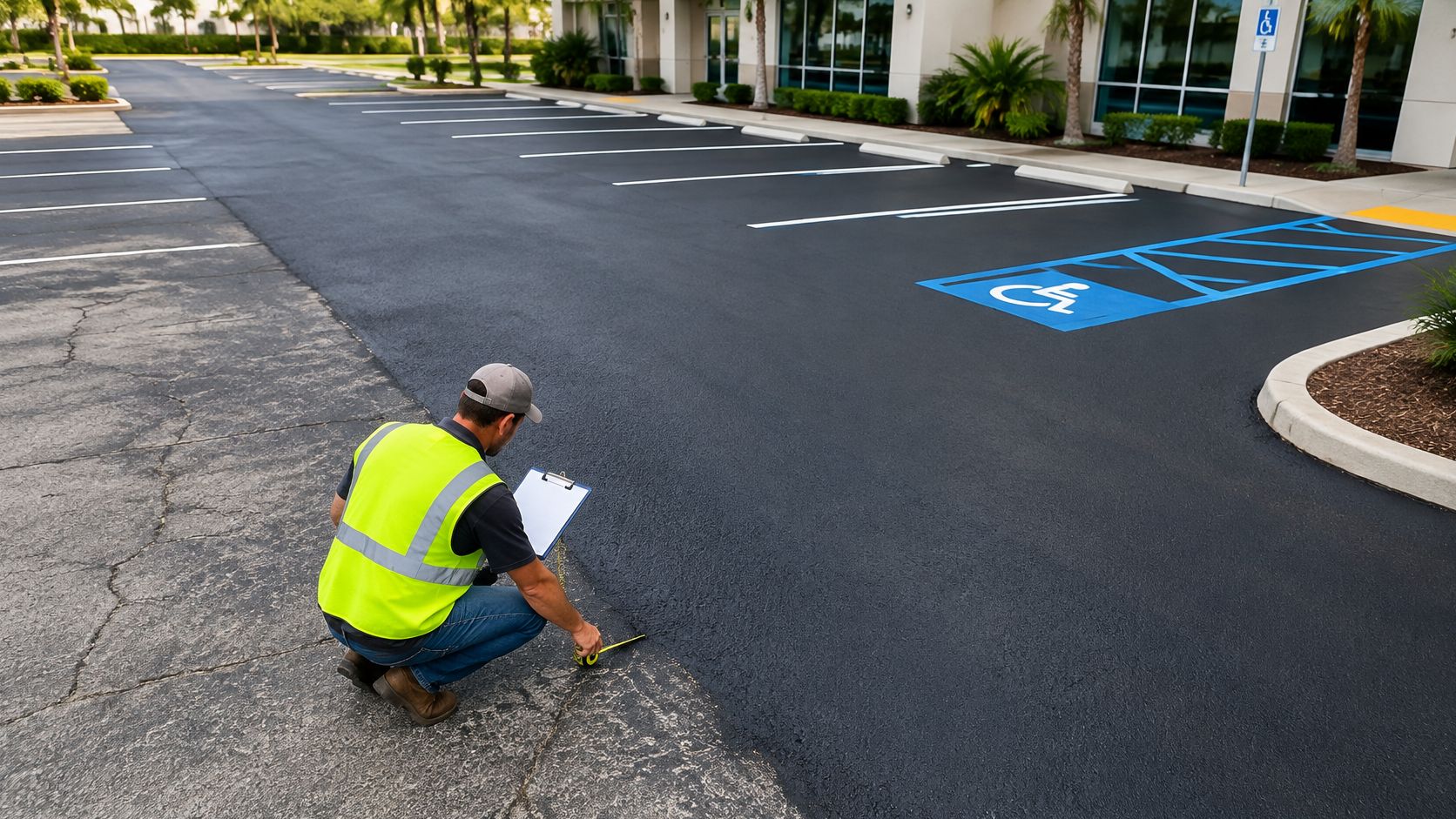
In 2026, parking lot sealing and striping cost commonly starts around $0.15 to $0.30 per square foot for sealcoating and $4 to $10 per standard stall for restriping. Combined cost per square foot generally falls as the lot gets larger, provided pavement condition and project scope are comparable.
For property managers in Marion County, FL and Citrus County, FL, the useful question isn't just what a contractor charges per foot. It's whether the proposal includes the repairs, accessible layout, and scheduling needed to deliver a usable parking lot without paying for avoidable rework.
Table of Contents
- 2026 Price Ranges for Sealing and Striping
- How Lot Size Changes the Price per Stall
- What Raises or Lowers a Sealing Bid
- Striping Scope and Required Accessible Spaces
- Heat Rain and UV on Central Florida Lots
- How to Get an Accurate Local Quote
- Questions to Settle Before You Book
2026 Price Ranges for Sealing and Striping
A low sealcoat number can leave out much of the work that makes a finished lot usable. Budget sealing and striping as separate line items, then test every proposal for the prep, repairs, markings, and reopening plan behind the unit rate. Published figures work for planning; an accurate bid has to reflect pavement condition and site access.
2026 planning ranges for sealing and striping
| Scope | 2026 planning range | How it is usually priced | What the figure leaves out |
|---|---|---|---|
| Sealcoating | According to Asphalt Calculator USA's asphalt water-damage cost discussion, one published cluster runs $0.14–$0.25 per sq ft; carry $0.15–$0.30 per sq ft as a broad planning envelope | Per square foot of asphalt | Crack filling, oil-spot primer, extra coats, traffic control, mobilization, and site condition |
| Restriping standard stalls | $4–$10 per stall, according to Pavement Directory's parking-lot striping cost resource | Per stall, sometimes per linear foot | ADA layout changes, arrows, fire lanes, thermoplastic, symbols, curbs, and layout correction |
| Sample maintenance cycle | About $6,975 for 24,000 sq ft and 65 stalls; the same SurfaceMeasure parking-lot maintenance estimate lists sealcoating at $0.17–$0.30 per sq ft and restriping at $5–$10 per stall | One combined maintenance visit | A different stall count, site condition, or failed base |
| Larger sealcoating project | $7,000–$14,000, with treatment typically repeated every 3–5 years, according to Asphalt Calculator USA's asphalt-maintenance economics article | Project price | Striping and structural patching, which need separate allowances |
| Overlay if maintenance is delayed | $3–$5 per sq ft; Asphalt Calculator USA's asphalt-repair timing article places sealcoating at $0.15–$0.25 per sq ft | Major rehabilitation by pavement area | Deeper base failures, which a surface treatment cannot correct |
These bands are budgeting references rather than Central Florida price guarantees. An overlay adds a new pavement surface. Reconstruction addresses deeper failures that a surface treatment cannot correct.
What the starting price actually buys
A seal-only rate pays for asphalt coverage. A striping rate pays for the layout and installation of markings, including stalls, directional arrows, symbols, and accessible spaces. Combining them into one allowance too early hides why bids differ.
An Ocala retail property may need phased closures to preserve customer access. A Crystal River church may offer a clear weekday work window while still requiring pedestrian routing around the entrance. Those access conditions change labor and staging even when the asphalt area is comparable.
A useful estimate identifies:
- Surface preparation: Cleaning, vegetation removal, and treatment of contaminated areas.
- Repairs: Crack work and patches, with quantities or clearly described locations.
- Application: Sealer type, coat count, and included treatment area.
- Striping scope: Stall layout, arrows, symbols, accessible markings, and layout correction.
- Reopening: Barricades, traffic control, and access restrictions.
Track the sealcoating cost per square foot separately from the complete project scope so material and application stay distinct from prep, repairs, markings, and reopening. For a local scope review, Riverside Sealing & Striping, LLC offers a free consultation and estimate for concrete, asphalt sealcoating, or striping projects.
Budgeting rule: A low unit price becomes a complete price only when the proposal identifies included and excluded work.
For an early budget, keep repairs and specialty markings visible rather than burying them inside a broad contingency. Sealcoating protects asphalt from water damage, UV deterioration, staining, oil, fuel, and weather; striping restores the markings that organize traffic and accessible parking. A low coating price that leaves crack repair or required markings outside the scope can create avoidable rework before the next maintenance cycle.
How Lot Size Changes the Price per Stall
A SurfaceMeasure combined resealing-and-restriping estimate placed the unit cost at $0.34 per square foot for a 32-stall lot, $0.27 for 108 stalls, and $0.20 for 363 stalls. Those are combined maintenance estimates, not sealcoating-only rates.
The size relationship is easier to understand when fixed setup is separated from work that scales with pavement area.
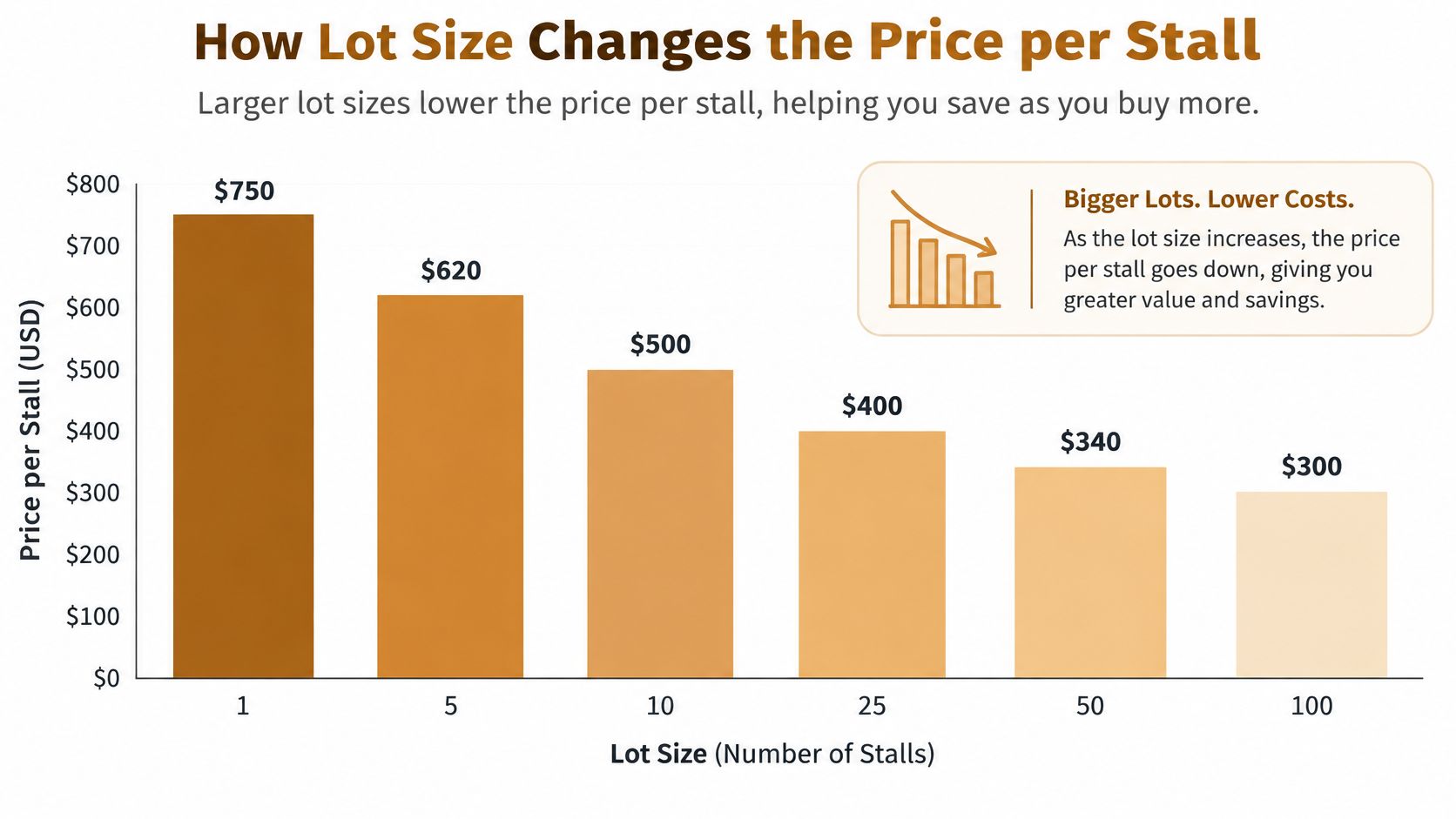
Combined reseal and restripe cost by lot size
| Lot size | Combined cost per sq ft | Why the unit price moves | Who this resembles locally |
|---|---|---|---|
| 32 stalls | $0.34 | Setup and mobilization spread over few stalls | Small church, office, or HOA lot |
| 108 stalls | $0.27 | Fixed setup spread over a mid-size layout | Neighborhood retail or community lot |
| 363 stalls | $0.20 | Mobilization becomes a smaller share of pavement area | Larger shopping or multi-tenant lot |
| Same area, failed pavement | Higher than the comparable sound-pavement example | Patching or base repair replaces a simple coat | Any size lot with potholes or alligator cracking |
Why a small lot can cost more per foot
A crew still has to load equipment, travel, unload, protect adjoining concrete, and establish traffic control at a small property. Those tasks don't disappear because the parking area is compact.
A church near Dunnellon, an office in Belleview, or an HOA common area near The Villages carries those setup costs across less pavement than a large Ocala shopping center. A larger open layout may also allow steadier equipment movement, while islands and tight corners require more handwork.
However, cost per square foot and cost per stall aren't interchangeable. A property with generous drive aisles can have more asphalt per stall than a compact lot. Count spaces and measure pavement rather than converting between those units by assumption.
When size stops being the deciding factor
A badly cracked lot in Inverness can cost more per foot than a small, sound lot in Summerfield. In that comparison, patching and preparation control the budget, not purchasing volume.
The same applies to interrupted work. A shopping center that requires repeated closures may lose some of the efficiency its size would otherwise provide.
Use our parking lot striping prices guide to organize marking quantities separately from the asphalt measurement. For comparable bids, give each contractor the same pavement boundaries, stall inventory, and access requirements. Otherwise, an apparent size discount may reflect a smaller scope.
What Raises or Lowers a Sealing Bid
Skipped crack repair is one of the easiest ways to make a bid look cheaper. The asphalt may look uniformly black after coating, but an untreated opening can still admit water beneath the surface.
The distinction is preparation versus appearance. A maintenance contractor should identify repair needs before specifying the coating, not assume sealer will hide them.
These are the scope factors that deserve a written allowance.
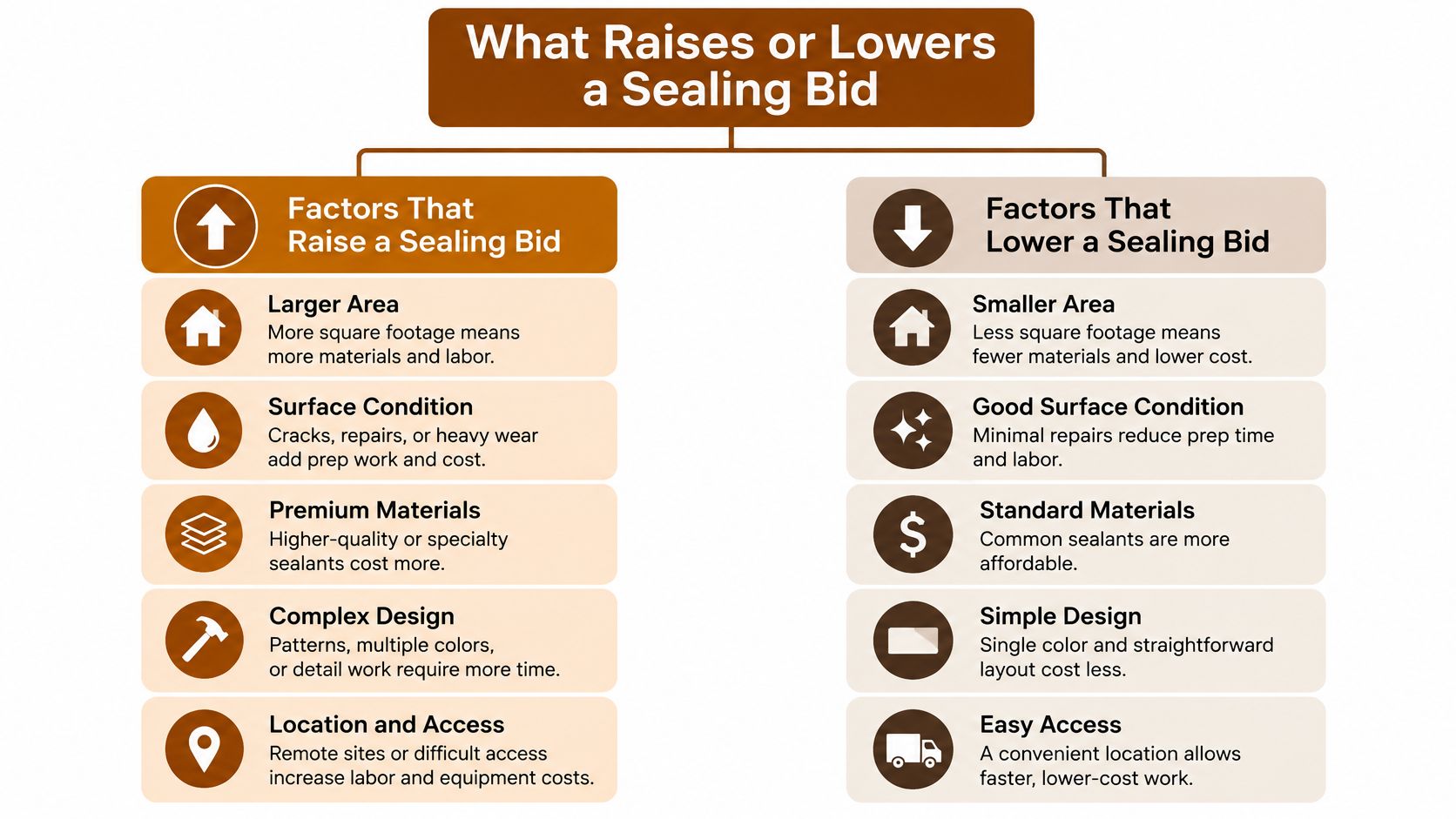
Separate preparation from application
A comparable sealing proposal should identify:
- Cleaning and preparation: Mechanical sweeping, blowing, edge cleaning, and any washing needed before application.
- Crack treatment: Crack length, preparation method, and repair material.
- Oil and fuel spots: Cleaning, primer, or removal where contamination has softened the asphalt.
- Coating specification: Sealer type, coat count, application method, and coverage boundaries.
- Labor and mobilization: Setup, return visits, and work around islands or parked vehicles.
- Traffic control: Barricades, pedestrian routes, and phased access when the site stays open.
On a Homosassa or Lecanto property with drainage trouble, correcting a wet area can add work before sealing begins. Coating over persistent moisture doesn't fix the cause.
Timing affects the bigger bill
In highway-scale pavement analysis, the Federal Highway Administration reported preservation costs of approximately $50,000 per lane-mile when substantial service potential remained, compared with approximately $400,000 per lane-mile after deterioration to fair condition, about eight times higher. These aren't parking-lot prices, but they demonstrate why delaying maintenance can change the type of work an owner must buy.
A maintenance coat can help postpone milling or overlay on sound asphalt. It can't restore a failed base, stop active pumping, level major depressions, or repair severe alligator cracking. Those conditions need a repair assessment first.
Our asphalt seal coating protects surfaces from damage caused by oil, fuel, and weather. That protection doesn't mean sealer can rescue asphalt already broken down by contamination or structural failure.
Buy protection for pavement that can still be protected. Don't buy a cosmetic coating instead of a necessary repair.
Concrete requires a separate decision. Our concrete driveway services include removal and replacement of damaged driveways and new installations with professional finishing; a failed entrance slab isn't an asphalt sealing item.
Before approving a proposal, require explicit lines for prep, crack repair, contamination treatment, coats, repairs, mobilization, traffic control, and exclusions. That's how you compare the cost of completed work rather than the price of a coat.
Striping Scope and Required Accessible Spaces
Count each lot separately before approving the layout. The federal ADA parking guidance sets the following accessible-space requirements, including one van-accessible space for every six accessible spaces, or fraction thereof.
Accessible parking spaces required when restriping
| Total spaces in that lot | Accessible spaces required | Van-accessible rule |
|---|---|---|
| 1–25 | 1 | 1 of every 6 accessible spaces, or fraction, must be van accessible |
| 26–50 | 2 | Same van rule |
| 51–75 | 3 | Same van rule |
| 76–100 | 4 | Same van rule |
| 101–150 | 5 | Same van rule |
| 151–200 | 6 | Same van rule |
| 201–300 | 7 | Same van rule |
| 301–400 | 8 | Same van rule |
| 401–500 | 9 | Same van rule |
| 501–1,000 | 2% of total | Same van rule |
| More than 1,000 | 20 plus 1 per 100, or fraction, over 1,000 | Same van rule |
Federal ADA restriping guidance explains that restriping triggers the obligation to provide required accessible parking under the 2010 ADA Standards. Common planning dimensions include stalls around 9 by 18 feet, lines around 4 inches wide, and two-way aisles around 24 to 26 feet, but those aren't substitutes for a compliant site-specific layout and applicable local code.
Review the route, not just the symbol
Repainting an old layout can preserve an old problem. A correctly painted wheelchair symbol doesn't resolve an obstructed access aisle, an unsuitable slope, or a route that ends at a curb.
The striping inventory should include:
- Parking layout: Total stalls, accessible spaces, van spaces, and access aisles.
- Access conditions: Slopes, signs, curb ramps, and the route to the entrance.
- Traffic markings: Arrows, fire lanes, loading zones, curb paint, and specialty symbols.
- Material choices: Ordinary traffic paint priced separately from thermoplastic or other specialty markings.
A small property in Beverly Hills or Hernando still needs the applicable accessible parking provision. Our ADA handicap parking space requirements guide helps owners prepare for that review without assuming existing lines are correct.
Separate paint from concrete construction
Our striping service includes precision line layout, ADA handicap markings, arrows, symbols, and high-visibility, durable traffic paint. Those items improve navigation, but paint can't correct an inaccessible entrance connection.
Our sidewalk services include ADA-compliant installation, anti-slip surfaces, professional grading and drainage, and repair and restoration. Where the accessible route requires concrete work, price that construction separately and complete the layout review before the striping crew mobilizes.
Heat Rain and UV on Central Florida Lots
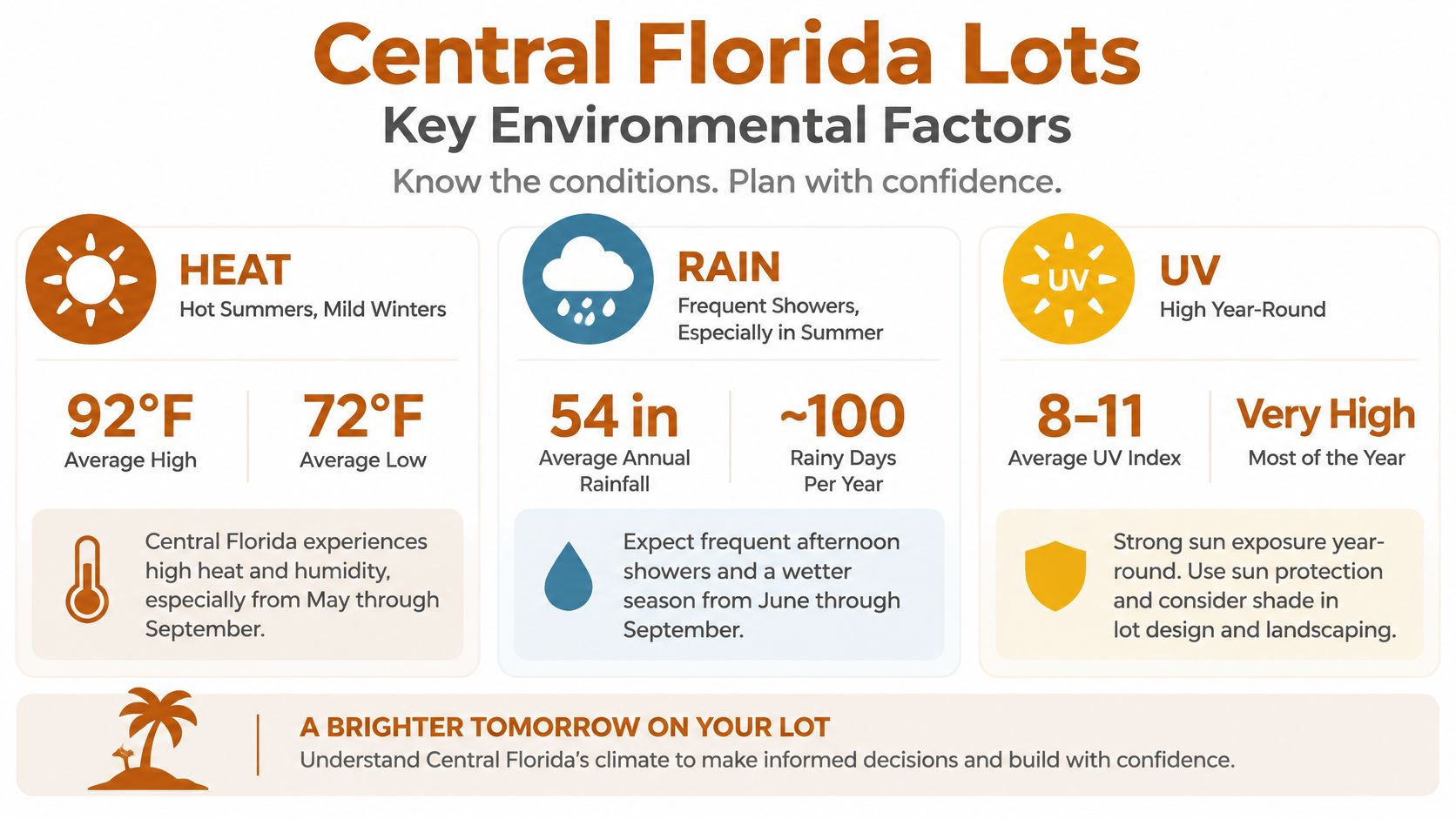
Strong sun, frequent rain, and turning traffic make pavement maintenance a scheduling problem as well as a material choice. Asphalt exposed to weather needs inspection for oxidation and surface loss, while markings need attention when drivers can no longer recognize them clearly.
Use the climate stresses below to plan inspections, not to assume every property needs treatment on the same calendar.
Match treatment to pavement condition
A practical planning allowance is restriping about every one to three years and evaluating sound pavement for sealcoating about every three to five years, adjusted for visibility, traffic, and surface condition. Those are maintenance benchmarks, not warranties or instructions to coat pavement that doesn't need it.
Highway preservation treatments also need careful labeling. The FHWA preservation evaluation reported service-life extensions of approximately three to eight years for chip seals, four to five years for fog seals, and zero to four years for crack sealing alone. Those treatments aren't interchangeable with a commercial parking-lot sealcoat.
The FHWA preservation report lists conventional chip-seal benchmarks near $3.00 per square yard with about five years of life, versus $5.04 per square yard with about eight years for a 15%-asphalt-rubber treatment. It also describes TxDOT seal-coat performance commonly around six to eight years, sometimes reaching twenty years under favorable conditions.
The useful lesson isn't to promise those lives on a Florida parking lot. It's that drainage, materials, preparation, weather, and installation quality determine whether a preservation expense performs well.
Put the dry-weather window in the plan
On sound asphalt, sealing slows oxidation, moisture intrusion, raveling, and crack growth. Standing water in Silver Springs or Summerfield needs attention before coating, while concrete walks and ramps need positive drainage and suitable walking surfaces.
- Sun and UV: Inspect exposed areas for a dry, weathered surface and fading markings.
- Rain: Check low spots after storms, not only when the pavement looks dry.
- Turning traffic: Watch entrances, drive-through lanes, and loading approaches for concentrated wear.
For properties in Hernando, Lecanto, and Inverness, afternoon storms and customer traffic both affect the available work window. Fast turnaround should come from organized phasing, not reopening an uncured surface.
A pavement-maintenance video can help owners visualize the work before agreeing to closures.
How to Get an Accurate Local Quote
A productive site visit starts with a clear description of the property, not a guessed total. Managers in Marion County and Citrus County can prepare the same information for every bidder so the resulting proposals cover comparable work.
This checklist keeps measurements, repairs, and operating restrictions together.
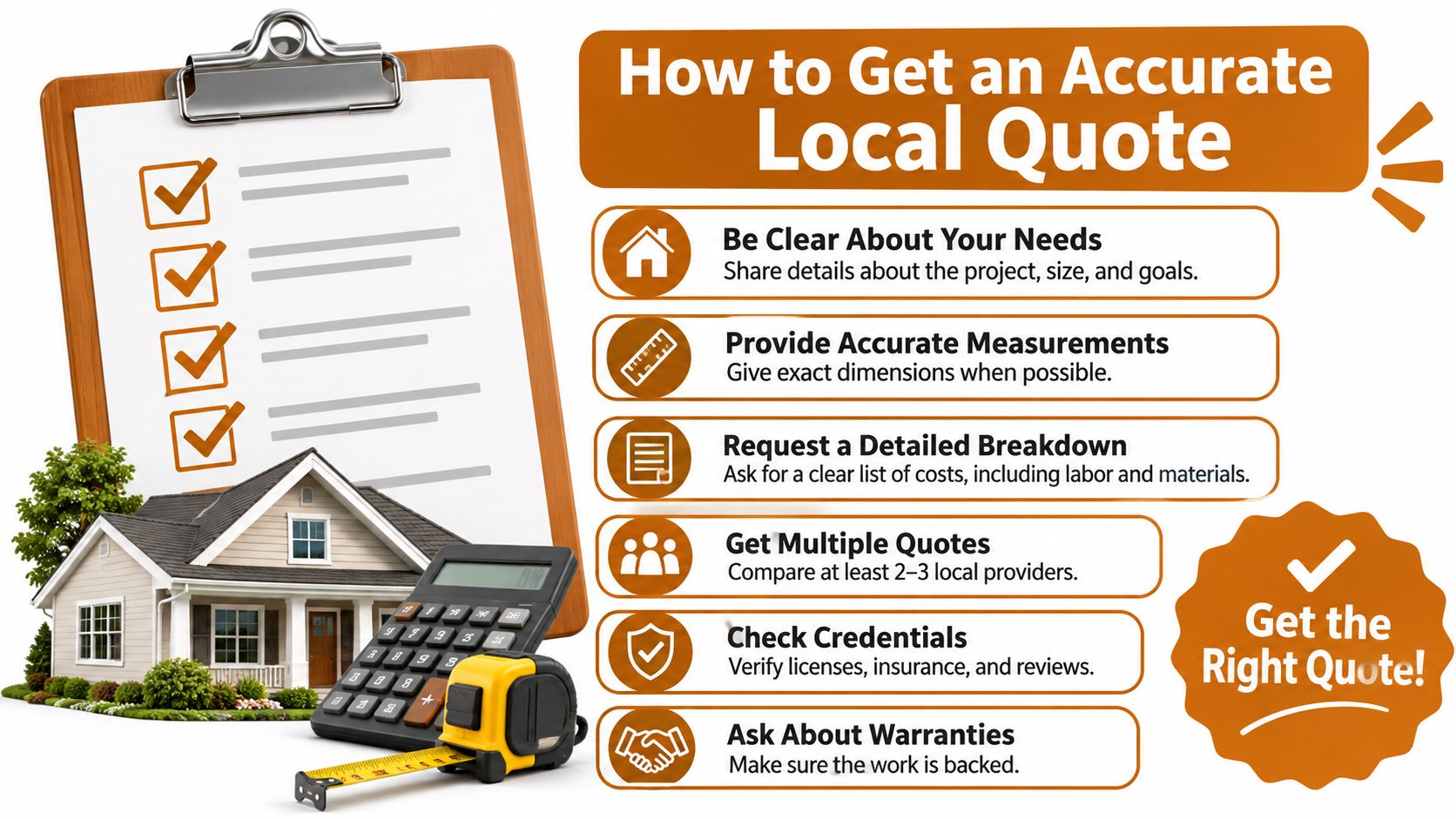
Measure asphalt and count stalls by lot. Use a measuring wheel or a scaled aerial takeoff, excluding buildings, planting areas, and concrete zones that aren't being sealed. Keep separate lots separate so quantities and accessible layouts remain clear.
Photograph defects. Capture cracks, potholes, oil spots, ponding, and faded symbols. Include a wider view showing where each defect sits, since a close-up alone doesn't identify repair boundaries.
Inventory the markings. List stalls, accessible spaces, arrows, curbs, fire lanes, and loading zones. Note where you want a layout change rather than assuming the crew will repaint everything exactly as it is.
Write down operating restrictions. Identify business hours, church services, school arrivals, deliveries, and HOA access needs. A closure plan affects crew sequencing and whether the job needs return visits.
Request separate scope lines. Cleaning, crack repair, oil-spot treatment, coating, striping, and mobilization should remain identifiable. Clear exclusions matter just as much as included work.
Compare ongoing cost, not just the application price. Consider included preparation, likely maintenance needs, disruption, and the condition of the pavement being treated. A short-lived cosmetic result isn't equivalent to a properly prepared maintenance project.
Book an on-site estimate. Square footage can support a preliminary allowance, but a site inspection establishes whether preservation is appropriate and which repairs belong in the budget.
Bring the concrete work into the same visit
Riverside Sealing & Striping, LLC is based in Dunnellon and offers free consultations and estimates for concrete, asphalt sealcoating, and striping projects throughout Central Florida and surrounding areas. Our commercial scheduling can limit business disruption, and maintenance and refresh programs help owners plan beyond the immediate project.
For asphalt sealcoating and parking lot striping, a drive-time site visit to a Crystal River church, a Homosassa business, or an Inverness community property allows us to examine access and adjoining concrete together. We're Concrete and Asphalt Experts in Marion and Citrus County, so an entrance walk doesn't have to disappear from the discussion just because the main project is asphalt.
Have your lot measurements, stall counts, defect photos, marking inventory, and required opening hours ready for the consultation.
Questions to Settle Before You Book
How soon can cars return?
The return-to-traffic window depends on the product, the temperature and humidity that day, and site conditions. Get the window written into the proposal, along with who removes the barricades and who authorizes reopening.
A surface that looks dry can still scar under turning tires.
Deliveries, service vehicles, and resident access belong inside the closure plan. Exceptions made after the crew leaves are what mark a fresh seal.
Will a Florida storm delay the job?
Yes, imminent rain can require postponement. The detail worth settling is what happens next: who calls the delay, when that call is made, and which backup date the crew returns on. Material applied to a wet lot to protect a calendar date gets paid for twice.
An Ocala retailer or Crystal River property manager should name who receives weather updates and how tenants or visitors get notified. Our scheduling focuses on limiting disruption, and curing conditions are part of that schedule.
Is the cheapest coat actually a saving?
Only when the proposals carry equivalent preparation, materials, access arrangements, and finished scope. A low number that skips crack repair, or prices paint without the accessible spaces and layout the stall count requires, hands those costs back later as rework and restriping. Read the exclusions before comparing totals, especially where a bid describes repairs vaguely.
Before approving: Resolve uncertain quantities and repair boundaries in writing. An unpriced assumption is a poor foundation for a maintenance budget.
Riverside Sealing & Striping, LLC is family owned and operated, with third- and fourth-generation professionals, and owner and founder Bert Counts leads the business. Customer Don describes the scheduling plainly: “Mr. Counts was prompt with an estimate and with completion of the project.”
Can the asphalt lot and concrete entrance be priced together?
Yes, and asking for each scope as its own line item inside one proposal shows where the money sits. Our concrete and asphalt services let a property be evaluated as a connected site, including damaged driveway slabs, entrance walks, ramps, grading, and drainage. Customer Robert saw the result: “Once we started the crew came in and did a great job, not only on the asphalt but put in a beautiful entrance sidewalk.”
Where concrete removal and replacement is needed, keep that construction distinct from coating and paint. Coordinate the finished elevations so the transition drains cleanly and the pedestrian route stays continuous.
Use the planning ranges to set your parking lot sealing and striping cost allowance, then adjust for stall count, pavement condition, and the accessible markings your lot requires. The next step is a free, no-pressure on-site evaluation from a concrete and asphalt contractor serving Marion County, Citrus County, and nearby Central Florida.
Riverside Sealing & Striping, LLC offers free estimates for parking lot sealcoating, precision striping, and related concrete improvements across Central Florida. Visit Riverside Sealing & Striping, LLC to arrange an on-site evaluation.