
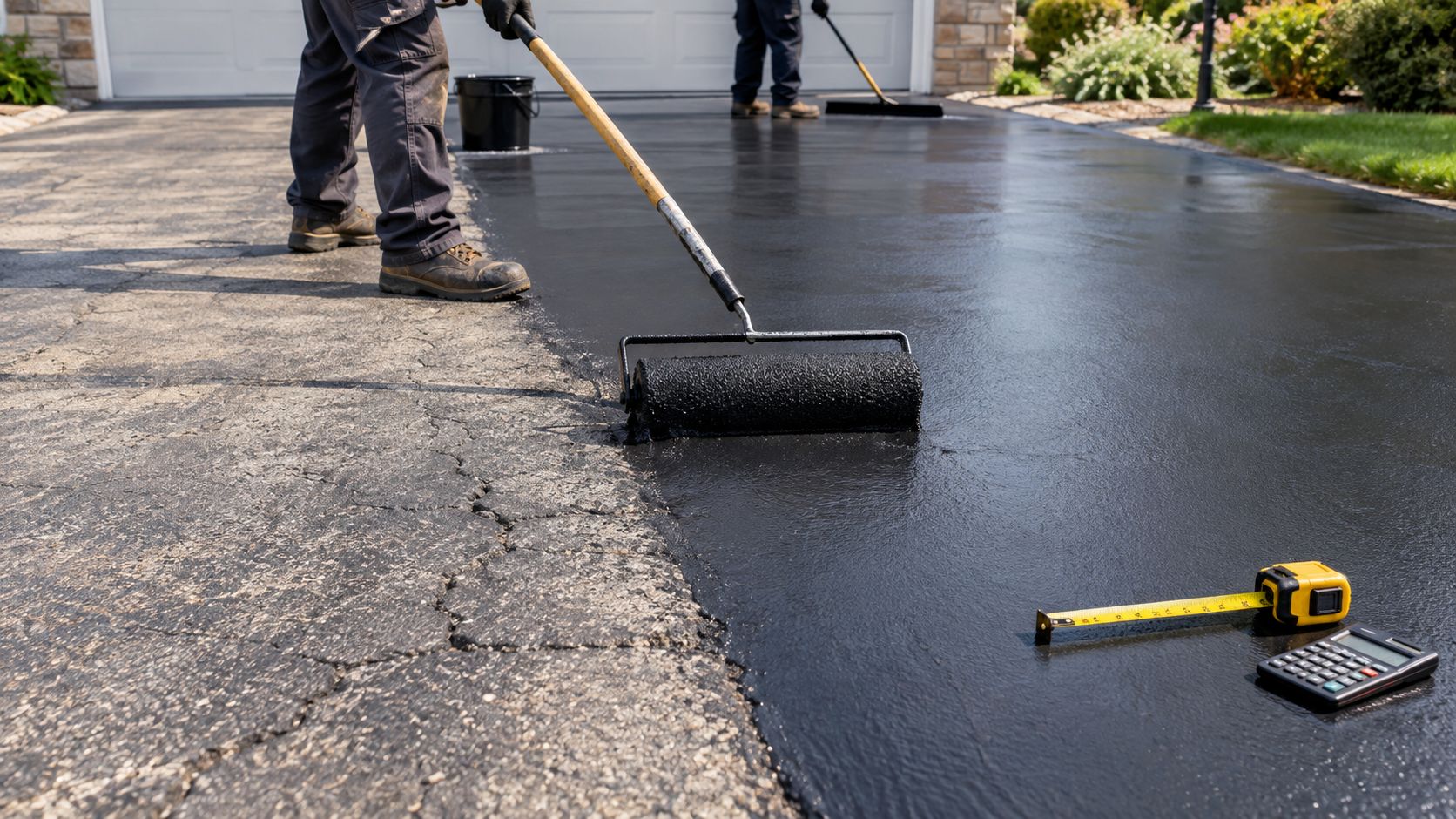
Professional sealcoating in 2026 generally runs $0.14 to $0.35 per square foot for a standard two-coat application, but a property owner should never stop at that headline number because preparation, crack filling, oil treatment, access, and striping can change the final invoice substantially.
You might be comparing three driveway quotes on a clipboard, or trying to build a parking-lot maintenance budget for a property in Ocala, Crystal River, or The Villages. The number that catches your eye may describe only the sealer application. It may leave out the work that determines whether the coating bonds properly and whether the pavement is ready for traffic afterward.
Central Florida asphalt takes steady punishment from UV exposure, heavy rainfall, humidity, traffic, and sand carried across the surface. Sealcoating is a protective maintenance treatment, not a cosmetic shortcut. The right estimate accounts for the base rate, surface condition, preparation, crack filling, oil-spot priming, number of coats, and line striping. This guide shows you how to read, compare, and challenge a 2026 sealcoating quote before you sign it.
Table of Contents
- What You Will Pay and Why It Matters
- The 2026 Per Square Foot Price Range
- Key Factors That Move Your Final Price
- How to Estimate Your Own Project
- Sample Cost Scenarios Across Central Florida
- Smart Ways to Lower Your Sealcoating Bill
- Maintenance Schedule and Long Term ROI
What You Will Pay and Why It Matters
The most useful way to understand sealcoating cost per square foot is to treat the quote as a layered equation. The base rate covers the application itself, while the property's condition and layout determine how much labor is needed before and after the sealer goes down.
A fair estimate should make these items visible:
- Base application rate: The charge for applying the specified sealer.
- Surface condition: Oxidized, porous, rough, or heavily cracked asphalt takes more preparation and material.
- Prep work: Cleaning, blowing, edging, weed removal, and treatment of loose debris affect bonding.
- Crack filling: Sealcoat won't stop active cracks from moving. Those cracks need separate attention.
- Oil-spot priming: Fuel and oil contamination can prevent sealer from adhering.
- Number of coats: A two-coat application uses more material and labor than a single coat.
- Line striping: Commercial lots usually need markings restored after the dark coating cures.
Practical rule: A low base rate means very little until you know what the contractor has excluded.
A 10,000-square-foot lot priced at $0.14 to $0.30 per square foot would total roughly $1,400 to $3,000 before add-ons, according to industry sealcoating pricing guidance. That range explains why commercial work is usually priced by area instead of a flat fee. Large lots spread mobilization and equipment costs across more pavement, while small driveways carry a greater share of setup and travel in the effective rate.
Central Florida conditions make maintenance planning more important. Sunlight accelerates oxidation, rain finds untreated cracks, and sandy soils can leave loose material around pavement edges. A property owner in Marion County, FL or Citrus County, FL should ask whether the bid addresses those conditions instead of accepting a generic price.
By the end of the estimating process, you should be able to identify the application rate, verify the scope, and spot a quote that looks inexpensive only because critical work has been omitted.
The 2026 Per Square Foot Price Range
A commercial lot with sound asphalt may fall near $0.14 to $0.30 per square foot for a standard two-coat sealcoating job. Broader 2026 estimates for commercial lots commonly reach $0.15 to $0.35 per square foot. Those figures give Central Florida property owners a useful starting range, but they cover the core application rather than every restoration or traffic-control requirement. The published sealcoating cost range and project examples provides the benchmark and project context.
Material selection changes the calculation. Asphalt emulsion material runs about $0.08 to $0.10 per square foot, while coal tar emulsion is listed at $0.10 to $0.18 per square foot. Labor-inclusive professional pricing in the same comparison often falls around $0.08 to $0.30 per square foot. These figures describe material and application benchmarks, not a guaranteed bid. Pavement condition, access, preparation, and the requested scope determine the final price. The material and labor comparison for sealcoating also shows why a small residential project can carry a higher effective rate than a large commercial lot.
| Project Type | Typical $/Sq Ft | 2-Coat Range | Notes |
|---|---|---|---|
| Large commercial lot | $0.14 to $0.30 | $0.15 to $0.35 | Open layout and larger volume can reduce the effective rate |
| Smaller commercial lot | $0.15 to $0.35 | $0.15 to $0.35 | Mobilization, access, and traffic control matter more |
| Residential driveway | Higher effective rate | Project-specific | Minimum charges can dominate a small area |
| Commercial lot with restoration | Above base rate | Scope-dependent | Crack work, oil treatment, and striping are separate considerations |
A 600-square-foot driveway can normalize to roughly $0.28 to $0.87 per square foot. Cleaning, setup, travel, and minimum charges are spread across a small area, even though the sealer itself costs much less per square foot.
Commercial projects in Marion, Citrus, Lake, and Sumter counties may reach the higher end when crews must mobilize equipment, manage vehicle access, protect curbs and islands, or work in phases. On a Florida lot, the base rate is only the starting line. Preparation, crack filling, and striping can double the completed bill, so compare the included scope before choosing the lowest quote.
Key Factors That Move Your Final Price
A Florida lot can look straightforward until the crew starts measuring pavement condition, contamination, and the work required around parked vehicles. The sealer's color matters far less than how dry, oxidized, rough, or open-textured the asphalt has become. Older pavement absorbs more product and may need more preparation, while sound asphalt usually takes less material and spreads more efficiently.
Surface preparation and contamination
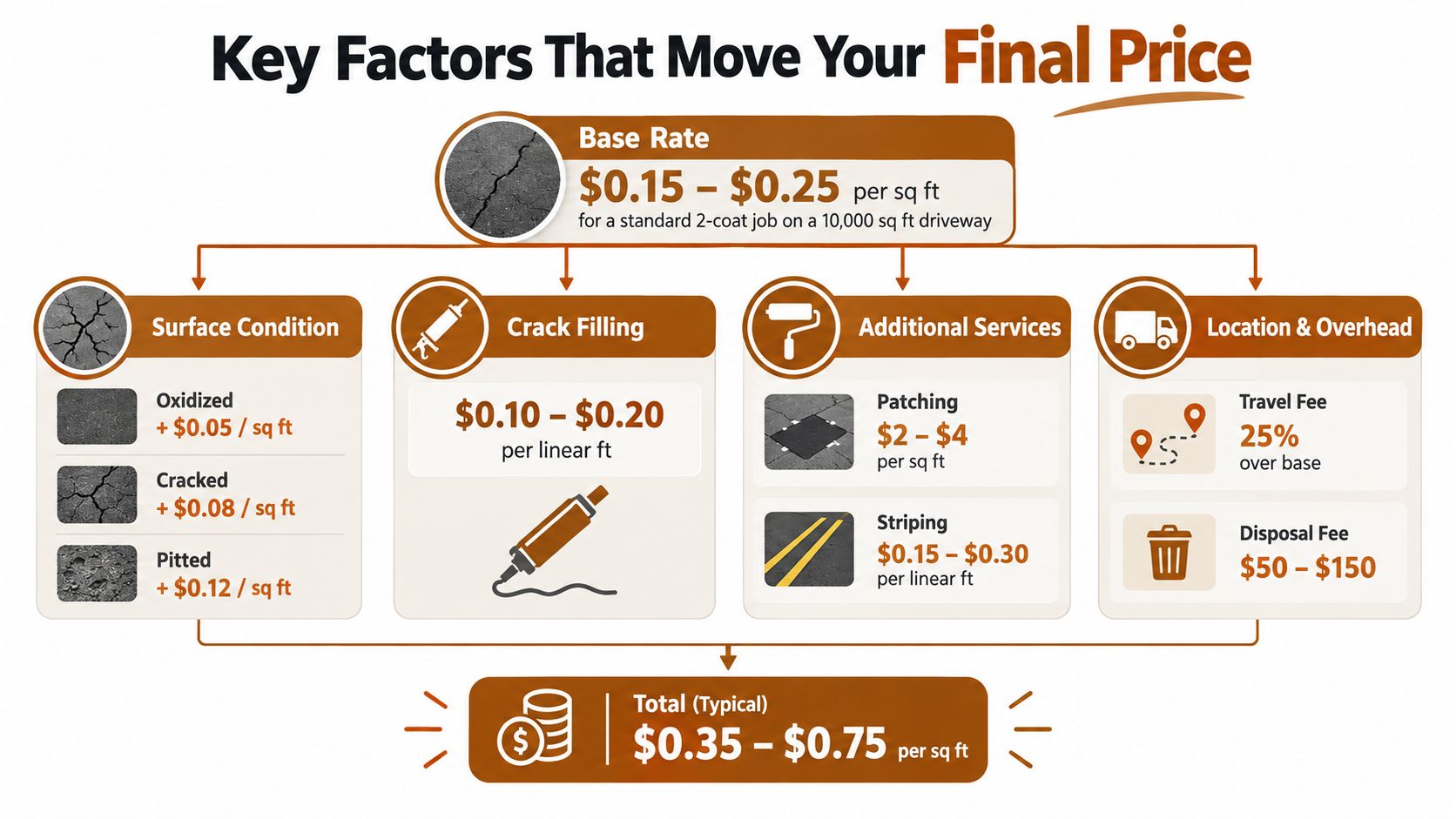
Preparation may include blowing debris, wire-edging, removing vegetation, cleaning loose aggregate, and treating problem areas. Basic commercial application may run near $0.14 to $0.25 per square foot, while a package that includes crack sealing and line striping can reach roughly $0.65 to $0.90 per square foot. The sealcoating scope and add-on comparison shows why a base rate gives an incomplete picture when restoration work is included.
Oil spots need separate treatment. The crew may have to clean the contamination and apply a bonding primer before sealing. Crack filling is another line item. Sealcoat protects the surface, but it does not bridge active structural movement or repair failed asphalt.
Material quantity and coats
Coverage changes with the pavement, product, and application conditions. A common planning rule allows about 1 gallon per 100 square feet on previously sealed pavement and roughly 1.5 gallons per 100 square feet on unsealed asphalt. Mixed sealer coverage may range from 50 to 80 square feet per gallon per coat, according to sealcoating and crack-filling calculator guidance.
Coal tar emulsion is often listed at about 100 square feet per gallon per coat, while asphalt emulsion is about 90 square feet per gallon per coat, according to a sealcoat coverage calculator. A second coat requires another application cycle, so a one-coat proposal cannot be compared directly with a two-coat proposal.
Striping and the finished package
Striping can push the completed per-square-foot figure much higher on parking lots. Lines, arrows, ADA markings, fire lanes, curbs, and wheel-stop details require layout and labor after the sealer cures. Ask the contractor to separate crack work, sealing, and striping so each quote reflects the same scope.
A bid of $0.18 per square foot can become $0.28 per square foot after documented preparation, crack filling, and oil treatment. On Central Florida properties, access, drainage features, islands, and vehicle control can add further labor. Compare the included work, not only the first number.
How to Estimate Your Own Project
You can sanity-check a sealcoating quote with three calculations. You won't replace a site inspection, but you can identify whether the contractor is pricing the same surface and scope you have in mind.
Step one is measuring the paved area
For a rectangular driveway, multiply length by width. If the shape is irregular, divide it into smaller rectangles, calculate each one, and add the results. Leave out concrete sidewalks, patios, and planted areas unless the contractor specifically includes them.
Parking lots need more care. Count the stalls and driving lanes separately, then estimate the paved area associated with each. A planning example may use a 9-by-20-foot stall, but the actual lot still needs field verification because islands, loading areas, curbs, and drive aisles vary.
Step two is setting the base application
Multiply the measured square footage by the applicable two-coat rate. A practical planning band for this calculation is $0.18 to $0.25 per square foot, but the final bid should identify the product, coats, coverage, and preparation included.
Material quantity provides another check. Previously sealed pavement may use about 1 gallon per 100 square feet, while unsealed pavement may need roughly 1.5 gallons per 100 square feet, as described in the sealcoating coverage guidance.
Step three is adding the line items
List crack filling, oil-spot treatment, edge work, patching, traffic control, and striping separately. Don't accept a total that hides whether cracks and contamination are included.
Quote test: If a bid doesn't mention crack filling or oil treatment, assume those items still need a decision before work begins.
For a second calculation check, use the Riverside asphalt sealcoat calculator and compare its result with the contractor's written scope. The calculator won't see every crack or oil spot, so treat it as a planning tool rather than a final estimate.
Sample Cost Scenarios Across Central Florida
A quote makes more sense when you compare it with a property of similar size and condition. The following examples use the stated project scopes and show how preparation and access can move the total away from a simple base-rate calculation.
A 600-square-foot residential driveway in Ocala with two coats, light crack filling, and no oil spots might land around $120 to $180 total. The small area means setup and minimum service considerations have a larger effect than they would on a commercial lot.
A 5,000-square-foot Dunnellon small-business lot with two coats, moderate crack repair, eight oil spots, and edge sealing could run roughly $1,100 to $1,650. The important comparison point isn't just the total. Confirm that the quote includes the eight oil treatments and the edge work rather than adding them later.
| Property | Square Footage | Prep and Add-ons | Estimated Total |
|---|---|---|---|
| Ocala residential driveway | 600 | Two coats, light crack filling, no oil spots | $120 to $180 |
| Dunnellon business lot | 5,000 | Two coats, moderate cracks, eight oil spots, edge seal | $1,100 to $1,650 |
| Belleview HOA private road | 15,000 | Two coats, heavy crack filling across 400 linear feet, no striping | $3,200 to $4,400 |
| Crystal River retail center | 40,000 | Two coats, full crack program, 30 oil spots, restriping of 120 stalls | $9,500 to $13,500 |
The 15,000-square-foot Belleview HOA private road carries a roughly $3,200 to $4,400 estimate because heavy crack filling across 400 linear feet creates a substantial preparation scope even without striping. HOA boards should confirm how the contractor will handle resident access and whether the work will be staged.
At a 40,000-square-foot Crystal River retail center, two coats, a full crack program, 30 oil spots, and restriping 120 stalls can produce a total around $9,500 to $13,500. The larger property benefits from scale, but retail access, layout, and business continuity add complexity. Similar conditions can affect properties in Homosassa, Inverness, Lecanto, Beverly Hills, Hernando, and Summerfield. Florida sand and UV exposure can push each project toward the upper half of its range when the pavement has been neglected.
Smart Ways to Lower Your Sealcoating Bill
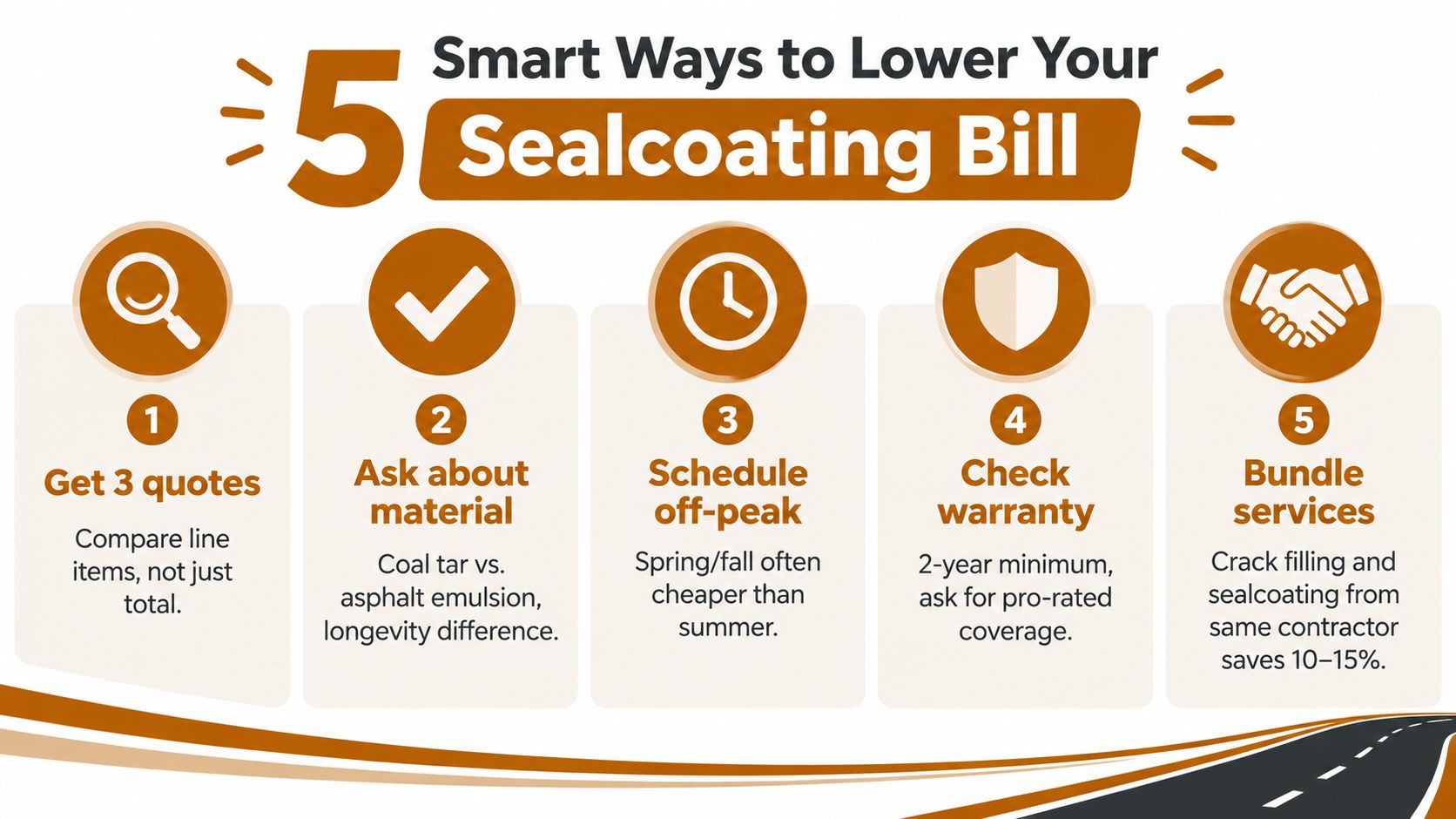
The cheapest quote isn't automatically the lowest-cost choice. A thin application over dirty asphalt may look acceptable at first and still leave you paying for earlier corrective work. Compare the work plan, product, and exclusions before comparing totals.
Five practical moves can reduce waste:
- Combine nearby properties: Neighbors, HOAs, or adjacent businesses may reduce duplicated mobilization when crews can work in one visit.
- Choose a workable season: Late fall through early spring can offer more scheduling flexibility in Central Florida, provided the weather supports proper curing.
- Handle basic cleaning carefully: If the contractor approves it, blowing and pressure washing before the visit can reduce preparation labor. Don't leave oil contamination untreated or push debris into drains.
- Treat oil spots early: Prompt cleaning gives the contractor a better chance of avoiding extensive primer work.
- Bundle related services: Crack filling, sealcoating, and parking lot striping can be planned together so the property doesn't require separate mobilizations.
Ask each contractor the same questions:
- What does the base rate include?
- Which cleaning and edge work are excluded?
- What sealer manufacturer and product specification will be used?
- Is crack routing or filling included?
- What does the warranty cover, and how does it distinguish peeling from normal wear?
- Is the company licensed and insured, and is the proposal fully documented?
A property manager in Marion County, FL should also ask how traffic will be controlled. A commercial lot in Citrus County, FL may need phased access so customers, residents, or deliveries can still reach the property. Review the asphalt sealcoating contractor service information as one reference point when comparing the scope offered by local providers.
Maintenance Schedule and Long Term ROI
Central Florida maintenance should follow the pavement's exposure and condition, not an arbitrary calendar alone. Inspect residential driveways and commercial lots for fading, open cracks, loose edges, standing water, and oil contamination. High-traffic entrances, delivery lanes, and shaded areas may need attention sooner than lightly used pavement.
A workable maintenance routine looks like this:
- Inspect regularly: Walk the surface after major rain and document changes with dated photographs.
- Keep drainage clear: Leaves, sand, and debris can block drains and leave water against pavement edges.
- Remove oil promptly: Fresh contamination is easier to address than a long-standing stain.
- Plan reapplication: Residential driveways and commercial lots should be evaluated separately because traffic and turning movements wear the coating differently.
- Refresh markings: Striping should be checked whenever the pavement is being resealed, especially where ADA spaces, arrows, and fire lanes affect safety.
Sealcoating is worthwhile only when the asphalt remains structurally sound. It protects against oxidation and water intrusion, but it won't correct failed base material, deep settlement, or widespread structural cracking. A professional evaluation can distinguish a maintenance project from repair or replacement.
Good pavement management is mostly timing. Owners save more by addressing small defects before water and traffic turn them into larger repairs.
For property owners considering service intervals, the Central Florida guide to how often asphalt should be sealcoated offers a useful planning reference. Riverside Sealing & Striping builds maintenance calendars into proposals for properties from Ocala down to Crystal River, helping owners budget for inspections, sealing, crack work, and striping instead of waiting for emergency repairs.
Riverside Sealing & Striping, LLC serves Marion County, FL, Citrus County, FL, and surrounding Central Florida with concrete work, asphalt sealcoating, and parking lot striping. For a licensed and insured local evaluation, visit Riverside Sealing & Striping, LLC to request a free, no-pressure estimate and compare your property's actual scope with the sealcoating cost per square foot.