
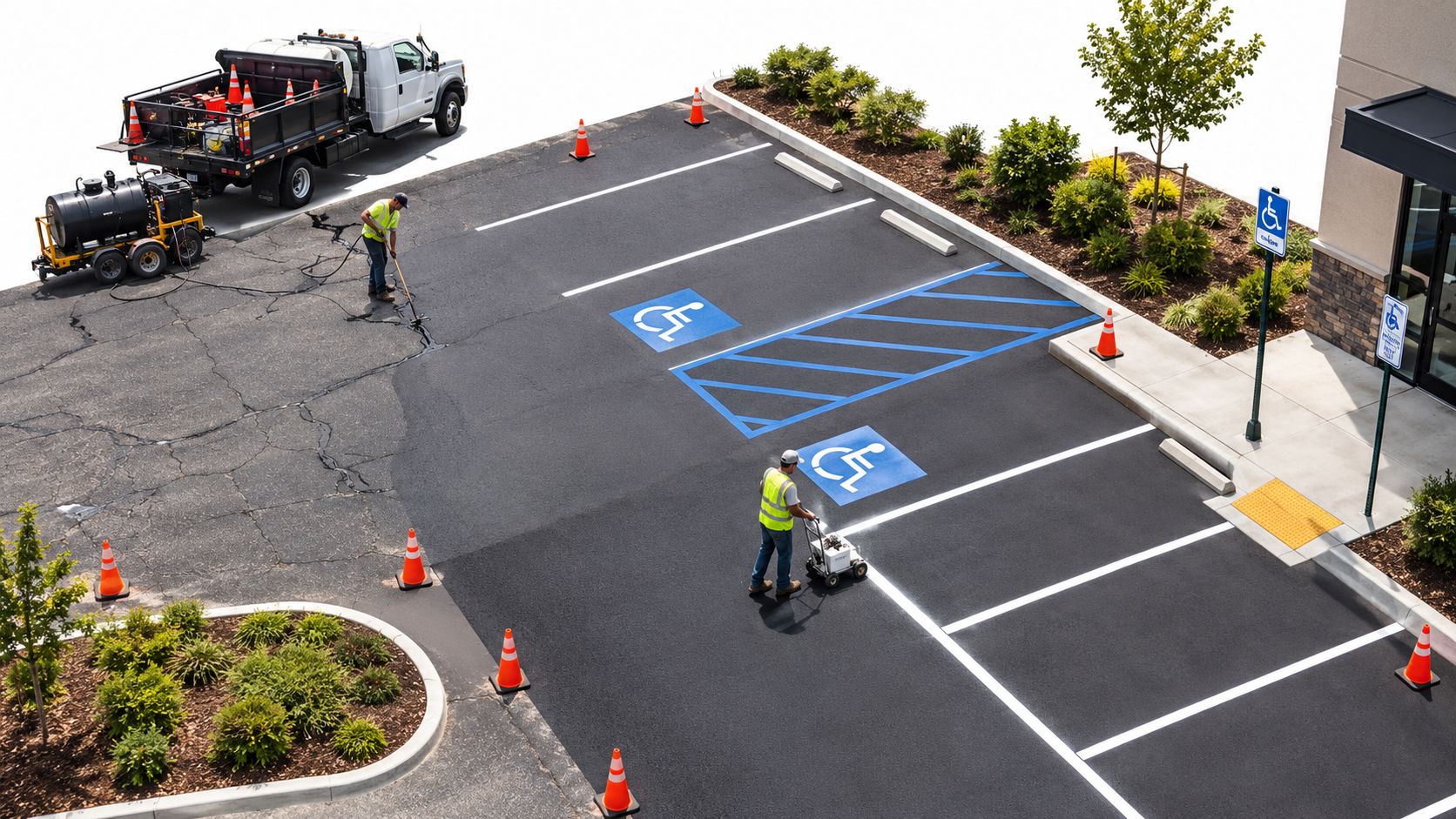
A summer storm has just moved through your shopping center. On the walk to the office, you notice faded parking stalls, a puddle beside the cart corral, and hairline cracks running across the drive lane. None of those problems looks urgent by itself. Together, they tell you the lot needs a plan, not another isolated touch-up.
That's the reality of parking lot services in Central Florida. From Ocala and The Villages to Crystal River, Homosassa, and Inverness, heat, UV exposure, heavy rain, oil, traffic, and changing accessibility needs all work on the same pavement. Property managers in Marion County, FL and Citrus County, FL should treat sealcoating, asphalt repair, striping, drainage, concrete, and ADA upgrades as connected decisions.
Table of Contents
- What Commercial Property Managers Mean by Parking Lot Services
- The Core Services That Keep a Lot Safe and Presentable
- When to Schedule Sealcoating Repairs and Restriping in Central Florida
- What Drives the Cost of Parking Lot Services
- ADA Compliance Striping and Accessible Route Upgrades
- How Drainage Signage and Walkways Connect to Pavement Work
- Building a Routine Maintenance Plan for Marion and Citrus Counties
- When a Professional Evaluation Is Worth Scheduling
What Commercial Property Managers Mean by Parking Lot Services
Parking lot services cover much more than applying black sealer and painting white lines. A complete maintenance scope may include crack sealing, pothole and base repairs, patching, resurfacing, sealcoating, parking lot striping, directional arrows, fire-lane markings, signage, ADA upgrades, drainage corrections, concrete walkways, curb work, and coordination with lighting or electrical improvements.
The right order matters. If a crew sealcoats over a crack that should have been routed and sealed, the surface may look finished while water continues entering the pavement. If a new striping layout ignores an uneven accessible route, the lot can have fresh symbols and still create a barrier for someone using a wheelchair or walker.
Start with a condition walk
Before approving a proposal, walk the full property after rain and during normal business activity. Mark the places where water sits, asphalt flexes, aggregate loosens, cracks branch out, or pedestrians leave the intended route.
Then separate visible symptoms from likely causes:
- Faded markings may call for restriping, but they may also reveal a layout that no longer fits current traffic or accessibility needs.
- Standing water may point to blocked inlets, settlement, deteriorated edges, or a poor drainage path.
- Recurring patches often deserve investigation below the surface instead of another layer of cold patch.
- Broken walkways can turn a freshly striped accessible stall into an incomplete route.
Practical rule: Don't buy the final appearance before you understand the defects underneath it.
The Americans with Disabilities Act requires accessible spaces at each parking facility on a site, rather than allowing a property to combine all spaces into one total. The required count ranges from one space for a facility with 1–25 spaces to two spaces for 26–50, with additional requirements as facility size increases. The ADA parking requirements also address van access, dimensions, slopes, surfaces, and routes to entrances.
That system approach applies to every property type. A church in Dunnellon, an HOA in Summerfield, a school near Belleview, a retail center in Ocala, or a medical office in Citrus County can't protect the lot by buying paint alone.
The Core Services That Keep a Lot Safe and Presentable
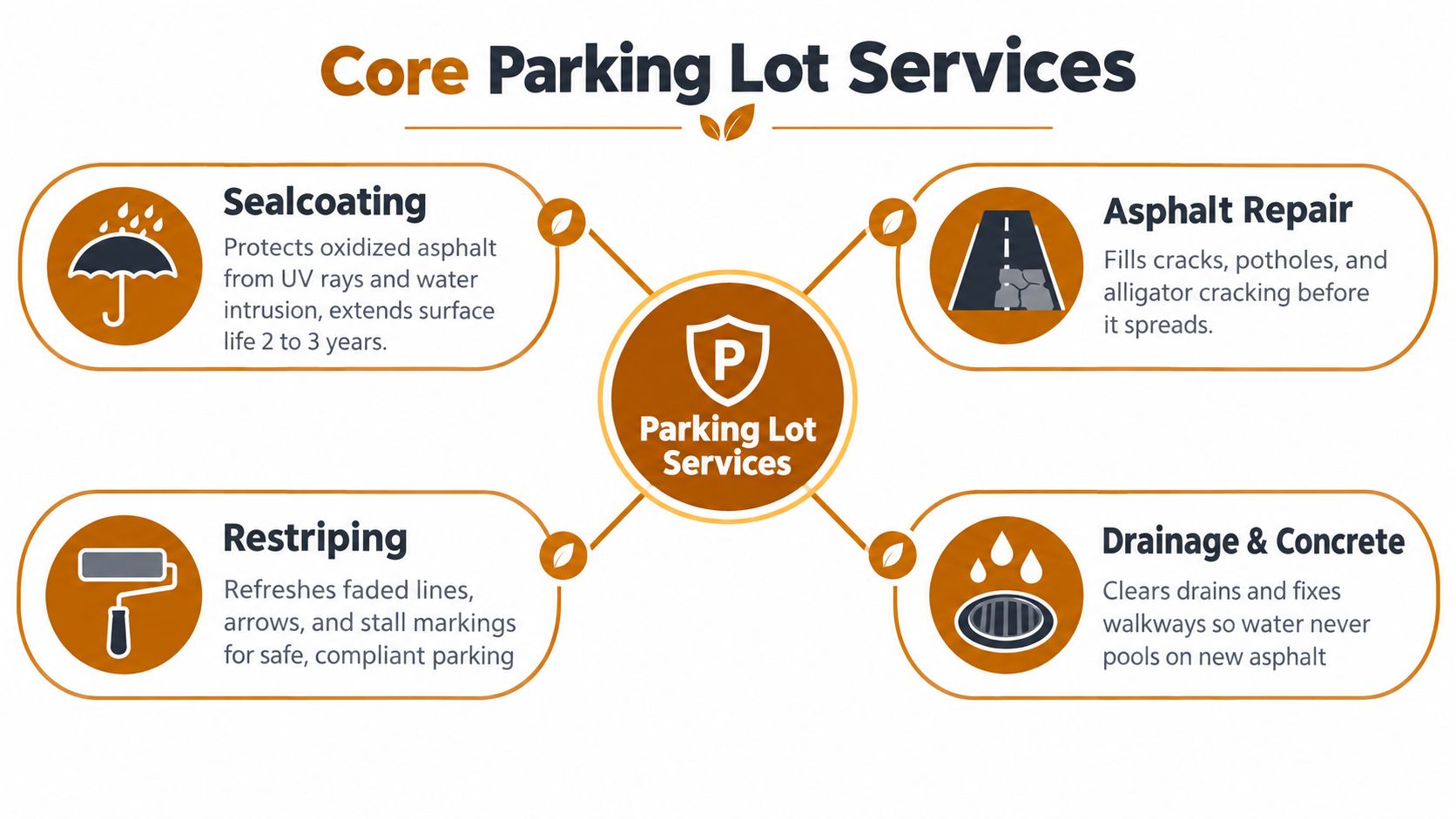
A clear proposal should tell the board what each service accomplishes and what it doesn't. Sealcoating is a protective surface treatment for oxidized asphalt. It helps shield the pavement from UV exposure and water intrusion, but it isn't a structural repair and won't correct a failed base, deep settlement, or drainage defect.
Crack treatment keeps water and debris from entering open pavement. Asphalt maintenance guidance describes crack sealing and filling as a way to address infiltration by water and non-compressible materials such as dirt, sand, rocks, and weeds. Asphalt maintenance guidance supports treating cracks as a preservation task, not merely a cosmetic one.
Patching handles localized failures. A contractor may need to remove damaged asphalt, repair the supporting material, and install new pavement where alligator cracking, potholes, or settlement has made the surface unstable. If the same patch keeps failing, request an explanation of the underlying cause.
Resurfacing places a new asphalt surface over an existing lot when the underlying pavement remains suitable for that treatment. It's not the right answer for every worn lot. The contractor should assess base stability, drainage, elevations, traffic patterns, curbs, door thresholds, and accessible routes before recommending an overlay.
Markings, concrete, and water control
Striping and signage organize traffic, define stalls, identify fire lanes, guide pedestrians, and keep safety information visible. ADA upgrades may include accessible stalls, van-accessible allocation, access aisles, route corrections, detectable warning surfaces, and signs.
Concrete work completes the system. Curbs, sidewalks, ramps, wheel stops, and walkway slabs affect how people enter and move through the lot. Use a written inspection process such as this parking lot maintenance checklist before comparing proposals.
Drainage belongs in the same conversation. Federal Highway Administration guidance directs designers to move water away from pavement while preventing runoff from flowing toward sidewalks, driveways, adjoining slopes, developed private property, or public land. Federal pavement drainage guidance makes the point clearly: a dark, freshly treated surface can still be a poor project if water continues collecting in the wrong places.
When to Schedule Sealcoating Repairs and Restriping in Central Florida
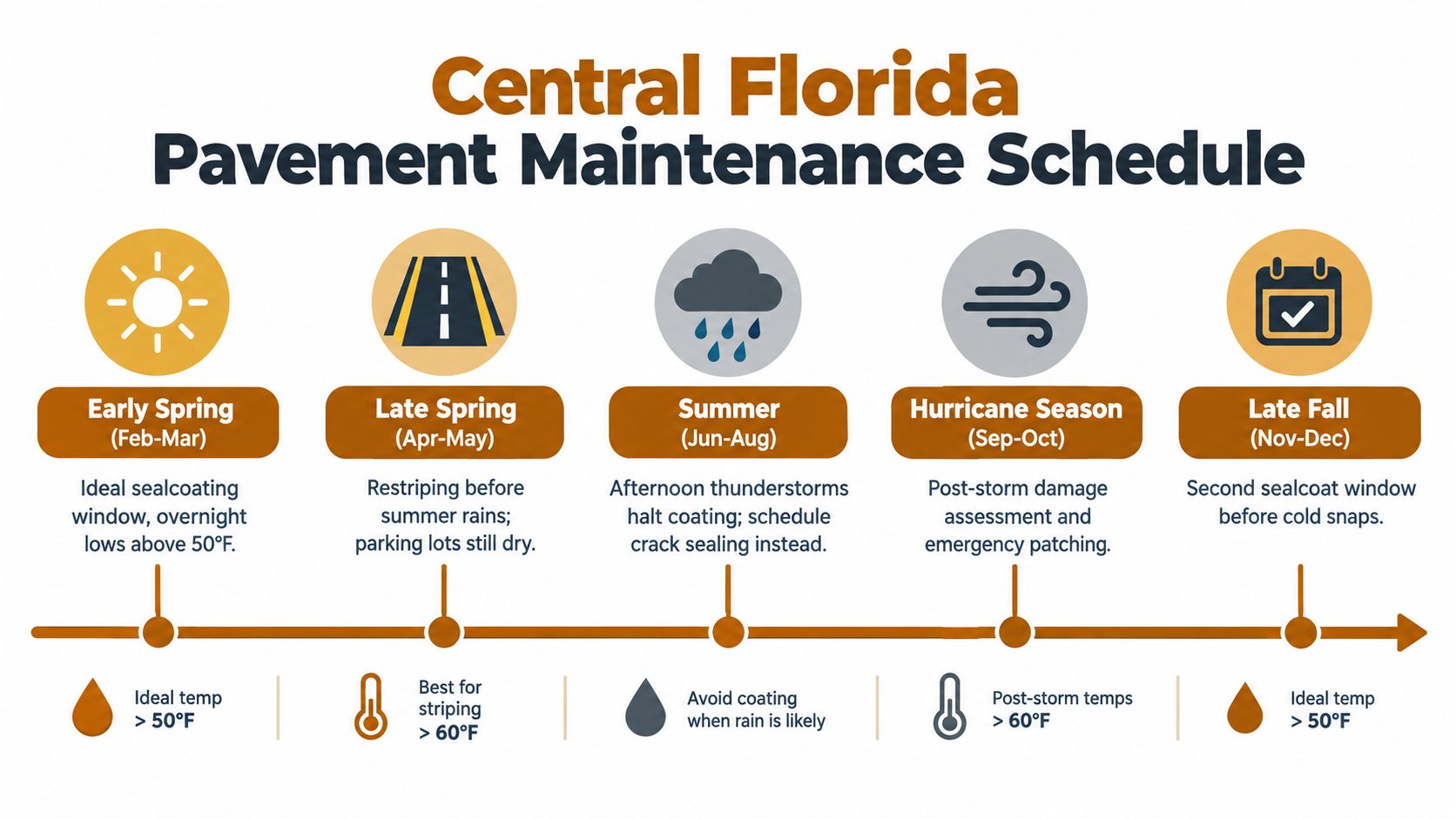
Central Florida scheduling should follow pavement condition and weather windows, not a reminder on a calendar. Heat and UV exposure fade asphalt and paint, while afternoon storms can interrupt coating work and expose weak areas.
A practical planning sequence starts with inspection. Look for loose aggregate, oxidation, open cracks, potholes, oil damage, faded lines, and ponding. Treat active cracks and failed areas before applying a protective surface treatment. Otherwise, the new finish can hide the condition that needed attention.
Use weather and wear as the trigger
Sealcoating needs suitable drying conditions. Schedule it during a stable weather window when overnight temperatures remain above 50 degrees Fahrenheit and rain isn't expected for 24 to 48 hours, following the application requirements of the selected product and crew. Spring and fall often offer more workable conditions than the wettest part of summer, but the actual forecast should control the decision.
Restriping should follow sealcoating after the surface has cured as specified. Don't paint too early and risk poor bonding, and don't wait until drivers can barely distinguish stalls, arrows, crosswalks, and fire lanes.
A surface that shows widespread raveling, recurring failures, or drainage-related settlement deserves a pavement evaluation before coating. Resurfacing may fit when the base is sound, while localized reconstruction or deeper repair may be needed where the structure has failed.
A calendar can remind you to inspect. It can't tell you whether the lot is ready for sealer.
Managers can use this sealcoating timing guide as a planning reference, then adjust the work around actual site conditions. A lot near a busy retail corridor in Ocala may wear differently from a quieter HOA lot in Beverly Hills. The same applies to seasonal traffic around Crystal River, Hernando, Lecanto, and The Villages.
What Drives the Cost of Parking Lot Services
Two lots with similar dimensions can require very different budgets. The difference usually comes from preparation, access, drainage, traffic control, concrete interfaces, and the condition below the visible asphalt.
Square footage affects material volume, while linear footage affects crack treatment, curbs, edge repairs, and striping. Surface condition determines whether the crew can clean and treat the lot or must remove failed areas first. Material grade, application thickness, cure requirements, and the number of mobilizations also change the proposal.
Accessibility work can add scope when stalls, aisles, routes, curb ramps, detectable warnings, or signs need correction. Drainage work may involve inlet cleaning, edge repair, grade correction, or pavement reconstruction. A contractor who leaves those items out may appear cheaper while only postponing the expense.
Compare bids by scope, not just totals
| Service | Key cost driver | Typical effect on price |
|---|---|---|
| Sealcoating | Surface preparation, oil spots, crack treatment, and access | More preparation and difficult access raise the price |
| Crack repair | Crack density, width, routing, cleaning, and sealing method | More linear footage and deeper defects raise the price |
| Asphalt patching | Failed area size, base condition, removal, and disposal | Structural failure raises the price more than surface wear |
| Resurfacing | Existing base, overlay thickness, milling, edges, and transitions | Sound pavement lowers scope, while grade and base problems raise it |
| Striping | Stall count, arrows, crosswalks, fire lanes, layout changes, and curing access | More markings and phased access raise the price |
| ADA upgrades | Stalls, aisles, routes, ramps, signs, and detectable warnings | Layout corrections and concrete work increase scope |
| Drainage and concrete | Inlets, low spots, curbs, sidewalks, and walkway transitions | Settlement and reconstruction can materially expand the work |
Ask every bidder to identify what is included, excluded, deferred, and measured. A low sealcoating bid that skips crack preparation or drainage correction isn't a savings plan. It's a promise to pay for the same defect later.
ADA Compliance Striping and Accessible Route Upgrades
ADA compliance striping is a layout and route issue, not a stencil issue. The space, access aisle, sign, curb transition, sidewalk, slope, surface, and path to the entrance must function together.
Under the 2010 ADA Standards, an accessible car space must be at least 96 inches wide, and a van-accessible space must be at least 132 inches wide. At least one of every six accessible spaces, or fraction of six, must be van accessible. The 2010 ADA design standards also require markings that define the stall width and an adjoining access aisle.
The access aisle must be at least 60 inches wide, level with the adjoining space, equal in length to the space it serves, connected to the accessible route, and limited to a maximum slope of 1:48 in every direction. The route to an accessible entrance must be at least 3 feet wide, firm, stable, slip-resistant, and free of curbs and stairs. ADA guidance on restriping parking spaces explains why surrounding walkways matter as much as painted symbols.
Inspect the whole route
A freshly sealed lot can still fail functionally if:
- The aisle is too narrow: Users may not have room to deploy a ramp or transfer safely.
- The route breaks at a curb: A compliant stall doesn't help if the pedestrian path ends at an inaccessible transition.
- The slope is excessive: Correcting drainage by creating a steep localized grade can solve ponding while creating an accessibility defect.
- The van allocation is wrong: A property may count accessible stalls correctly but fail to provide the required van-accessible arrangement.
- The signage is outdated or damaged: Faded, missing, blocked, or poorly placed signs undermine the marked layout.
Common triggers include resurfacing, a tenant buildout, a change of use, altered grades, and deteriorated signage. Treat ADA work as a recurring inspection and maintenance line item, not a one-time paint purchase. This ADA parking lot striping requirements guide can help organize a site review before a restriping project.
How Drainage Signage and Walkways Connect to Pavement Work
A Marion County manager may see ponding near the accessible stalls after a summer storm, while a Citrus County owner notices a settled walkway and faded markings at the same entrance. Those are not separate purchases. Water damage can weaken pavement, a broken route can undermine striping, and new paint will not correct either defect.
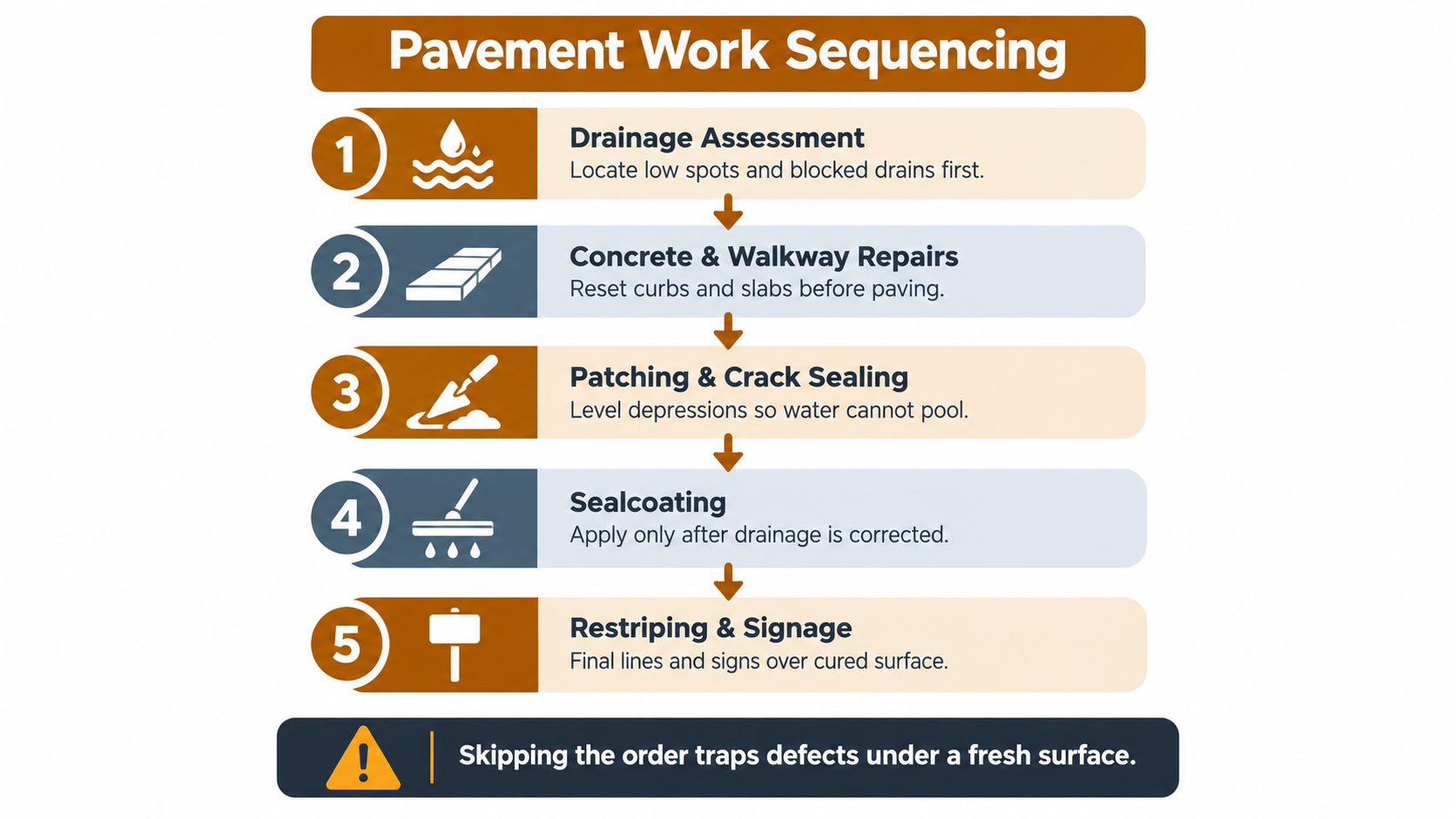
Sequence the work before approving a sealcoating or restriping proposal. Find blocked inlets, low points, eroded edges, and runoff paths first. Then repair failed concrete, curbs, base areas, pavement depressions, and route transitions. Sealcoat only when the pavement can accept it, then finish the striping and replace signs on the corrected surface. Skipping that order turns a quick cosmetic job into repeat repairs.
The proper order protects the investment
- Assess drainage: Record ponding after rain, inspect collection points, and trace runoff across and beyond the lot.
- Repair concrete and walkways: Fix broken slabs, curbs, ramps, and route transitions before final surface work.
- Patch and seal cracks: Stabilize failed areas and keep water and debris out of open cracks.
- Apply sealcoating: Coat only after drainage and pavement repairs are ready.
- Restripe and install signage: Add final markings and signs after the surface has cured.
Accessible stalls and pedestrian aisles need special attention. Drainage corrections cannot shift water by creating a steep crossfall or an unsafe route. Federal drainage guidance supports evaluating runoff and pavement grade together. For a property manager, that means coordinating drainage, ADA route work, sealcoating, and striping in one scope instead of paying for separate fixes that conflict.
Building a Routine Maintenance Plan for Marion and Citrus Counties
A useful maintenance plan gives an owner something more reliable than “call us when it looks bad.” It assigns inspections to seasons, records defects, and connects each finding to a service decision.
Use the calendar as an inspection framework
Spring: Walk the lot after winter rains. Check inlets, edges, ponding, cracks, settled concrete, and route continuity. Schedule sweeping, crack treatment, drainage corrections, and patching before the surface is coated.
Summer: Watch for UV oxidation, oil staining, loose aggregate, faded paint, and heavy-wear lanes. Afternoon storms can interrupt coating work, so use suitable dry windows and don't rush a crew onto wet pavement.
Fall: Review the lot before increased activity around Ocala, Crystal River, and other Central Florida destinations. Focus on entrances, cart corrals, drive aisles, delivery areas, fire lanes, and pedestrian crossings.
Winter: Close open cracks, document storm damage, update the striping inventory, and prepare a capital recommendation for resurfacing or reconstruction where repairs no longer hold.
Keep a site map with photographs, dates, defect locations, completed work, and deferred items. That record helps an HOA board in Silver Springs, a church in Dunnellon, or a commercial owner in Inverness understand why a repair moved forward or stayed in the plan.
Turn annual work into capital planning
Routine work should cover inspections, cleaning, crack treatment, surface protection, markings, signage, and small concrete repairs. Larger pavement work belongs in a multi-year capital plan that accounts for base condition, drainage, traffic, property use, and expected disruption.
Move a project forward when cracks widen, patches reopen, water remains after ordinary rain, accessible routes break, or traffic markings become difficult to read. Don't wait for a pothole to become the board's only evidence that the lot needs attention.
This approach works across Marion County, FL and Citrus County, FL, including Summerfield, Lecanto, Homosassa, Hernando, and The Villages. It also makes maintenance easier to explain: the property isn't buying random services. It's preserving drainage, structure, safety, access, and appearance in the right order.
When a Professional Evaluation Is Worth Scheduling
An on-site evaluation is worth scheduling before annual budgeting, after a major storm, when accessibility exposure is suspected, or when a sealcoating proposal seems unusually cheap. It's also the right move when different contractors recommend completely different scopes for the same lot.
A proper evaluation should begin with a documented pavement assessment. Depending on the visible condition, that may include visual review, targeted investigation of soft or recurring failures, drainage observations after rainfall, and a review of how traffic uses the property.
Ask for a prioritized scope
A useful consultation should address:
- Pavement condition: Identify surface oxidation, cracks, raveling, potholes, alligator cracking, settlement, and recurring patches.
- Drainage performance: Check low points, inlets, edges, runoff paths, and the relationship between ponding and pavement failure.
- ADA layout: Compare stall counts, dimensions, access aisles, van allocation, signage, slopes, concrete routes, and entrance connections with current requirements.
- Work sequence: State what must happen before coating, what can follow curing, and what should be deferred.
- Budget priorities: Separate urgent repairs from useful preservation work and longer-term capital improvements.
- Traffic phasing: Explain how customers, residents, deliveries, emergency access, and pedestrians will move during construction.
Red flags include a proposal that promises a beautiful black surface without mentioning cracks, drainage, base failures, accessible routes, or curing access. Another warning sign is a single bottom-line number with no square footage, marking scope, preparation allowance, signage count, or exclusions.
For property managers, the deliverable should be a written, prioritized plan that ownership can understand and budget. A professional evaluation can prevent you from paying for sealcoating, then paying again to remove it when a drainage or base defect finally demands correction.
Riverside Sealing & Striping, LLC provides concrete work, asphalt sealcoating, parking lot striping, and ADA-related pavement improvements for properties across Central Florida, with free, no-pressure on-site consultations and estimates. For a practical evaluation in Marion County, Citrus County, or nearby communities, visit Riverside Sealing & Striping, LLC and request a scope that separates immediate repairs from long-term maintenance planning.