
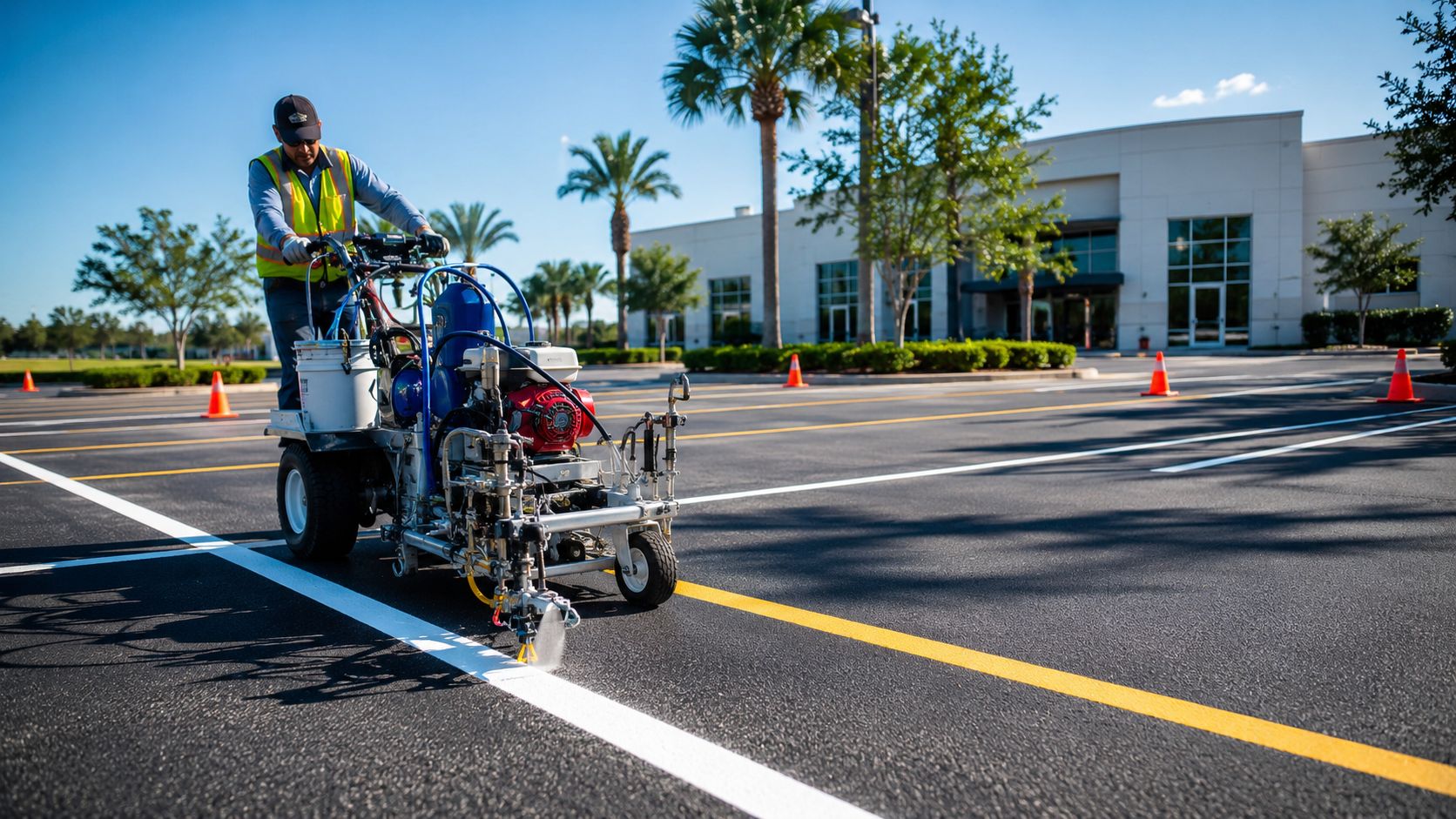
A property manager usually notices the problem when a tenant complains, a fire lane disappears under faded paint, or an accessible space no longer reads clearly from the drive aisle. In Central Florida, heat, ultraviolet exposure, rain, oil, and daily traffic can turn a once-clean lot into a safety and compliance concern before the asphalt itself looks ready for major work.
That's why a parking lot striping business should be treated as part of the property maintenance plan, not as a crew you call only after the lines vanish. For owners in Marion County, FL, Citrus County, FL, and nearby communities such as Ocala, Dunnellon, Belleview, Silver Springs, Summerfield, Crystal River, Homosassa, Inverness, Lecanto, Beverly Hills, Hernando, and The Villages, the practical question is when to inspect, repair, seal, restripe, and reopen the lot without paying for the same work twice.
Table of Contents
- What a Parking Lot Striping Business Actually Does
- The Striping Process From Site Prep to Final Inspection
- ADA Compliance Rules That Drive Every Restriping Job
- What Parking Lot Striping Really Costs
- Bundling Striping With Sealcoating and Asphalt Work
- Central Florida Climate and Seasonal Timing
- Questions to Ask Before Hiring a Striping Contractor
- Long-Term Striping Strategy for Commercial Properties
What a Parking Lot Striping Business Actually Does
A commercial lot with faded markings needs more than a fresh coat of paint. A professional contractor reviews the traffic pattern, measures the existing layout, checks accessible parking, confirms fire lanes and directional markings, prepares the surface, applies the specified material, and verifies the finished work before vehicles return.
The deliverable is a safe, traffic-ready, and readable parking system. That system can include standard stall lines, accessible symbols, access aisles, crosswalks, stop bars, arrows, curb markings, fire lane stencils, speed-bump markings, and signage. The exact striping method and color can also be affected by state or local codes, even where federal accessibility rules set the underlying requirements. The ADA compliance guidance for parking lot line striping explains why layout, signs, and recurring restriping belong in the same conversation.
The client mix is broader than retail
Retail centers are common customers, but a working striping contractor may also serve:
- HOA communities: Refresh private-road markings, guest spaces, curb paint, and accessible areas.
- Medical offices: Keep routes, entrances, accessible stalls, and patient drop-off areas understandable.
- Schools and churches: Coordinate work around busy arrival periods and preserve safe pedestrian crossings.
- Warehouses and industrial sites: Mark loading areas, drive aisles, equipment zones, and restricted sections.
- Municipal properties: Maintain public lots, fire lanes, curb markings, and directional traffic controls.
Most lots need attention on a recurring cycle because paint wears from turning tires, sunlight, cleaning, weather, and traffic. A common planning window is 12 to 24 months for restriping, though the actual interval depends on surface condition, traffic volume, material, drainage, and how clearly the markings remain visible.
Practical rule: Striping should be the final visible layer of a pavement project. If a sealcoat or resurfacing job is still scheduled, painting first usually creates avoidable rework.
A capable contractor may also handle ADA layout adjustments, fire lane stenciling, curb painting, speed bumps, bollard installation, and removal or blackout of obsolete lines. That broader scope matters because the striping crew often determines whether a sealcoating or resurfacing investment remains functional for drivers, pedestrians, tenants, and inspectors.
Road-safety research supports the value of clear pavement markings beyond appearance. A U.S. Department of Transportation literature review reported benefit-cost ratios from 24:1 to 55:1 for certain marking treatments, including wider edge lines, showing that marking improvements can carry measurable safety value relative to cost. The U.S. DOT pavement-marking literature review also places pavement marking within a broader commercial, municipal, and industrial equipment market.
The Striping Process From Site Prep to Final Inspection
A clean job starts before the striper rolls. The crew needs a documented layout, a surface that can accept paint, and a traffic-control plan that keeps residents, customers, and workers out of the work zone.
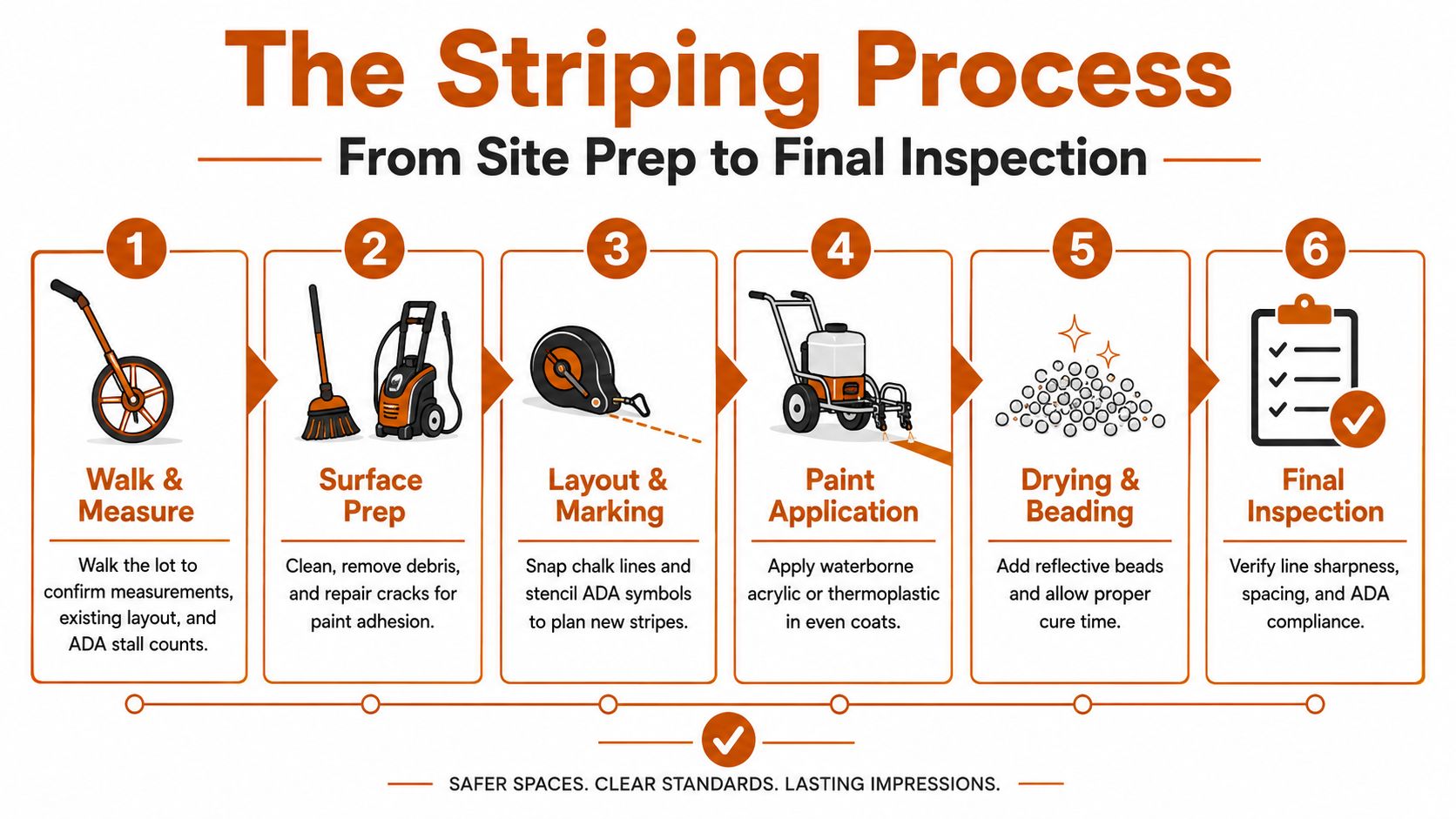
Six steps that protect the finished result
Walk and measure: The contractor confirms stall dimensions, drive aisles, existing lines, curb conditions, fire lanes, pedestrian routes, and accessible-stall counts. A measuring wheel, site plan, or laser guide can expose layout problems that an estimate based only on a quick drive-by will miss.
Prepare the surface: Crews blow off sand and debris, degrease oil spots, and identify cracks or failed asphalt that need repair before marking. If old lines conflict with a new layout, they may be taped, ground, or blacked out so ghost markings don't confuse drivers.
Lay out the markings: String lines, chalk lines, templates, and laser guides help crews keep stalls straight and consistent. This is also the point to verify arrows, stencils, accessible aisles, fire-lane legends, and any requested layout changes.
Choose the paint system: Water-based acrylic traffic paint works for many routine lots. High-wear areas, crosswalks, fire lanes, and facilities that need stronger visibility may justify traffic paint with reflective elements, thermoplastic, or preformed markings. Material selection should follow the surface, traffic, exposure, and manufacturer specifications.
Apply even coats: Airless and HVLP striping machines help produce consistent edges and coverage. The crew should apply the material at the thickness specified by the manufacturer, rather than thinning or stretching paint just to make a low quote work.
Control drying and inspect: Barricades stay in place while each coat dries. Many jobs require blocking the affected area for 30 to 60 minutes per coat, but weather, humidity, product, and surface temperature can change that window. The handoff should include a final walk-through, photographs, an updated striping diagram, and a suggested inspection or restriping date.
Paint performance also affects traction and lifecycle planning. Research on preformed thermoplastic markings reported dry skid-resistance values of 80 to 90 SRV and wet values of 66 to 73 SRV in tested conditions, while published specifications identify retroreflectivity minimums of 325 mcd/lux/m² for white and 200 mcd/lux/m² for yellow solid thermoplastic after 180 days under AASHTO M 249. The pavement-marking material study provides useful background for owners comparing basic paint with higher-performance systems.
ADA Compliance Rules That Drive Every Restriping Job
The Americans with Disabilities Act became law on July 26, 1990, and its parking requirements still affect routine restriping whenever a business or public agency renovates its lot. The federal standards tie the number of accessible spaces to the total parking supply. For example, a lot with 101 to 150 spaces needs 5 accessible spaces, a lot with 301 to 400 spaces needs 8, lots with 501 to 1,000 spaces need 2% of total spaces, and lots with 1,001 or more spaces need 20 plus 1 for each 100 spaces over 1,000. The federal parking-space restriping guidance explains how those requirements apply during layout work.
A standard accessible space must be at least 96 inches wide with an adjacent access aisle at least 60 inches wide. A van-accessible arrangement can use an 11-foot space with a 5-foot aisle, or an 8-foot space with an 8-foot aisle. Another construction reference describes the same van configurations as 132 inches with a 60-inch aisle or 96 inches with a 96-inch aisle. This accessible parking dimensions guide is useful for visualizing the measurements on an existing lot.
| Space Type | Stall Width | Access Aisle | Notes |
|---|---|---|---|
| Standard accessible space | At least 96 inches | At least 60 inches | Aisle must connect to an accessible route |
| Van-accessible option one | 132 inches | 60 inches | Commonly described as an 11-foot stall with a 5-foot aisle |
| Van-accessible option two | 96 inches | 96 inches | Commonly described as an 8-foot stall with an 8-foot aisle |
The accessible route needs to connect the parking area to the building entrance and public sidewalks. The accessible surface must remain stable, firm, and slip-resistant, and the slope cannot exceed 1:48, or 2%, in any direction. A sign showing the International Symbol of Accessibility must be mounted at least 60 inches above the ground to the bottom of the sign, so it remains visible beside a parked vehicle.
The pavement marking, sign placement, stall count, aisle connection, and surface slope should be inspected together. A contractor familiar with ADA handicap parking space requirements can help identify layout conflicts before the paint goes down. Federal rules establish a baseline, but Florida building requirements and local authorities may add requirements affecting fire lanes, colors, signs, and installation details.
What Parking Lot Striping Really Costs
Striping quotes vary because contractors aren't always pricing the same scope. One quote may include surface preparation, stencils, traffic control, and signs. Another may price only line footage or gallons of paint, leaving labor and prep as separate items.
The following ranges are commonly used for planning:
| Lot Size | Stall Count | Typical Cost Range | Main Cost Drivers |
|---|---|---|---|
| Small retail lot | 40 to 60 spaces | $400 to $800 | Standard lines, basic prep, limited stencils |
| Mid-size commercial lot | 100 to 200 spaces | $1,200 to $2,500 | ADA re-stenciling, arrows, layout complexity, traffic control |
| Large commercial property | More than 300 spaces | $3,000 to $6,000 or more | Linear footage, specialty markings, signs, phased access, layout redesign |
For more context on how contractors separate routine work from complex layouts, review this guide to parking lot striping prices.
The largest cost drivers are total line footage, the number of arrows and legends, ADA symbols, sign replacement, parking bumpers, bollards, and whether the contractor is repainting an established layout or designing a new one. Oil removal, old-line removal, blacking out obsolete markings, and after-hours work can change the labor substantially.
Mobile setup fees, minimum trip charges, and work scheduled around an occupied retail center also affect the total. A property manager should ask for a written scope that separates line striping, stencils, signs, surface preparation, repairs, traffic control, and exclusions. That makes a low quote easier to compare with a complete quote.
Bundling Striping With Sealcoating and Asphalt Work
Striping should be scheduled around the asphalt work, not treated as an independent appointment. Sealcoating protects asphalt from ultraviolet exposure, oil, and water, but it also covers existing lines. If the lot is striped first, the owner may pay to cover those markings and then pay again to restore them.
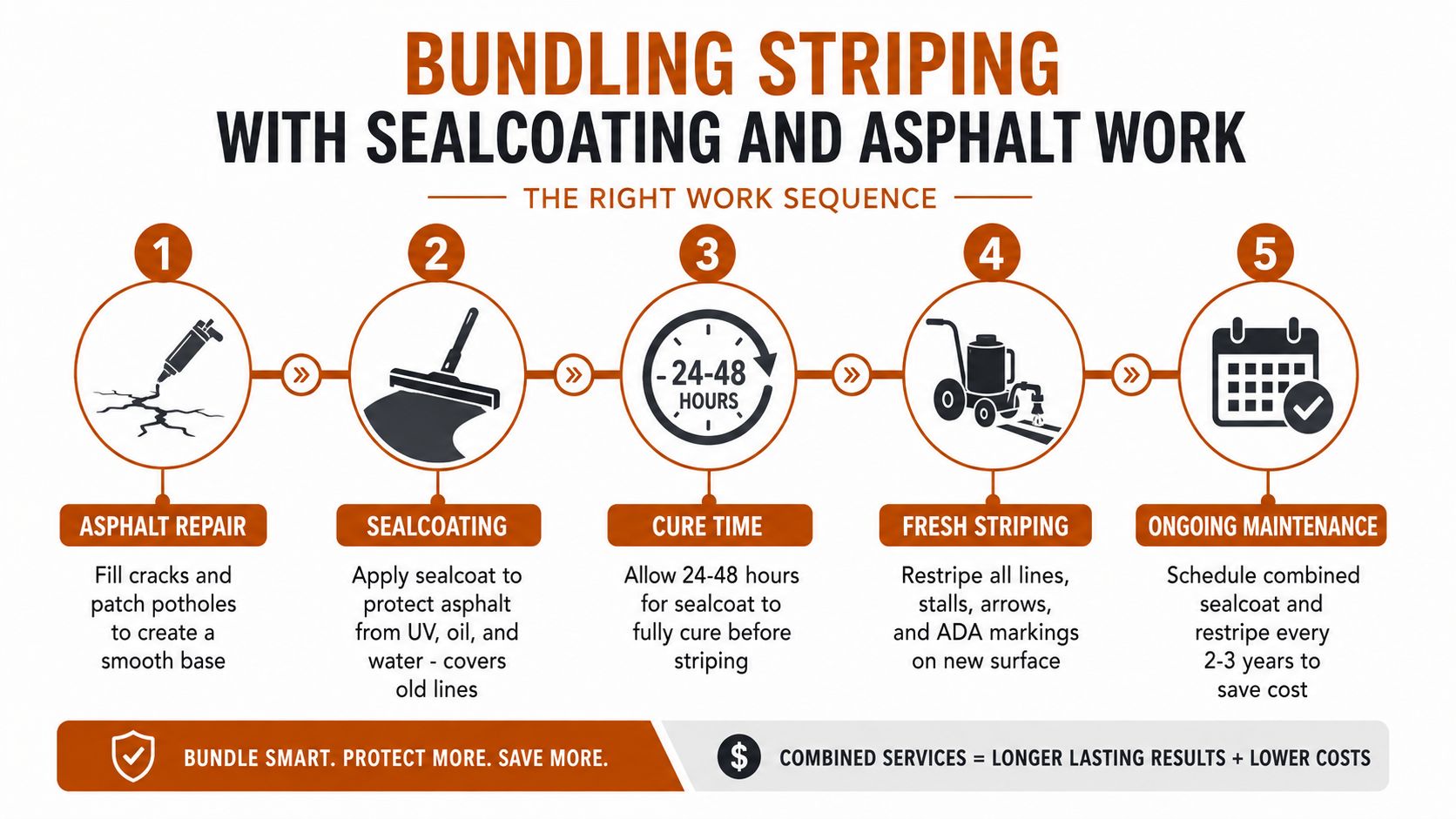
Use the sequence that prevents rework
- Repair first: Fill cracks and patch potholes before coating or painting. Paint won't correct failed asphalt.
- Seal next: Apply sealcoat after the base repairs. The coating protects the surface but hides old markings.
- Allow curing: Wait for the sealcoat to cure according to the product and site conditions. The infographic identifies a 24 to 48 hour curing window, but the contractor should follow the actual product requirements and weather conditions.
- Stripe last: Repaint stalls, arrows, fire lanes, crosswalks, and accessible markings on the finished surface.
- Maintain the cycle: Keep inspection and future coating dates together so the lot doesn't drift into emergency work.
Resurfacing requires a full layout review rather than a simple repaint. A new asphalt layer can change surface texture, grades, edges, and the relationship between stalls and drainage. The contractor should confirm the layout after the paving work and make sure accessible routes still connect properly.
Some property managers phase crack repair, sealcoating, and striping across different seasons. Others bundle the work under one contractor to reduce mobilization and scheduling conflicts. Independent market coverage reports that parking-lot work averaged 34% of work mix among top striping contractors, while a market estimate placed the parking-lot marking segment at about $223 million in 2025, with a projected 4.2% CAGR. The line-striping robot market overview illustrates why parking facilities remain a meaningful recurring application.
A bundled project may save 10% to 20% compared with separate trips, according to the planning data for this service line, but the more important benefit is avoiding duplicate mobilization and preventing fresh paint from being buried under a later coating. Ask every bidder whether they also handle parking lot sealcoating and asphalt repairs, and require the proposed sequence in writing.
Central Florida Climate and Seasonal Timing
Central Florida pavement markings face a different maintenance burden than markings in colder regions. Strong sun and ultraviolet exposure break down paint binders, while repeated rain, standing water, turning tires, and oil contamination reduce contrast and adhesion.
Afternoon thunderstorms are especially disruptive during the wetter season. A crew that applies paint late in the day may lose the work to rain before the material cures. Storm debris and water flow can also scuff or cover lines, particularly where drainage is poor.
Build the calendar around conditions
A practical schedule looks like this:
- Late summer: Inspect fading, drainage trouble, cracked pavement, and damaged signs before the busiest storm period finishes.
- Fall: Plan the main restripe when conditions are cooler and more predictable. October or November can give the paint a drier winter period before spring traffic increases.
- Late spring: Consider sealcoating when the contractor can manage humidity, cure time, and weather exposure.
- After severe storms: Walk the lot for debris, standing water, washed-out markings, and damaged curbs or signs.
The exact date still depends on the product, forecast, shade, surface temperature, and the property's operating schedule. A school in Ocala may need work during a break, while a shopping center in The Villages may need phased closures during low-traffic hours. A medical office in Crystal River or a church in Inverness may need pedestrian routes preserved throughout the job.
Central Florida owners should inspect before the lot becomes visibly deficient. A faded line can be corrected during a planned maintenance visit, but a failed route, blocked fire lane, or confusing accessible area demands faster coordination.
Questions to Ask Before Hiring a Striping Contractor
Treat the proposal like a small audit of the contractor's field process. The lowest number isn't useful if the bidder never measured the lot, ignored accessible parking, or left traffic control out of the scope.
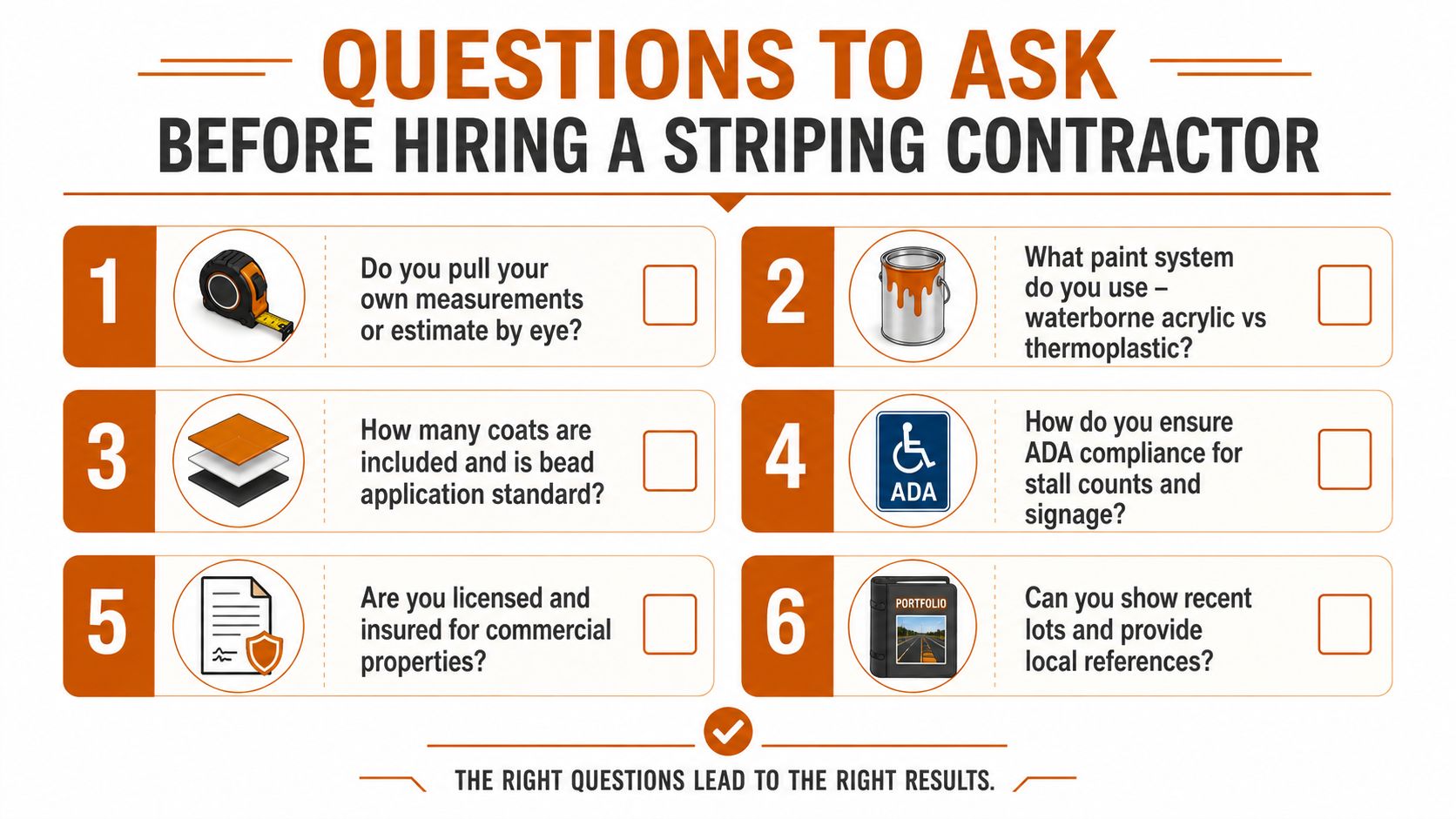
Ask these questions before approving the work:
How did you measure the lot? A contractor should be able to explain whether the crew walked the site, confirmed existing dimensions, and counted accessible spaces rather than estimating from a phone conversation.
Which material are you proposing? Waterborne acrylic can suit many routine areas, while thermoplastic or preformed markings may make more sense in high-wear locations. The answer should relate to traffic, weather, visibility, and surface condition.
How many coats and what preparation are included? Clarify whether the quote covers blowing, degreasing, old-line removal, crack repairs, stencils, reflective beads, and cure protection.
Who verifies ADA details? The contractor should address stall dimensions, access aisles, accessible routes, van-accessible spaces, symbol markings, and sign height as one layout rather than leaving the property manager to coordinate separate corrections.
Are you licensed and insured? Request proof of general liability and workers' compensation coverage, along with a Florida license when the scope or jurisdiction requires one. A serious commercial contractor should provide documentation without hesitation.
Can you show comparable local work? References from a small HOA lot don't answer the same questions as a medical campus, warehouse, school, or shopping center. Ask for examples with similar traffic, surface age, and operating constraints.
Red flags include a phone-only quote, vague line items, no mention of barricades or reopening, pressure for a deposit before a site walk, and refusal to identify the paint system. Reliable scheduling and clear timelines matter just as much as clean lines because a poorly planned closure can disrupt tenants and customers.
Long-Term Striping Strategy for Commercial Properties
A lot is easier to budget when the owner keeps a simple maintenance record instead of waiting for a complaint. Record the last restripe, paint or thermoplastic system, accessible-space layout, sign condition, sealcoat date, asphalt repairs, and any changes to traffic flow.
For many well-maintained Central Florida lots, a complete restripe is planned around 18 to 24 months, with inspections and selective touch-ups between full cycles. Sealcoating may be planned on a 3 to 4 year cycle, while crack repair should be handled as defects appear. These intervals are planning tools, not guarantees, because traffic, drainage, surface condition, and material performance determine the actual need.
Keep the work in the right order
- Month 0: Complete the full layout, including stalls, fire lanes, arrows, and accessible markings.
- Month 6: Walk the lot and check high-turnover areas, entrances, stop bars, and storm-related wear.
- Month 12: Touch up faded or damaged markings where the rest of the layout remains sound.
- Months 18 to 24: Review the entire lot and schedule the next full restripe when visibility or compliance requires it.
- Ongoing: Align sealcoating and asphalt repairs so striping remains the final surface treatment.
Keep an as-built diagram in the property file. It gives the next crew a reliable starting point, helps preserve accessible counts and fire-lane placement, and makes layout changes easier to review before work begins. Re-evaluate accessible parking whenever the lot changes, including resurfacing, expansion, reconfiguration, or changes to building access.
Riverside Sealing & Striping, LLC provides concrete work, asphalt sealcoating, parking lot striping, ADA upgrades, accessible-space markings, directional arrows, and related pavement maintenance for properties in Marion County, FL, Citrus County, FL, and surrounding Central Florida. The company offers licensed and insured service, reliable scheduling, free estimates, and no-pressure on-site consultations for owners who want to coordinate the work in the correct sequence.
Riverside Sealing & Striping, LLC can evaluate your lot, review the ADA layout, and coordinate striping with sealcoating, asphalt repairs, or concrete improvements so you don't pay to redo finished work. Visit Riverside Sealing & Striping, LLC to request a free, no-pressure consultation for your commercial property in Marion or Citrus County.