
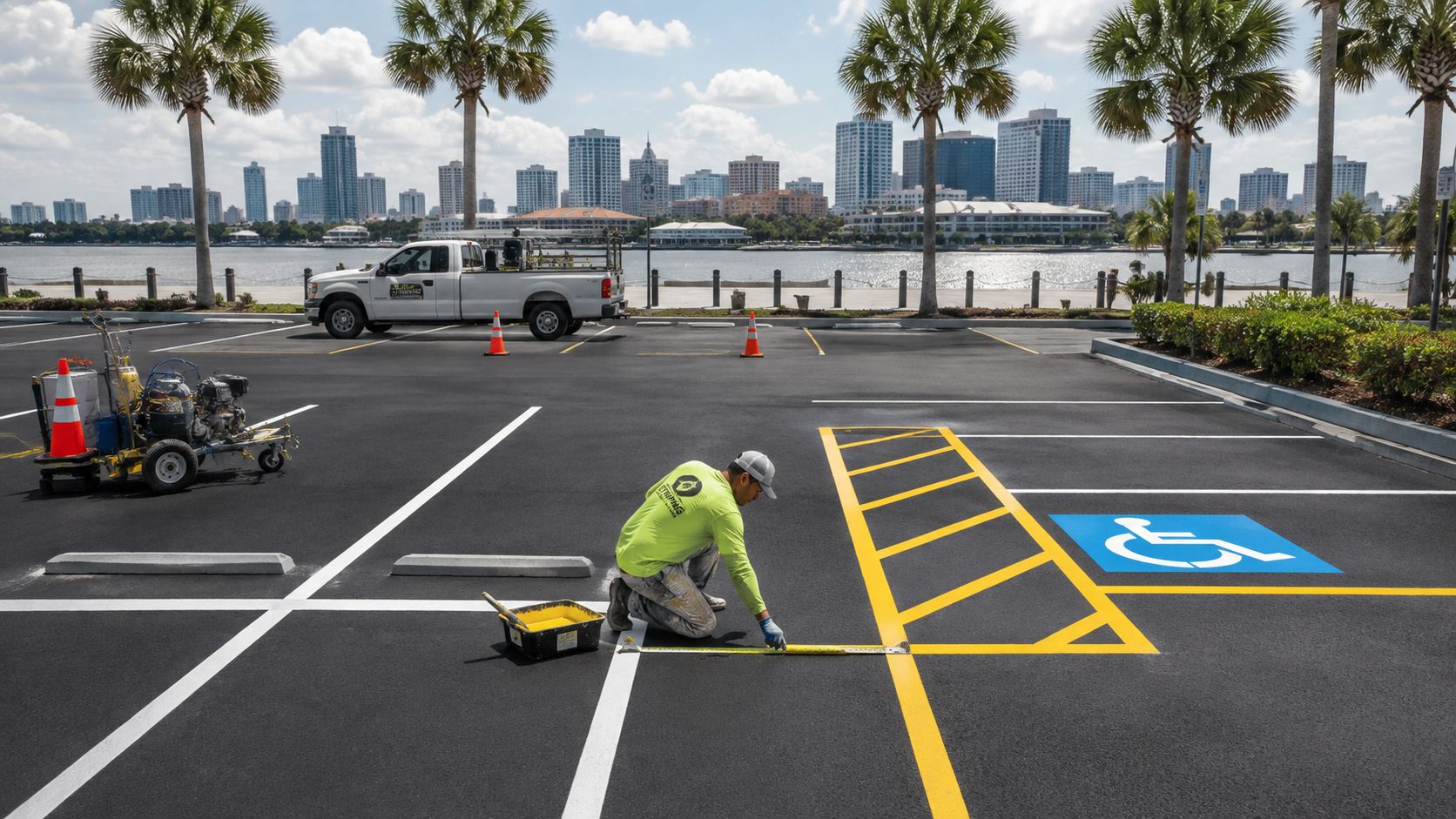
You pull into a Tampa shopping center and the lines are barely there. The stall edges have turned into gray shadows, the accessible space looks like it was guessed at years ago, and drivers are parking wherever they can fit. That's the moment most property managers realize parking lot striping in Tampa isn't a cosmetic touch-up, it's a maintenance decision tied to safety, access, and how hard the lot works every day.
Tampa's parking environment proves the point. The City of Tampa's parking master plan reported over 12,500 off-street parking spaces and about 3,130 metered spaces in the system, so striping here supports a lot more than a small private lot in the background. It also found that more than 85% of paid parking sessions lasted three hours or less during the study period, and the Ybor Lots had an average turnover rate of over 500%, which means the same space was being reused about five times per day in that district. That kind of traffic beats up stall lines, arrows, fire lanes, and accessible markings fast, especially in Florida heat and rain. City of Tampa parking master plan state of the system report
What follows is the practical side of the job. Not just what striping is, but when it needs to happen, what layout details matter, how sealcoating changes the order of work, and how to avoid paying for the same lines twice on the same lot.
Table of Contents
- Why Tampa Lots Need Regular Restriping
- Striping Standards Every Tampa Property Manager Should Know
- ADA and Florida Accessibility Requirements for Parking Lots
- How a Professional Striping Project Is Sequenced
- Tampa Striping Costs and Restriping Cadence
- How to Choose a Tampa Striping Contractor You Can Trust
- A Simple Maintenance Calendar for Tampa Commercial Lots
- Questions Tampa Property Owners Ask About Parking Lot Striping
Why Tampa Lots Need Regular Restriping
A faded lot usually shows up the same way every time. A driver circles once because the stall lines are weak, a visitor can't tell where the accessible space starts, and the whole place starts looking neglected even if the asphalt underneath is still serviceable. Tampa's parking environment proves the point, striping here has to hold up in a lot that gets read quickly, turned over often, and exposed to hard weather.
The city parking study shows why striping has to be treated as recurring maintenance. More than 85% of paid parking sessions lasted three hours or less in the study period, and the Ybor Lots saw turnover above 500%. That means markings are getting read, driven over, and worn down again and again, which is exactly why stall lines and directional markings fade faster in busy commercial cores.
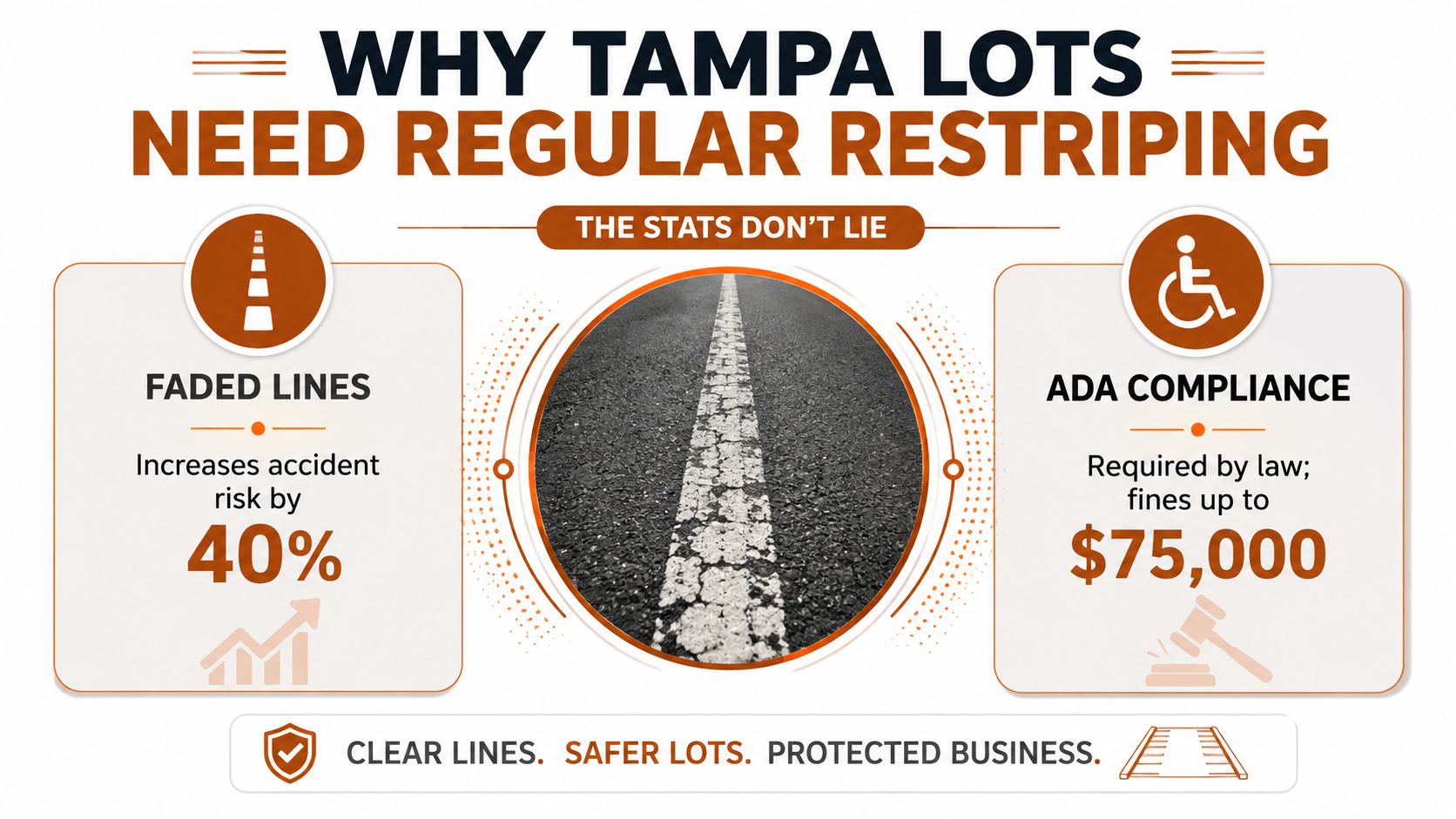
Practical rule: if a line is hard to see from the driver's seat on a bright day, it's already past the point where you should be planning the next restripe.
What the Tampa climate does to paint
Heat and UV work on striping the same way they work on everything else in Florida, they shorten the useful life of the finish. Afternoon rain, standing water, and vehicle traffic pull brightness out of the markings faster than property owners expect. A lot that looked acceptable two summers ago can become borderline today, even when the pavement itself still looks structurally fine.
That is why restriping belongs in the maintenance calendar, not the emergency list. A faded lot can still function in the loose sense, but it stops functioning well, especially when a tenant mix changes, a property gets busier, or a complaint-driven inspection forces a fresh look at accessibility and circulation. For properties in Tampa, parking lot striping is part of keeping the lot readable, compliant, and organized. The same logic carries across Central Florida, from Ocala and Belleview to Crystal River, Inverness, and The Villages, where heat and moisture beat on pavement the same way.
Striping Standards Every Tampa Property Manager Should Know
A faded lot creates a different problem than a damaged lot, and Tampa managers need to read both correctly. Striping starts with measurements, stall geometry, line widths, and paint build, because those details decide whether the layout makes sense from a moving vehicle and still holds up after sun, rain, and traffic. On commercial lots, the working baseline is standard stalls that are typically 9 feet by 18 feet and parking lines that are usually 4 inches wide. Parking lot striping standards
The quote should say more than paint color. It should tell you whether the crew is doing a light refresh, a full relayout, or a thicker two-pass application, because Florida-focused specs often call for 4 to 6 inch line widths and two coats to build durability to roughly 15 mil dry film thickness. That thicker build helps the lines stay legible longer under traffic and weather, which matters in Tampa lots that see heat, moisture, and regular turnover.
The paint options you'll hear about
Contractors usually talk about water-based acrylic, solvent-based, and thermoplastic striping products. Each one behaves differently in the field, but the key question is whether the product matches the pavement condition and the way the lot gets used. Fresh sealcoat, older oxidized asphalt, and patched areas do not all take paint the same way.
Fresh pavement and sealed pavement do not accept striping the same way. If the substrate is not ready, the prettiest line in the world will not hold up.
A contractor who walks the lot first is worth more than a crew that only wants to measure lines. New sealcoat, a rough patch, or a section with poor bond can change the prep method, the paint choice, and the order of work. If striping is scheduled before patching or sealcoating is finished, the lot often gets striped twice, once to satisfy the schedule and again to fix the layout after the surface work changes the field. Around Marion County, FL and Citrus County, FL, the same holds true whether the property is in Dunnellon, Homosassa, Lecanto, Beverly Hills, or the commercial corridors around Silver Springs and Hernando. Concrete and Asphalt Experts in Marion and Citrus County should be able to explain those trade-offs before anyone starts laying tape or pulling a chalk line.
ADA and Florida Accessibility Requirements for Parking Lots
Compliance is where a lot can look “fine” and still be wrong. The federal baseline sets the general direction, but Florida-specific guidance can be stricter, and that's where property managers get caught. One Florida reference states accessible parking spaces should be 12 feet wide with a 5-foot access aisle, while the federal baseline notes 96 inches for a car space and 132 inches for a van-accessible configuration. Florida accessibility parking guidance
That difference matters because accessibility isn't just about painting a blue box. It's about recalculating the layout from the total number of spaces in the lot, then making sure the accessible stall count, van-accessible allocation, access aisles, and signage all line up with the current inventory. A lot that passed inspection before can fail later if stalls were added, removed, or squeezed into a new arrangement without redoing the math.
What usually gets missed
The mistakes are rarely dramatic. They're usually the small layout errors that only show up when somebody measures them. An aisle gets narrowed. A van space doesn't have the right geometry. A stall count changes but the accessible count doesn't. Or a property manager assumes a repaint is enough when the actual issue is the layout itself.
- Recount before repainting: If the stall count changed, recalculate accessible spaces before anyone stripes.
- Check the aisle geometry: A blue space without the right access aisle is still a problem.
- Verify the signage: Striping alone doesn't finish the job.
- Confirm the slope and access route: The route from the parking space to the entrance has to work, not just look neat.
That's why parking lot striping Tampa jobs need more than paint crews. They need people who know when to redraw the entire accessible section and when a simple restripe is enough. For churches in The Villages, schools in Ocala, retail centers in Belleview, or HOAs in Summerfield, that layout math has to be right before the first line goes down.
How a Professional Striping Project Is Sequenced
A real project starts with a site walk, not a paint order. The contractor checks the pavement condition, measures the lot, looks at where the old layout has failed, and decides whether the job needs prep, patching, or a staged approach that keeps part of the property open. On a shopping center or church, that sequence matters because the lot usually has to stay usable while the work moves ahead in sections. Tenants, customers, and congregants still need access.
The fastest way to waste money is to stripe at the wrong point in the maintenance cycle. If a lot is going to be sealcoated, new lines laid down too early can disappear under the coating and have to be done again. If the pavement has not cured or the repairs are not solid, the paint can lift, smear, or peel before the lot is back in service.
The practical order usually runs from layout to prep to application to cure time. That sounds simple, but each step has a decision attached to it. The contractor has to decide whether the old marking should come off first, whether the surface is ready for paint, and whether sealcoating belongs before or after striping. Those choices are where a good crew protects the finish and keeps the owner from paying for the same work twice.
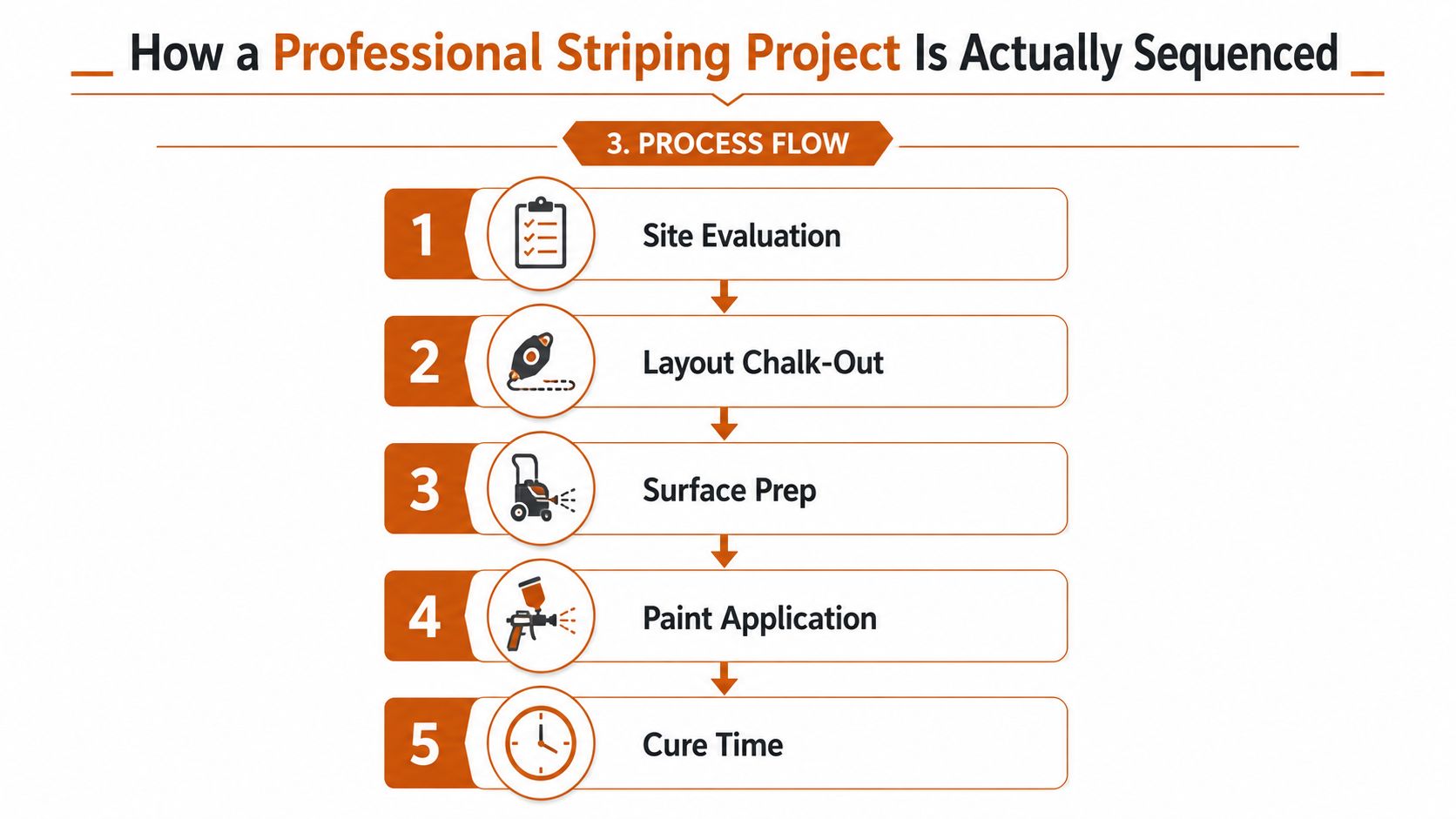
A field-level guide like how to stripe a parking lot helps owners see the order of operations without the sales gloss. If a quote leaves out that sequence, it usually leaves out the parts that protect the work, especially where Tampa heat, rain, and a busy property put the finish under stress.
Tampa Striping Costs and Restriping Cadence
Tampa pricing usually makes more sense when you think in lines, not lump sums. A local cost survey put parking lot striping at about $3.74 per 18-foot, 4-inch white stripe, with a range of roughly $3.57 to $3.90. That kind of pricing tells a manager something important, the scope is often built line by line, so fire lanes, directional arrows, stalls, and special markings can be estimated separately instead of bundled into a vague total. Tampa parking lots costs and prices
The same Tampa market data supports the idea that striping is part of an ongoing maintenance cycle, not a one-off expense. Independent Tampa-focused guidance says many commercial properties plan restriping every 18 to 24 months, and another Tampa service source says complete restriping is often needed every 1 to 3 years, depending on traffic and exposure. That window shortens when the lot sees heavy use, strong sun, and constant weathering. Tampa parking lots costs and prices Proper Stripe Tampa
| Item | Typical Tampa Range | Notes |
|---|---|---|
| White stripe, 18-foot by 4-inch | About $3.74 | Local line-item pricing from the market survey |
| White stripe range | Roughly $3.57 to $3.90 | Useful for estimating stall refresh cost |
| Routine restripe timing | 18 to 24 months | Common commercial planning window |
| Complete restripe timing | 1 to 3 years | Depends on traffic and exposure |
A manager should use those numbers as a starting point, not a promise. The right date depends on what the lot lives through every week, delivery trucks, sun exposure, sealcoat timing, and how much of the paint is already failing. For a center in Tampa, the same logic applies in nearby markets like Crystal River, Inverness, and Homosassa, because traffic and weather push the work forward just as fast.
How to Choose a Tampa Striping Contractor You Can Trust
A low bid is easy to understand. A contractor who can protect your budget is harder to spot, because the difference shows up before the first gallon of paint goes down. If the contractor will not walk the lot, measure the accessible spaces, or talk through sealcoating and patch work, that quote is leaving out the part that keeps you from paying twice.
Start with how they talk about the project. A solid striping contractor will ask about current stall counts, existing accessible stalls, surface condition, and whether the striping should happen before or after other maintenance. That matters in Tampa, where heat, rain, and surface repairs can change the order of the work. A contractor who handles parking lot maintenance as a sequence, not a paint-only job, should be willing to explain how striping fits with patching, sealcoating, and any ADA recalculation before the crew arrives. For a closer look at that kind of contractor, see our guide to choosing a parking lot maintenance company.
The quote should also say who is doing the work, whether the crew is in-house or subcontracted, and what paint build and prep method they plan to use. In practice, that is where the price difference usually lives. A lot that needs a clean restripe after sealcoating is not the same as a lot that needs layout corrections, widened access aisles, or fresh markings over tired asphalt.
Questions worth asking
- Proof of insurance: Do not accept a verbal answer.
- Layout method: Ask how they will measure and mark the lot.
- Paint type: Get a direct answer on the material.
- Film build: Ask whether the job is a light refresh or a thicker application.
- ADA layout work: Make sure the scope includes compliance, not just paint.
The red flags usually show up in the finished lot. Oversprayed curbs, paint tracked across clean asphalt, lines that blur after the first rain, and markings that do not match the measured layout all point to a rushed project. A contractor with licensed and insured operations, Central Florida experience, and reliable scheduling should be able to explain the work in plain language before the job starts, and the proposal should read the same way. For property managers in Marion County and Citrus County, Riverside Sealing & Striping, LLC is one option that handles striping alongside concrete work and sealcoating, which matters when the lot needs more than paint.
If you are comparing proposals across Ocala, Dunnellon, Belleview, Silver Springs, or The Villages, look for the quote that shows the sequence, the measurements, and the compliance pieces up front. That is how you avoid stripping out good money for stripes that need to be redone after the next phase of work.
A Simple Maintenance Calendar for Tampa Commercial Lots
A lot doesn't stay in good shape by accident. It stays in good shape because somebody checks it on a rhythm and acts before the markings are gone. In Tampa, that rhythm has to account for rain, UV, traffic spikes, and the fact that a lot can look presentable from the office window while the lines are already hard to read from a car.
Spring is a good time for a post-rain inspection, especially after the weather has had a chance to expose cracks, ponding, and worn markings. Summer is the window for sealcoating when the surface needs it, because that coating changes the order of striping and can cover existing paint. Fall is when touch-up restriping usually makes the most sense, and winter is a solid time for a full assessment before the next cycle starts.
A practical checklist like parking lot maintenance checklist helps a manager turn that rhythm into something staff can consistently follow. Use it for HOAs, churches, retail centers, and office properties that need a repeatable plan instead of a one-time fix.
Keep the lot on a calendar, not in a crisis file. The cheapest striping work is the work you plan before the markings disappear.
Questions Tampa Property Owners Ask About Parking Lot Striping
Does routine restriping in Tampa usually need a permit?
Many routine maintenance jobs don't, but the safer answer is to check the scope before work starts. If the job includes reconfiguration, layout changes, or anything that affects access or circulation, the project may need more review than a simple repaint.
Should striping happen before or after sealcoating?
After sealcoating, not before. If you stripe first and then coat the lot, you cover the new markings and end up paying to do them again. The correct sequence depends on the pavement condition, but the finish work needs to respect the coating plan.
When does a lot need a full ADA recount instead of a repaint?
Any time the total stall count changes, the accessible section should be recalculated. A repaint only refreshes what's already there. A recount checks whether the layout still meets the current inventory and geometry.
What if a tenant reconfigures parking without telling the property manager?
Treat it as a layout problem, not a paint problem. If stalls, aisles, or access routes changed, the lot needs a fresh measurement before anyone restripes it. Otherwise the property can look improved while still being out of alignment with the current use.
For property owners comparing options in Tampa, Marion County, FL, and Citrus County, FL, the value is getting the sequencing right the first time. If you want a no-pressure on-site estimate for striping, sealcoating, or concrete work, visit Riverside Sealing & Striping, LLC and ask for a review of your lot before the next repair cycle starts.