
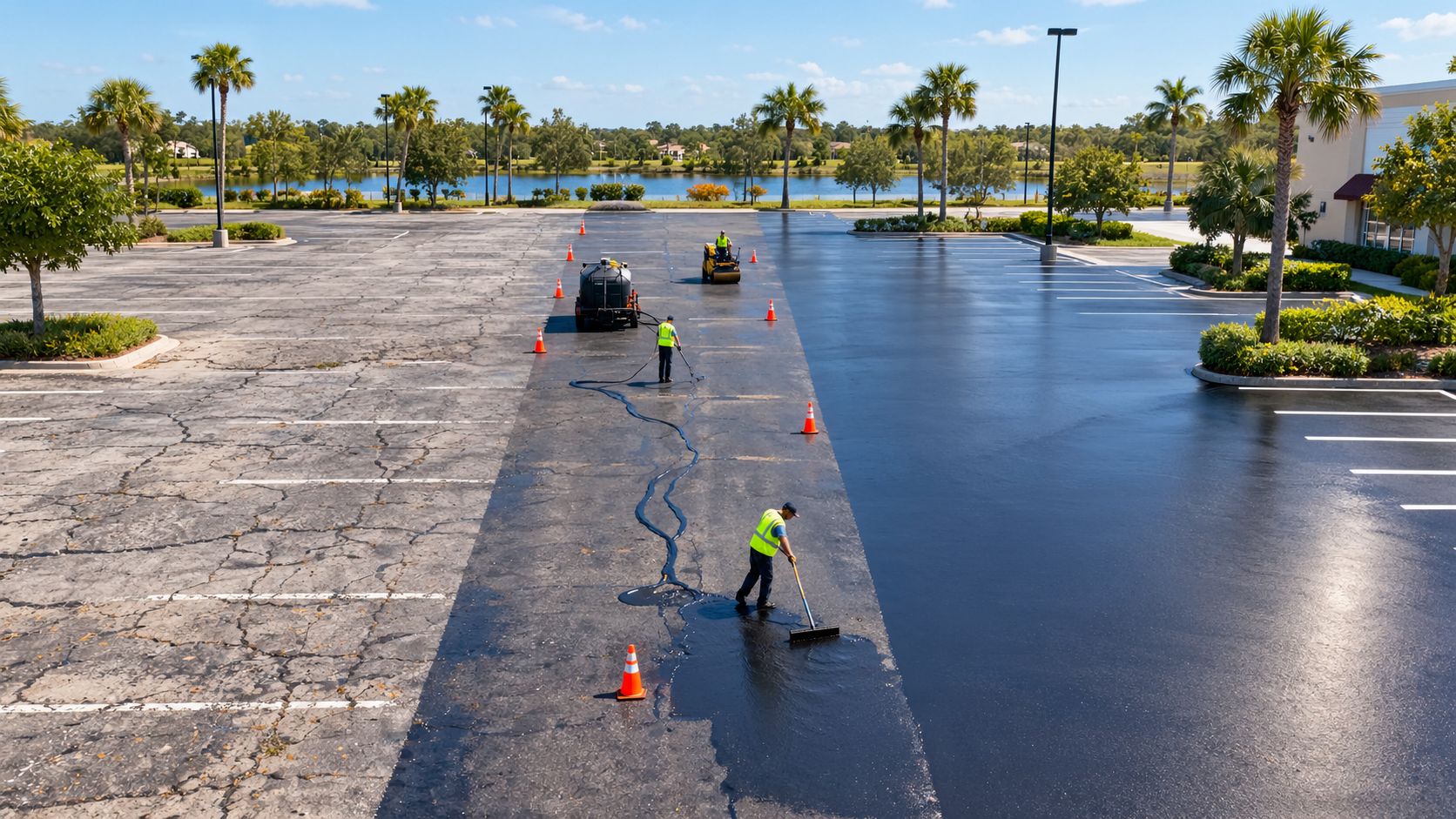
A property manager in Ocala may notice the warning signs before tenants do. The lot still looks serviceable, but the dark surface has faded, small cracks are spreading near the drive lanes, and summer rain is collecting beside the curb. By the time potholes become the complaint of the week, water may already be reaching the pavement base.
Pavement preventive maintenance gives owners in Marion County, FL, Citrus County, FL, and nearby Central Florida communities a more controlled way to manage that risk. The aim isn't to patch every failure after it appears. It's to inspect the surface, identify the right trigger point, and apply a treatment while the pavement can still be preserved.
For property managers, HOA boards, churches, retailers, and owners from Dunnellon and Belleview to Crystal River, Homosassa, Inverness, and The Villages, the central question is simple: what does the lot need this season, and what should wait?
Table of Contents
- What Pavement Preventive Maintenance Really Means
- The Core Treatment Toolkit Explained
- Reading Your Pavement and Choosing the Right Treatment
- Timing, Service Life, and the Cost of Waiting
- Building a Practical Schedule and Budget for Central Florida
- Safety, ADA, and Curb Appeal Benefits
- Putting the Full Program Together
- Planning Your Next Steps with a Local Expert
What Pavement Preventive Maintenance Really Means
The Federal Highway Administration and the American Association of State Highway and Transportation Officials define pavement preventive maintenance as a planned, cost-effective strategy that preserves a roadway system, slows future deterioration, and maintains or improves function without significantly increasing structural capacity. The FHWA preservation framework distinguishes preservation from major rehabilitation. Preservation works on pavement that remains sound. Rehabilitation addresses pavement that needs structural correction.
That distinction changes how you manage a parking lot. Crack sealing, chip seals, slurry or microsurfacing, thin asphalt overlays, concrete joint sealing, diamond grinding, and localized concrete repairs are preservation tools listed in the federal framework. They aren't interchangeable, and they aren't appropriate for every surface.
Practical rule: Preventive work protects sound pavement. It doesn't turn a failed base into a sound base.
Central Florida conditions make that rule especially important. Strong sunlight accelerates oxidation, frequent summer downpours test drainage, and changing moisture conditions can weaken unsupported areas. A surface can look acceptable during a dry inspection and show ponding, edge breakdown, or soft spots after a storm. Properties near busy routes such as SR-200 and US-19 may also see repeated turning movements that stress entrances and drive lanes.
Preservation versus reactive repair
A sealed working crack is a manageable maintenance item. A crack that admits water into the base can become part of a larger failure pattern involving settlement, potholes, and alligator cracking. Once the pavement begins deflecting under traffic, a surface treatment alone won't solve the underlying problem.
Preventive maintenance therefore treats the lot as managed infrastructure. The owner records conditions, schedules work during a suitable weather window, and updates the plan after each inspection. That approach protects the original paving investment and makes future capital requests easier to explain to an HOA board or ownership group.
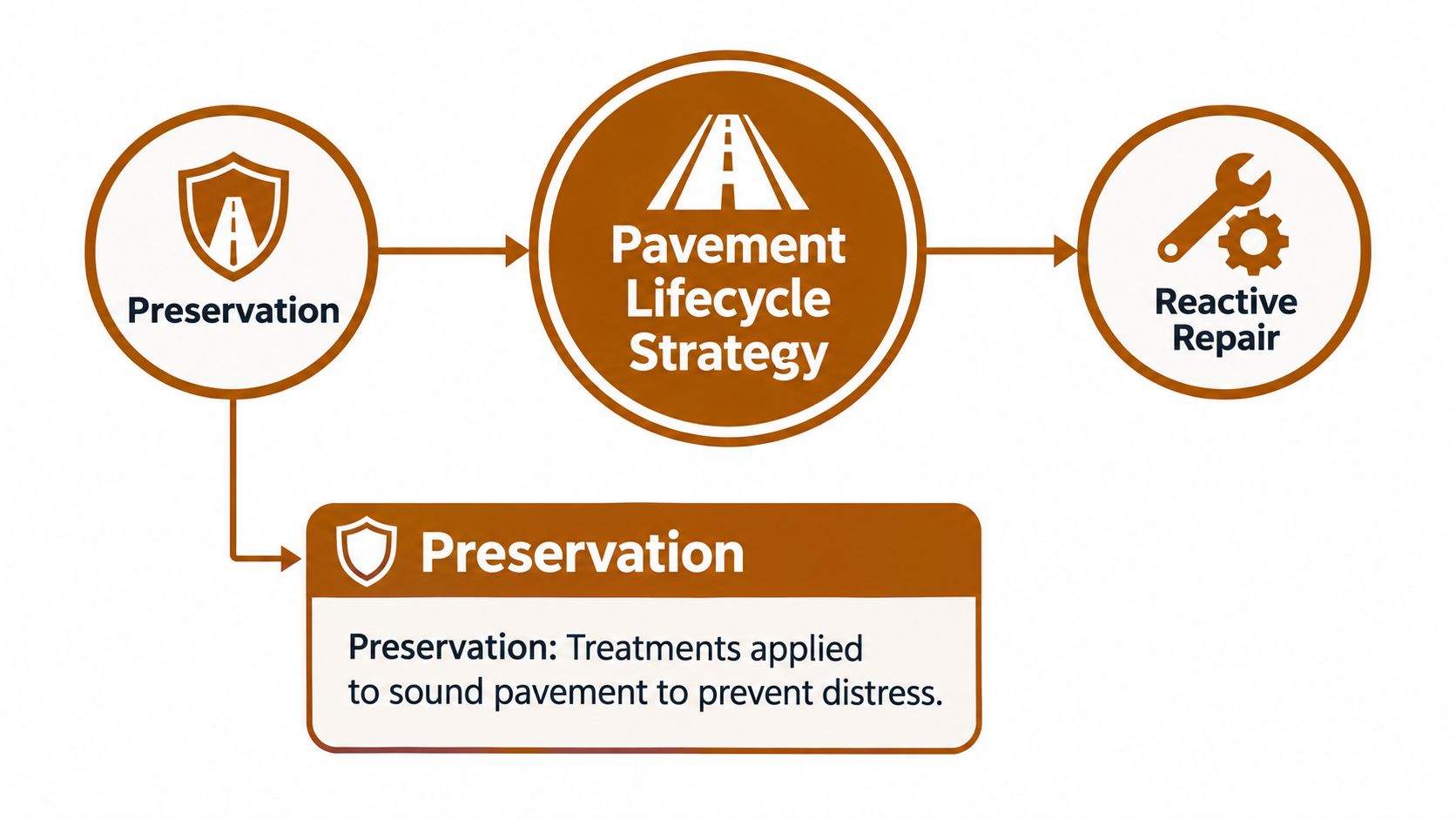
The formal preservation definition became a major policy milestone when AASHTO's Standing Committee on Highways published it in 1997, a definition FHWA continues to cite in its preservation materials. That history matters because preventive maintenance isn't merely a contractor's label for patching. It's a recognized lifecycle philosophy for maximizing the value of existing pavement.
The Core Treatment Toolkit Explained
A commercial lot in Summerfield can look serviceable while sending several different maintenance signals. The asphalt may still carry normal traffic, the entrance may have working cracks, the surface may appear dull, and a delivery vehicle may leave a shallow depression near the loading zone. Each condition points to a different response. The practical choice is often a sequence, not one product applied everywhere.
Crack sealing suits active cracks when the surrounding pavement remains firm. FHWA defines the treatment as placing specialized material in working cracks to keep water and incompressible material out. Its guidance recommends sealing soon after these cracks develop and under moderately cool conditions, approximately 7 to 18°C, as described in FHWA's crack-sealing guidance. On a Central Florida property, spring and fall may provide more workable conditions than the hottest part of a summer day.
A sealcoat shields asphalt from oxidation, water entry, and routine wear. Coal-tar and asphalt-emulsion products serve different project requirements, so the contractor should identify the specified material instead of treating every sealcoat as interchangeable. Sealcoating improves surface protection, but it cannot correct a failed base or a drainage problem.
Patching starts with identifying how deep the failure goes. A shallow skin patch can address isolated surface loss. A full-depth patch is better suited to damage that reaches the asphalt or base. If water continues entering through a crack or drainage defect, new material placed over the area only covers the cause for a limited time.
A slurry seal or microsurfacing can suit a lot with oxidation, modest texture loss, and limited distress when the pavement underneath remains stable. A thin overlay addresses broader surface renewal while the existing structure still supports preservation. Base failure calls for rehabilitation or reconstruction rather than a surface treatment.
| Treatment | Best Used On | Service Life Added | Optimal Timing |
|---|---|---|---|
| Crack sealing | Working cracks in otherwise sound pavement | Roughly 1 to 4 years, according to FHWA benchmark guidance | Soon after working cracks develop, during moderately cool conditions |
| Fog seal | Light surface oxidation and minor surface wear | Roughly 1 to 4 years, per FHWA benchmark guidance | Before significant surface distress |
| Chip seal or slurry seal | Surface wear on pavement with adequate support | About 5 to 7 years, per FHWA benchmark guidance | Before advanced raveling or structural distress |
| Thin overlay | Broader surface renewal where structure remains adequate | About 5 to 10 years, per FHWA benchmark guidance | Before failure requires major rehabilitation |
These options form a coordinated toolkit. A Marion or Citrus County lot may need crack work and drainage attention first, followed by surface protection, repairs, or striping in a later season. The order should reflect pavement condition, traffic, heat, rain, and maintenance history rather than age alone.
Reading Your Pavement and Choosing the Right Treatment
Start with a slow walk, not a calendar. Photograph entrances, turning lanes, drainage edges, parking bays, accessible routes, and any area where vehicles brake or turn repeatedly. A property manager in Ocala can use the same basic inspection process as an HOA board in Crystal River, but the treatment decision must follow the distress.
Hairline or narrow working cracks in otherwise firm asphalt generally point toward crack sealing. Raveling, a loose or rough surface texture, signals surface wear and may call for a seal or surface treatment if the pavement underneath remains stable. A faded sheen by itself doesn't prove that an overlay is needed. It tells you to inspect more closely.
A simple field decision
Use these questions in order:
Does the pavement flex or deflect under traffic?
If a vehicle load causes visible movement, the problem may be structural. A surface treatment won't restore lost base support.Are cracks isolated or interconnected?
A few working cracks can often be sealed. Interconnected alligator cracking usually requires a deeper evaluation and localized structural repair.Is water standing after rain?
Ponding may indicate settlement, blocked drainage, or an incorrect slope. Treating the surface without addressing water movement can shorten the result.Is the surface only oxidized and worn?
A sound but faded lot may suit sealcoating, slurry sealing, or microsurfacing, depending on texture and distress.Has the surface lost enough material that the texture is open and rough?
Advanced raveling may require a broader surface treatment or thin overlay, provided the base remains sound.
Federal guidance emphasizes that preventive maintenance is cost-effective before significant distress appears. TxDOT's preventive maintenance guidelines also reinforce that pavement type, distress, traffic, climate, and maintenance history affect treatment selection.
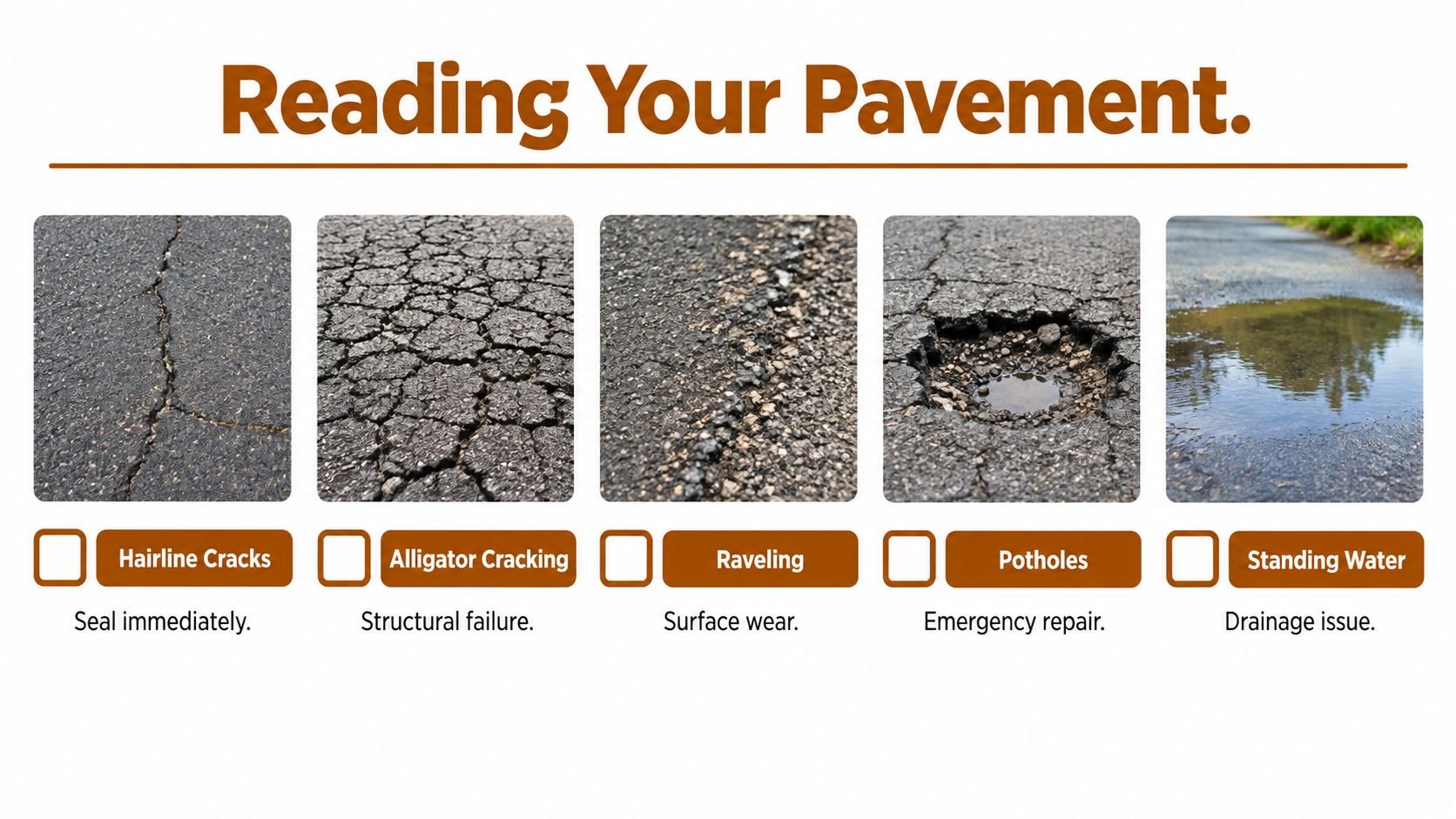
A newer lot with minor cracking may need sealing and surface protection. An older lot showing oxidation and raveling may need a surface renewal treatment. A lot with potholes, pumping, settlement, or base deflection needs a professional assessment before anyone recommends sealcoat.
This short visual overview can help teams recognize common distress patterns:
Timing, Service Life, and the Cost of Waiting
A parking lot can look acceptable in spring and become a repair problem by late summer. In Marion and Citrus counties, intense sun dries and oxidizes exposed asphalt, while heavy rain tests cracks, drainage paths, and weak areas. The right treatment window is the point when the surface can still be preserved, not the date printed on a recurring calendar.
FHWA and AASHTO preservation benchmarks provide useful planning ranges. Crack sealing and fog seals may add roughly 1 to 4 years of service life, chip seals and slurry seals about 5 to 7 years, and thin overlays approximately 5 to 10 years. These are benchmarks, not promises. Traffic, drainage, weather, materials, installation quality, and existing pavement condition can shorten or extend the result.
Treatment timing has its own inspection windows. For bituminous-surfaced pavement, initial ranges include 1 to 3 years for crack sealing, 2 to 6 years for slurry seals, 3 to 7 years for microsurfacing, 2 to 5 years for chip seals, and 5 to 8 years for thin HMA overlays. A contractor should adjust those ranges after examining the lot. A treatment applied too early may be unnecessary, while one delayed until the base is failing may no longer solve the underlying problem.
The practical order is simple: seal working cracks before water reaches lower layers, protect sound asphalt before oxidation and raveling spread, and repair isolated failures before they become broader structural defects.
Waiting doesn't preserve your budget. It transfers spending from planned surface work to increasingly disruptive repair.
Planned preservation gives owners time to schedule access, notify tenants, and compare treatment options. Reactive work arrives after storms, complaints, or visible potholes have already disrupted operations. On a Marion or Citrus County property, ponding after a storm, widening cracks, loose aggregate, or soft patch edges are field triggers that deserve attention before selecting a treatment.
Cost comparisons should stay tied to the property. Square footage, preparation, access, materials, repair depth, traffic control, and pavement condition all affect the estimate. Ask for two scopes: the recommended preservation work now and the probable repair scope if the owner defers it. That comparison helps a board or ownership group weigh risk without treating one price as universal.
| Treatment | Typical Timing Window | Added Service Life | Approx. Cost per Sq Ft |
|---|---|---|---|
| Crack sealing | 1 to 3 years after suitable cracks develop | Roughly 1 to 4 years | Obtain a project-specific quote |
| Slurry seal | 2 to 6 years | About 5 to 7 years | Obtain a project-specific quote |
| Microsurfacing | 3 to 7 years | About 5 to 7 years | Obtain a project-specific quote |
| Chip seal | 2 to 5 years | About 5 to 7 years | Obtain a project-specific quote |
| Thin HMA overlay | 5 to 8 years | About 5 to 10 years | Obtain a project-specific quote |
For Florida-specific planning, this guide to how often to sealcoat asphalt explains how intervals depend on surface condition and site exposure. Schedule preservation while the pavement can accept it, before failure forces a larger project.
Building a Practical Schedule and Budget for Central Florida
A workable maintenance calendar starts with inspection and weather, not with a rigid anniversary date. For lots in Ocala, Inverness, or Crystal River, plan surface treatments during a reliably dry window, commonly between October and April, while reserving shoulder-season opportunities for crack sealing and targeted repairs. Summer work must account for afternoon storms, damp surfaces, and curing requirements.
A rolling plan can look like this:
- Year 1, inspect and seal cracks: Map working cracks, check drainage, photograph distress, and repair isolated defects that could admit water.
- Year 2, protect the surface: If the pavement remains structurally sound, schedule sealcoating or another suitable surface treatment during a dry period.
- Year 3, patch and refresh markings: Address localized failures, then coordinate striping, accessible spaces, fire lanes, arrows, and traffic controls.
- Every year, review the record: Update photographs, note ponding or traffic changes, and revise the next treatment window.
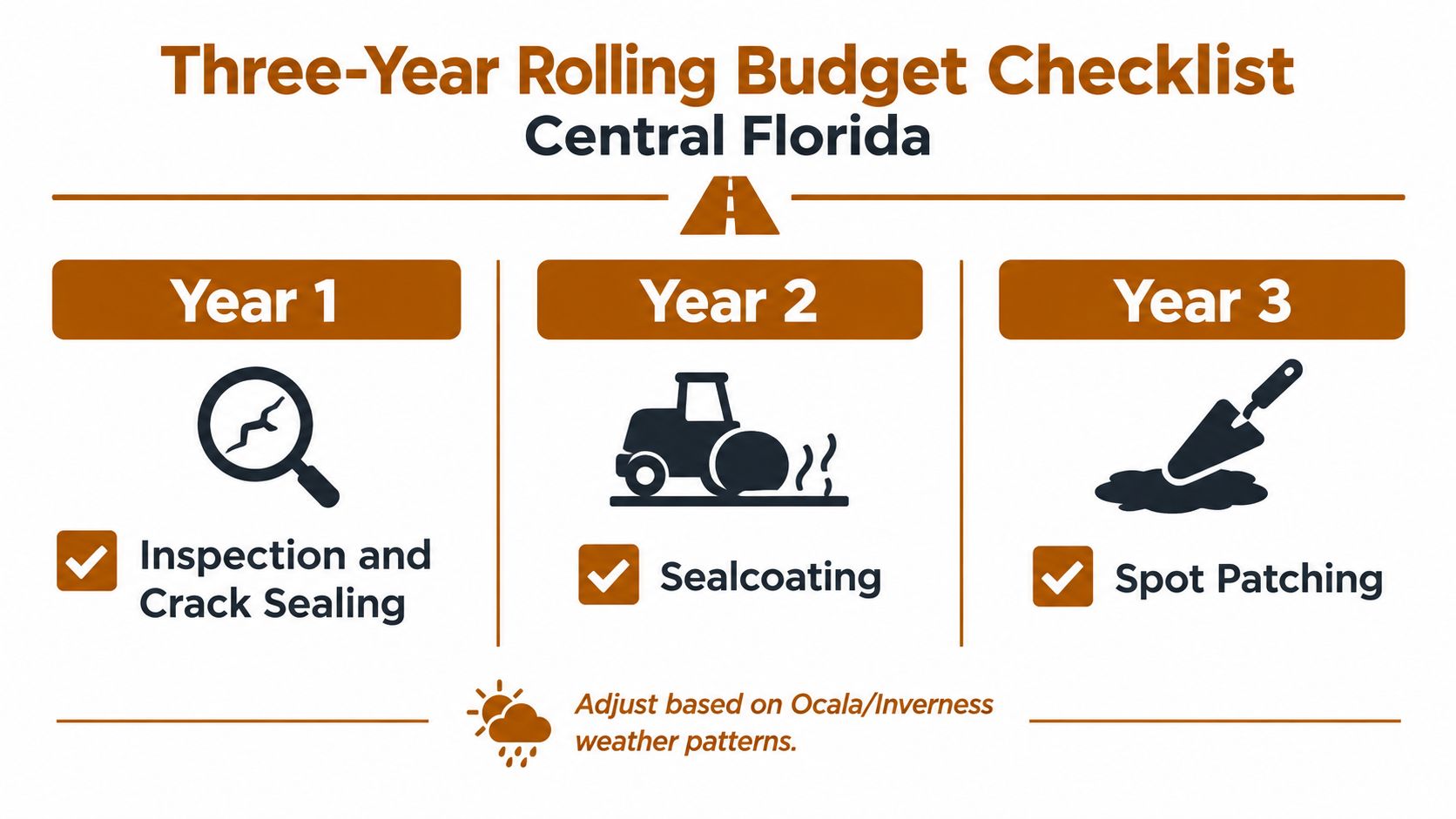
For budgeting, keep preservation visible as its own line item instead of burying it under emergency repairs. A commercial owner or HOA can build a rolling capital reserve, combine related work into a planned project, and request a written assessment before approving a treatment. That structure helps account for storm debris, drainage concerns, tree roots, and changing traffic patterns without claiming that one universal reserve percentage fits every property.
A spreadsheet-ready checklist
| Budget line | What to record |
|---|---|
| Inspection | Date, weather, photos, distress locations, ponding observations |
| Sweeping and cleaning | Debris, sediment, blocked drainage, oil or fuel contamination |
| Crack sealing | Crack locations, working versus non-working cracks, preparation needs |
| Patching | Surface patch or full-depth repair, square footage, drainage cause |
| Sealcoating | Surface condition, material specification, cure and access plan |
| Striping | Parking stalls, arrows, fire lanes, speed bumps, accessible markings |
| ADA upgrades | Accessible spaces, access aisles, routes, signs, and restriping scope |
| Contingency | Storm damage, unexpected base failure, drainage or subgrade findings |
A pavement management system can help organize condition records, treatment history, and upcoming work. The system doesn't replace an inspection. It gives the inspection a durable place in the property's budget and maintenance history.
Safety, ADA, and Curb Appeal Benefits
Preventive maintenance has a direct effect on how people use a property. Smooth drive lanes, visible markings, and controlled drainage help drivers, pedestrians, delivery teams, and emergency responders understand the lot. Crack sealing and patching can remove surface hazards, but the contractor must also investigate why water or traffic is damaging the area.
Fresh surface work creates a clean base for markings. Accessible parking spaces, access aisles, directional arrows, fire lanes, and speed-bump markings are easier to read when the pavement background is uniform. The ADA states that when a business or state or local government restripes parking spaces in a parking lot or parking structure, it must provide the accessible parking spaces required by the 2010 ADA Standards for Accessible Design, as explained in TxDOT's pavement preservation and ADA guidance.
That makes restriping more than a cosmetic decision. Before a commercial property in Ocala or a community in Beverly Hills restripes, the owner should review the accessible layout, route conditions, signs, and current markings. A new asphalt surface with outdated or incomplete accessible markings still leaves a compliance concern.
Conditions worth documenting
- Ponding: Record where water remains after a storm and whether the cause is slope, settlement, or blocked drainage.
- Uneven transitions: Check drive lanes, sidewalks, wheel stops, and accessible routes for trip hazards.
- Faded controls: Note worn stall lines, arrows, stop bars, fire lanes, and speed-bump markings.
- Surface contamination: Identify oil, fuel, algae, leaf debris, and other material that affects traction or treatment adhesion.
- Dark shaded areas: Watch shaded pavement near trees and buildings for persistent dampness, organic growth, and slippery surface conditions.
Curb appeal matters to tenants and visitors, especially at retail centers, churches, offices, and resort-oriented properties near the Nature Coast. Clean sealcoat edges and crisp striping make a property look cared for, while repaired drive lanes reduce the visual impression of neglect.
Concrete work belongs in the same property conversation. A damaged sidewalk, driveway apron, patio, or accessible route may need removal and replacement rather than an asphalt treatment. Riverside Sealing & Striping, LLC operates as a full-service concrete and asphalt maintenance contractor, handling concrete improvements alongside sealcoating and parking lot striping.
Putting the Full Program Together
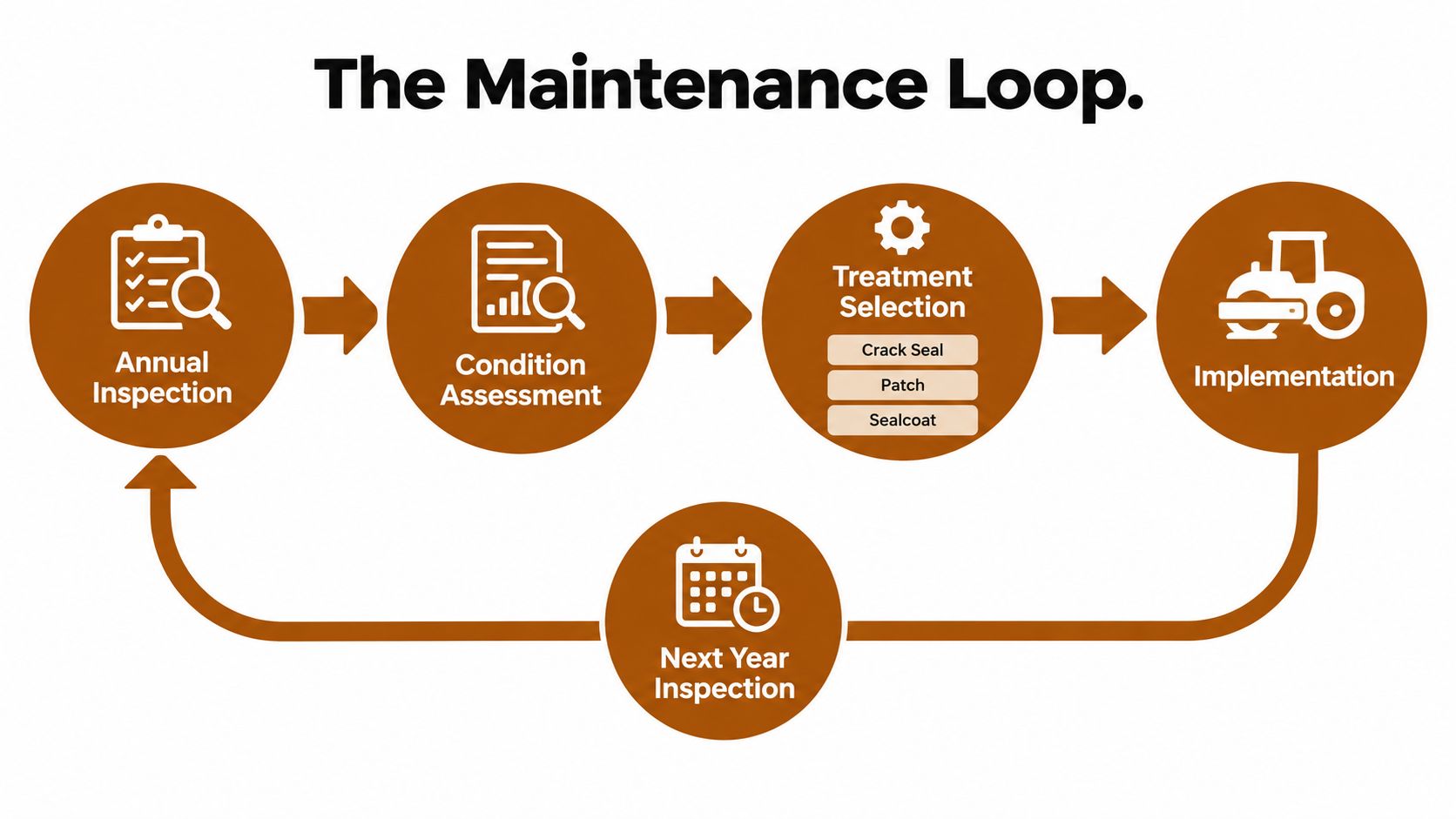
A complete program connects four actions: inspect, assess, select, and implement. The inspection creates the record. The condition assessment separates surface wear from structural failure. Treatment selection matches the distress to crack sealing, patching, sealcoating, microsurfacing, thin overlay, or a deeper repair. Implementation then produces a new reference point for the following inspection.
A four-year rotation can keep the process understandable:
- Year one: Seal working cracks and complete appropriate localized patching.
- Year two: Reinspect the lot and apply sealcoating or another compatible surface treatment if the structure remains sound.
- Year three: Complete targeted patching, correct drainage-related concerns, and refresh markings where needed.
- Year four: Evaluate surface condition, review treatment performance, and plan for an overlay or larger capital project if preservation is no longer sufficient.
The rotation isn't a substitute for condition-based decisions. A storm, utility cut, drainage failure, construction load, or unexpected settlement can move a section ahead of schedule. Conversely, a stable area may not need the same treatment as a heavily trafficked entrance.
Make the record useful
For an HOA board, the maintenance file should show photographs, inspection dates, proposals, completed work, weather delays, cure instructions, and remaining exclusions. For a commercial owner, it should connect pavement condition to tenant access, safety, striping, and capital planning. For a city or facility manager, it can support budget requests and document why a preservation treatment was selected instead of a more extensive repair.
The asphalt parking lot maintenance resource can help property managers frame that recurring work. A well-run program is a feedback loop, not a single project. Each inspection improves the next decision.
Planning Your Next Steps with a Local Expert
Start with a written condition assessment, not a request for a generic sealcoat price. Ask the contractor to mark cracks, failed patches, ponding areas, raveling, traffic lanes, accessible spaces, and any location that may require base investigation. Photo documentation gives property managers and HOA boards a shared reference when they compare proposals or explain the work to owners.
Your proposal should also show the recommended sequence. Request a four-year treatment and budget projection with clear inclusions and exclusions. The quote should identify preparation, cleaning, crack treatment, patch depth, sealcoat material, striping, traffic control, curing expectations, and what happens if the crew finds hidden structural damage.
Questions worth asking
- Who will perform the work? Ask about crew experience, relevant certifications, supervision, and insurance.
- Which materials are specified? Request the product type, preparation method, and application requirements.
- When can traffic return? Cure time depends on the treatment, weather, shade, and site conditions.
- How are rain delays handled? Central Florida's summer storms can change a workday quickly, so the schedule should explain rescheduling.
- What isn't included? Drainage correction, base excavation, concrete replacement, utility work, and extensive reconstruction may require separate pricing.
- How will the site be protected? Confirm pedestrian routing, vehicle control, accessible access, and communication with tenants.
Local familiarity helps because conditions vary across Marion, Citrus, Hernando, and Sumter counties. A contractor serving Dunnellon, Silver Springs, Summerfield, Lecanto, Hernando, Homosassa, Inverness, and The Villages should understand that a lot's performance depends on more than the visible asphalt. Subgrade behavior, drainage, roots, water-table conditions, shade, and traffic patterns all influence the correct treatment.
A no-pressure walkthrough is often the fastest way to replace guesswork with a defensible maintenance plan.
Look for a licensed and insured contractor that provides reliable scheduling, clear timelines, high-quality workmanship, and a written scope. Riverside Sealing & Striping, LLC offers free, no-pressure on-site consultations and estimates for concrete work, asphalt sealcoating, crack maintenance, parking lot striping, and ADA-related improvements across Central Florida.
Riverside Sealing & Striping, LLC helps property managers, HOAs, churches, retailers, and property owners plan pavement preventive maintenance with inspections, crack sealing, asphalt sealcoating, patching, concrete work, and parking lot striping. For a free, no-pressure consultation in Marion County, Citrus County, or surrounding Central Florida areas, visit Riverside Sealing & Striping, LLC.