
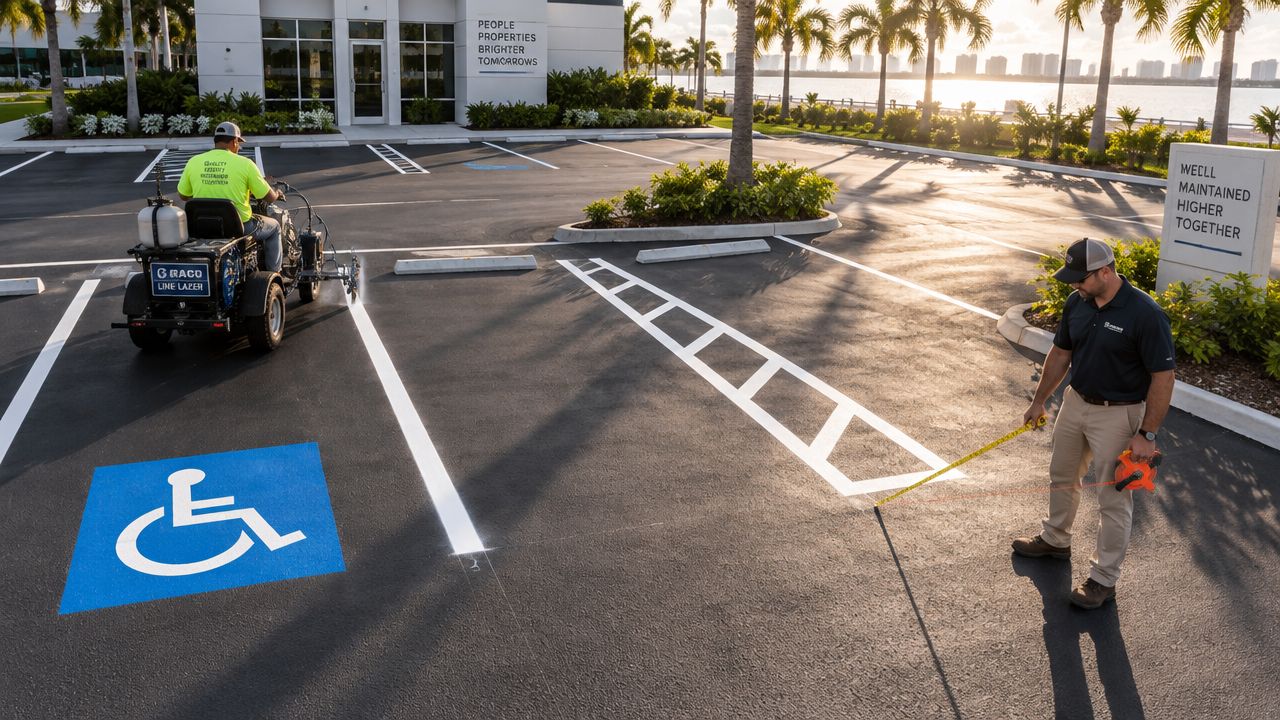
A property manager in Dunnellon can tell when a parking lot has reached the point of no return. The summer sun has bleached the stall lines, an arrow points nowhere useful, and the accessible space has lost most of its blue contrast. Customers hesitate, drivers cross lanes unpredictably, and a simple restriping job starts looking more like a safety and compliance problem.
Professional line marking is the planned measurement, layout, preparation, and application of pavement markings that keep a property orderly and usable. It covers parking stalls, fire lanes, crosswalks, directional arrows, accessible spaces, sports courts, and industrial floor markings. A crew with a roller and improvised guides can put paint on pavement, but that doesn't guarantee accurate dimensions, durable adhesion, or an ADA-ready layout.
For property managers in Marion County, FL, Citrus County, FL, and surrounding Central Florida, the right decision depends on more than appearance. Material, surface condition, traffic, drainage, sunlight, compliance requirements, and inspection timing all matter. This guide explains how those factors fit together, from paint and thermoplastic to layout, weather exposure, contractor selection, and the next restriping decision.
Table of Contents
- What Professional Line Marking Means
- Materials Used in Modern Line Marking
- ADA Standards and Compliance Requirements
- The Line Marking Process From Start to Finish
- How Central Florida Weather Affects Markings
- Cost Factors and Lifespan by Material
- How to Evaluate and Hire a Line Marking Contractor
- Bringing It All Together and Next Steps
What Professional Line Marking Means
Professional line marking is a measured site operation, not paint applied over old lines. The contractor reviews the existing layout, measures stalls and drive aisles, identifies accessible routes, checks drainage and pavement condition, and decides whether the property needs a refresh or a full reconfiguration. That planning determines whether the result holds up as a working traffic system or fades into a cosmetic patch.
The scope may include:
- Parking stalls: Clear boundaries improve circulation and reduce disputes over usable space.
- Directional markings: Arrows and symbols guide drivers through one-way or shared traffic patterns.
- Safety zones: Fire lanes, loading areas, pedestrian crossings, and no-parking curbs need consistent visual treatment.
- Accessible parking: Stalls, access aisles, symbols, signs, and routes must work together.
- Specialty surfaces: Courts, warehouses, and industrial floors need markings suited to their use and substrate.
A qualified crew uses measured layout lines, calibrated striping equipment, traffic-rated materials, and reflective glass beads where nighttime visibility matters. The MUTCD pavement marking guidance describes a normal pavement line as 100 to 150 millimeters wide, approximately 4 to 6 inches. The measurement reinforces a practical rule for parking lots: consistency beats estimating by eye.
Job-site rule: If the layout isn't measured before application, the finished lines are only guesses with paint on top.
Restriping also creates a compliance checkpoint. If a business or government entity restripes parking spaces, it must provide accessible spaces required by the 2010 ADA Standards for Accessible Design. The layout must account for the stall, access aisle, signs, and route together, rather than treating a blue symbol as a complete solution.
For property managers in Central Florida, this decision affects scheduling and budgets. UV exposure, heat, rain, drainage, and traffic determine how quickly markings lose contrast or adhesion. Document the layout, material, and installation date, then schedule inspections before faded lines create a safety or compliance problem.
Materials Used in Modern Line Marking
A Dunnellon medical office and an Ocala retail lot should not receive the same marking specification. Choose the material from the pavement condition, traffic pattern, exposure, and restriping schedule, not from the lowest bid. Modern projects commonly use water-based or solvent-based traffic paint, cold-applied plastic, epoxy, thermoplastic, or preformed tape. Each trades installation speed and initial cost against bonding, visibility, maintenance, and service life.
Paint fits short-cycle refreshes
Traffic paint is the practical choice for sound asphalt when the owner expects regular refreshes. It installs quickly and costs less, but Central Florida sun, heat, rain, and tire traffic shorten the useful contrast. Water-based and solvent-based products are nondurable systems, while epoxy, polyester, thermoplastic, and preformed tape are classified as durable systems in transportation research. The same Auburn pavement marking research reports average initial retroreflectivity of roughly 250 mcd/m²/lx for paint and 500 mcd/m²/lx for thermoplastic, with repaint expectations of about 6 to 12 months for paint and 3 to 7 years for thermoplastic. Treat those as transportation benchmarks, not a guarantee for a Florida parking lot.
Durable materials cost more upfront
Thermoplastic is heat-applied and builds a thicker, more wear-resistant marking. Specify it for busy retail drive aisles, repeated fire-lane markings, and areas where nighttime visibility matters. Cold-applied plastic, including MMA systems, and preformed tape suit detailed symbols or heavily worn locations where the longer service interval justifies the premium.
Epoxy bonds aggressively to properly prepared surfaces. It still requires a contractor to address pavement movement, heat, moisture, and contamination before application. On concrete or selected asphalt areas, preparation determines whether the higher material cost delivers value.
| Material | Typical Thickness | Approx. Service Life | Relative Cost per sq ft |
|---|---|---|---|
| Water-based traffic paint | Varies by product and application | Shortest of the listed systems | Lowest |
| Solvent-based traffic paint | Varies by product and application | Shorter cycle than durable systems | Low |
| Cold-applied plastic or preformed tape | Varies by product and application | Durable under appropriate conditions | Higher |
| Epoxy | Varies by product and application | Durable when properly bonded | Higher |
| Thermoplastic | Varies by product and application | About 3 to 7 years in cited transportation expectations | Highest |
A Queensland government road-marking fact sheet reports that cold-applied plastic can last 5 times longer than water-based marking and recommends it for new permanent line marking (Queensland line-marking fact sheet). For a shaded office lot with moderate traffic, paint can be the sensible budget choice. For sun-baked asphalt in Ocala, thermoplastic or another durable system can reduce repeat closures and labor. Schedule the decision around the expected inspection and restriping cycle, because heat and UV can consume a low-cost coating before the budget year ends.
ADA Standards and Compliance Requirements
A faded accessible space can hide a layout violation. Repainting existing blue boxes is not enough after resurfacing, expansion, reconfiguration, or pavement deterioration. Property managers should verify the full accessible route before approving restriping.
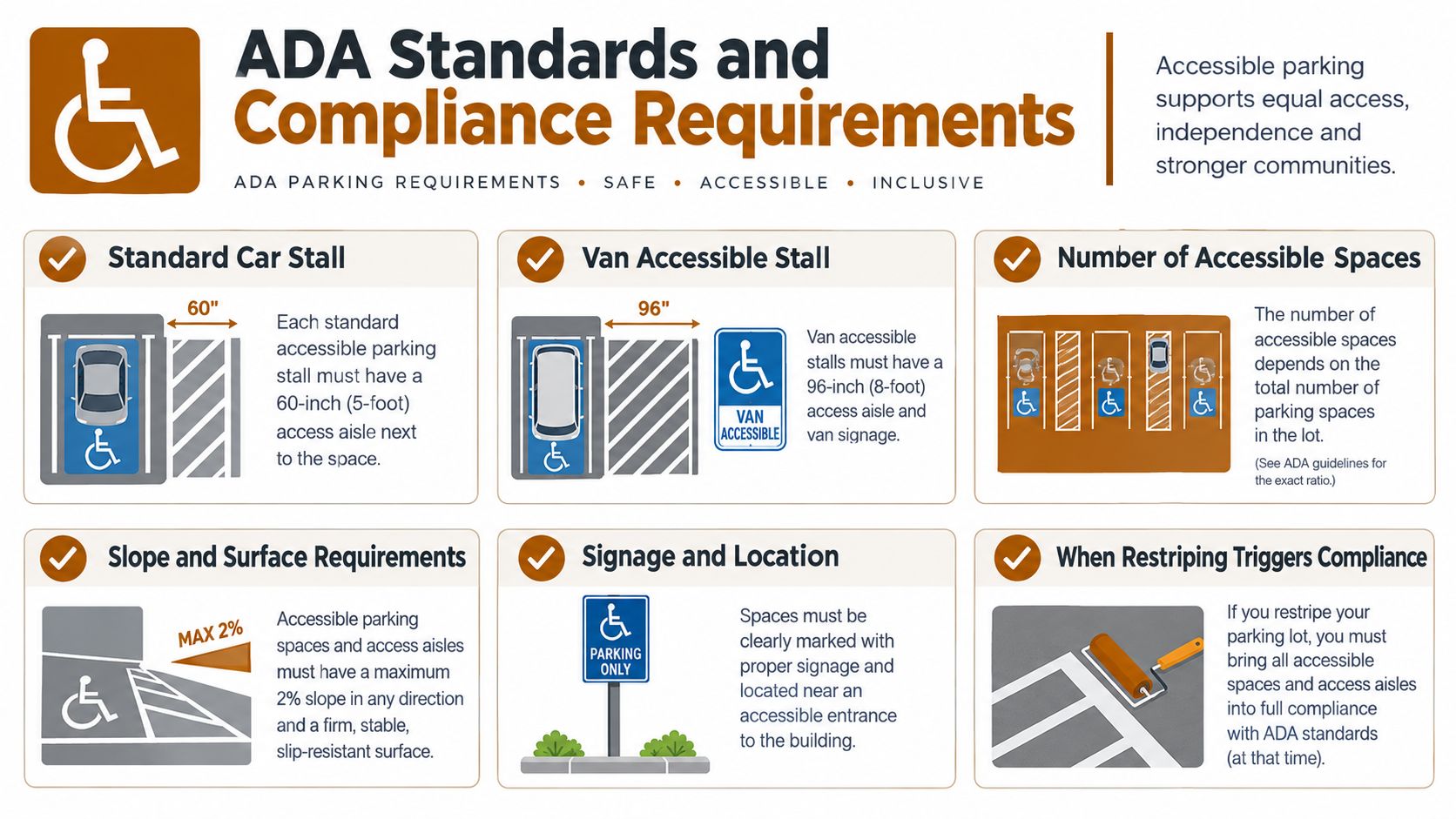
Under the 2010 ADA Standards, a standard accessible space must be at least 96 inches wide with a 60-inch access aisle. A van-accessible space must use either 96 inches of stall width with a 96-inch access aisle or 132 inches of stall width with a 60-inch access aisle, as outlined in this ADA parking dimensions and pavement marking guidance. The aisle must connect to an accessible route, and the slope cannot exceed 1:48, approximately 2%. The same compliance guide also covers the federal space-count table, which begins at 1 accessible space for lots containing 1 to 25 total spaces and reaches 6 accessible spaces for lots containing 151 to 200 spaces. For every 6 accessible spaces, at least 1 must be van-accessible (ADA parking compliance guide).
Layout details matter
Mark the access aisle beside the stall, usually with diagonal crosshatching and clear no-parking identification. MUTCD-based guidance commonly specifies the International Symbol of Accessibility at a minimum size of 28 inches high by 24 inches wide (accessible parking marking guidance).
Central Florida lots often develop faded blue paint, incorrectly installed signs, post-resurfacing slope changes, or landscaping that narrows the route. Inspect the complete path from the accessible space to the building entrance, not just the stall. For a practical layout reference, review these ADA parking lot striping requirements before scheduling work. In Dunnellon or Ocasal, that inspection also helps managers time restriping before Florida heat and UV exposure make faded markings a compliance problem.
The Line Marking Process From Start to Finish
A professional crew treats the lot as a work site, not an open canvas. The first step is coordination. Managers need to plan for traffic control, tenant access, deliveries, customer parking, and weather. A split schedule often works better than closing an entire commercial property at once.
Preparation comes before layout
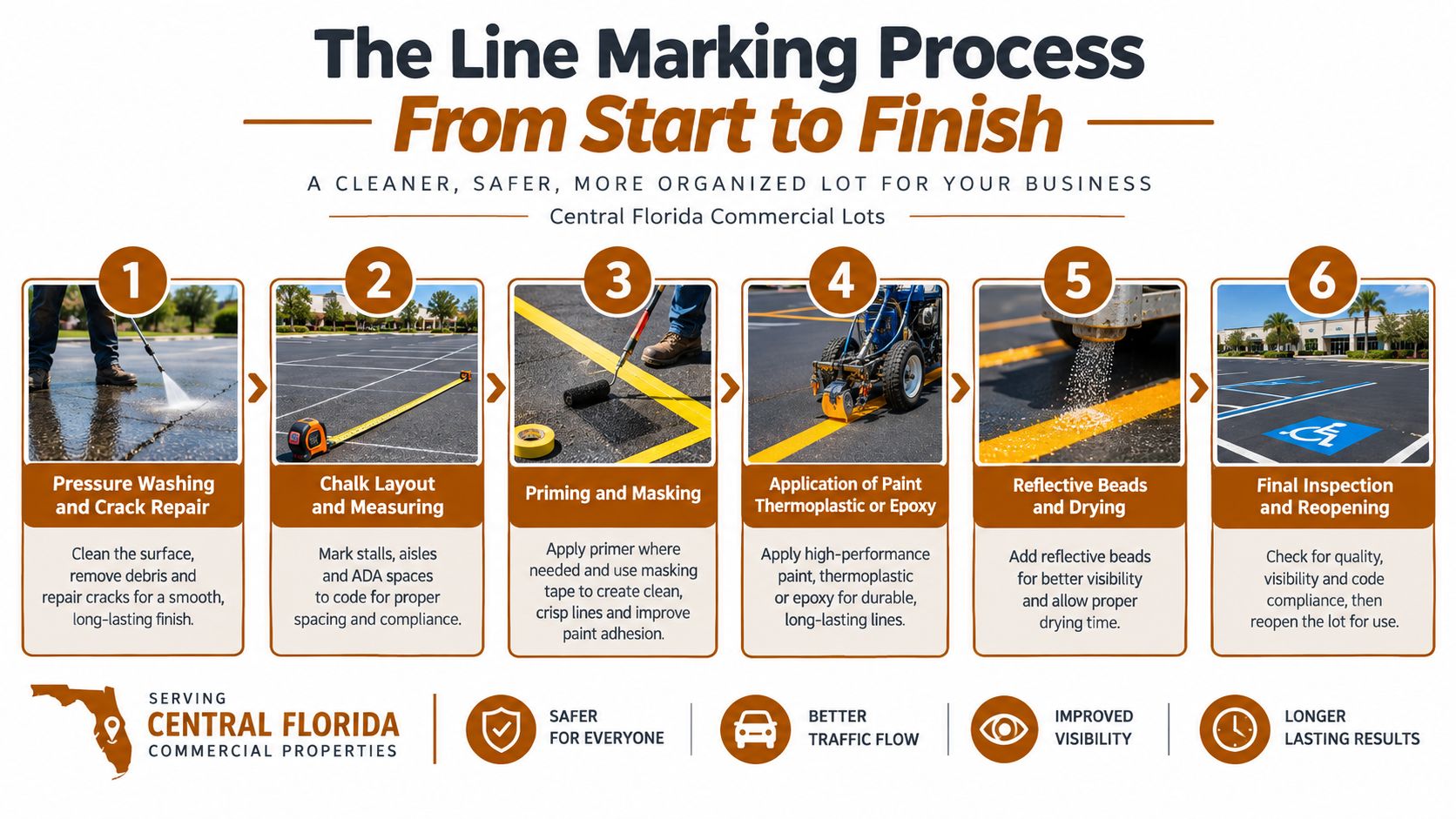
The crew cleans the surface, removes loose debris, pressure washes where appropriate, and repairs cracks or failed pavement areas that would interrupt adhesion. Oil, dust, standing water, and loose aggregate can shorten the life of even a premium marking material.
Next, the layout is measured and marked with chalk or temporary guides. The crew checks stall geometry, drive aisles, arrows, fire lanes, accessible spaces, access aisles, and the route to the entrance against the approved design. The pavement must be dry before application, and temperature and humidity conditions need to fall within the product's requirements.
Application and reopening require control
Equipment changes by material. A walk-behind or ride-on striping machine suits traffic paint, while thermoplastic requires heating equipment and careful temperature control. Epoxy and cold-applied systems need accurate mixing, placement, and curing management. Reflective beads may be broadcast into compatible wet material so the finished line can return light toward approaching drivers.
Water-based paint generally needs more protection from early rain and traffic, while fast-dry acrylic systems can reopen sooner when conditions cooperate. Thermoplastic solidifies quickly after application but still needs a controlled installation area. The crew should give the manager a reopening plan rather than just saying the work is finished.
A typical 75,000-square-foot lot can require a staged schedule, particularly when it includes repairs, ADA adjustments, multiple symbols, and traffic management. There isn't a reliable one-size-fits-all duration because layout complexity, weather, surface preparation, and material determine the usable window.
For a practical field sequence, review this guide to how to stripe a parking lot.
How Central Florida Weather Affects Markings
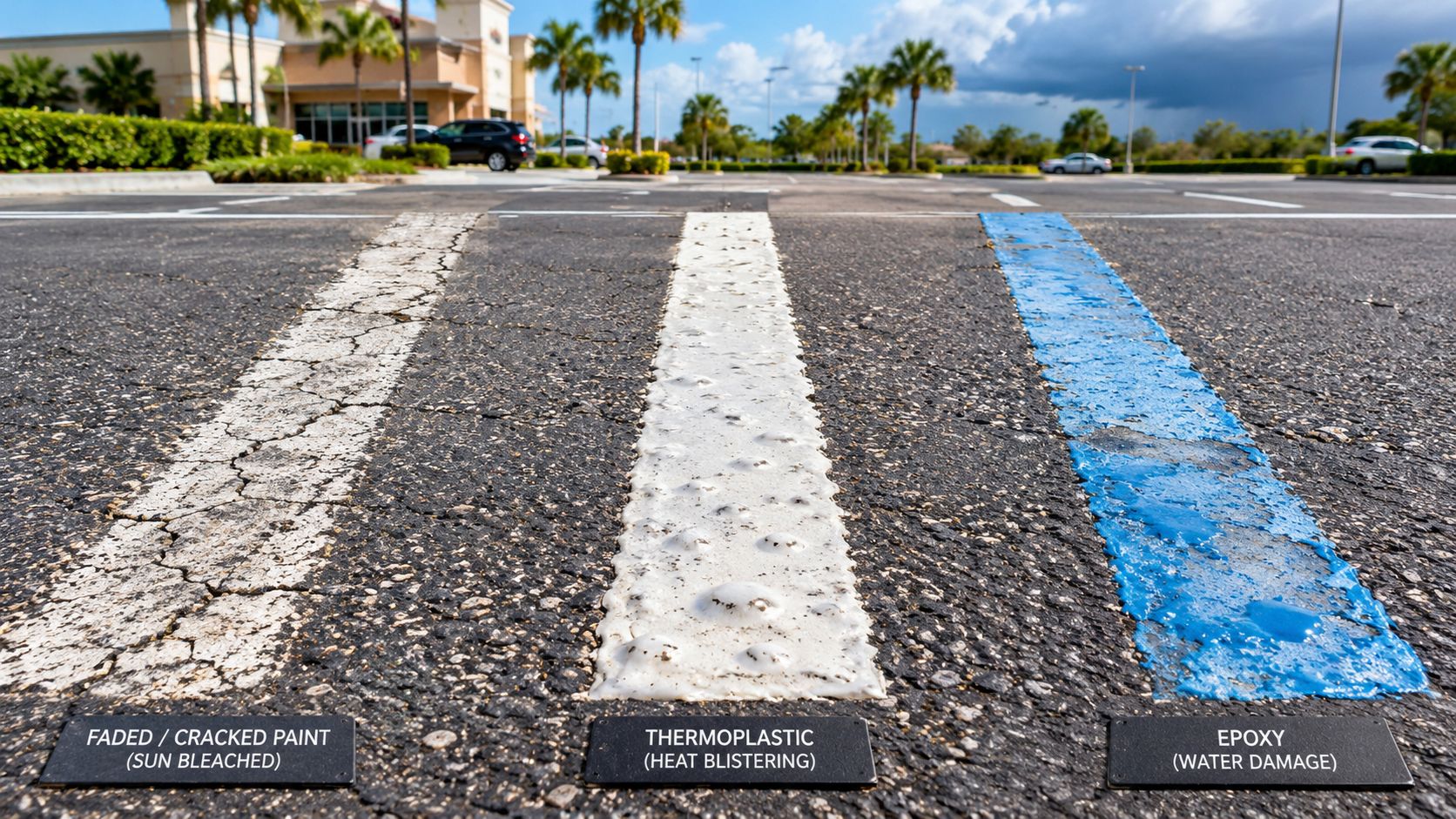
Florida's weather attacks pavement markings from several directions at once. Strong UV exposure fades pigments and weakens surface binders. Sustained heat softens asphalt and stresses the bond between the pavement and marking. Sudden thunderstorms can interrupt application, wash uncured paint away, and push moisture into surface texture.
Nighttime visibility can fail before a line disappears in daylight. FHWA synthesis data found that, for white lane lines, 13 of 16 test sections initially exceeded 100 mcd/m²/lx, but only 6 did after one winter and only 1 remained above that level after two winters. For yellow edge lines, 7 of 16 initially exceeded that level, falling to 3 after one winter and 2 after two winters** (FHWA wet pavement marking research). The study also found that grooved installations performed better than nongrooved sections in the cited conditions.
Rain changes the maintenance conversation
Wet-night performance matters in Marion and Citrus counties because afternoon storms can leave pavement dark and reflective just when drivers need the markings most. Surface texture, bead retention, material thickness, and installation technique influence whether a line remains legible through glare and standing moisture.
A property manager shouldn't restripe by calendar alone. Inspect after the most intense summer exposure, after sealcoating, after resurfacing, and when drivers begin missing arrows or accessible markings at night. Annual inspection and retroreflectivity measurement provide a stronger maintenance basis than daylight appearance alone (parking-lot line-marking standards).
Cost Factors and Lifespan by Material
A Dunnellon or Ocasal property manager should price restriping around pavement condition, traffic, layout, and Florida exposure. A small lot with clean asphalt and simple lines is a different job from a busy shopping center needing crack repair, ghost-line removal, ADA changes, symbols, signs, and night traffic control.
Material choice sets the maintenance cycle. Traffic paint may last 1 to 3 years, epoxy 5 to 8 years, and thermoplastic 7 to 9 years in the parking-lot durability data cited earlier. Transportation repaint cycles cited earlier show that paint can require attention sooner, while thermoplastic can remain serviceable for several years under suitable conditions. Treat those ranges as planning guidance, not a promise. Central Florida sun, heat, rain, turning traffic, pavement movement, and poor surface preparation can shorten any system.
| Material | Cost per Linear Foot | Lifespan in FL | Traffic Rating | Best Application |
|---|---|---|---|---|
| Water-based paint | Varies by scope and site | About 1 to 3 years in cited parking-lot data | Light to moderate | Budget refreshes on prepared asphalt |
| Solvent-based paint | Varies by scope and site | Varies with exposure and traffic | Moderate | Outdoor markings needing a different paint system |
| Cold-applied plastic | Varies by scope and site | Durable system with longer service than water-based marking | Heavy in suitable applications | Permanent symbols and high-wear areas |
| Epoxy | Varies by scope and site | About 5 to 8 years in cited market data | Moderate to heavy when properly bonded | Selected asphalt or concrete applications |
| Thermoplastic | Varies by scope and site | About 7 to 9 years in cited market data | Heavy | Busy lots, fire lanes, and high-visibility markings |
Cost per linear foot means little without the full scope. Surface cleaning, oil removal, crack repair, old-line removal, layout changes, ADA dimensions, access control, and night work can change the estimate more than the material itself. Require each bid to identify the product, preparation method, line and symbol dimensions, application conditions, and expected maintenance interval.
Use paint when the lot needs a lower-cost refresh and planned inspection supports a shorter cycle. Choose thermoplastic when repeated turning, heavy traffic, strong UV exposure, and ADA or fire-lane visibility justify the higher initial cost. Schedule the next budget review around the material's expected service window, then inspect sooner if lines fade, edges wear, or accessible markings become difficult to read.
How to Evaluate and Hire a Line Marking Contractor
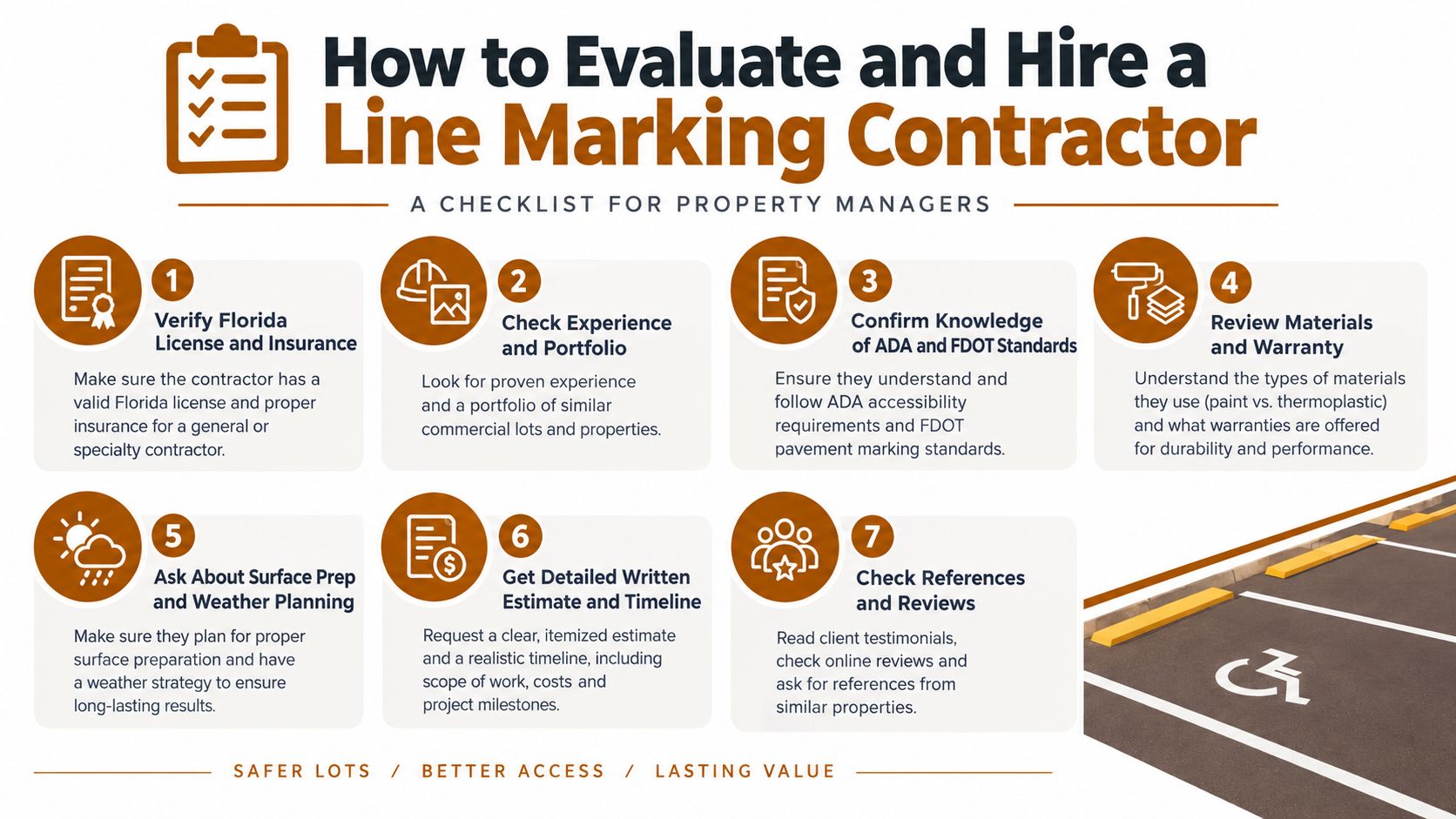
A low bid doesn't tell you whether the contractor understands pavement, compliance, or Florida installation conditions. Compare contractors on a written scope that lets you evaluate the same work line by line.
Verify the company before comparing finishes
Start with licensing and insurance. Ask for the applicable Florida general contractor or specialty license, current general liability coverage, and workers' compensation coverage for everyone who will work on the lot. The requested plan notes call for $1 million in general liability coverage, but a property manager should verify the actual policy and discuss whether the project needs additional protection.
Ask for references in Marion, Citrus, or Levy counties. Don't stop at online reviews. Request permission to drive past a commercial project that has been in service for at least two years, then look at line sharpness, blue-space visibility, arrows, crosswalks, and areas exposed to turning traffic.
Test technical knowledge
Ask the contractor to explain:
- ADA layout: Can they quote the required stall, aisle, van-space, slope, and accessible-route dimensions?
- Surface preparation: Will they pressure wash, remove oil, repair cracks, and eliminate loose material?
- Material selection: Why is paint, epoxy, cold-applied plastic, or thermoplastic appropriate for this pavement?
- Weather planning: What happens if rain, humidity, or a wet surface interrupts the application?
- Warranty terms: What defects are covered, and when does the warranty begin?
A detailed estimate should identify line locations, colors, symbols, preparation, material type, traffic control, cleanup, and reopening conditions. It should also explain whether old markings will be obliterated if the layout changes, because ghost lines can confuse drivers and undermine the new design.
Door-to-door pressure, large upfront deposit demands, and one-line estimates are red flags. A local contractor should be able to discuss scheduling, tenant coordination, and site-specific weather constraints. Riverside Sealing & Striping, LLC is one local option that combines parking-lot striping with concrete and asphalt maintenance services, including sealcoating and ADA upgrades. Property managers can also review this parking lot maintenance company resource when building a broader maintenance plan.
Bringing It All Together and Next Steps
On a sun-baked retail lot in Ocala, faded lines create a different maintenance problem than worn markings at a shaded medical office. A church in Inverness, a shopping center in Crystal River, an HOA in Summerfield, and a warehouse near Lecanto each need a plan based on traffic, pavement use, visibility, compliance, and exposure.
Use the material's expected service life to set a budget, then adjust the schedule for Central Florida's UV, heat, rain, and traffic. Water-based paint generally needs restriping sooner than chlorinated rubber, while thermoplastic costs more but can last longer. The right choice depends on surface preparation, pavement condition, traffic, and whether the site can tolerate frequent closures. Inspect ADA markings annually instead of waiting for them to disappear.
ADA compliance controls the timing. When parking spaces are restriped, accessible spaces and access aisles must meet current requirements, even if the rest of the layout stays unchanged. Confirm dimensions against the 2010 ADA Standards for Accessible Design. Schedule an inspection before hurricane season or after sealcoating, once the pavement is clean and cure conditions are known. Ask the contractor to remove conflicting old lines before applying a new layout.
Owners and managers across Marion County, FL, Citrus County, FL, Ocala, Dunnellon, Belleview, Silver Springs, Summerfield, Crystal River, Homosassa, Inverness, Lecanto, Beverly Hills, Hernando, and The Villages should include line marking in the property maintenance budget. Keep sidewalk, driveway, sealcoating, asphalt, and access-route work separately inspected and priced.
Riverside Sealing & Striping, LLC provides parking lot striping, ADA-compliant upgrades, asphalt sealcoating, and concrete work across Marion and Citrus counties. Request a free, no-pressure on-site estimate at Riverside Sealing & Striping, LLC to review pavement condition and the next maintenance step.