
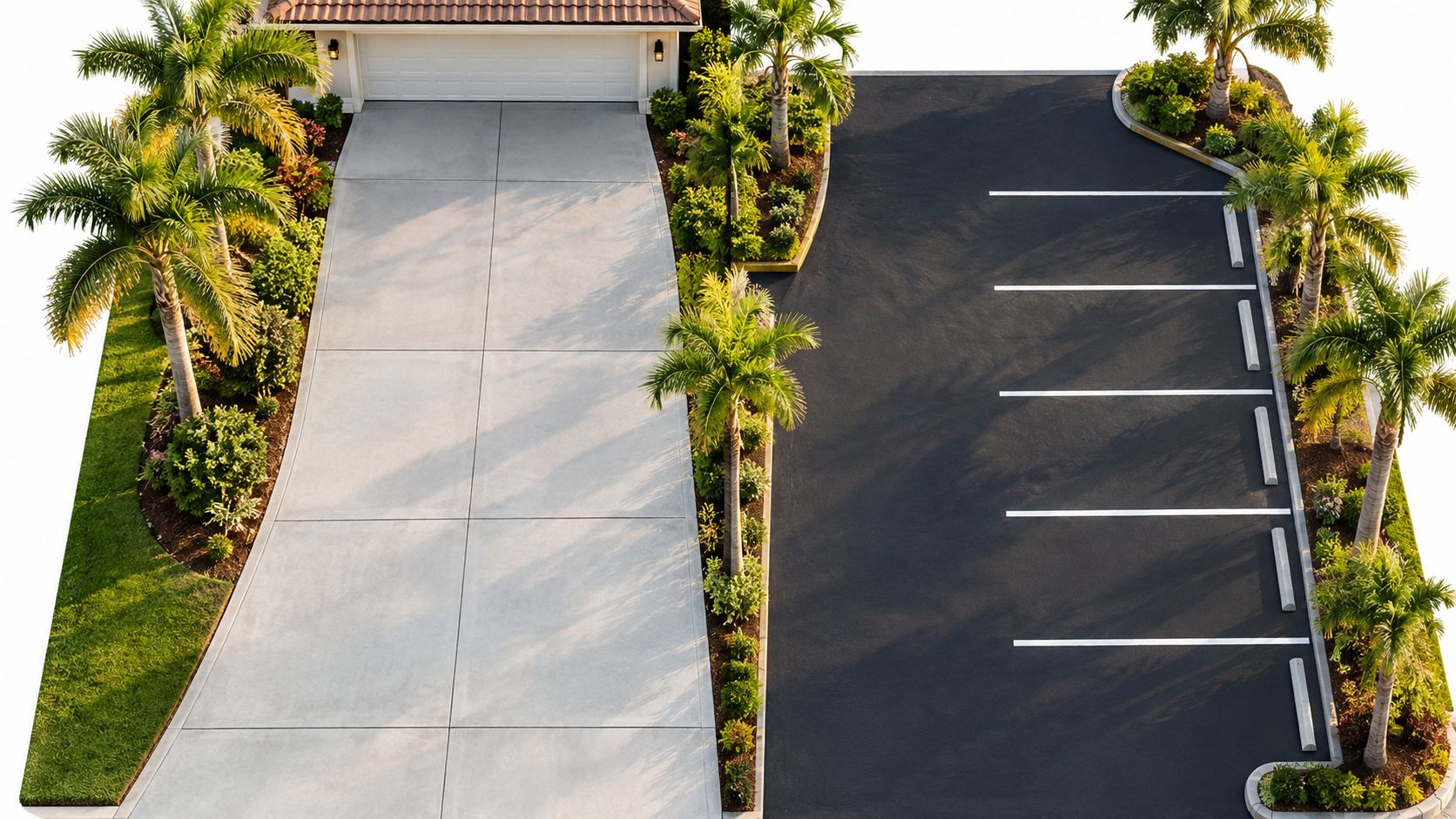
A cracked driveway, faded parking lines, or a walkway that holds water can make an otherwise well-kept property look neglected. In Central Florida, the problem often gets worse after one hot summer and a season of afternoon storms. Owners in Marion County, FL, and Citrus County, FL, frequently ask whether decorative concrete, fresh sealcoating, or new striping will improve property value. The practical answer is yes, but only when the work follows the right order.
Property value enhancement starts below the finish. Repair the base, correct drainage, confirm accessibility requirements, and then improve the appearance. That sequence applies to a Dunnellon driveway, an Ocala patio, an HOA street in Summerfield, and a commercial lot in Crystal River just as much as it applies to properties in Belleview, Silver Springs, Homosassa, Inverness, Lecanto, Beverly Hills, Hernando, and The Villages.
Table of Contents
- Two Central Florida Property Owners, One Costly Sequencing Mistake
- Why Curb Appeal Moves Appraisal Numbers in Marion and Citrus Counties
- Concrete and Asphalt Upgrades That Lift Property Value
- Florida Maintenance Cycles for Driveways, Lots, and Walkways
- ADA Striping and Compliance as a Value Signal
- Building a Four-Season Maintenance Plan for Central Florida Real Estate
- When a Licensed Local Crew Beats the DIY Shortcut
Two Central Florida Property Owners, One Costly Sequencing Mistake
On one humid July morning, a Dunnellon homeowner was proud of a newly finished patio. The stamped overlay looked sharp, and the color gave the backyard the polished appearance buyers notice. The trouble sat below it. The original slab had drainage problems and movement that hadn't been corrected before the decorative layer went down. Within ten months, the old slab heaved and cracked, taking the new finish with it.
That kind of failure is frustrating because the visible work may be attractive when the contractor leaves. It doesn't mean the surface was the core issue. Water moving toward the slab, weak subgrade, tree roots, and unaddressed settlement can continue working underneath a decorative upgrade.
Across the county line, a Citrus County strip-center manager faced a different version of the same mistake. The lot had been restriped with bright thermoplastic markings, but an accessibility review later found that three slopes didn't meet the required geometry. The new markings had to be removed, the pavement re-graded, and the spaces installed again.
The sequence that protects the investment
A reliable order of operations looks like this:
- Inspect the structure. Identify settlement, heaving, potholes, alligator cracking, broken edges, spalling, and unstable slabs.
- Correct the water path. Check downspouts, irrigation overspray, low areas, driveway transitions, and runoff crossing the pavement.
- Verify accessibility geometry. Confirm accessible-space counts, stall dimensions, access aisles, slopes, signage, and the route to the entrance.
- Complete the surface work. Replace concrete, patch or resurface asphalt, sealcoat, stripe, and add decorative finishes only after the base is sound.
- Schedule maintenance. A finished surface still needs inspections, crack treatment, joint care, and periodic refreshes.
Practical rule: A finish can hide a defect for a while, but it can't repair the drainage or structure causing that defect.
The right sequence also makes budgeting more honest. Cosmetic work may produce the most immediate visual change, but structural repairs and compliance corrections protect the value signal that buyers, tenants, inspectors, and appraisers are evaluating.
Why Curb Appeal Moves Appraisal Numbers in Marion and Citrus Counties
A buyer sees the driveway before the kitchen. An appraiser sees the exterior condition while approaching the property. That first view doesn't determine value by itself, but it shapes expectations about maintenance, risk, and future negotiation.
Research summarized by Texas A&M found that a patio designed to boost property value was associated with a 12.4% increase in home value, while curbs designed to boost property value were associated with a 4.4% increase. The same paper reported that, within a 200-meter vicinity, home value rose by 0.0666% for each 1% increase in tree cover and 0.0478% for each 1% increase in irrigated grass cover. These findings support a practical point for property owners in Ocala, Dunnellon, Homosassa, and Inverness. Exterior presentation can influence market value, especially when improvements also correct visible maintenance issues. Texas A&M property-value research
The National Association of REALTORS® reported that 92% of REALTORS® recommend curb appeal improvements before listing, while 97% consider curb appeal important for attracting buyers. Independent valuation research has also associated strong curb appeal with about a 7% sale-price premium on average, reaching as much as 14% in weaker markets. Those benchmarks don't promise a fixed return for every driveway or parking lot, but they show why an exterior-first inspection deserves attention. NAR outdoor-features remodeling report
What buyers and appraisers notice first
A fresh interior can lose some of its effect when the approach to the property shows:
- Cracked access surfaces. Broken concrete and uneven transitions raise questions about drainage and future repair.
- Faded or confusing markings. A disorganized commercial lot can suggest weak management.
- Standing water. Ponding points toward grading, base, or drainage concerns.
- Neglected edges. Raveling asphalt and broken curbs make the whole site appear older.
| Upgrade | Typical Cost | Estimated Resale Recovery | Buyer or Appraiser Signal |
|---|---|---|---|
| Concrete driveway repair or replacement | Varies by site and specification | Project-specific | Stable, clean access and reduced visible defects |
| Asphalt maintenance and sealcoating | Varies by area and condition | Project-specific | Protected pavement and active upkeep |
| Parking-lot striping and accessibility markings | Varies by layout and compliance needs | Project-specific | Order, safety, and professional management |
| Patio or hardscape improvement | Varies by materials and drainage work | Project-specific | Usable outdoor space when the structure is sound |
For a practical checklist of exterior improvements, see this guide to improving property curb appeal. The important distinction is that surface work should correct defects, not merely cover them. In Marion and Citrus counties, a smooth driveway, clear walkway, and orderly lot can support the appearance of a property that has been maintained deliberately.
Concrete and Asphalt Upgrades That Lift Property Value
Material selection should follow the property's use, drainage, traffic, and maintenance capacity. Concrete fits homeowners seeking a firm, finished driveway, patio, sidewalk, or slab. Asphalt often suits longer drives, HOA streets, and commercial areas where flexible pavement allows targeted repairs instead of replacing every section.
Florida-specific guidance places a properly maintained concrete driveway at about 25 to 30 years. Under favorable installation, reinforcement, drainage, and maintenance conditions, some projects may support an expected life of 30 to 50 years. Florida concrete lifespan guidance Asphalt sealcoating guidance commonly recommends reapplication every 2 to 3 years. Lower-traffic areas may extend to 3 to 4 years, while higher-traffic commercial pavement may need attention every 1 to 2 years. Florida sealcoating guidance
Concrete decisions that determine durability
A concrete replacement earns its value through preparation, not color or broom pattern. The contractor should assess:
- Subgrade and base. Caliche, loose fill, and poorly compacted material can lead to settlement.
- Drainage. Water needs a clear path away from the slab and nearby structures.
- Reinforcement and vapor control. The specification should match expected loads and site conditions.
- Joints and edges. Proper control joints help manage cracking, while supported edges resist breakage.
- Root and irrigation conflicts. Oak roots and sprinkler overspray can damage otherwise sound work.
Decorative concrete belongs at the end of the sequence. Resolve movement, poor slope, drainage, and slab failure first. A broom finish can provide useful traction on a driveway or sidewalk. Stamped or exposed-aggregate finishes may improve a patio or entry after the underlying work is sound.
Where asphalt earns its place
Asphalt works well for parking areas and broad driveways because crews can maintain sections without treating every defect as a full replacement. The pavement still needs a stable limerock base, proper compaction, supported edges, and drainage that keeps water from entering the structure.
Central Florida heat, heavy rain, and traffic expose weak preparation quickly. A decorative finish applied over unresolved settlement or water problems may look improved at completion and deteriorate within the next two years. Owners should sequence structural repair, accessibility needs, and surface protection before selecting decorative upgrades.
The value decision is site-specific. Compare intended use, appearance, access, repair strategy, and maintenance schedule rather than the initial bid alone. Property managers should also account for traffic patterns, turning areas, striping, and the work required to keep the lot presentable.
For a focused review of whether a new concrete driveway can increase home value, consider execution, neighborhood expectations, and whether the project removes a visible defect or adds an expensive finish.
Florida Maintenance Cycles for Driveways, Lots, and Walkways
Central Florida pavement doesn't fail on a convenient schedule. UV exposure oxidizes asphalt, thunderstorms drive water into cracks, sand abrades surfaces, and vehicle traffic works weak edges. Concrete shows a different set of warnings, including joint separation, surface scaling, settlement, and white calcium deposits that can indicate moisture movement.
A maintenance plan should match the surface and its use. Residential asphalt may need less frequent attention than a busy retail lot, while an HOA street requires repeated inspections because small cracks can spread across connected pavement. The intervals below reflect practical planning ranges, not guarantees.
| Surface Type | Sealcoat Interval | Cost per Sq Ft | Inspect Every | Warning Signs |
|---|---|---|---|---|
| Residential driveway | Every 3 to 4 years | Site-specific | Regularly and before wet season | Faded oxidation, fine cracking, edge wear |
| HOA streets | Every 2 to 3 years | Site-specific | Annually | Long cracks, raveling, drainage-related damage |
| Busy commercial lot | Every 1 to 2 years | Site-specific | Regularly | Alligator cracking, potholes, oil damage, faded lines |
No verified source supports a universal cost-per-square-foot band for these services, so owners should request a measured proposal rather than rely on a generic online price. The condition of the base, access, repairs, traffic, and required striping can change the scope substantially.
Warning signs deserve different responses
Oxidation and fading often call for evaluation and timely sealcoating before the surface becomes brittle. Alligator cracking usually points to structural failure below the surface, so sealing over it won't solve the cause. Edge raveling may reflect weak shoulders or water intrusion and needs attention before vehicles break away more pavement.
Concrete requires its own inspection routine. Look for widening cracks, rocking sections, ponding, broken corners, exposed reinforcement, and white calcium leaching. A failing driveway can affect adjacent curbs, sidewalks, and garage approaches when runoff has nowhere to go.
A planned asphalt sealcoating schedule gives owners a way to budget before the lot reaches emergency condition. Preventive work isn't glamorous, but it usually preserves more usable pavement than repeated spot repairs after water and traffic have already reached the base.
ADA Striping and Compliance as a Value Signal
Accessible parking is both a legal responsibility and a visible test of property management. A lot can look freshly painted and still create exposure if the stall count, van spaces, access aisles, route, or slopes are wrong.
A federally accessible parking space must be at least 8 feet wide with a 5-foot access aisle. A van-accessible space can be 11 feet wide with a 5-foot aisle or 8 feet wide with an 8-foot aisle. The space must connect to the shortest accessible route to the entrance, and the surface must remain stable, firm, and slip-resistant. Accessible parking dimensions and requirements
Start with the count, not the paint
The number of accessible spaces scales with the total number of spaces. The published schedule requires:
- 1 accessible space for a lot with 1 to 25 total spaces
- 2 for 26 to 50
- 3 for 51 to 75
- 4 for 76 to 100
- 5 for 101 to 150
- 6 for 151 to 200
At least 1 van-accessible space is required for every 6 accessible spaces or fraction thereof. Parking-lot accessibility schedule
The access aisle should provide the required clearance, and the route of travel should avoid steep or obstructed transitions. The commonly cited maximum cross-slope for accessible paths is 1:48, so a contractor should verify the pavement rather than assume a visually flat area is compliant.
Use a measured striping sequence
- Inventory the lot. Count all spaces and compare the layout with the applicable accessibility schedule.
- Check the surface. Repair settlement, potholes, and slopes before applying markings.
- Place van spaces. Confirm the stall and aisle configuration.
- Mark access aisles. Keep them clear of wheel stops, drainage structures, and traffic conflicts.
- Complete signage and route markings. Make the accessible path legible from the space to the entrance.
Tenants, lenders, buyers, and inspectors notice whether a lot appears controlled and cared for. Correct markings don't replace legal review, but they reduce the risk of treating a compliance problem as a cosmetic striping project.
Building a Four-Season Maintenance Plan for Central Florida Real Estate
A small owner or HOA board doesn't need a complicated asset-management system. It needs a calendar that puts inspections ahead of failure and matches work to Central Florida's weather pattern.
Q1 from January through March
Start with a concrete and pavement inspection after winter cold snaps and heavy rain. Check joint sealant, settlement, trip hazards, driveway edges, curbs, and areas where water collects. Use this quarter to document defects with photographs, mark priorities, and obtain scopes before the summer workload begins.
Q2 from April through June
Prepare for the rainy season. Address potholes and structural asphalt failures before sealcoating, correct drainage paths, and schedule asphalt protection while the surface is ready to receive it. Review irrigation near concrete walks and patios, because overspray can keep joints and edges wet.
Q3 from July through September
Commercial properties should review parking-lot markings and accessible spaces before peak traffic periods. Confirm that restriping hasn't reduced aisle clarity, that signs remain visible, and that repairs haven't changed the route to the entrance. Homeowners can use this quarter to watch for storm-related erosion and movement around slabs.
Q4 from October through December
Complete a damage survey and build the next year's budget. Separate urgent safety work from planned replacement, then group projects by location so crews can reduce repeated mobilization. This is also a good time to gather warranty records, inspection photos, and maintenance invoices for future resale or ownership review.
| Quarter | Priority inspection | Planned action |
|---|---|---|
| Q1 | Concrete joints, settlement, trip hazards | Reseal joints and document defects |
| Q2 | Drainage, potholes, asphalt oxidation | Patch failures and schedule sealcoating |
| Q3 | Striping, van spaces, access aisles | Recheck ADA layout and refresh markings |
| Q4 | Surface damage and budget needs | Build the next maintenance scope |
Quarterly planning can spread spending and reduce the chance that a small defect becomes a full replacement. It doesn't justify promising a specific extra lifespan. Soil, traffic, drainage, installation quality, and maintenance determine whether a surface reaches the stronger end of its expected service range.
When a Licensed Local Crew Beats the DIY Shortcut
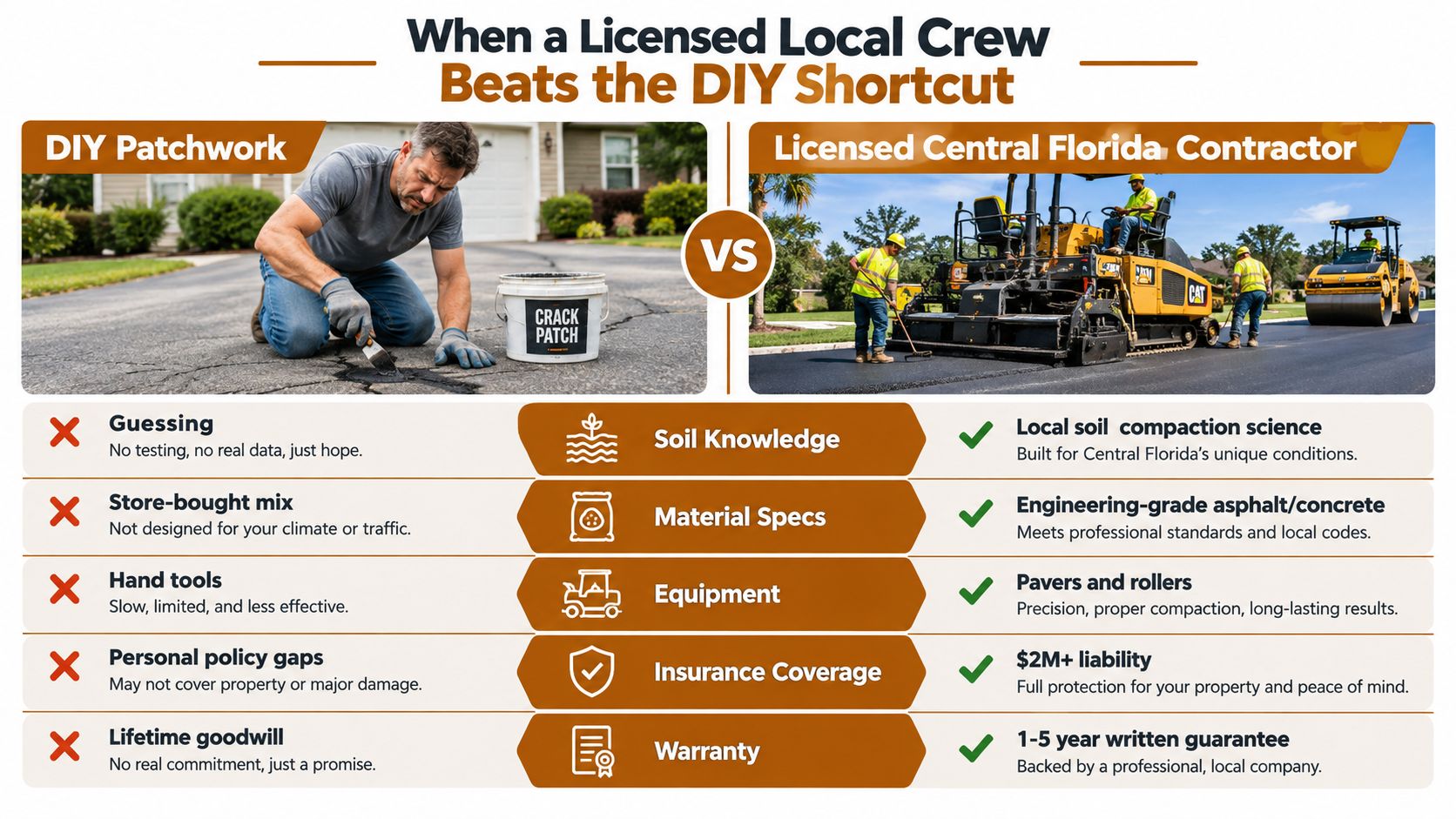
DIY patching works for some minor, temporary repairs. It becomes a poor value strategy when an owner is trying to protect resale condition, satisfy a commercial inspection, or correct a failure that involves soil and water.
The first difference is site knowledge. A local crew evaluates subgrade behavior, drainage, tree roots, irrigation, and traffic instead of treating every crack as the same. Conditions can vary between Marion County and Citrus County, and even neighboring properties can have different fill and runoff problems.
The second is material specification. A bag of repair concrete or a rental-store sealer may look acceptable at the edge of a driveway, but the product still needs the right preparation, thickness, cure conditions, and joint strategy. A patch over moving pavement won't become structural because its color matches.
Five decision points that affect value
- Soil knowledge: Professionals assess compaction and drainage before recommending replacement or resurfacing.
- Material specifications: The mix, asphalt treatment, reinforcement, and joint details should match the use.
- Equipment: Proper saws, compactors, pavers, rollers, finishing tools, and layout equipment produce results hand tools can't duplicate.
- Insurance documentation: Licensed and insured contractors can provide documentation that helps owners, managers, and closing professionals evaluate risk.
- Written warranty terms: Clear paperwork identifies what the contractor covers and what maintenance the owner must perform.
A DIY shortcut can also create resale friction. Buyers may ask who completed the work, whether the base was prepared correctly, and whether accessible markings or slopes were measured. The cheapest bid can become expensive when a crew must remove decorative material, redo striping, or replace a failed section that wasn't prepared properly.
A qualified contractor should be willing to walk the site, explain the repair sequence, provide a written scope, and give a realistic timeline. Look for licensed and insured service, reliable scheduling, clear communication, and workmanship that accounts for Florida heat, rain, and traffic rather than promising a perfect result without inspecting the property.
For property owners who want a visual comparison of repair approaches, this short video provides additional context.
Riverside Sealing & Striping, LLC provides concrete driveway, patio, slab, sidewalk, asphalt sealcoating, and parking-lot striping work for properties in Marion County, FL, Citrus County, FL, and surrounding Central Florida communities. Request a free, no-pressure site consultation to receive a written scope, clear timeline, and practical recommendations for improving property value without putting decorative work ahead of structural or ADA needs, then visit Riverside Sealing & Striping, LLC.