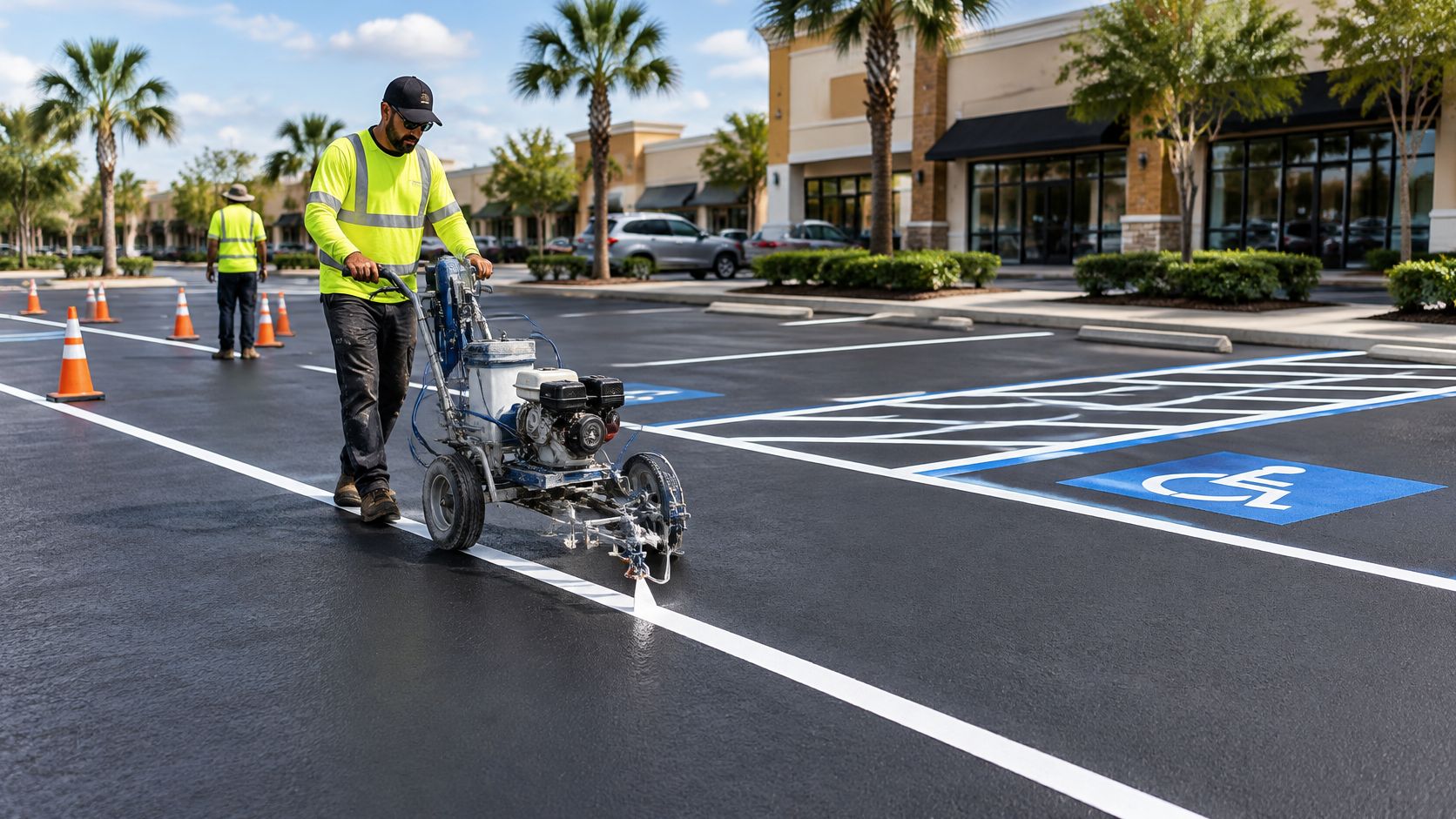
You're standing in your own lot on a Monday morning and you can't tell where one space ends and the next begins. The asphalt's turned gray, the accessible symbols are ghosts, and a delivery truck just parked across what used to be your fire lane in Ocala. That's usually when a property manager calls about paint, then realizes the surface under the paint is the core problem.
If you're going to seal and stripe a parking lot, do it as one job with one plan. In Marion County, FL and Citrus County, FL, sun, afternoon rain, and tight turning traffic age the pavement and the markings together, just not at the same speed. Treating them separately means paying twice to close the lot, and painting lines that won't last on worn asphalt.
Table of Contents
- Why Seal and Stripe a Parking Lot as One Project
- Prep Work and Repairs That Decide the Outcome
- Applying the Sealcoat the Way Crews Actually Do It
- ADA Layout and Space Counts That Hold Up to Inspection
- Laying Out, Painting, and Verifying the Striping
- Florida Heat, Pavement Temperature, and the Lighter Surface Question
- Common Questions from Central Florida Property Managers
Why Seal and Stripe a Parking Lot as One Project
A shopping center in Belleview, an HOA clubhouse near The Villages, and a church in Inverness don't have the same traffic, but they fail the same way. UV oxidation dries out the binder at the surface. Rain finds hairline cracks. Power steering turns in the same stalls scuff both sealer and paint. By the time lines look tired, the asphalt they're stuck to usually is too.
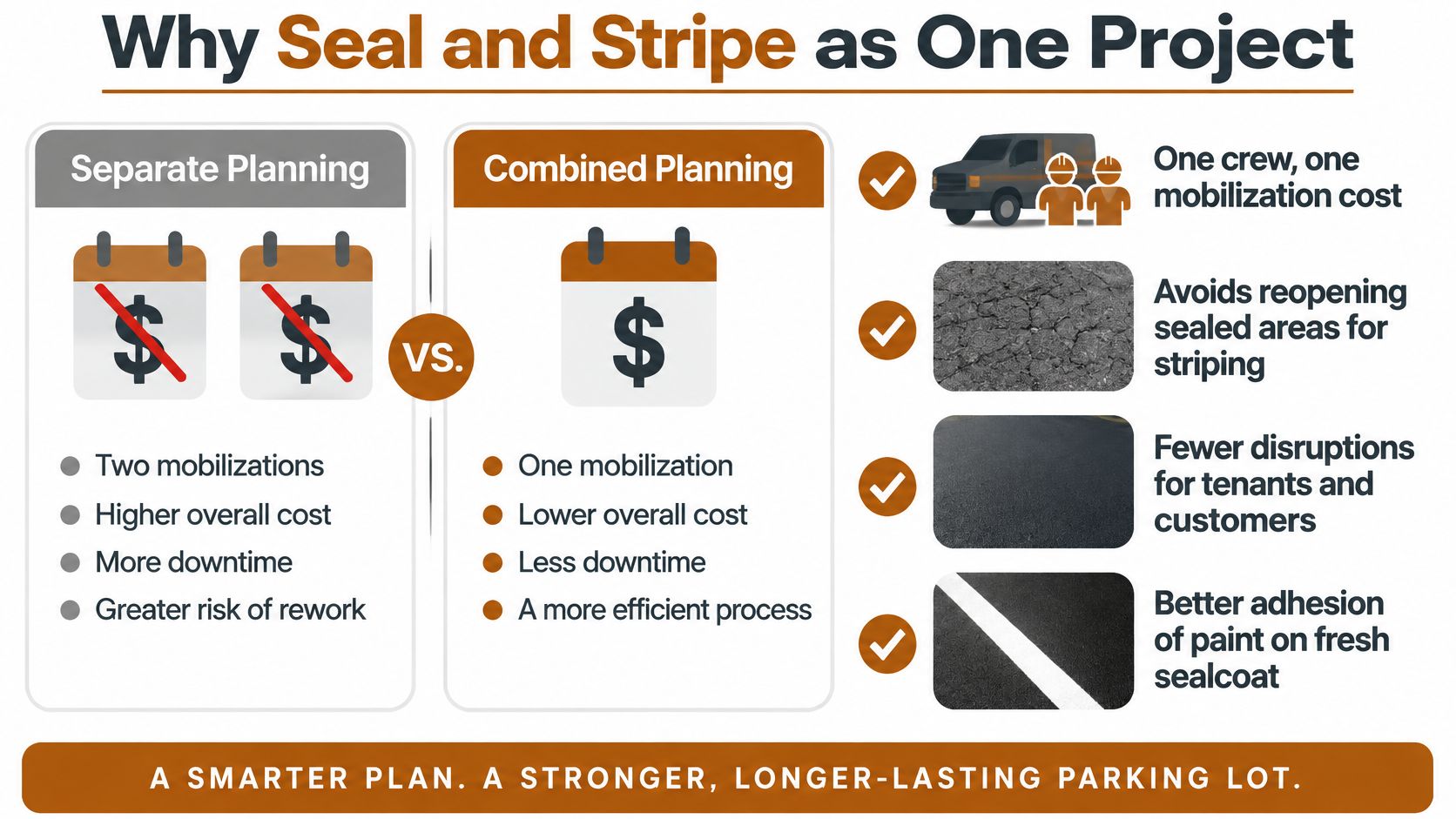
Budgeting sealcoating and striping as separate line items sounds tidy. In the field it creates waste. You close the lot, seal it, reopen it unmarked while you wait on a striping crew, then close sections again. Tenants in Summerfield or customers in Crystal River get confused twice, and fresh paint ends up on a surface that drivers have already tracked dirt across.
One crew, one mobilization, and one closure window fixes that. The work runs as a continuous sequence, assessment, repairs, cleaning, sealing, curing, layout, painting, and verification. Paint bonds cleanly to cured sealer, the layout gets corrected before lines go down, and you reopen finished instead of half done.
Start With a Slow Walk, Not a Screenshot
Every good job starts on foot. I don't quote a lot from satellite photos because they don't show oil softening, settled patches, or which drain holds water after a storm in Dunnellon. A proper field inventory counts total spaces, measures existing stalls and aisles, finds the shortest accessible route to each entrance, and checks slopes where people transfer from car to chair.
That walk separates two very different problems. Surface wear is oxidation, light raveling, and small defects that a preservation treatment can legitimately address. Structural failure is alligator cracking, potholes that keep coming back, base movement, and drainage that ponds against a curb. Sealer over structural failure is makeup over a broken bone. It looks dark for a while, then it peels, cracks through, and takes your new striping with it.
If a contractor won't walk the lot and mark repairs before talking price, he's selling square footage, not a finished parking lot.
What We Document Before Anyone Mixes Material
Documentation protects you and the crew. Photos of each cracked bay, notes on oil spots near dumpsters and drive through lanes, moisture and weather readings on application day, and slope checks at accessible stalls become your baseline. When the striping pass comes later, that same record shows whether an aisle was already tight or a patch changed the grade.
- Space and stall count: Confirms what you have now, not what the old site plan claims.
- Drainage paths: Shows where water sits, where it should go, and which low spots will wear first.
- Pavement type: Verifies you're dealing with conventional asphalt, plus any concrete aprons, sidewalks, or pads that need different treatment.
- Repair map: Flags full depth patches, crack treatment, and concrete work that must happen before coating.
That last point matters for a full service property. As Concrete and Asphalt Experts in Marion and Citrus County, a combined contractor is looking at the sidewalk trip edge and the broken concrete dumpster pad on the same walk as the asphalt. Fixing the concrete transition after you've sealed and striped means cutting into finished work.
Central Florida timing also starts at the walk. A lot in Lecanto with heavy tree shade dries slower than an open retail lot in Silver Springs. A medical office in Homosassa can't close its only accessible route during clinic hours. The walk tells you how to phase the job, not just what it costs.
Prep Work and Repairs That Decide the Outcome
Sealcoat doesn't hide prep mistakes. It highlights them. Dirt under sealer becomes a bond breaker, oil softened asphalt stays soft underneath, and loose stone telegraphs through as a rough, thin spot that wears first in the drive lanes.
The Sequence Crews Actually Run
Cleaning comes first and it's mechanical, not cosmetic. Crews sweep, power blow, and edge along curbs and sidewalks where grass and sand collect. Low spots and drains get extra attention because that's where silt sits after every rain in Beverly Hills and Hernando.
Repairs happen before coating, in a specific order. Potholes and base failures get cut out and patched full depth, not skimmed. Active cracks get cleaned, routed where appropriate, and sealed so water stops moving into the base. For a clear breakdown of that step, see our guide to parking lot crack sealing before sealcoating. Oil spots need remediation or removal of contaminated material. Primer helps in some cases, but coating over saturated asphalt is how you get peeling in perfect tire sized patches.
Practical rule: If the surface isn't clean, dry, and sound, the calendar doesn't matter. Push the job a day.
One identification mistake causes real damage. Per FHWA guidance on porous asphalt pavements with stone reservoirs, those systems should never be sealcoated or crack sealed because the treatments obstruct intended infiltration. If your lot was built to drain through the pavement, sealing it defeats the design. Confirming pavement type during the walk prevents an expensive, well intentioned error.
DIY prep usually fails on patience. A rented blower moves leaves, but it doesn't remove embedded sand from cracked bays, and a garden hose rinse leaves moisture in the pores. Professional prep looks slow because it is. That clean, dry substrate is the single biggest predictor of whether the finished seal and stripe parking lot work survives Florida heat or starts tracking in the first month.
Applying the Sealcoat the Way Crews Actually Do It
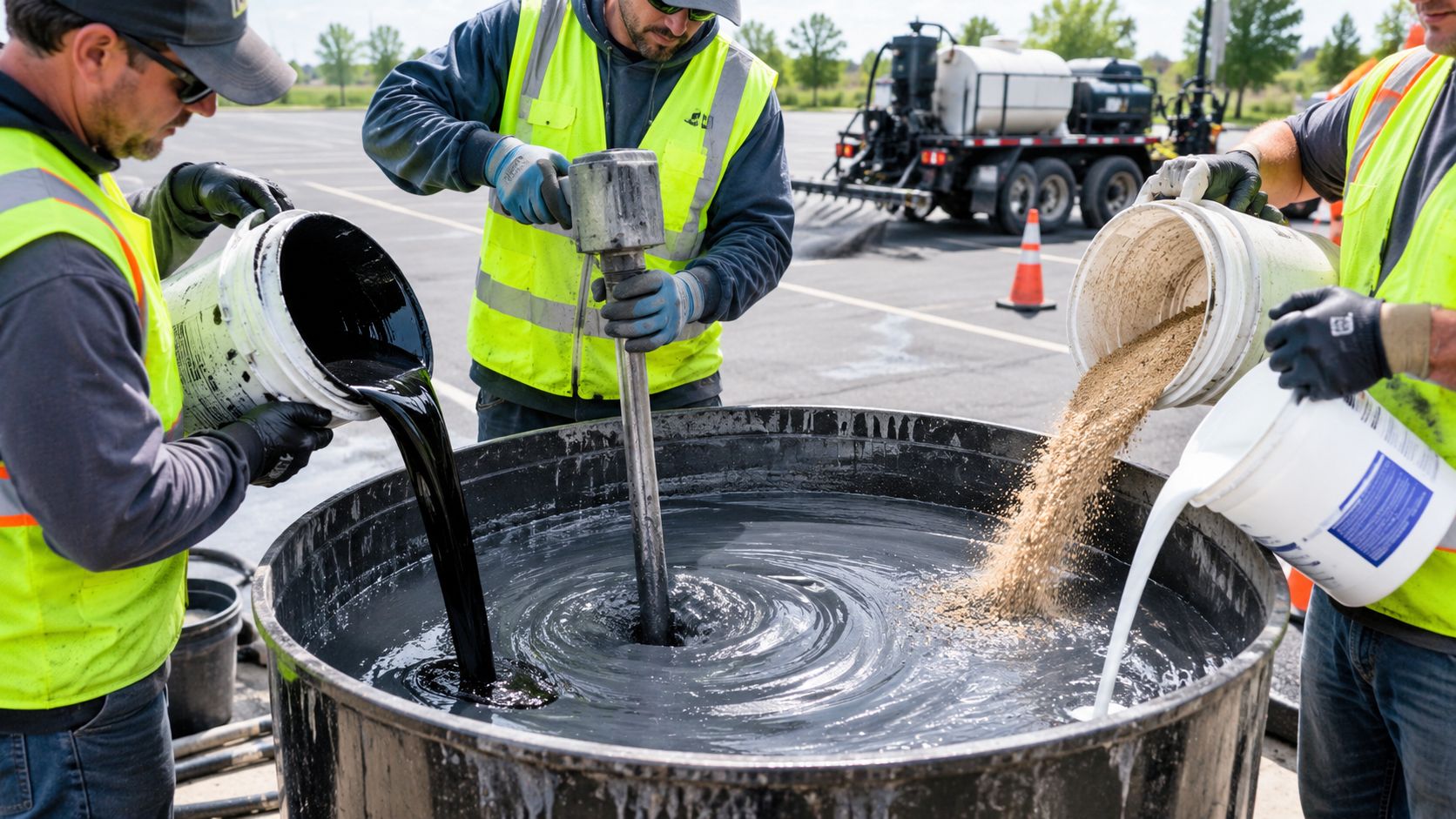
Sealcoat isn't paint you stir and pour. A commercial mix is typically asphalt emulsion, water, sand for traction and wear, and sometimes a latex modifier, blended to the manufacturer's ratio and kept agitated. Too much water stretches coverage and thins protection. Too little sand leaves a slick surface that polishes under tires.
For context on the preservation idea itself, the Texas Department of Transportation definition of a seal coat as asphalt binder covered with aggregate describes a treatment used to renew skid resistance and seal small defects before they become larger failures. Parking lot sealer works on the same principle, protect serviceable asphalt at the surface, don't pretend to rebuild it.
The mixing and handling stage sets up everything that follows, from coverage rate to cure.
Squeegee, Spray, and Why Two Thin Coats Win
Application method depends on surface texture and layout. Squeegee application works material into a rougher, older surface and helps fill surface voids. Spray application gives uniform coverage on smoother lots and speeds up large open areas. Brush work handles tight edges around curbs, bollards, and building faces where overspray would create a cleanup problem.
Two thin coats beat one heavy coat almost every time. A heavy coat skins over, traps moisture, and stays tender underneath. Thin coats cure more evenly, wear more predictably, and give the second pass a chance to cover holidays from the first. Crews work lane by lane to keep a wet edge, protect cleanouts and drainage structures, and keep material out of concrete joints that need to move.
Weather decides whether any of this happens. You need a dry surface, suitable air and pavement temperatures under the manufacturer's limits, no rain in the near forecast, and wind you can control overspray in. Our asphalt seal coat specifications page outlines how those product limits translate to a go or no go call. A licensed and insured crew that reschedules on a marginal morning is protecting your money, not wasting your time.
Dry to the Touch Is Not Cured
Owners get burned here. A lot can look dry in a few hours of Central Florida sun and still scuff under a tight turn. Surface dry means you can walk it carefully. Full cure means the film has coalesced enough to take vehicle traffic, power steering, and heat without softening.
Plan on a realistic reopening window and phase the property so business continues. Cones alone aren't a traffic control plan. You need barricades at entrances, pedestrian reroutes that don't send people through wet sealer, and clear tenant communication the day before in places like Ocala retail centers where lunch traffic peaks hard.
- Reopened too early: Tire scuffing, black tracking into stores, and soft impressions at stall entry points.
- Cured properly: Uniform matte finish, no ponded material, clean edges at drains and curbs, and a documented reopening time.
- Turning areas last: Drive through lanes and tight end caps need the longest protection because steering while stationary twists the film.
Curing time also controls striping. Paint applied to sealer that hasn't cured can trap moisture, lose adhesion, and gray out early. Fast turnaround matters, but rushing the handoff between sealing and striping undoes both steps. Reliable scheduling means building cure time into the quote, not discovering it after the crew is on site.
ADA Layout and Space Counts That Hold Up to Inspection
Restriping stops being cosmetic at the accessible stalls. Counts, dimensions, signage, slopes, and the route to the entrance are one audit, not separate details you can average across a property.
Under the 2010 ADA Standards, accessible spaces are calculated for each parking facility, such as an individual lot or garage, rather than by combining all spaces across a site. The schedule in ADA guidance on accessible parking space counts by lot size requires 1 accessible space for 1 to 25 total spaces, 2 for 26 to 50, 3 for 51 to 75, 4 for 76 to 100, 5 for 101 to 150, 6 for 151 to 200, 7 for 201 to 300, 8 for 301 to 400, and 9 for 401 to 500, with at least 1 of every 6 accessible spaces van accessible.
ADA Accessible Space Requirements by Total Lot Size
| Total Parking Spaces | Minimum Accessible Spaces | Minimum Van Accessible |
|---|---|---|
| 1 to 25 | 1 | 1 |
| 26 to 50 | 2 | 1 |
| 51 to 75 | 3 | 1 |
| 76 to 100 | 4 | 1 |
| 101 to 150 | 5 | 1 |
| 151 to 200 | 6 | 1 |
| 201 to 300 | 7 | 2 |
| 301 to 400 | 8 | 2 |
| 401 to 500 | 9 | 2 |
For larger facilities, the same standards require accessible spaces equal to 2% of total capacity for 501 to 1,000 spaces, and 20 plus 1 for every 100, or fraction of 100, above 1,000 after that. Those aren't targets to round down from when a layout gets tight.
Owners in Dunnellon and Crystal River often ask if they can keep the old count because it passed years ago. If you're restriping, verify the current count and location. Our reference on ADA parking lot striping requirements helps you compare the existing layout against the standard before paint locks in a problem. Moving an accessible stall to the shortest route, fixing a sign, or widening an aisle is cheap during layout and expensive after an inspection or complaint.
Laying Out, Painting, and Verifying the Striping
A clean layout starts with chalk, not paint. Crews snap control lines from fixed points, measure stall widths twice, and walk the full pattern before a striper rolls. Old lines are a reference, never proof. Lots drift over years as each restripe copies the last mistake a little wider.
The field sequence below shows how that layout, masking, painting, and verification flow connects.
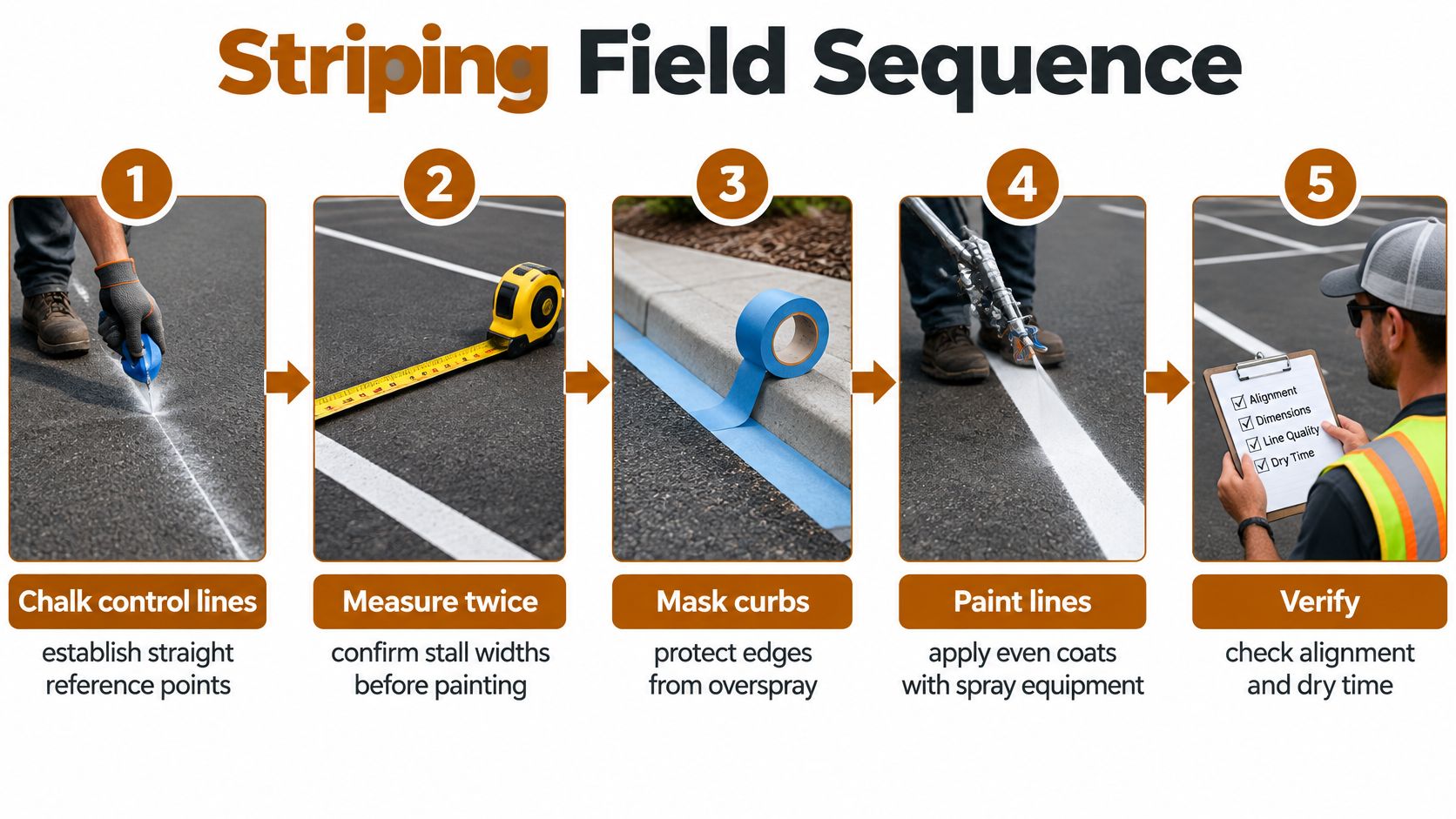
Dimensions at accessible stalls need field verification, not nominal math. Per the 2010 ADA Standards for accessible car and van space dimensions, a car space must be at least 96 inches wide with a 60 inch access aisle, maximum slope is 1 to 48, about 2.08 percent, in any direction, and a van configuration can use 132 inches plus a 60 inch aisle or 96 inches plus a 96 inch aisle with at least 98 inches of vertical clearance.
Paint choice follows the surface and marking. Traffic paint rated for asphalt, applied at consistent thickness with a properly set line striper, gives you sharp edges that a roller can't match. Access aisles are hatched so they read as no parking space, not extra room. Stencils for accessible symbols, directional arrows, stop bars, fire lanes, and crosswalks are positioned, secured, and lifted clean so repeated markings stay consistent across the property.
The walkthrough in this video shows the measuring and verification habits that separate a defensible layout from a fast repaint.
Verification closes the job. Remeasure every accessible stall after painting, confirm aisles run the full length of the space and connect to an accessible route, check that ramps don't intrude into aisles, confirm sign placement, and photograph the finished layout. That photo record helps HOAs in The Villages and managers in Inverness prove what was installed long after the paint has been driven on.
Florida Heat, Pavement Temperature, and the Lighter Surface Question
Standard advice says seal everything dark and stripe it bright. In Central Florida, that default deserves a second question. Lots in Ocala, Belleview, and Lecanto sit in direct sun most of the year, and the surface your customers cross at noon in August isn't just a maintenance item. It's part of pedestrian comfort and safety.
Dark sealcoat still has clear advantages. It provides high contrast for white and yellow markings, it's the most familiar specification for crews and suppliers, and it delivers proven surface protection when applied to sound asphalt. For drive lanes with heavy turning traffic, that durability and line visibility are hard to beat.
The trade off is heat. According to field data reported by Arizona State University on lighter asphalt coatings, lighter coatings can produce surfaces up to 20 degrees cooler than darker surfaces. That difference matters at crosswalks, accessible routes, outdoor waiting areas, and school or church lots where people stand, load children, or transfer to wheelchairs on the pavement.
Can maintenance reduce pavement heat without creating glare or washing out your markings? That's the right question to ask your contractor, not whether light or dark always wins.
Where a Selective Approach Can Make Sense
You don't have to choose one treatment for every square foot. Properties in Homosassa and Silver Springs sometimes pair conventional dark sealcoat in drive lanes with shade trees or canopies at pedestrian zones, stronger contrast striping where a lighter treatment is suitable, and concrete walkways that break up long asphalt crossings. Concrete sidewalks and pads, built for Florida conditions, also give you a durable, lighter route that doesn't depend on coating color alone.
Glare is the counterweight. A surface that's too reflective can bother drivers at low sun angles and reduce marking contrast if the paint color isn't planned for it. Local specifications, drainage, product durability, and how the lot is lit at night all belong in the same conversation. Any lighter compatible treatment should be tested against line visibility in both midday sun and evening conditions before you commit a whole center in Summerfield to it.
Putting Seal and Stripe on a Recurring Plan
A combined project shouldn't be a once a decade rescue. Build it into a parking lot maintenance plan with an annual walkthrough, crack monitoring, and a restripe cycle driven by traffic and UV exposure rather than a fixed calendar date. High turn stalls near a storefront fade faster than overflow parking behind a building in Dunnellon. Budget years, tenant peak seasons, and school or church calendars should drive scheduling.
A documented maintenance log, photos, measurements, repair records, and reopening times, supports property value and helps defend decisions if accessibility or a trip incident gets questioned. It also tells you when you've crossed from maintenance into rehabilitation. Widespread alligator cracking, recurring base failure, and drainage that can't be corrected at the surface mean patching and paving conversations, not another coat.
Knowing that threshold is where professional judgment earns its fee. A licensed and insured local crew with Central Florida experience can tell you when to seal and stripe, when to repair concrete first, and when to stop spending maintenance money on pavement that's structurally done. That candor saves more over a property's life than the cheapest per square foot price on a single visit.
Common Questions from Central Florida Property Managers
How Long Does the Lot Need to Stay Closed
It depends on product, humidity, shade, and overnight temperatures, and on whether you're phasing sections. Plan the closure around full cure for vehicle traffic, not surface dry, and give turning areas extra protection. A professional evaluation on site will give you a reopening plan by section, so tenants in Crystal River or Ocala know exactly where to park each day.
Can We Skip Sealcoat and Just Restripe
You can, and sometimes you should if the asphalt is sound and still holding binder. If the surface is oxidized and raveling, new paint will wear with the loose surface under it. The walkthrough decides. Restriping worn asphalt just to look fresh for a sale or inspection usually costs you a second mobilization sooner than expected.
What Drives Cost Up or Down
Size matters, but repairs, cleaning, oil remediation, layout corrections, signage, and phasing drive the spread between quotes. A low price that excludes crack work and patching isn't cheaper, it's incomplete. Ask for repairs as clear line items with a free estimate and no pressure consultation, so you can compare scope rather than totals.
How Often Should We Restripe in Florida Sun
Let traffic and visibility decide. When accessible symbols, fire lanes, or stop bars stop reading clearly at normal driving distance, you're overdue regardless of the date. An annual check catches ADA drift, a sign knocked down, an aisle blocked by a new ramp or storage, a stall count changed by a tenant build out, before it becomes a liability in Marion County, FL or Citrus County, FL.
When you're ready to seal and stripe a parking lot in Marion or Citrus County without closing twice or guessing at ADA layout, contact Riverside Sealing & Striping, LLC for a free, no pressure on site estimate and professional evaluation. We'll walk the lot with you, map repairs for both asphalt and concrete, and lay out a phased sealing and striping plan with clear timelines so your property reopens finished, compliant, and easy to use.