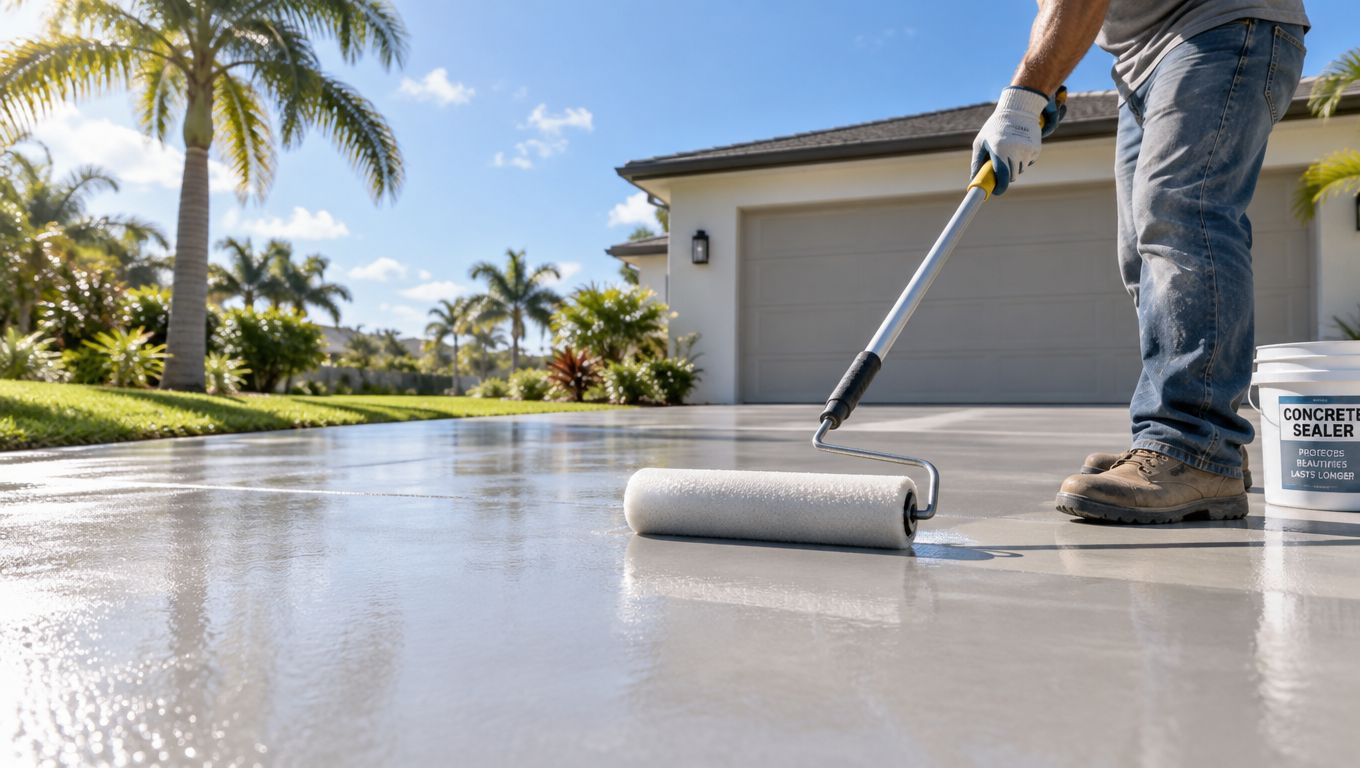
You've just watched a crew finish a new driveway in Ocala, Dunnellon, or somewhere else in Central Florida. The slab looks firm the next morning, the edges are clean, and the natural question comes quickly: When can it be sealed?
The answer isn't “as soon as it looks hard.” Sealing a new concrete driveway is the final step in a sequence: cure, dry, then seal. Concrete may support a careful step while it's still losing moisture, developing strength, and remaining vulnerable to surface damage.
That sequence matters even more around Marion County, FL and Citrus County, FL. Afternoon thunderstorms, high humidity, intense UV exposure, irrigation overspray, and wet soil can affect both the slab and the sealer. A product that resists water but doesn't allow moisture vapor to escape may create problems if it's applied before the concrete is ready.
Table of Contents
- A New Driveway in Central Florida and the Question Every Homeowner Asks
- Curing Before Sealing and Why the Order Matters
- Penetrating Versus Film-Forming Sealers for a New Slab
- Surface Preparation and Application Technique
- How Central Florida Weather Changes the Sealing Timeline
- Matching the Sealer to the Real Risks on Your Driveway
- The Question Most Sealing Guides Skip
A New Driveway in Central Florida and the Question Every Homeowner Asks
An Ocala homeowner may walk outside the morning after a pour and see what appears to be a finished driveway. The surface is no longer soft, the broom texture is visible, and the crew has cleaned up. It's natural to assume that the next job is applying a protective sealer.
That assumption can lead to an expensive mistake. The concrete has set enough to look finished, but cement hydration and strength development continue after the surface hardens. The first hours are especially important because rapid moisture loss can contribute to plastic-shrinkage cracking and reduce long-term durability, as explained in Federal Highway Administration curing guidance.
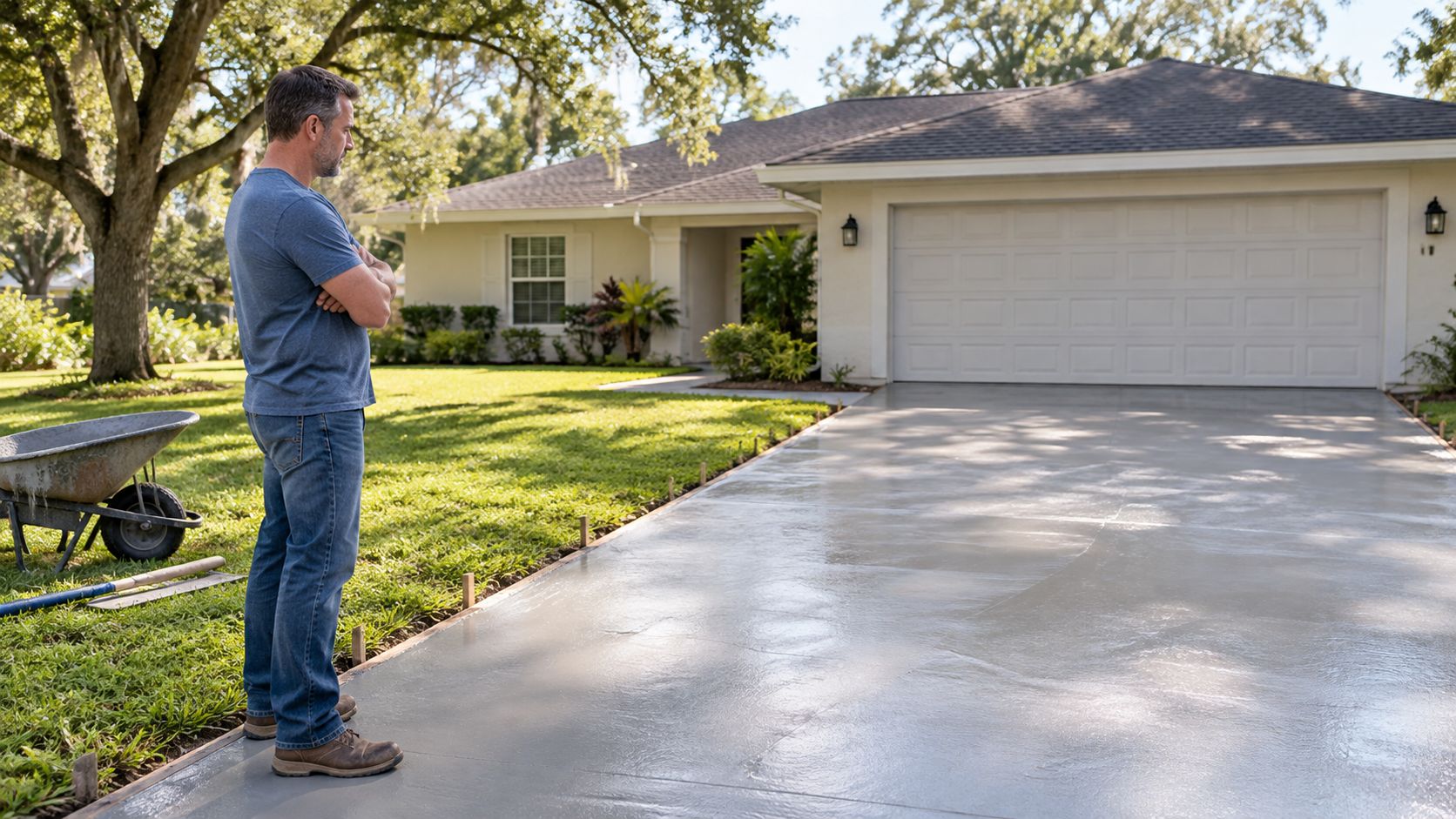
A liquid membrane-forming curing compound may be applied soon after finishing to retain water for hydration. That material isn't the same as a later decorative or penetrating sealer. The curing compound protects the young slab during early hardening, while the later sealer is selected for surface protection, water resistance, appearance, or stain resistance.
The practical question isn't only “When can I seal?” It's “Has the slab cured and dried, and can this sealer let it breathe under my site conditions?”
A homeowner in Dunnellon may have a different moisture situation from someone in Summerfield or Beverly Hills. One driveway may receive irrigation overspray every morning. Another may sit beneath trees, collect rainwater near a control joint, or remain damp because of poor drainage. Before comparing concrete driveway sealing costs, first establish whether the slab and product are ready for the same job.
The safest mental model is simple. Curing protects strength development. Drying prepares the surface. Sealing provides later protection. Skipping or combining those stages without confirming product compatibility can trap moisture beneath the sealer.
Curing Before Sealing and Why the Order Matters
Curing manages moisture inside young concrete. It is separate from sealing. Approved methods include water sprinkling or fogging, damp burlap or cotton mats, waterproof paper, polyethylene sheets, and curing compounds. Each method helps retain the water cement needs for hydration after finishing, once the surface can withstand protection without being marked.
The three stages on a normal driveway
First, place and finish the slab. The crew sets the grade, edges, joints, and texture. It may look finished, but Central Florida heat, sun, and wind can pull water from the surface faster than the concrete can replace it.
Second, cure the concrete. Portland Cement Association hot-weather guidance recommends starting moist curing as soon as finishing is complete and continuing for at least 24 hours, with continuous moist curing preferred. If that is not practical, protect the damp slab with curing paper, heat-reflecting plastic sheets, or a membrane-forming curing compound. Repeated wetting and drying can contribute to crazing and cracking, so the concrete should dry gradually after curing.
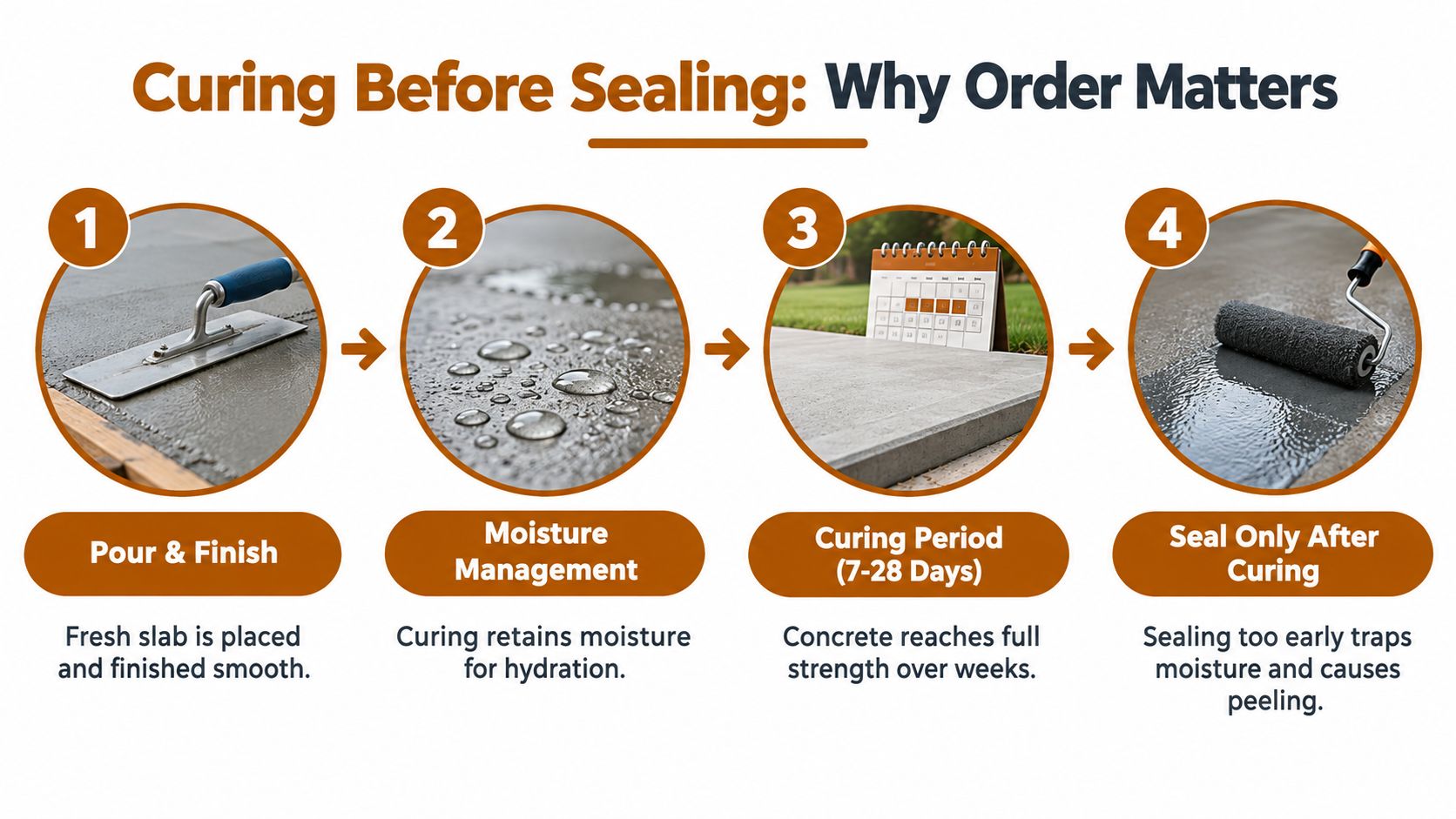
Third, let the surface dry before sealing. ACI-based guidance commonly uses about 7 days of curing for conventional concrete above 40°F (5°C), while many concrete-care references use approximately 28 days as the benchmark for fully cured concrete before a conventional penetrating or film-forming sealer. The concrete curing guidance supports treating curing time and surface dryness as separate checks. The slab may have reached a typical curing milestone while still holding moisture beneath the surface.
What to ask the installer
Ask which curing method was used, whether curing compound remains, and whether it is compatible with the planned sealer. Some cure-and-seal products are made for early application after surface water disappears. That does not make every conventional sealer suitable for young concrete.
The surface must be clean and dry, including low spots, saw cuts, and textured grooves. After compatible cleaning and rinsing, many decorative-sealer applications require roughly 12 to 24 hours of drying. For the broader sequence, see our guide on how long concrete takes to cure before sealing.
In Ocala, Dunnellon, and Citrus County, humidity, shade, irrigation overspray, and afternoon rain can extend drying after the concrete looks hard. A film-forming product can restrict vapor release if applied too soon, while a suitable penetrating product may give moisture more room to move. Follow the product label, confirm the curing method, and test dryness before sealing.
A hard-looking driveway is not automatically ready for sealer. Confirm curing, remove incompatible residue, verify dryness, and choose a product that can handle the slab's remaining moisture.
Penetrating Versus Film-Forming Sealers for a New Slab
A new driveway doesn't need the strongest-looking coating. It needs a product that fits the slab's age, porosity, exposure, and ability to release moisture.
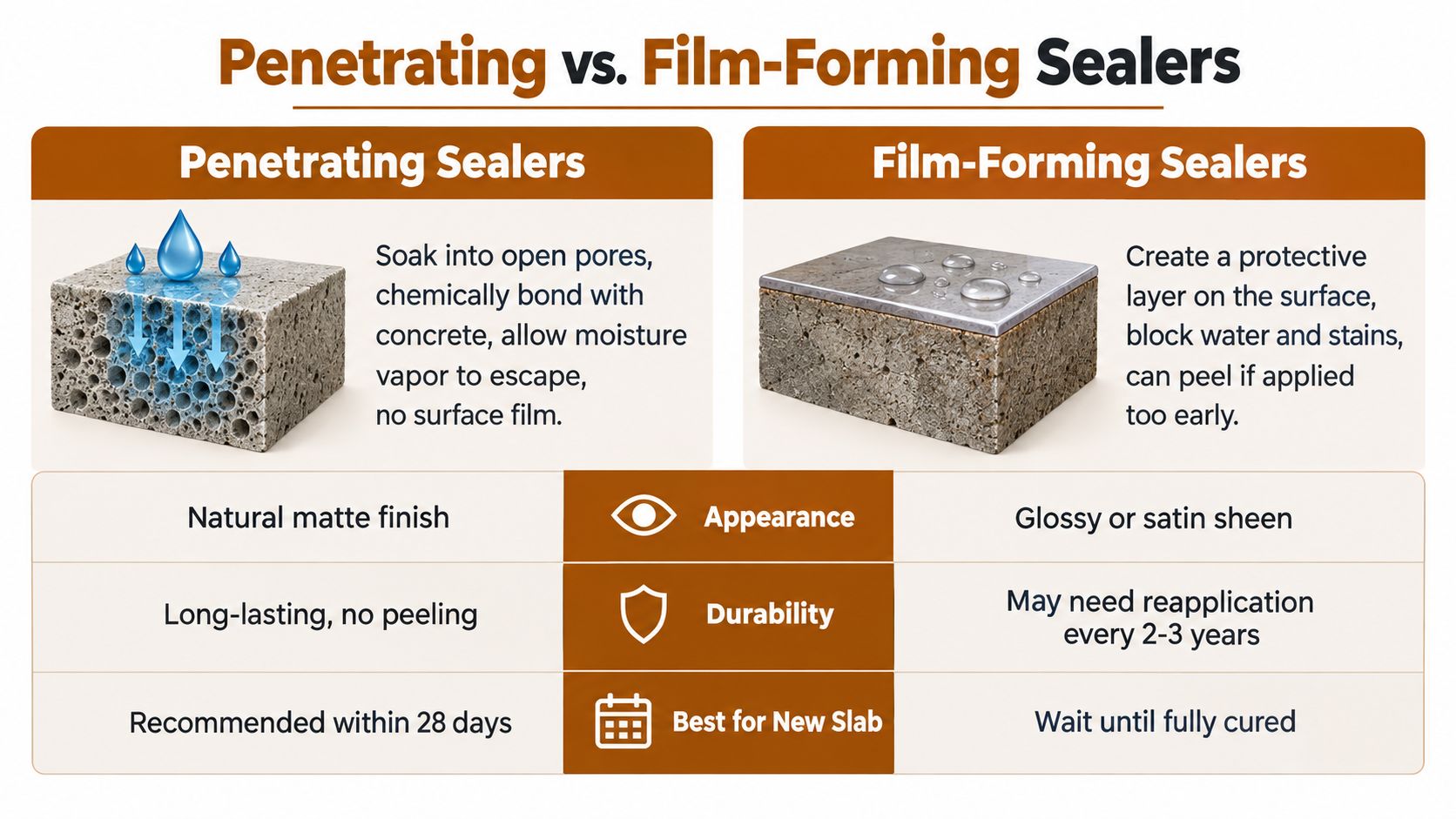
Penetrating sealers enter open pores and react within the concrete or occupy pore space without leaving a conventional surface film. They're often a sensible direction for a plain broom-finished driveway where the homeowner wants a more natural appearance and reduced water absorption. They still require clean, dry, open pores. A penetrating product can't properly enter voids filled with water.
Film-forming sealers sit on top of the concrete and create a visible protective layer. They can deepen color and provide a decorative sheen on stamped, colored, or exposed-aggregate surfaces. The trade-off is that a surface film has less tolerance for trapped moisture, excessive application, poor preparation, or movement beneath the coating.
Vapor transmission matters more than a waterproof slogan
Transportation research warns that barrier coatings can trap moisture already present in concrete. Where the sealed surface is the only route for drying, researchers recommend a product transmitting at least 35% as much water vapor as untreated concrete, according to this transportation research on vapor transmission.
That finding matters in Central Florida even though homeowners here aren't usually focused on freeze-thaw cycles. Rainfall, humidity, irrigation, wet subgrades, and ponding can keep moisture moving through a slab. A “waterproof” film may reduce surface absorption while making it harder for internal moisture to escape.
The right choice depends on the driveway. A broom-finished slab with uncertain drying conditions generally deserves careful evaluation of a vapor-permeable penetrating product. A decorative slab may justify a film-forming sealer for color enhancement, but only after the concrete is adequately cured, dry, and compatible with that coating.
A strong water barrier isn't automatically the best protection for a young driveway. Moisture resistance and vapor release have to work together.
Surface Preparation and Application Technique
Sealer performance starts with preparation. Even the right product can fail if it is applied over curing residue, oil, dust, efflorescence, or damp concrete.
Prepare the slab
Remove curing compounds, laitance, dirt, oil, and efflorescence using a method approved for the selected sealer. Mechanical preparation or controlled washing may work, but avoid damaging the finished surface or opening the concrete unevenly.
Rinse thoroughly. Clear standing water from saw cuts, control joints, edges, broom grooves, and low spots. Those recessed areas can stay wet while the main field appears dry.
Allow roughly 12 to 24 hours of drying when the product guidance supports that window. The clock is only a guide. Delay sealing if moisture remains, rain is approaching, or the concrete is at or below the dew point.
Test before covering the driveway
Apply the sealer to a small, inconspicuous area first. Check:
- Absorption: Does the product enter the concrete or remain wet on top?
- Appearance: Does it create more color or sheen than expected?
- Slip: Does the surface remain safe underfoot?
- Compatibility: Does it react with a curing compound or previous treatment?
- Uniformity: Does the finish cure evenly?
Textured or broom-finished concrete often benefits from spray-and-back-roll application. Spray a controlled amount, then use a roller to work the sealer into the profile so grooves and high points receive consistent coverage.
Typical decorative-sealer coverage is approximately 200 to 350 square feet per gallon, but the product's specified rate controls, as described in these decorative concrete sealing best practices. On a textured driveway, apply two thin passes at the label rate with a 1/2-inch nap roller after spraying. Keep a wet edge across each control-joint panel to limit lap marks.
Avoid common application failures
Puddling around joints, edges, grooves, and low spots can leave a glossy, slippery, milky, or uneven film. Divide a broad driveway into manageable sections and maintain a wet edge between passes.
Keep people and vehicles off the surface until the sealer reaches its specified tack-free or full-cure condition. “Dry to the touch” does not mean ready for tires, turning wheels, or repeated foot traffic.
How Central Florida Weather Changes the Sealing Timeline
A driveway in Ocala, Belleview, Silver Springs, Inverness, or Homosassa has to deal with fast-changing weather. A clear morning can become a wet afternoon, and a shaded surface can remain damp after the surrounding pavement appears dry.
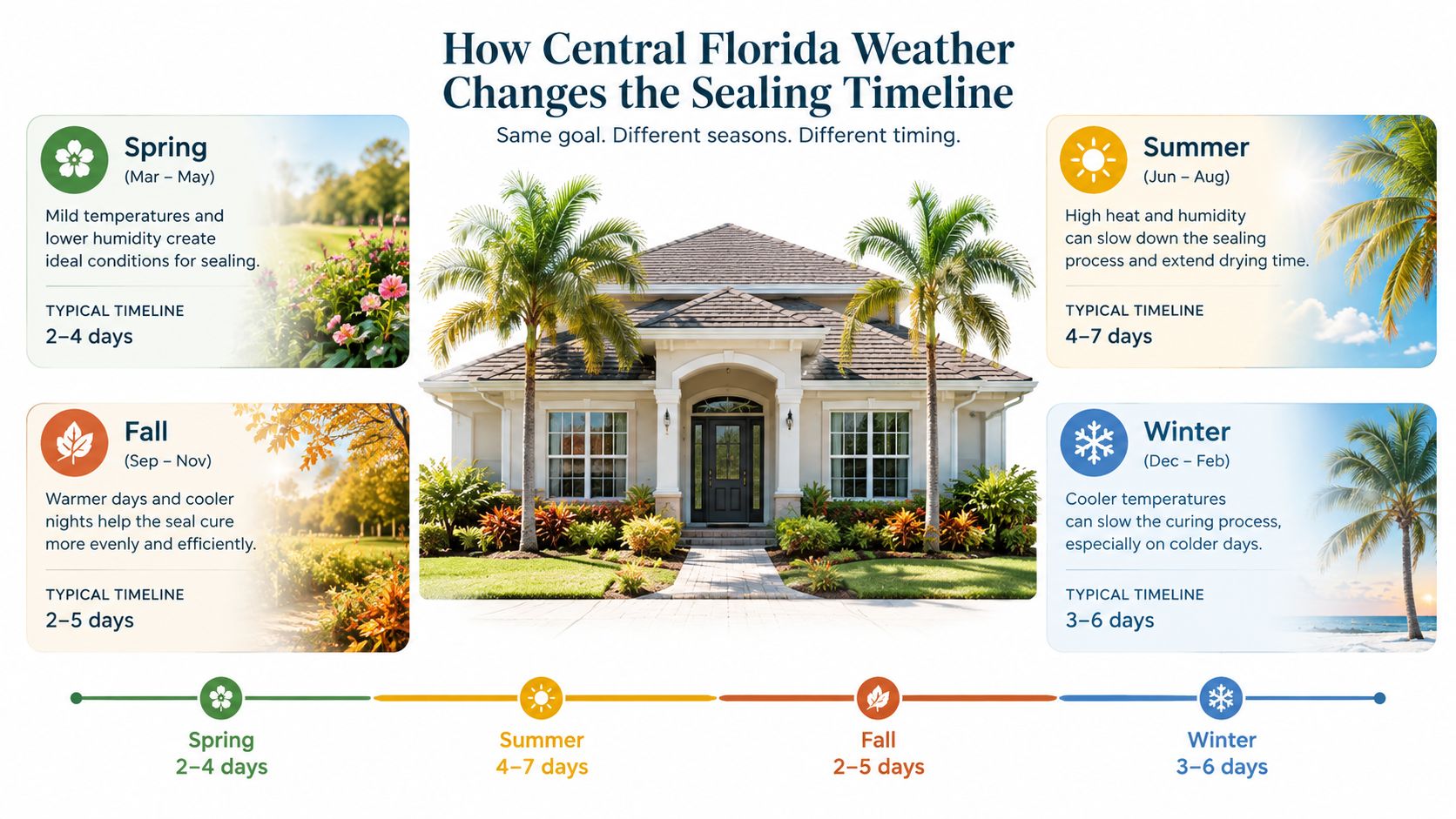
Hot, windy conditions increase evaporation. If early curing is delayed, the slab can lose moisture too quickly before it develops the intended durability. High humidity creates the opposite problem later, slowing drying and increasing the chance that moisture remains beneath a coating.
Conditions that should stop the application
- Rain risk: Don't apply if rain is imminent or forecast within the next 24 hours.
- Dew point: Don't seal when the concrete is at or below the dew point.
- Visible moisture: Stop if the slab, joints, or grooves remain damp.
- Irrigation: Redirect sprinkler overspray and wait until the affected area has dried.
- Surface heat: Avoid the hottest part of the day when rapid flash drying can create bubbles, lap marks, or uneven curing.
- Wind: Watch for accelerated evaporation that makes sections dry at different speeds.
The application window should be selected around the slab's actual temperature and moisture condition, not just the calendar. A dry, stable period with moderate surface temperatures is usually easier to manage than a scorching afternoon followed by a thunderstorm.
Central Florida's climate also strengthens the case for reviewing vapor transmission. A young slab may continue releasing moisture while the surface faces heat, rain, and humidity. The sealer has to protect the top without creating an unnecessary barrier to that movement.
A visual weather reference can help homeowners understand why the same driveway may be ready on one day and unsuitable the next. The following video offers additional context on concrete sealing conditions and preparation.
Matching the Sealer to the Real Risks on Your Driveway
The correct sealer depends on what threatens the driveway most. A property in The Villages may have different traffic and drainage patterns from a coastal-area property near Crystal River. A home in Lecanto may need a different balance of stain resistance and vapor release from a lightly used driveway in Hernando.
| Risk on the Driveway | Sealer Property That Helps | Suggested Sealer Family |
|---|---|---|
| Rainfall, ponding, and damp subgrade | Water resistance with vapor release | Vapor-permeable penetrating sealer |
| Humidity and slow drying | Moisture tolerance and documented vapor transmission | Penetrating product selected for the slab |
| Vehicle fluids and parking stains | Stain and chemical resistance | Penetrating or compatible film-forming product, chosen after testing |
| Irrigation overspray and mineral deposits | Reduced absorption and easy surface cleaning | Penetrating sealer where natural appearance is preferred |
| Salt exposure near coastal or treated areas | Reduced chloride and water penetration | Product tested for the relevant exposure |
| Daily vehicle wear | Surface durability and appropriate abrasion resistance | Product matched to traffic and finish |
A sealer can't correct a driveway that directs water toward the house, holds water at the edge, or has failed joints. Correcting slope and drainage comes first. Review site-specific concerns such as concrete driveway drainage before treating the surface.
Surface defects also need attention. Cracks, damaged edges, weak paste, and defective joints won't disappear beneath a sealer. A coating may make them less visible temporarily, but it won't rebuild missing concrete.
Research summarized by the American Concrete Institute found that sealers reduced water absorption and chloride penetration, while delaying critical saturation didn't always improve frost resistance. That distinction is useful in Florida. Choose a product for rainfall, humidity, staining, salt exposure, and wear instead of assuming every sealer protects against every failure mode.
A Washington State University formulation improved laboratory water repellency by 75% and reduced salt damage by 44% versus a commercial sealer, according to the Iowa concrete penetrating sealer evaluation. Those results are laboratory-specific and don't prove that every premium product will deliver the same result on a residential driveway.
The Question Most Sealing Guides Skip
Many homeowners receive a simple answer: wait until the concrete cures, then seal it. That advice is incomplete because curing time alone doesn't confirm that the slab is dry enough or that the chosen sealer can release moisture vapor.
The more useful question is: Can this specific sealer let the slab breathe under this site and climate?
Why trapped moisture causes visible failure
When moisture remains in the concrete and a low-permeability coating blocks its escape, the result can include whitening, blistering, peeling, or reduced penetration. The problem may appear as a milky finish, isolated bubbles, loose edges, or areas where the sealer never bonds consistently.
Film-forming coatings show this failure clearly because the surface layer can lift or delaminate. Penetrating products don't create the same type of peeling film, but they still need open, dry pores to enter and perform properly.
A product label should answer practical questions:
- Moisture requirements: What surface moisture condition does the manufacturer require?
- Vapor performance: Does the product provide relevant vapor-transmission information?
- Compatibility: Can it be applied over the curing compound used on this driveway?
- Temperature limits: What concrete and air temperatures are acceptable?
- Forecast requirements: How long must the surface remain dry?
- Traffic release: When can people, tires, and turning vehicles return?
“Waterproof” can sound reassuring, but it may oversell the value of a hard surface barrier. In a humid Marion County, FL or Citrus County, FL setting, vapor-permeable protection may be more useful than the strongest waterproof film.
What sealing can and can't protect against
A sealer can reduce water absorption, help resist staining, simplify cleaning, and protect a suitable surface from selected exposures. It won't correct poor drainage, replace missing concrete, repair structural cracking, or guarantee resistance to every type of wear.
The American Cement Association describes sealing as optional for many concrete surfaces, while noting that it can improve appearance, simplify cleaning, and increase resistance to deicing chemicals. For a decorative or exposed-aggregate driveway, appearance and stain resistance may justify sealing. For a plain driveway, the decision should follow the actual exposure and maintenance goals.
Care after the sealer reaches full cure
Once the product reaches its specified full-cure condition, return the driveway to service gradually and follow the manufacturer's traffic instructions. Keep vehicle fluids, leaf residue, mud, and irrigation deposits from sitting on the surface. Prompt cleaning helps prevent contaminants from working into the concrete or leaving mineral marks.
Watch for:
- Areas that absorb water noticeably faster than nearby sections
- Dull or worn traffic paths
- Whitening, peeling, blistering, or flaking
- New staining around parking positions
- Puddling caused by settlement or drainage changes
- Open or damaged joints
Clean with methods approved for the sealer. Avoid harsh chemicals, aggressive pressure washing at close range, and dragging heavy equipment across the driveway. Address small joint or surface repairs before applying another coat.
There isn't one honest resealing interval for every Central Florida driveway. Traffic, UV exposure, product family, moisture, chemicals, and preparation all affect service life. A shaded residential slab may behave differently from a driveway receiving constant sun, irrigation, and vehicle traffic. Inspect the surface rather than resealing automatically by date.
When professional help reduces risk
A homeowner can reasonably handle light cleaning, a small test patch, and routine inspection when the slab is already sound and the product is familiar. The risk increases when the driveway is newly poured, a curing compound was used, the surface has decorative texture, or the weather window is narrow.
A licensed and insured local crew can verify the cure sequence, identify incompatible residue, evaluate drainage, select a suitable product family, and manage application across a large slab. Reliable scheduling matters because sealing during a poor weather window can undo careful preparation.
That same local experience is useful beyond residential concrete. A full-service contractor may also handle concrete driveways, patios, and sidewalks, along with asphalt sealcoating and parking lot striping for commercial properties. The work remains different, but the underlying priorities are similar: sound preparation, compatible materials, safe access, and durable workmanship.
Riverside Sealing & Striping, LLC provides concrete driveway evaluations, sealing, repairs, and related concrete work throughout Marion County, FL, Citrus County, FL, and surrounding Central Florida communities. For a no-pressure consultation and free on-site estimate, visit Riverside Sealing & Striping, LLC to discuss your driveway's curing, drying, drainage, and sealer requirements.