
Sidewalk concrete repair cost usually falls around $3 to $8 per square foot for moderate repairs and $10 to $25+ per square foot for full panel replacement, with local conditions heavily affecting the final number. In Central Florida, sandy soil, heavy rain, drainage problems, and HOA or municipal requirements can push a simple-looking sidewalk job into a much bigger project.
If you're looking at a cracked or uneven sidewalk in Ocala, Dunnellon, Belleview, Crystal River, Homosassa, Inverness, Lecanto, Beverly Hills, Hernando, Silver Springs, Summerfield, or The Villages, you're probably asking a practical question. Is this a small repair, or is it turning into a replacement job? That answer is what really controls cost.
As Concrete and Asphalt Experts in Marion and Citrus County, we see the same pattern over and over. Homeowners focus on the visible crack. Contractors price the cause. If the issue is only surface wear, the repair is usually straightforward. If the slab moved because the base failed, water got underneath, or roots lifted the panel, the quote changes fast.
Table of Contents
- Understanding Sidewalk Repair Cost Metrics
- Key Factors That Influence Your Repair Quote
- The Florida Factor How Climate Affects Sidewalk Costs
- DIY Repair vs Hiring Professional Concrete Experts
- When Full Replacement Is the Smarter Investment
- Frequently Asked Sidewalk Repair Questions
Understanding Sidewalk Repair Cost Metrics
A homeowner in Ocala or Inverness often starts with the same question: what does sidewalk repair cost per square foot? That helps, but it does not tell the full story. In Marion and Citrus counties, the final number usually depends on how the slab failed, how easy the area is to access, and whether the work has to meet HOA or community standards such as the ones you see in The Villages.
How contractors usually price sidewalk work
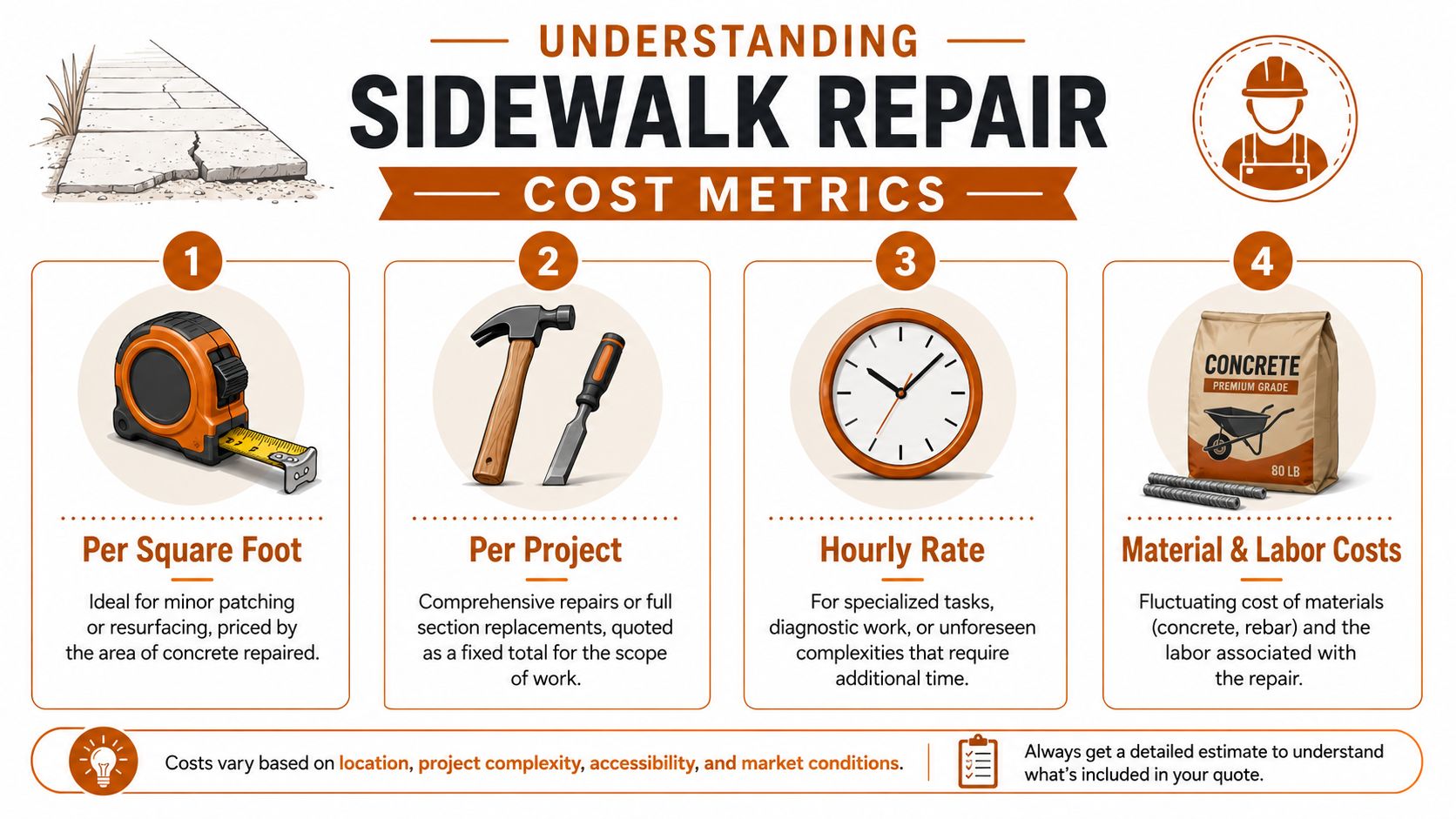
National pricing guides are useful for setting expectations, but local quotes rarely come in as one simple flat rate. Contractors usually price sidewalk work four ways, depending on the repair type and how clearly the scope can be measured.
- Per square foot for resurfacing, patching, or replacing a measured area.
- Per panel when specific sidewalk sections need to be removed and poured back.
- Per project when demolition, haul-off, forming, concrete placement, and cleanup are bundled together.
- Line-item pricing when each part of the job is broken out separately for review.
That last format is common on HOA, rental, and commercial properties because property managers need to see exactly what they are paying for.
Two quotes can look far apart on price and still both be reasonable. One contractor may only be pricing the visible concrete work. Another may be including saw cutting, haul-off, subgrade correction, compacted base, and finish work. On Central Florida jobs, that difference matters because sandy soil and frequent rain can turn a simple-looking sidewalk repair into a base repair job.
Practical rule: If the estimate does not say whether demolition, disposal, and base prep are included, you do not yet know the total sidewalk concrete repair cost.
What the numbers mean on a real estimate
Broad national guides can still help you read a quote. Angi's sidewalk repair pricing guide outlines a wide project-cost range for repairs and explains why material cost is only one part of the bill. Labor, removal, setup time, and site conditions often carry as much weight as the concrete itself.
That is why a small trip hazard near a driveway may cost more per square foot than a larger open run behind a building. Small jobs still have fixed costs. Crews have to mobilize, protect surrounding areas, cut clean edges, bring material, and return for finishing or cure checks if needed.
For comparison shopping, read the estimate the same way a contractor does:
| Pricing method | Best used for | What to watch |
|---|---|---|
| Per square foot | Surface repair or measured replacement area | Make sure the repair depth and prep are specified |
| Per panel | Sidewalk sections with clear joint lines | Confirm how many panels are included |
| Per project | Full-scope repair jobs | Check what's bundled and what's excluded |
| Line items | HOA, commercial, or permit-heavy jobs | Good for seeing where cost comes from |
If you want a clearer picture of how contractors break out concrete pricing, this guide on concrete slab cost per square foot shows how area, thickness, prep, and finish can change the final number.
In this part of Florida, I tell owners to focus less on headline price and more on scope clarity. A cheaper quote is only cheaper if it covers the same work.
Key Factors That Influence Your Repair Quote
A homeowner in Ocala may call about a "small sidewalk crack," while a property manager in The Villages may ask for pricing on "one bad panel." On site, those can turn into very different jobs. One may need a simple surface repair. The other may need demolition, base correction, disposal, and a new pour that meets community requirements.
Localized damage versus structural failure
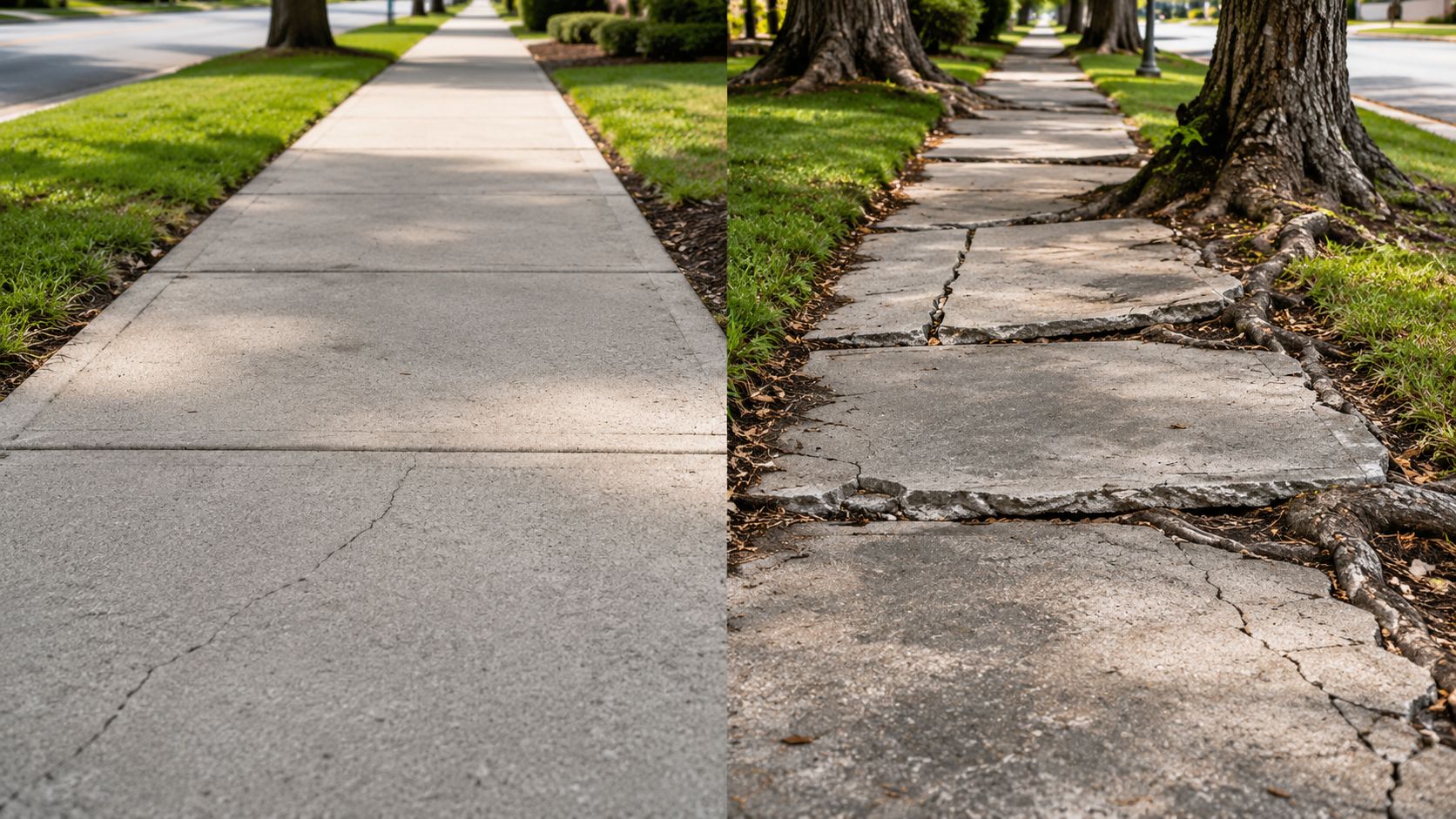
The first thing I sort out is whether the problem is limited to the surface or whether the slab has lost support. Moderate repairs often fall in a lower price range, while full slab replacement usually costs more per square foot because it adds demo, haul-off, base prep, forming, and new concrete placement, according to this sidewalk repair cost estimator from NYC Sidewalk Violations.
That distinction matters more than the visible crack pattern.
A shallow spall, minor edge break, or isolated cosmetic crack may be repairable. A slab that has lifted, settled, rocked underfoot, or broken through the full depth usually points to a support problem underneath. In Marion and Citrus counties, that often means the quote is being shaped by soil movement, washout, root pressure, or drainage, not just by the amount of concrete you can see from the top.
A surface defect can be repaired. A height difference between panels usually means the real problem is below the slab.
Seven things that change the price
On Central Florida sidewalk jobs, these are the items that most often push a quote up or down:
Type of damage
Hairline cracking and light surface wear are usually cheaper to address than settlement, heaving, corner breaks, or multiple failed panels in a row.Repair versus replacement scope
Spot repair has a lower upfront cost. Replacement costs more because the crew has to remove concrete, dispose of debris, rebuild the base if needed, and place new concrete.Base condition
If the slab lost support underneath, a cosmetic fix will not last. Sandy soils in this part of Florida can shift or wash out faster than owners expect, and correcting that adds labor and material.Drainage around the walk
Water coming off roofs, driveways, downspouts, or lawn grading can keep undermining the sidewalk. If that runoff is not addressed, the same section may fail again.Tree roots and landscaping conflicts
Roots can lift a panel even when the concrete itself was poured correctly. The lowest quote is not always the lowest long-term cost if it removes and replaces concrete without addressing the root issue.Site access
A sidewalk next to open lawn is simpler and faster than one boxed in by fences, irrigation lines, curbing, pavers, or finished beds. Tight access can raise labor time and cleanup time.Removal, haul-off, and finish restoration
Broken concrete has to go somewhere. On some jobs, the cleanup, disposal, and restoration of disturbed sod or garden bed edges are a meaningful part of the total price.
Local rules can add another layer. In communities with HOA review or stricter appearance standards, contractors may need to match finish, joint layout, work hours, protection requirements, or access routes. In places like The Villages, that can affect scheduling and labor even when the repair area is small.
The Florida Factor How Climate Affects Sidewalk Costs
A sidewalk in Central Florida lives in a different environment than one in a cooler, drier region. In Marion County, FL and Citrus County, FL, the slab has to deal with sandy soils, sharp rain events, heat, and year-round exposure.
Why Central Florida sidewalks move
In areas like Ocala, Dunnellon, Summerfield, and Silver Springs, the biggest hidden issue is often the ground itself. Sandy soils drain quickly, but they can also shift, wash, and compact unevenly. When the base under one part of the sidewalk changes, the concrete doesn't flex much. It cracks, settles, or tips.
That local condition changes repair strategy. A patch on top of moving concrete may look better for a while, but it doesn't solve the reason the slab moved. In neighborhoods with mature trees, root pressure adds another layer. A new panel poured back into the same root conflict can fail again.
Rain heat and UV change repair decisions
Central Florida weather affects both damage patterns and installation choices.
- Heavy rain can wash fines out from under a slab or soften unsupported spots around the edges.
- High heat speeds surface drying, which makes timing and finishing more important.
- Strong UV exposure is hard on sealants and other surface treatments.
- Humidity can slow some phases of curing and affect scheduling.
For homeowners in Crystal River, Homosassa, Lecanto, or Beverly Hills, drainage is often the cost variable that doesn't show up until the site visit. The sidewalk may not need extra concrete. It may need the water redirected so the next repair lasts.
If water keeps running under the walkway, the cheapest repair is usually the one that fails first.
Local experience matters here. A contractor who works in Central Florida regularly is more likely to look beyond the crack and check runoff paths, low spots, adjacent grade, and whether the slab edge is losing support.
DIY Repair vs Hiring Professional Concrete Experts
A homeowner in The Villages sees a chipped sidewalk corner, buys a patch kit, and expects a quick fix before the next HOA walkthrough. Two rainstorms later, the patch is loose, the color stands out, and the edge still catches a shoe. That is a common result when the primary problem is slab movement, not surface wear.
When a DIY fix can make sense
DIY repair works best on small, shallow surface damage where the panel is still stable and level. Hairline cosmetic flaws, minor edge spalls, and isolated blemishes on a private walkway can often be cleaned up well enough with store-bought material.
That kind of repair is usually about appearance and short-term control, not restoring the slab to like-new condition.
For a lightly used path behind a home in Belleview, Dunnellon, or Hernando, that may be good enough. If the concrete is not settling, rocking, or creating a trip edge, a careful patch can buy time while you plan a larger repair.
When hiring a pro usually costs less overall
Once a sidewalk panel has dropped, lifted, separated, or broken through, the job changes. Surface products do not correct drainage, base loss, root pressure, or bad slope. They cover symptoms.
That is where I see homeowners spend money twice. First on patch material and labor they handle themselves, then again on demolition or replacement after the repair fails.
The difference is usually not just tools. It is diagnosis, prep, and knowing what has to be corrected so the repair lasts in Central Florida conditions.
| DIY approach | Professional approach |
|---|---|
| Best for small cosmetic patching | Best for uneven slabs, broken sections, and repeat failures |
| Uses off-the-shelf repair products | Uses proper prep, cutting, forming, and placement methods |
| Often leaves a visible texture or color difference | Better finish control and cleaner joint lines |
| May miss drainage, access, or HOA issues | Better fit for shared walkways, entries, and code-sensitive areas |
This matters more on front walks, shared-use paths, and sidewalks tied into a driveway or building entrance. In Marion and Citrus counties, I also see repair costs climb when a contractor has to fix a failed DIY attempt before addressing the original issue. Loose patch material has to come off. Edges may need to be cut back. Sometimes the surrounding panel is damaged more during removal than it was at the start.
HOA communities add another layer. The Villages and similar neighborhoods may care about finish, panel match, line control, and how quickly the area is reopened. Property managers usually need a repair that looks consistent and reduces callback risk, not just the cheapest material on the shelf.
If you are comparing bids, this checklist of questions to ask a concrete contractor helps sort out who is pricing a real repair and who is only pricing a surface fix.
One local option for homeowners and property managers is Riverside Sealing & Striping, LLC, which handles sidewalk removal and replacement along with other paving-related work in Central Florida. That can help when the concrete ties into a driveway apron, parking area, or ADA access route and the full path needs to be evaluated together.
When Full Replacement Is the Smarter Investment
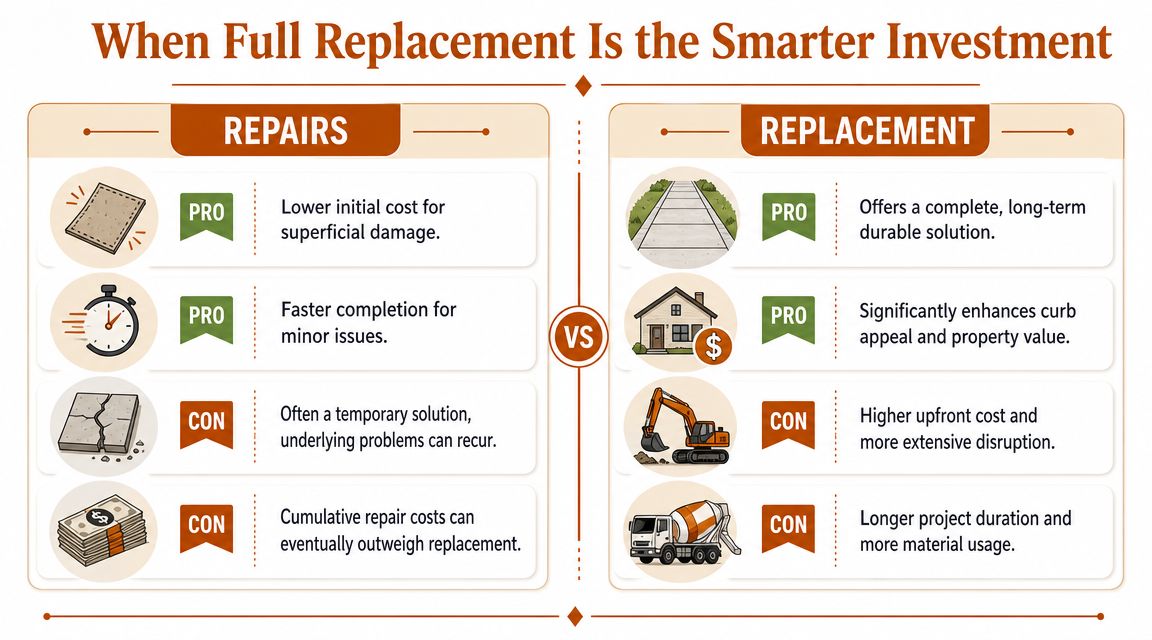
There comes a point where repair stops being repair and starts being repeated delay. That's especially true when multiple panels are failing for the same reason.
The point where repairs stop making sense
A life-cycle cost analysis found that some systems may cost more upfront but still produce a lower total present-worth cost over the analysis period because maintenance needs are lower. That same source notes that once damage is severe, removal and replacement of a 200-square-foot sidewalk often rises into the $2,000 to $5,000 range according to the ICPI sidewalk life-cycle cost analysis report.
That doesn't mean replacement is always the right answer. It means repeated small repairs can become the more expensive path when the slab keeps moving, cracking, or separating.
A few signs replacement is usually the smarter investment:
- Multiple failed panels instead of one isolated problem
- Noticeable heaving or settlement across a run of sidewalk
- Recurring cracks after earlier repairs
- Poor base support that can't be fixed from the surface
- Drainage-related movement that has already damaged the concrete more than once
What replacement solves that patching cannot
The reason replacement often wins isn't just fresh concrete. It's the chance to correct what caused the failure in the first place. That may include removing broken sections, rebuilding the base, correcting the slope, and repouring panels with proper joints and finish.
This video gives a useful visual example of why full removal is sometimes the practical answer.
For homeowners in Ocala, The Villages, or Crystal River, a new sidewalk also improves curb appeal and removes the patchwork look that comes from years of piecemeal fixes. For a church, school, retail site, or HOA in Marion or Citrus County, replacement can also simplify maintenance planning because you're no longer chasing the same trip hazard every season.
Patching works best when the slab is basically sound. Replacement works best when the concrete and the base have both stopped doing their job.
If you're looking at several broken sections, it's worth reviewing options for concrete sidewalk replacement near me instead of treating each panel as a separate repair.
Frequently Asked Sidewalk Repair Questions
Do I need a permit for sidewalk repair
Maybe. It depends on where the sidewalk sits and who controls it.
A private sidewalk on residential property may be simpler. A sidewalk in a public right-of-way, near a street, or serving a commercial entrance often triggers more oversight. In towns and cities across Marion County and Citrus County, local requirements can differ, so the safe move is to ask before work starts.
For ADA or public right-of-way sidewalks, cost is often driven by municipal standards and permits, not just the concrete itself. Public bid schedules show that this work is often priced through line items, which is a good reminder that specifications, inspections, and compliance can materially affect final cost, as shown in the San Francisco Public Works schedule of bid prices.
How long does a sidewalk repair or replacement take
The field work may be short, but the project timeline isn't just about pouring concrete.
A small repair can move quickly once scheduled. A replacement job takes longer because demo, haul-off, prep, forming, placement, finishing, and cure time all have to happen in sequence. Permits, inspections, weather, and access restrictions can add more time.
For homeowners in Summerfield, Dunnellon, or Inverness, the practical question isn't only "How fast can you pour it?" It's "When can people safely walk on it, and does anything else need to happen before that?"
How does ADA compliance affect cost
ADA work usually raises the importance of slope, transitions, clear access, and finish consistency. It also raises the stakes for getting the work right the first time.
That matters most for:
- Commercial properties with public access
- HOA common areas where residents and guests use shared walkways
- Churches and schools with frequent foot traffic
- Properties tied to parking lot access routes or marked accessible spaces
If a sidewalk ties into parking areas, ramps, striping, or access aisles, the concrete work and pavement markings should be considered together. That's one reason full-service contractors matter. Concrete and asphalt systems often connect, especially around storefronts, multifamily properties, and community entrances.
Should HOAs and property managers treat sidewalks differently
Yes. The cost conversation is different when you're managing liability, resident access, and scheduling across occupied properties.
For HOAs and commercial sites in Lecanto, Beverly Hills, Homosassa, or The Villages, the cheapest quote isn't always the lowest total cost. A repair that requires another mobilization in a short time, disrupts residents twice, or leaves uneven finish from panel to panel can create bigger management problems than a properly planned replacement.
A good sidewalk plan for shared properties usually includes:
- Prioritizing hazards first so the worst trip points are addressed immediately
- Looking at drainage patterns before approving repeat repairs
- Matching the repair scope to the cause instead of defaulting to patching
- Coordinating concrete with striping or access work when walkways connect to parking areas
If you need a practical estimate for sidewalk concrete repair cost in Marion County, FL or Citrus County, FL, Riverside Sealing & Striping, LLC offers free, no-pressure consultations for homeowners, HOAs, churches, and commercial properties across Central Florida. If you're dealing with cracked panels, uneven walkways, or deciding between repair and full replacement, a site visit can tell you what the concrete is doing, what caused it, and which fix makes financial sense.