
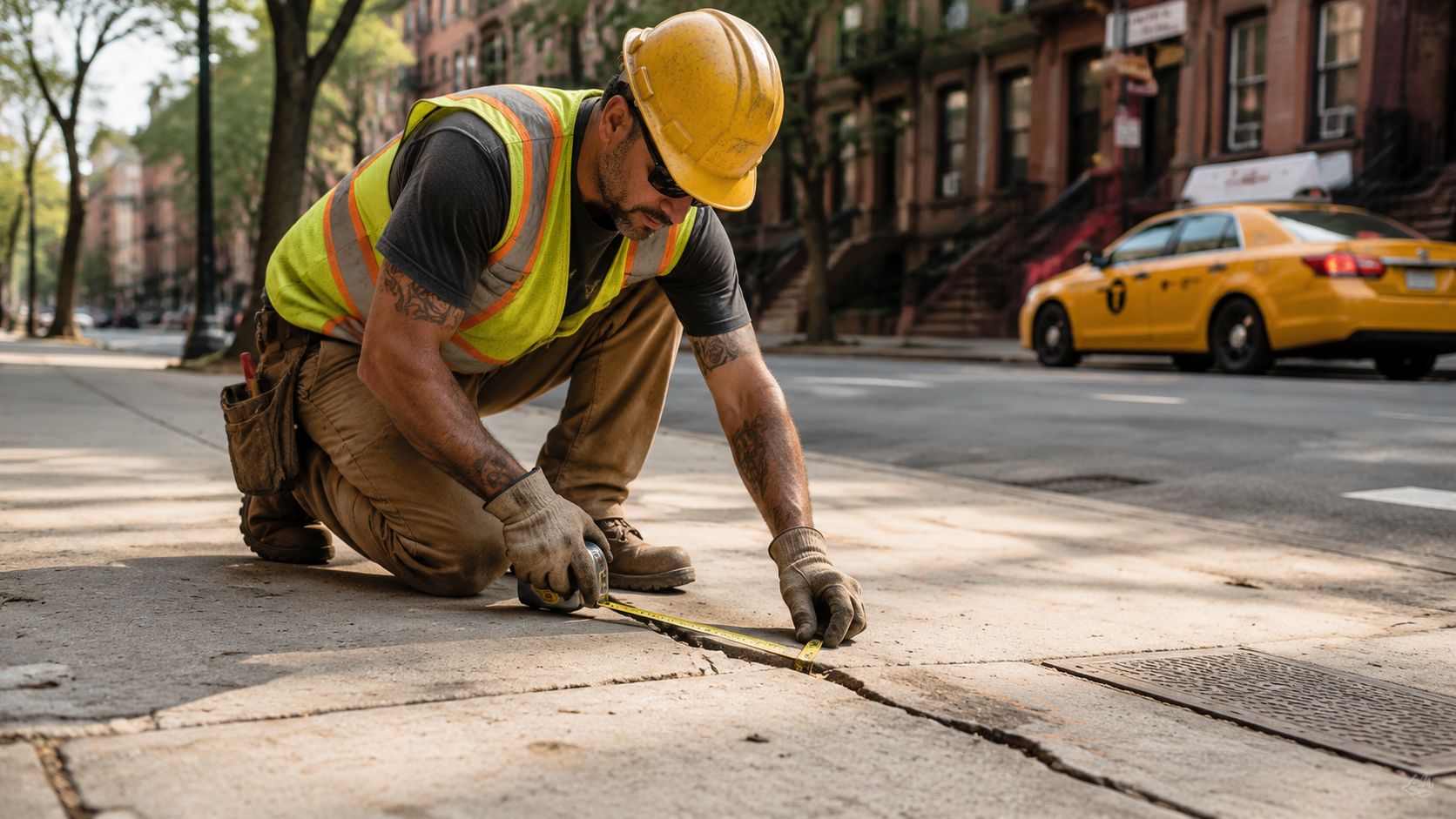
You open the mail, see a New York City sidewalk notice, and your first question is usually the right one: who do I call without making this worse?
That's the hard part. In NYC, sidewalk work looks simple from the curb, but the process behind it isn't. A repair can involve contractor licensing, DOT permits, inspection standards, and ADA requirements that many first-time property owners never think about until a violation lands in front of them. The difference between a clean repair and an expensive repeat job often comes down to whether the contractor understands the paperwork and the underlying cause of the damage, not just the concrete on top.
This guide is written for that moment. It's a practical look at how property owners usually sort through sidewalk contractors in New York City, what to verify before signing anything, how permit and compliance issues affect the job, and where owners often get tripped up. Although Riverside Sealing & Striping serves Marion County, FL and Citrus County, FL, including Ocala, Dunnellon, Belleview, Silver Springs, Summerfield, Crystal River, Homosassa, Inverness, Lecanto, Beverly Hills, Hernando, and The Villages, the hiring logic here is useful anywhere: know the rules, define the scope, and hire for the underlying problem, not the cheapest surface fix.
Table of Contents
- Your Guide to NYC Sidewalk Violations and Repairs
- Finding and Vetting Reputable Sidewalk Contractors
- Navigating NYC DOT Permits and ADA Compliance
- Understanding Repair Costs Estimates and Timelines
- Common Pitfalls and Proactive Sidewalk Maintenance
- Frequently Asked Questions About NYC Sidewalk Repair
Your Guide to NYC Sidewalk Violations and Repairs
If your property sits in Manhattan, Brooklyn, Queens, the Bronx, or Staten Island, the city expects you to pay attention to the sidewalk in front of it. That catches a lot of first-time owners off guard. They assume the sidewalk is city property, so the city must handle the repairs. In practice, the owner usually carries the responsibility for installing, maintaining, and repairing the adjacent sidewalk.
That matters because a violation notice isn't just a suggestion. It's the start of a process that can become more expensive if you ignore it, hire the wrong crew, or approve a repair that doesn't match the actual condition on site. A bad contractor can leave you with fresh concrete and the same unresolved violation.
What usually causes confusion
Most owners hit the same problems early:
- They don't know if the damage is simple or structural. A cracked flag is one thing. A slab failing over a vault or meter pit is another.
- They assume every mason does sidewalk violation work. Many pour concrete. Fewer handle permit-driven public right-of-way work correctly.
- They compare bids without comparing scope. One proposal may include permits, demolition, haul-away, and final sign-off. Another may only include the pour.
Practical rule: The first contractor who says “we'll just patch it” before diagnosing the cause is the one to slow down on.
The hiring process matters more than the sales talk. You need a contractor who can identify whether the issue is a standard sidewalk defect, a drainage problem, tree-related movement, or a utility-related condition under the slab.
What a sound process looks like
A proper sidewalk repair job in NYC usually follows a basic sequence:
- Confirm the violation or visible hazard
- Define the actual scope of repair
- Verify the contractor's legal status
- Determine whether permit work is required
- Complete the repair to inspection standards
- Close out the paperwork and sign-offs
That same discipline applies in other markets too. In Central Florida, property owners in Marion County, FL and Citrus County, FL often run into similar hiring mistakes on sidewalks, driveways, and paved access areas. Climate and code are different in Ocala or Crystal River than they are in Brooklyn, but the principle is the same. The contractor has to match the site condition, not guess at it.
For owners looking at broader property improvements, this same thinking also applies when comparing concrete walkways, asphalt maintenance, and ADA access upgrades. That's why companies positioned as Concrete and Asphalt Experts in Marion and Citrus County tend to be more useful than firms that only talk about one surface and ignore the rest of the site.
Finding and Vetting Reputable Sidewalk Contractors
The fastest way to waste money is to start with price before legitimacy. In New York City, sidewalk contractors must be licensed by the Department of Consumer and Worker Protection if the repair cost exceeds $200, and that license is tied to the contractor's ability to legally move toward permit work, as outlined by NYC 311's guidance on sidewalk contractor licensing.
Start with license status, not the sales pitch

A contractor can sound experienced and still fail the first test. Before you discuss finish options, scheduling, or “good deals,” verify that the company is legally set up to do the work. For this kind of job, the license check isn't paperwork theater. It protects you from hiring someone who can demolish concrete but can't legally carry the project through the city process.
Three bids are still a smart idea, but only after the first screening.
- Check the DCWP status first. If the job is over the threshold, this isn't optional.
- Match the company name everywhere. The license name, insurance name, and contract name should line up.
- Ask who pulls permits. If the answer is vague, keep looking.
For owners who aren't sure what to ask during the first call, this list of questions to ask a concrete contractor is a good model because it pushes the conversation past promises and into scope, insurance, and responsibility.
What else separates a real contractor from a risky one
Insurance is the next filter. You want active liability coverage and workers' compensation coverage, and you want them current when the work starts, not “available later.” Sidewalk work happens in public-facing space. If somebody gets hurt or adjacent property is damaged, a loose insurance answer becomes your problem quickly.
Recent reviews help, but read them carefully. A lot of owners make the mistake of counting stars instead of reading details. You're looking for signs that the contractor handled permit jobs, communicated clearly, and closed work out properly.
A written contract is another hard line.
Get the scope in writing before demolition starts. “We'll take care of it” is not a scope of work.
A usable sidewalk contract should identify what's being removed, what's being replaced, who handles debris, whether permits are included, and what happens if hidden conditions show up once the slab is opened. That last point matters more in NYC than many owners realize.
From a contractor's standpoint, borough experience also counts. The crews that work repeatedly in dense urban conditions tend to think differently about staging, pedestrian access, utility obstructions, and inspection prep. That practical knowledge is hard to fake in an estimate meeting.
If you own property outside New York and you're reading this from Belleview, Inverness, Lecanto, or The Villages, the same screening logic holds up. Whether the project is a sidewalk in front of a storefront or a residential concrete walkway, licensed and insured still comes first. For full-site projects, that often means hiring a contractor who can think across both concrete and pavement maintenance, not just one trade in isolation.
Navigating NYC DOT Permits and ADA Compliance
You hire a contractor to replace a few bad sidewalk flags. Then the crew opens the area and finds a cellar vault edge, a utility structure, or a slope issue at the corner. What looked like a simple concrete job turns into a permit, inspection, and compliance job fast. That shift catches a lot of first-time owners off guard in New York City.
The first thing to sort out is what kind of repair you have. A standard crack or isolated flag replacement is one category. A vault, meter pit, driveway crossing, corner condition, or anything affecting pedestrian access is another. Those jobs carry more paperwork, tighter review, and more ways to get delayed if the scope was guessed instead of verified.
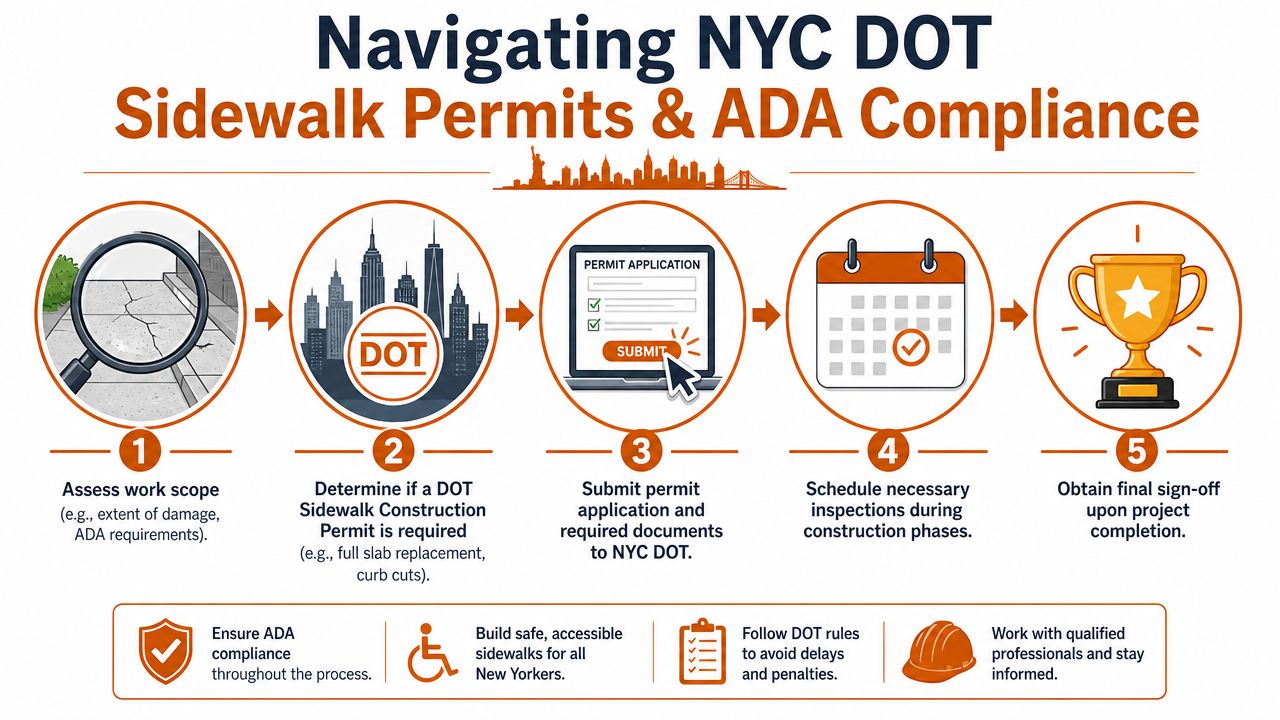
If the repair or replacement involves more than 25 square feet, a DOT Sidewalk Construction Permit is required, and the adjacent property owner is generally responsible for the sidewalk, according to this NYC sidewalk repair FAQ covering permit thresholds and owner responsibility.
That threshold matters because it changes the job from field work into field work plus administration. The permit has to be in place before concrete starts. In many cases, the contractor also has to coordinate pedestrian protection, staging, inspections, and closeout. If there is a vault or another nonstandard condition under the sidewalk, expect extra review and more back-and-forth than a basic slab replacement.
A competent contractor should walk the site with three questions in mind before giving you a firm plan:
- What is the true repair area? Sidewalk defects rarely stop neatly at the visible crack line.
- Is this standard sidewalk work or a special-condition job? Vaults, hardware, and corner ramps change the filing path.
- Which agency has to sign off? DOT is usually central, but license and consumer protection issues can matter too if the contractor is not properly credentialed.
That last point gets missed. In NYC, owners tend to focus on the DOT notice and forget the contractor side of compliance. The business doing the work should be properly licensed where required, insured for street and pedestrian exposure, and used to working under city inspection. Hiring a cheap crew that only knows residential flatwork is how owners end up paying twice.
ADA is the other half of this. Passing inspection is not just about replacing broken concrete with new concrete that looks clean. The finished sidewalk has to work for pedestrians, including people using wheelchairs, walkers, and strollers. Cross-slope, transitions, trip edges, and ramp geometry are where a lot of otherwise decent-looking jobs fail in practice. For a plain-language overview, this guide to ADA sidewalk requirements is a useful reference.
A quick visual overview helps if you've never dealt with this process before.
ADA details that affect whether the repair passes
On a straightforward flag replacement, ADA issues may be limited to finish, level changes, and how the new slab meets the old one. On a corner, curb ramp, vault area, or meter pit condition, the review gets stricter because the repair affects the accessible route itself.
That is the trade-off owners need to understand. A standard crack fix is mostly production work. A complex violation is part concrete work, part paperwork, part inspection prep.
The best crews build to the approval standard from the start. They check elevations before the pour, confirm slope at transitions, and deal with obstructions before the inspector finds them. That approach costs more up front than a fast patch job, but it usually costs less than a failed inspection, a tear-out, or a permit that stays open longer than it should.
Keep your own file on the job. Save the permit record, site photos, invoices, and final sign-off. If DOT questions the work later, or if you sell the property, those records matter.
Understanding Repair Costs Estimates and Timelines
Cost questions usually come too early in the conversation. Owners want a number before the scope is defined, and contractors who provide one too quickly are often guessing. In this trade, guessing is expensive.
What the price range really tells you
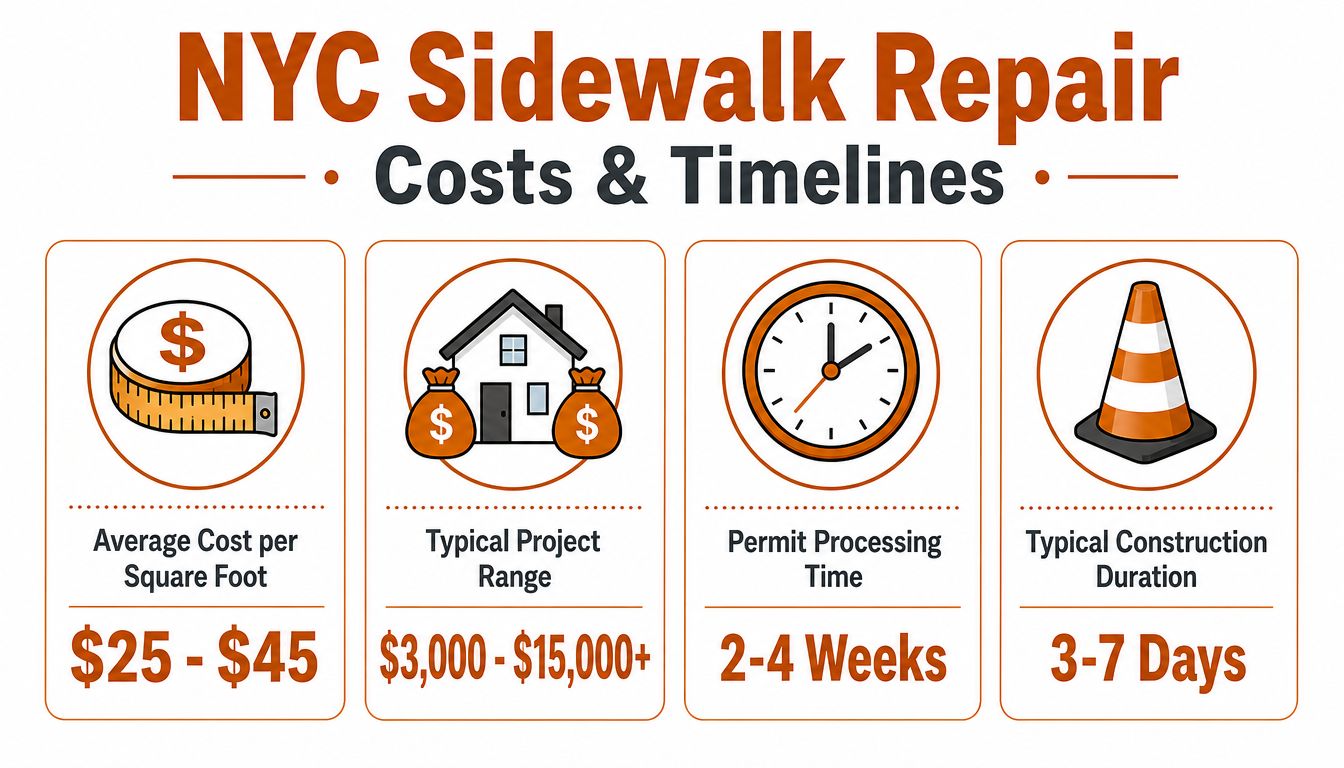
The best broad price anchor available is this: the average cost of repairing a concrete sidewalk in New York City is $1,975, and most homeowners spend between $949 and $3,023, based on Angi's New York concrete sidewalk repair cost page.
That figure is useful because it keeps expectations grounded. It's not useful if you treat it as your price. A sidewalk estimate only becomes meaningful once the contractor knows what's under the failed area, how much has to come out, whether access is tight, and whether the work includes permit handling and final closeout.
What pushes a job upward or downward is usually the scope, not the contractor's mood that day. A straightforward replacement with open access is one thing. A repair involving deeper structural conditions, difficult staging, or extra compliance steps is another.
For a broader budgeting perspective, this article on sidewalk concrete repair cost is a helpful companion because it gets owners thinking in terms of cost drivers instead of just headline pricing.
How to read an estimate without missing the expensive parts
A good estimate should tell you what is included and what is not. If the contractor gives you a one-line number, ask for more detail before comparing it with anyone else's bid.
Look for these items in writing:
| Estimate item | Why it matters |
|---|---|
| Demolition and removal | Old concrete has to be broken out, loaded, and hauled away |
| Material and placement | This is the actual replacement work, not the whole job |
| Permit handling | Owners often assume this is included when it isn't |
| Site protection | Pedestrian safety and protection measures affect labor |
| Final cleanout and closeout | A job isn't done when the concrete is placed |
A cheap estimate can still become the expensive one if it omits permit work, debris removal, or remediation of hidden conditions. I've seen owners focus on the base number and miss the contract language that turns common site conditions into “extras.”
That's why timeline talk should also stay tied to scope. A contractor who gives a fixed schedule before confirming permit and site conditions is selling confidence, not certainty.
This same budgeting discipline matters on Florida properties too. In Marion County, FL and Citrus County, FL, owners comparing driveway replacement, sidewalk installation, or parking lot improvements get better results when they compare scope side by side. It's one reason a contractor that understands both surfaces can be useful. For example, Riverside Sealing & Striping, LLC handles concrete work such as sidewalks and also asphalt maintenance services, which matters when an access route connects multiple surfaces on the same property.
Common Pitfalls and Proactive Sidewalk Maintenance
Most expensive sidewalk mistakes start before the first saw cut. They start when the owner assumes every visible defect is the same kind of defect.

A surface crack and a vault problem are not the same job
Take two common scenarios.
One owner has a standard cracked slab. The defect is visible, the cause is clear, and the repair mostly comes down to replacing the affected section to the proper standard. That's the kind of job many competent sidewalk crews can price and execute.
Another owner sees what looks like a bad patch or recurring settlement over a utility area. The concrete keeps failing in the same zone. That's where the diagnosis matters more than the pour.
According to this discussion of NYC contractor gaps and meter pit violations, many sidewalk violations are tied to underlying gas or water meter pits, and these repairs may require specialized tools such as a flush diamond blade rather than a basic remove-and-pour approach.
That difference changes everything.
- A standard crack repair usually addresses the slab itself.
- A meter pit or vault issue may require the contractor to deal with the structure below or around the slab.
- A generic bid may miss that distinction completely.
If the repair keeps failing in the same exact footprint, stop calling it “just cracked concrete.”
This is the part most general hiring guides skip. Owners compare three prices for “sidewalk repair” when one contractor is pricing a true correction and two are pricing surface replacement only. The cheaper number looks attractive until the same area settles or fails again.
What owners can do before the next notice arrives
Preventive maintenance won't solve every sidewalk problem in NYC, but it can reduce surprises.
- Watch recurring movement: If one flag repeatedly rises, sinks, or opens at the same joint, there's probably more going on than weathering.
- Manage drainage early: Water moving under or across the slab can speed up deterioration and create winter hazards.
- Don't ignore small defects near transitions: Edges, ramps, and utility-adjacent zones tend to become enforcement issues faster than cosmetic cracking in the middle of a panel.
- Keep records: Photos, old invoices, and permit documents help the next contractor diagnose what was done before.
Owners in Central Florida should read this as a broader property lesson too. In Summerfield, Dunnellon, or Crystal River, the same principle applies to sidewalks, driveways, and paved approaches. Small surface defects are sometimes just surface defects. Sometimes they point to movement, drainage, or a base problem that needs a different fix. That's why Concrete and Asphalt Experts in Marion and Citrus County are usually more helpful than a contractor who only wants to quote the visible patch.
Frequently Asked Questions About NYC Sidewalk Repair
A first-time owner usually asks the hardest questions after the estimate is already in hand. That is usually when the job stops looking like “replace a few broken flags” and starts looking like NYC paperwork, inspection risk, and scope questions that affect cost.
That shift is real. A standard cracked flag is one type of job. A vault, meter pit, or utility-adjacent violation is another. If a contractor treats both as simple concrete replacement, the owner is the one who pays for the mistake.
Common questions owners ask
| Question | Answer |
|---|---|
| Can I repair the sidewalk myself? | On private property, small concrete work is one thing. NYC public sidewalk work tied to a violation, permit, inspection, or pedestrian access requirement is different. DIY work often creates more exposure than savings, especially if the repair has to be redone to satisfy DOT or related agency requirements. |
| How do I know if the contractor understands inspection requirements? | Ask what kind of sidewalk issue they believe you have. A plain crack repair, a grade problem, and a vault or meter pit condition do not get handled the same way. Ask who pulls permits, who schedules inspections if needed, and who closes out the job. If the answers stay vague, keep looking. |
| What happens after the concrete is placed? | The pour is not always the end of the job. Depending on the scope, there may still be curing time, inspection steps, punch-list items, or agency sign-off before the matter is truly finished. Keep copies of permits, invoices, and any final paperwork. |
| What if a city tree seems to be part of the damage? | Do not let anyone pour around root pressure and call it solved. Tree-related sidewalk damage can trigger coordination beyond the concrete crew, and it can delay the repair path. A competent contractor should flag that condition before work starts. |
| Why does ADA compliance matter on a basic sidewalk job? | The walking surface must function safely. In NYC, that means the finished sidewalk has to meet access and surface requirements, especially at changes in elevation, crossings, and ramps. Even a small job can fail if the finished condition creates a trip edge or an unusable path of travel. |
Practical answers that save owners trouble
The most expensive mistake is hiring off the lowest number before confirming the actual scope. If the condition is only a cracked flag, the repair may be straightforward. If the violation involves a cellar door, vault light, meter pit, utility hardware, or a bad transition at a ramp, the job can require different approvals, different sequencing, and different subcontractors.
Paperwork mistakes also cost real money.
Owners sometimes assume any licensed concrete crew can handle a sidewalk violation from start to finish. In NYC, that is not always true. A contractor may be fine at forming and pouring concrete but weak on DOT filing, weak on DCWP licensing requirements, or careless about ADA details that show up at inspection or in a later complaint.
Ask one direct question before signing anything: “Is this a plain sidewalk replacement, or is there any vault, utility, grade, or access issue that changes the job?”
A serious contractor will answer clearly. They will also tell you what could delay the work, what could trigger added cost, and what is outside their scope.
For owners reading from Marion County, FL or Citrus County, FL, there's a parallel here worth keeping. Sidewalks, driveways, parking lots, and access routes all work together on real properties. In Ocala, Inverness, Homosassa, and The Villages, the best long-term results usually come from contractors who understand concrete construction, asphalt maintenance, and ADA-related access improvements as one site problem, not separate sales categories.
A first-time owner does not need to become a sidewalk expert. You do need to verify who is handling permits, who understands NYC agency requirements, and whether the proposed fix matches the actual condition on site.
If you're planning sidewalk, driveway, or access-route improvements in Central Florida, Riverside Sealing & Striping, LLC provides concrete and asphalt services for residential and commercial properties across Marion County, FL and Citrus County, FL. As Concrete and Asphalt Experts in Marion and Citrus County, the company handles projects such as sidewalks, concrete replacement, asphalt sealcoating, and parking lot striping, with free estimates and no-pressure consultations for property owners who want a professional evaluation before committing to the work.