
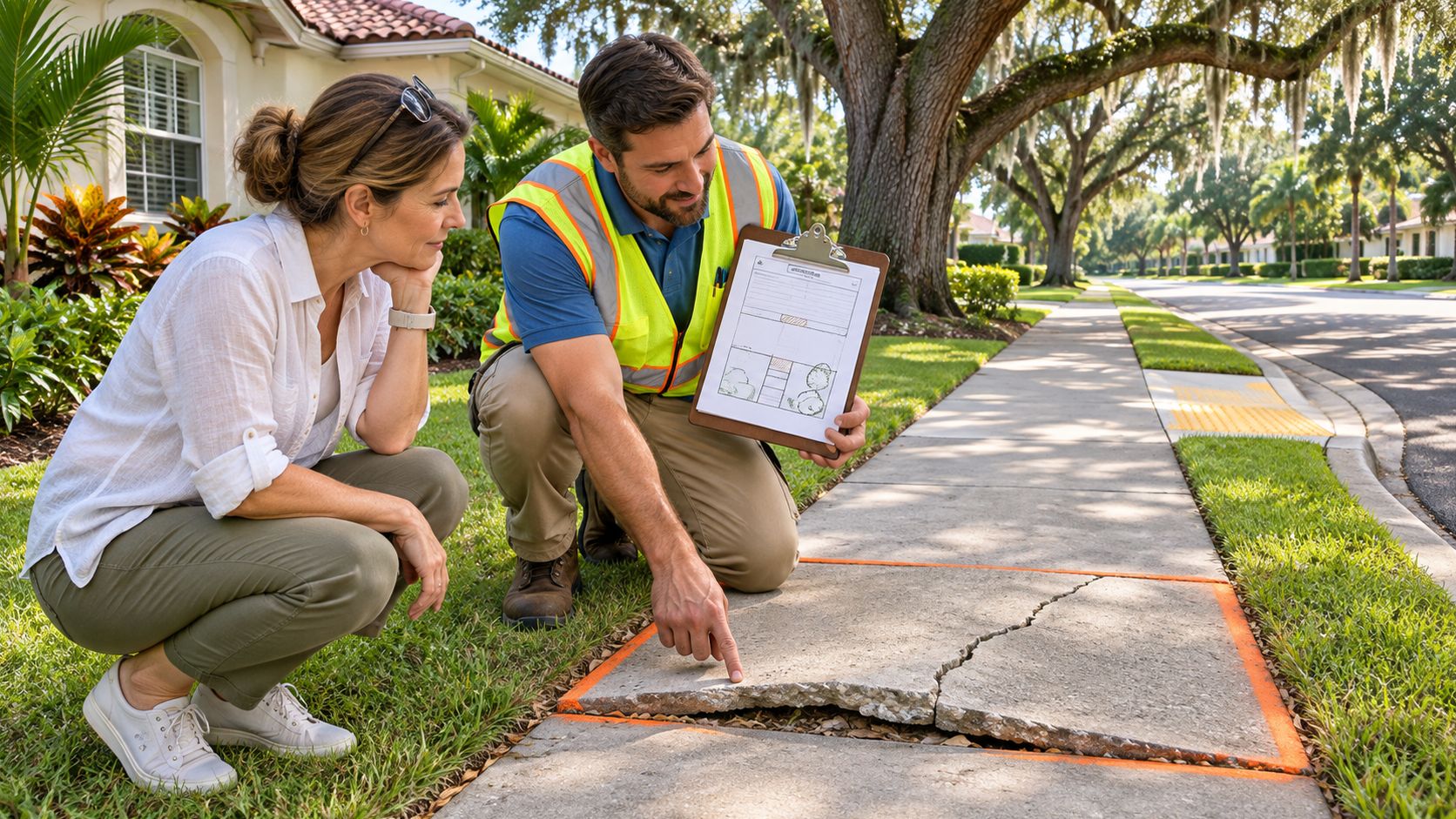
Does a cracked sidewalk out front need a permit, or just a concrete crew with an early start? Most property owners answer that by looking at the damage: one panel, small job, no paperwork. In Marion County and Citrus County, that assumption is exactly where the trouble starts.
The same three-panel replacement can be private flatwork in one spot and a permitted right-of-way project a few streets over, depending on whether the sidewalk sits inside your lot line or in the strip the public owns. Ocala, Dunnellon, Belleview, Summerfield, Crystal River, Homosassa and Inverness all mix public frontage, HOA common areas and private walks, and the rules follow the ground, not the mailing address.
This guide takes the jurisdiction question first, because that's the part that stops projects. Concrete technique is the easy half. Get the paperwork lane wrong and a two-day repair turns into a month of stop-work notices, re-inspection and, occasionally, a brand new slab that has to come out.
Table of Contents
- Which Sidewalk Repairs Need a Permit
- Who Issues the Permit in Marion and Citrus Counties
- Accessibility Standards Every Sidewalk Repair Must Meet
- How to Prepare and File a Sidewalk Repair Permit
- How Florida Heat, Rain and Traffic Affect Sidewalk Repairs
- Frequently Asked Questions About Sidewalk Repair Permits
- When to Bring In a Licensed Concrete Contractor
Which Sidewalk Repairs Need a Permit
A permit depends on the type of work and where the concrete sits, not on how big the crack looks.
Work inside the public right-of-way needs approval before anyone breaks out a panel. Private flatwork inside the property line usually doesn't need a right-of-way permit, though a building or flatwork permit can still apply depending on local thresholds. The gray zone catches people: a like-for-like patch that changes grade, width or the pedestrian route can trigger review even when the scope looks cosmetic.
Cities treat these permits as infrastructure data, not paperwork. Oakland, California issued 1,445 private sidewalk-repair permits covering 273,719 square feet between fiscal year 2010-11 and fiscal year 2019-20, and used the counts to track private maintenance demand along public streets, according to the city of Oakland sidewalk annual report.
The application is also where scope gets fixed in writing. Portland's sidewalk policy requires a permit before a defective sidewalk is repaired, and the permit specifies the repair type, materials, and applicable dimensions, per the Portland sidewalk maintenance guidelines. That same guidance points to PennDOT's example that more than 100 linear feet of repair may require full ADA compliance, which reclassifies a long patching run as an alteration.
| Work type | Permit usually needed | Notes |
|---|---|---|
| Replacing one or more cracked panels in place | Often yes, when in the public right-of-way | Confirm with the agency that owns the sidewalk |
| Grinding or raising a lifted slab | Often yes | Changing grade may trigger inspection |
| Widening a driveway crossing or cutting a new curb cut | Yes | Changes vehicle access and curb transitions |
| Building or rebuilding a curb ramp | Yes | Ramp slope and detectable warnings are reviewed |
| Removing a tree root or relocating a utility cover | Yes, often with separate utility or tree approval | The utility owner may require its own approval |
| Private walkway fully inside the property line | Usually no right-of-way permit; building or flatwork permit may apply | Check local building department thresholds |
| Replacing a sidewalk on a state road | Yes, FDOT right-of-way permit | State road right-of-way rules apply |
Two Central Florida examples
Say a homeowner in Ocala is replacing three heaved panels along the street frontage. That's a right-of-way job: photographs, measurements, and a call to whichever office owns that strip. Panel replacement and restoration work is straightforward once the lane is clear, and our sidewalk repair service page describes the physical scope.
Now say an HOA in Homosassa is regrading a common-area walk. If the walk is association property and doesn't touch public frontage, the association's own approval may be the controlling document. The moment the work meets a driveway crossing that connects to a county road, a government review usually re-enters the picture.
Before you call any office: write down the work type, the location (street frontage, common area, or inside the lot line) and the estimated square footage. Those three facts decide which application you're filling out.
Who Issues the Permit in Marion and Citrus Counties
The issuing office follows ownership. Start at the property line on the recorded plat or survey, then work outward from there. That order matters because the repair itself may be simple, while jurisdiction decides whether you file with a city, county, state office or private association.
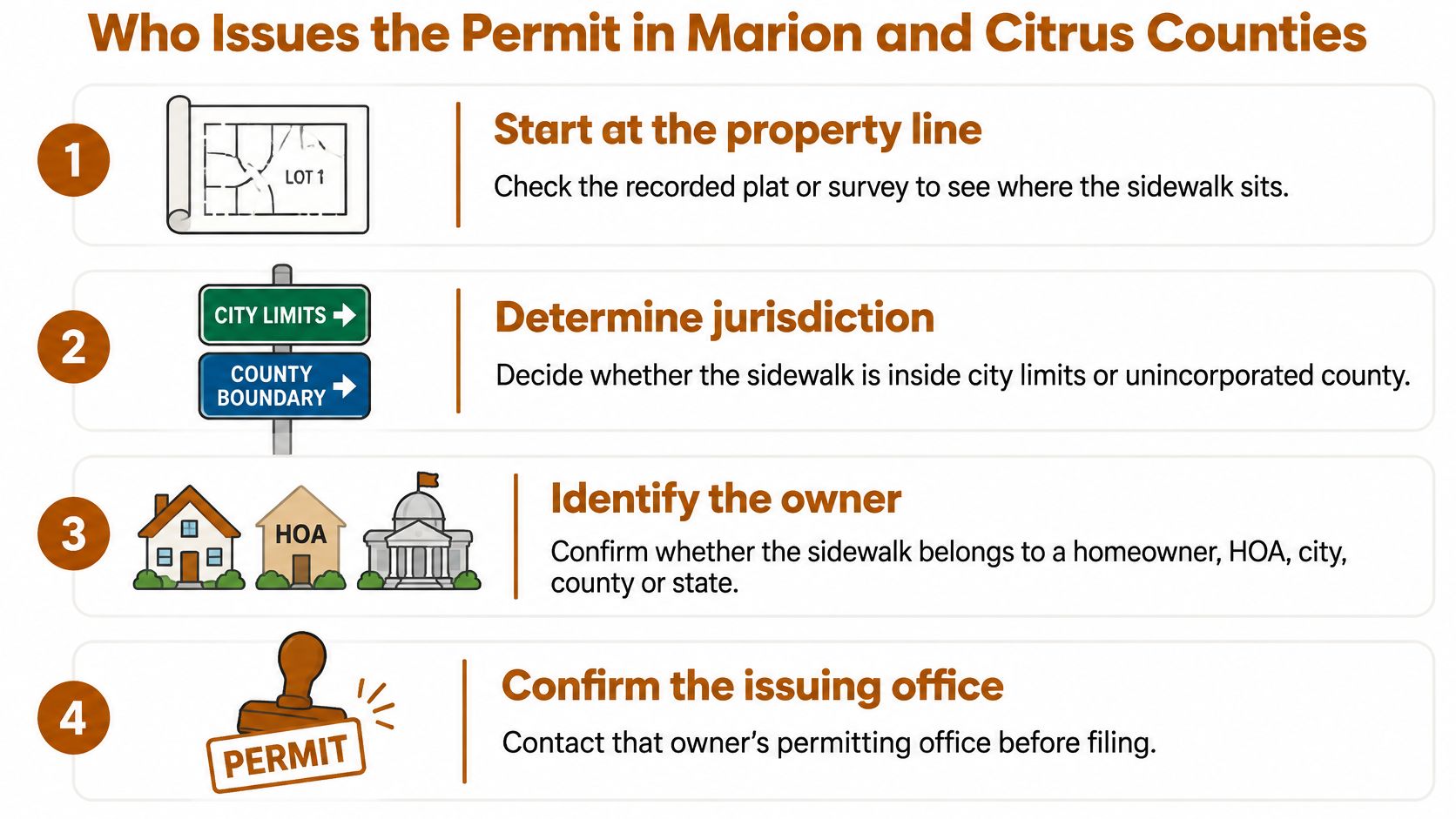
A mailing address in Ocala, Dunnellon, Belleview, Summerfield, Inverness, Crystal River or Lecanto doesn't prove the parcel is inside city limits. Silver Springs, Beverly Hills, Hernando and parts of The Villages each raise their own boundary questions. In unincorporated Marion or Citrus County, start with county public works rather than a city building department.
The distinction carries real weight. Work in a public right-of-way can require a dedicated right-of-way, encroachment, obstruction, grade or public-works permit, while private sidewalk work may follow a different building-permit process, as the City of Sumner sidewalk guidance sets out. Ask before ordering concrete, because a permit doesn't make the slab harder, but it can determine where joints, grades and drainage are allowed to land.
The five-step jurisdiction check
- Confirm the property line. Pull the recorded plat or survey and mark where the sidewalk sits relative to it. Every other question depends on that line.
- Identify the owner. The sidewalk is usually city, county, FDOT or a private association. Ask flatly who maintains this segment.
- Call the matching department. City building or public works inside limits, county public works outside them, and the FDOT district office when the walk runs along a state road.
- Ask what else is required. Inspection, traffic control plan, bond, licensed contractor, right-of-way use agreement. Ask in those exact words.
- Get the answer in writing. An email naming the permit type and the issuing office is worth far more than a phone answer nobody can find later.
HOA common areas and private roads usually need the association's approval stacked on top of anything a government agency issues. Collect both before the concrete truck gets scheduled, because board meeting dates in a Villages or Hernando community can eat two weeks on their own. A written owner answer also prevents the common failure here: grading and pouring a walk that later has to be opened because the agency or association claims the alignment.
Accessibility Standards Every Sidewalk Repair Must Meet
A repair can fail inspection even when the concrete itself is perfect. A patch that narrows the walk, or a slab poured with too much side slope, leaves the finished route measuring worse than the one it replaced.
Reviewers judge the pedestrian route, not the new concrete. A 1/4 inch offset between panels is a trip edge, cross slope over 2 percent pushes a wheelchair toward the traffic lane, and a single poorly placed patch can squeeze clear width below what an accessible route allows.
PennDOT's sidewalk and ADA technical sheet sets a maximum 2 percent cross slope, a longitudinal slope generally limited to 5 percent unless it must match the roadway, a minimum 5-foot clear width with 4 feet allowed when compliant passing spaces are provided, and no vertical displacement greater than 1/4 inch between adjoining panels, per the PennDOT sidewalk and ADA technical sheet.
| Measure | Benchmark | Why it matters |
|---|---|---|
| Vertical offset between panels | 1/4 inch maximum | Creates trip hazards at joints |
| Cross slope | 2 percent maximum | Pushes wheelchair users toward traffic |
| Longitudinal slope | 5 percent generally | Steep runs are hard to push and control |
| Continuous clear width | 5 feet, with 4 feet allowed where passing spaces exist | Narrow routes fail after patching |
| Passing space | 5 by 5 feet every 200 feet where sidewalk is under 5 feet wide | Gives wheelchair users room to turn or pass |
| Curb ramp running slope | 8.33 percent maximum | Ramp must stay usable at street crossings |
| Curb ramp detectable warning | Contrasting color across full ramp width, extending 24 inches from back of curb | Alerts visually impaired pedestrians |
Accessibility standards applied across Florida follow the same pattern. An accessible sidewalk must provide a clear width of at least 36 inches at its tightest point, 60 inches is the design standard for new sidewalk, cross slope stays at or under 2 percent, and the surface must be firm, stable and slip-resistant, which a broom finish delivers. Detectable warnings at curb ramps must use a contrasting color, run the full ramp width, and extend 24 inches from the back of the curb.
Florida's floor versus your target
Treat 36 inches as the floor and 48 inches as your planning target on any repair. The 36-inch minimum only tells you where the route fails outright. The 48-inch target is what keeps the walk passable after the forms come off, whether the job is a residential street in Beverly Hills or a commercial frontage in Lecanto. Patching around a tree or a utility cover is where width disappears, so measure the narrowest point before you pour, not after.
Narrow walks have their own rule. Indiana's accessibility standard requires a 5-foot-by-5-foot passing space every 200 feet where a sidewalk is under 5 feet wide, and caps curb ramp running slope at 8.33 percent, with 8 percent recommended for design, per the INDOT accessibility standards.
Check every slope and offset with a digital level, and put the readings in the permit file next to the photographs. Recorded numbers answer questions a verbal promise cannot, especially on work that touches an accessible route. Our ADA sidewalk requirements guide covers the route-by-route detail.
How to Prepare and File a Sidewalk Repair Permit
Most permits don't stall on concrete. They stall on incomplete packages: a site sketch without dimensions, no proof of insurance, a detour plan nobody drew.
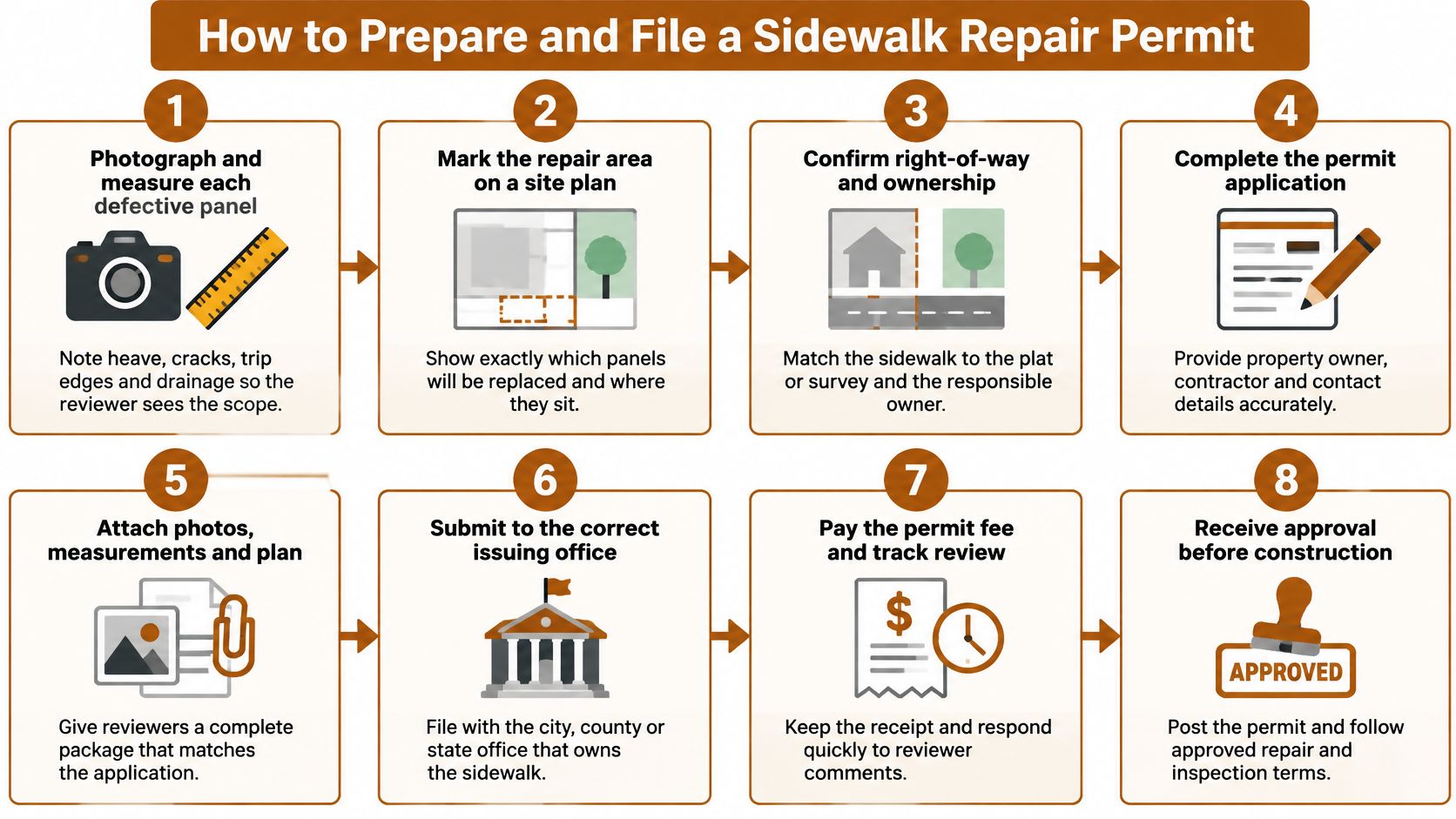
Fees themselves are usually modest and occasionally surprising. New Orleans publishes $20 in the Canal Street corridor, $40 in the Downtown Development District, and $0.60 per square foot in the Vieux Carré, according to the New Orleans sidewalk repair permit page. One city, three fee structures, all tied to location.
The eight-step filing sequence
- Photograph and measure every defective panel. Record heave, crack width, trip edges and ponding. Reviewers approve the scope they can see.
- Draw a scaled site sketch. Mark removal limits, driveway and curb transitions, trees and utility covers. Undimensioned sketches get sent back.
- Complete the application in full. Pull the forms from the office that owns the sidewalk and fill in every field, including the ones that look optional.
- Attach proof of ownership, contractor license, insurance certificate and any bond. A missing certificate of insurance is the single most common delay.
- Plan the pedestrian detour. If the route closes, show the protected path. Reviewers reject plans that leave pedestrians with nowhere to go.
- Submit and schedule any pre-construction meeting. Getting the inspector out before demolition settles scope questions early.
- Verify slopes and grades with a digital level before the pour, then request inspection. The inspector measures the same numbers you do.
- Keep the permit, inspection sign-off and closeout photos in one file. That file matters at resale, refinance and the next repair.
Where filings actually stall
The costly slip is pouring before inspection approval. When that happens, the office can require the new concrete to come out, and you pay twice for one panel.
Permit records also outlive the pour. Oakland issued 1,859 sidewalk compliance certificates and 103 related construction permits in fiscal year 2025, per its annual sidewalks program update, which shows how often these documents surface during property transactions and formal compliance reviews rather than emergencies.
A complete package is one set: sketch, measurements, photos, forms, proof of insurance and the route plan, stapled in that order. If a reviewer has to email you for a document, you've added a week.
How Florida Heat, Rain and Traffic Affect Sidewalk Repairs
Conditions across Marion and Citrus Counties change what a permitted repair looks like in practice, from pour timing to how much root work gets uncovered.
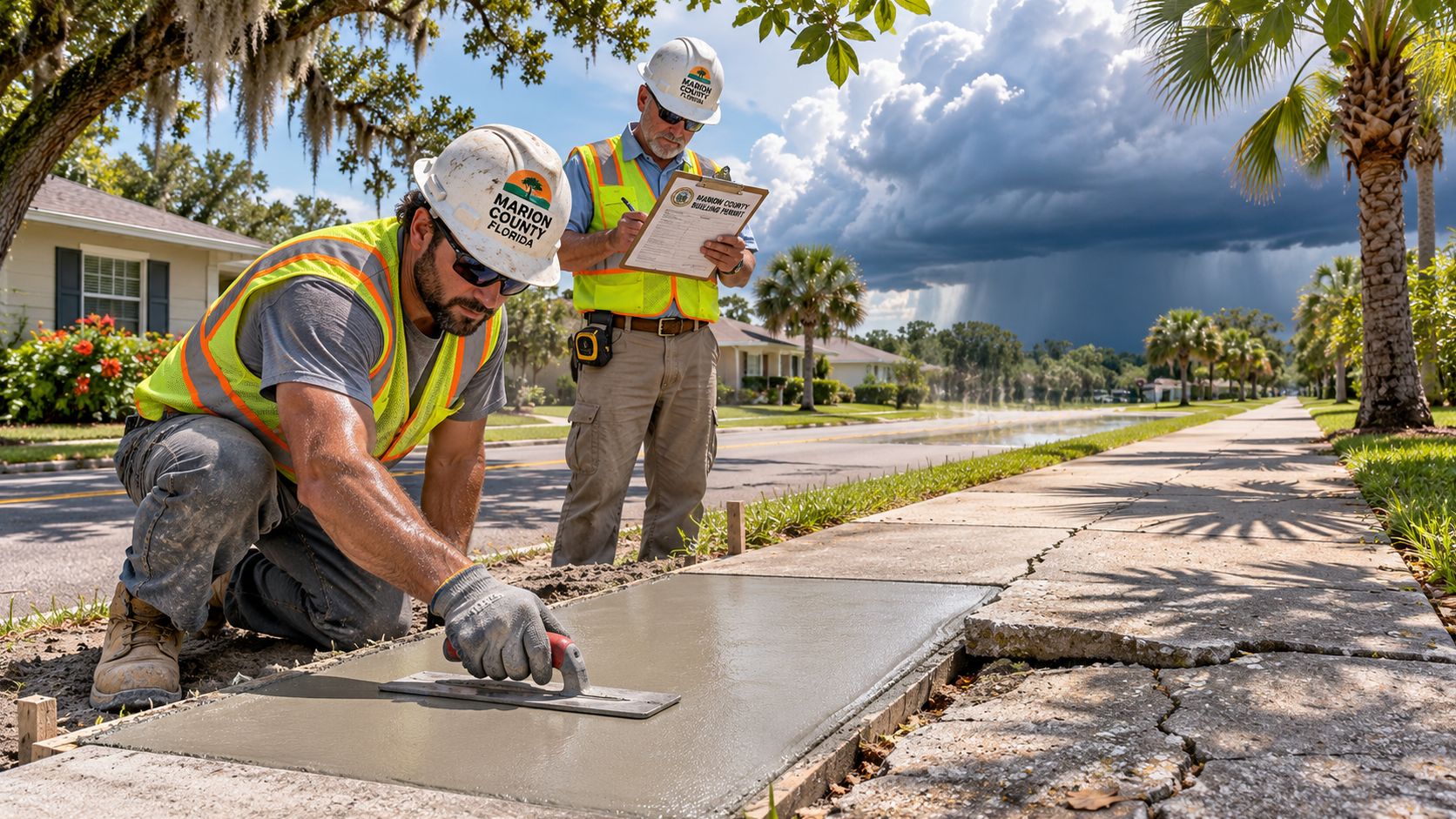
- Heat and UV: midday pours in July cure fast enough to crack at the surface before finishing is done, so schedule early, use retarders when the mix calls for it, and cure with water or a curing compound. Ultraviolet exposure also breaks down sealers and finishes on adjacent asphalt and walkway surfaces over time.
- Afternoon storms: a summer downpour can wash out fresh base material and push sediment into storm drains. Some permits require sediment control, and a tarped base costs less than a re-excavation.
- Sandy soils and seasonal moisture: base compaction shifts with the water table, so proof-roll the subgrade rather than assuming last year's compaction holds.
- Tree roots: live oaks in Ocala, Dunnellon and across Citrus County lift panels and turn a two-panel repair into a root-cut decision that may need separate tree approval.
- Traffic: shopping corridors and church or school drop-off zones in Ocala and Inverness demand a real maintenance-of-traffic plan, not cones at 8 a.m.
Here's how that plays out on a typical residential job.
Schedule pours for early morning and check the forecast before you set the inspection date. A rained-out inspection slot costs a week, and a washed-out base costs more.
Frequently Asked Questions About Sidewalk Repair Permits
Do I need a permit to replace two or three cracked panels?
Often yes, if those panels sit in the public right-of-way. Size doesn't decide it. One call to the office that owns the sidewalk settles the question, and that call takes five minutes.
Who is responsible for a sidewalk lifted by a tree root?
The adjacent property owner is often responsible, but city, county and HOA rules vary, so confirm ownership first. Several cities place construction-period responsibility on the permit holder and continuing maintenance on the abutting owner, as the Grove City sidewalk program describes.
What happens if concrete is poured without a permit?
The issuing office can require removal and re-inspection, and fines may apply on top of the permit fee. Removing cured concrete costs several times what filing the application would have.
Can a homeowner do the work without a licensed contractor?
Unlicensed work may be rejected at inspection, and many permits require a licensed, insured contractor on the application. Insurance is the part homeowners underestimate: if a helper gets hurt, the exposure lands on the property owner.
Do HOA rules apply on top of government permits?
Yes. Get the association's written approval before work starts, particularly on common-area walks in Hernando, The Villages or any Citrus County community with architectural review.
When to Bring In a Licensed Concrete Contractor
A single cracked panel on private property is a homeowner-scale job. The moment the scope grows, the math changes, and the deciding factor is rarely the concrete itself. It's the paperwork, the inspection, and the question of which office controls the sidewalk.
Call a licensed contractor when the repair changes grade, involves building or rebuilding a curb ramp, widens a driveway crossing, touches a state road, or runs across more than a few panels in one continuous stretch. Those scopes carry engineering questions, inspection exposure and, often, a full accessibility upgrade. Grade work is the one homeowners misjudge most often: a panel poured an inch too high or low against its neighbor fails inspection and comes back out, at several times the cost of doing it once with proper forms.
A contractor who already works in your county also shortens the jurisdiction triage. Instead of cold-calling offices to learn whether the walk sits in a city right-of-way, a county right-of-way or on state road frontage, you get the answer during the estimate, along with the measurements the application will need. That confirmation step is what keeps a simple repair from stalling for weeks in the wrong office's inbox.
Riverside Sealing & Striping, LLC is a concrete and asphalt contractor serving Marion and Citrus Counties. Sidewalk work includes ADA-compliant installation, repair and restoration, anti-slip surfaces, and professional grading and drainage. Where a walk meets pavement, the same crew handles driveway edges, sealcoating and parking lot striping, so the whole transition closes out in one visit. The company is family owned and operated across third- and fourth-generation professionals, uses licensed and insured contractors, and has a track record of arriving on the time and day specified, as customer Robert put it after the crew "put in a beautiful entrance sidewalk" alongside his asphalt work.
A free on-site estimate walks the sidewalk, confirms which office controls the permit, and checks the measurements before anything gets filed. That's a no-pressure conversation, not a sales call. If the scope points past a patch job and toward replacement, the sidewalk replacement contractors at Riverside handle removal, grading and new installation with professional finishing under one roof. When the jurisdiction question is still open, get that evaluation before the first panel comes out.