
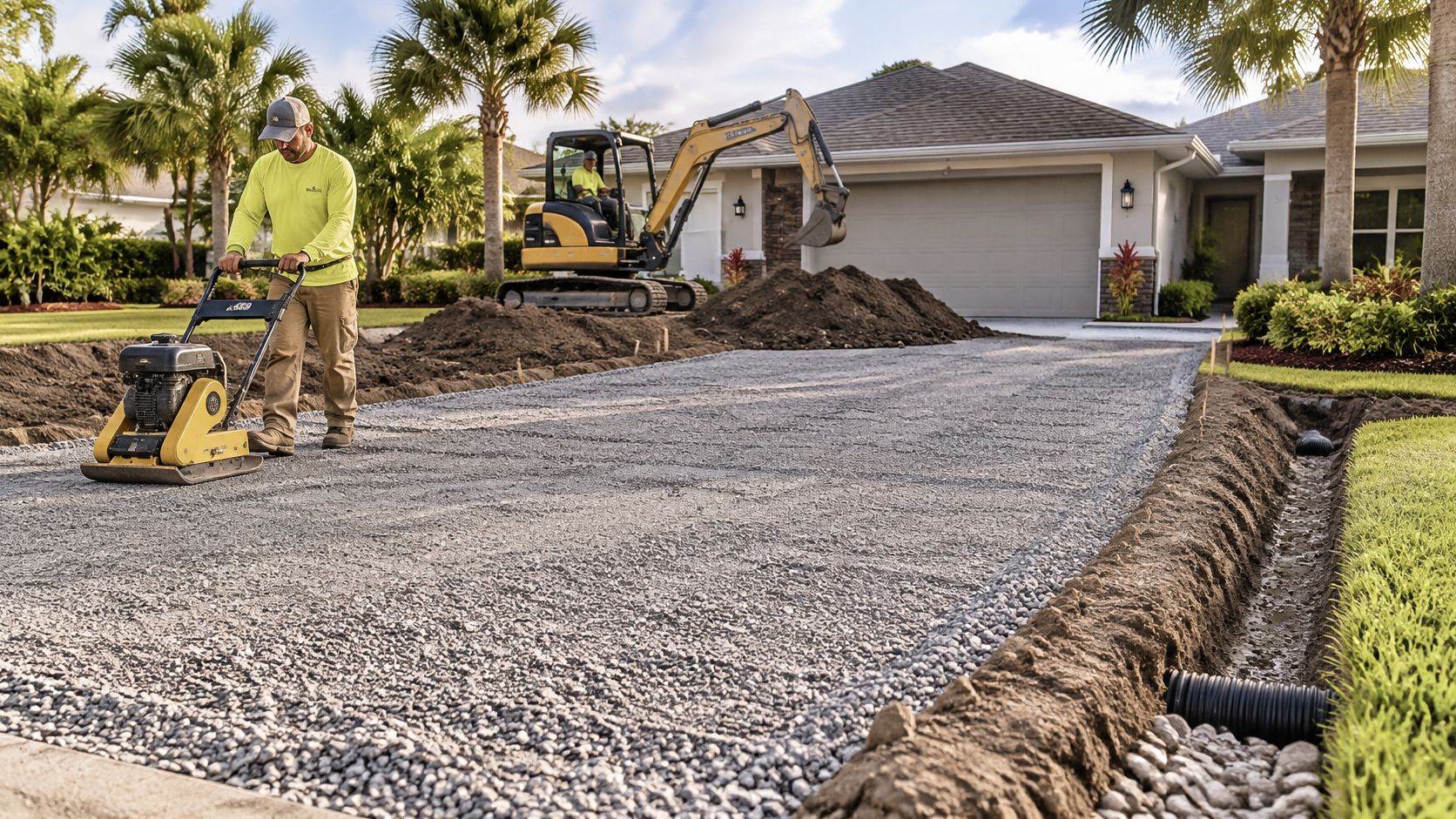
You have a quote in front of you for a driveway in Ocala, or a patio that has to meet a sidewalk in The Villages. One line is easy to skim past. Site preparation. The concrete price looks familiar. The groundwork does not. Two summers from now, a crack in a straight line, or a puddle against the garage, usually starts in that line.
In Marion County, FL and Citrus County, FL, the soil is sandy, afternoon storms are routine, and shallow limestone shows up when a bucket hits it. Site preparation services turn that ground into a stable, level, drained platform before concrete or asphalt is placed. You can check most of it on a free site visit, with a tape, a slope reading, and a few direct questions.
Table of Contents
- What Site Preparation Services Include
- Why Preparation Decides How Long Driveways and Patios Last
- How Central Florida Conditions Change Site Prep
- Permits and Accessibility Checks Before Work Starts
- Compaction, Drainage and Grade Targets That Matter
- How a Site Gets Prepared From Survey to Base
- How Long Site Prep Takes and What Drives the Cost
- Site Prep Questions Homeowners Ask
- Confirm Your Site Plan Before Work Begins
What Site Preparation Services Include
Site preparation is the groundwork done before concrete or asphalt goes down, so the surface sits on a stable, level, and drained platform. Pushing dirt around is only a piece of it.
The U.S. Census Bureau industry series classifies these contractors under NAICS 238910. That specialty trade covers excavating, grading, demolition, land clearing, trenching, backfilling, and compaction for building sites, roads, and utilities, including equipment rented with an operator.
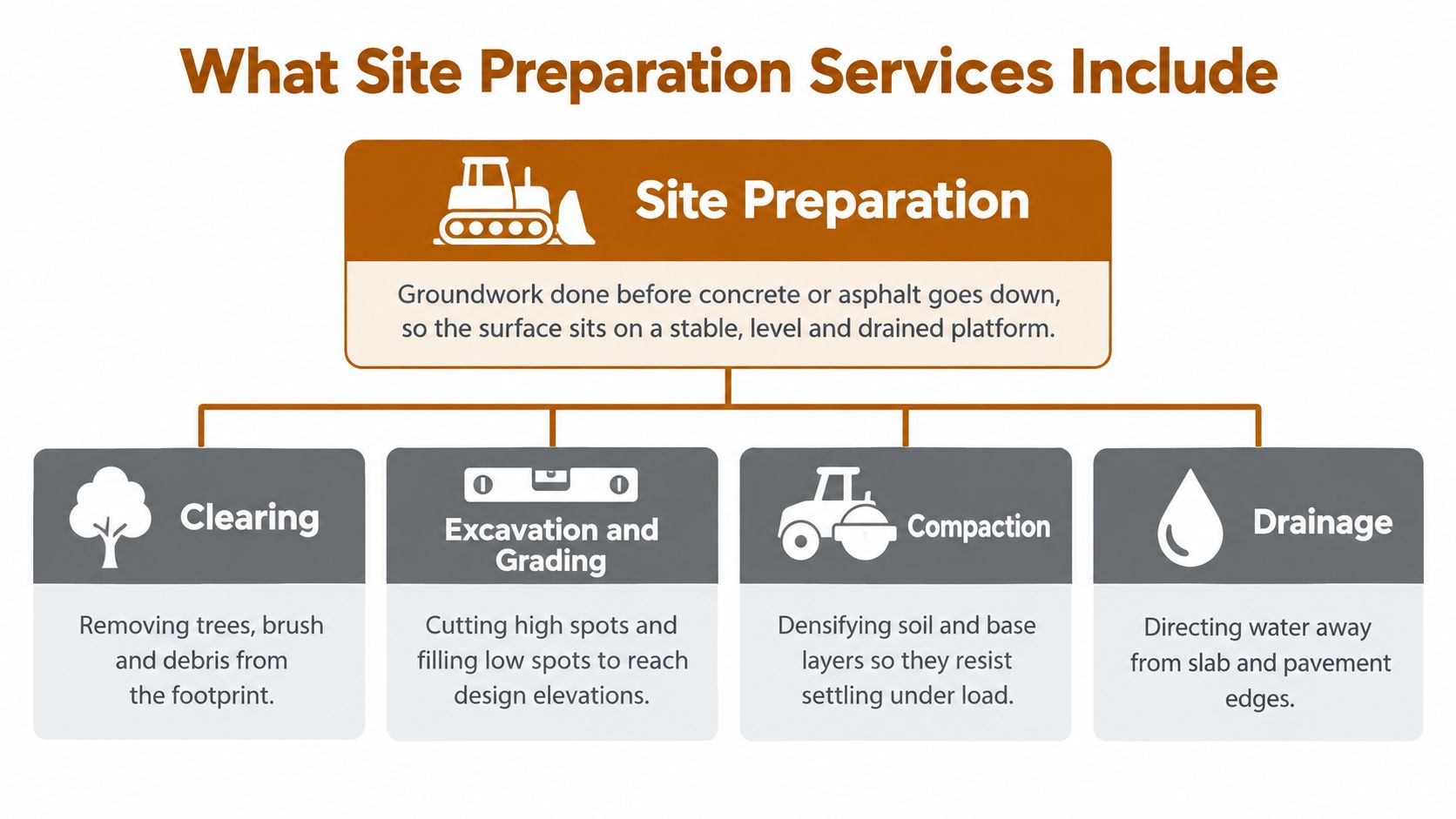
A patio in Belleview and a parking pad in Inverness use the same tasks. Depth and slope change with the load. Walk the list on a site visit and ask which rows are in the price.
| Task | What It Involves | Why It Matters for Driveways and Patios |
|---|---|---|
| Clearing and demolition | Removing vegetation, roots, old slabs, and debris | Old material left in place causes soft spots and uneven settlement |
| Excavation | Digging to the design depth | Leaves room for base and slab thickness so the finished surface is not too thin |
| Grading | Setting slopes and finished elevations | Moves water away from the slab and the house foundation |
| Subbase and base preparation | Removing unsuitable soil and placing granular base | Gives the slab uniform support instead of a stiff-to-soft mix |
| Compaction | Densifying soil and base in controlled layers | Limits settlement, cracking, and rocking under load |
| Drainage | Installing swales, outlets, or culverts where needed | Keeps standing water from saturating the base |
| Permitting and utility locates | Obtaining approvals and marking buried lines before digging | Prevents stop-work orders and damage to utilities |
Call Sunshine 811 before any digging. The ticket marks public lines. A private well, irrigation main, or septic lateral still needs its own locate.
A slab is like a tabletop. It sits flat only when the legs underneath are set evenly.
Why Preparation Decides How Long Driveways and Patios Last
Say a driveway in Summerfield cracks along one line within two summers. The mix was fine. The crack follows a strip of old fill that nobody compacted. A slab bends where its support changes. Uneven stiffness or moisture produces differential settlement, so one area drops while the next stays put.
The CEMEX USA technical bulletin treats uniform support as a primary durability requirement for driveways, sidewalks, patios, and slabs. A sound sequence removes organic or compressible material, sets design elevation, places granular base where specified, adjusts moisture, and compacts the subgrade in lifts. FHWA guidance cited there uses AASHTO T99 and recommends keeping compacted soil moisture within roughly 85% to 120% of optimum for that pavement application. A slab across wet and dry, or stiff and soft, is more likely to crack, rock, or fail at an edge.
You can spot weak prep without a lab.
- Edge cracks: Hairlines that track the perimeter often follow a soft shoulder, not a bad mix.
- Rocking: A panel that moves under your foot has lost contact with the base.
- A step at a joint: One panel sits higher because settlement was uneven.
- Perimeter puddles: Water standing at the edge keeps feeding the soil under the slab.
Each sign points under the surface. The concrete can be sound while the soil is not. Checking the base comes before another skim of patch.
Patios and pavers are thinner, so roots and wet soil heave them with less warning. The same prep logic applies, with a smaller margin.
A crack in a straight line is often a map of the fill, not a verdict on the concrete.
How Central Florida Conditions Change Site Prep
Four local conditions change the plan. Clean sand, summer rain, shallow rock, and a high water table do not get the same answer.
Sandy soil that will not hold a tire
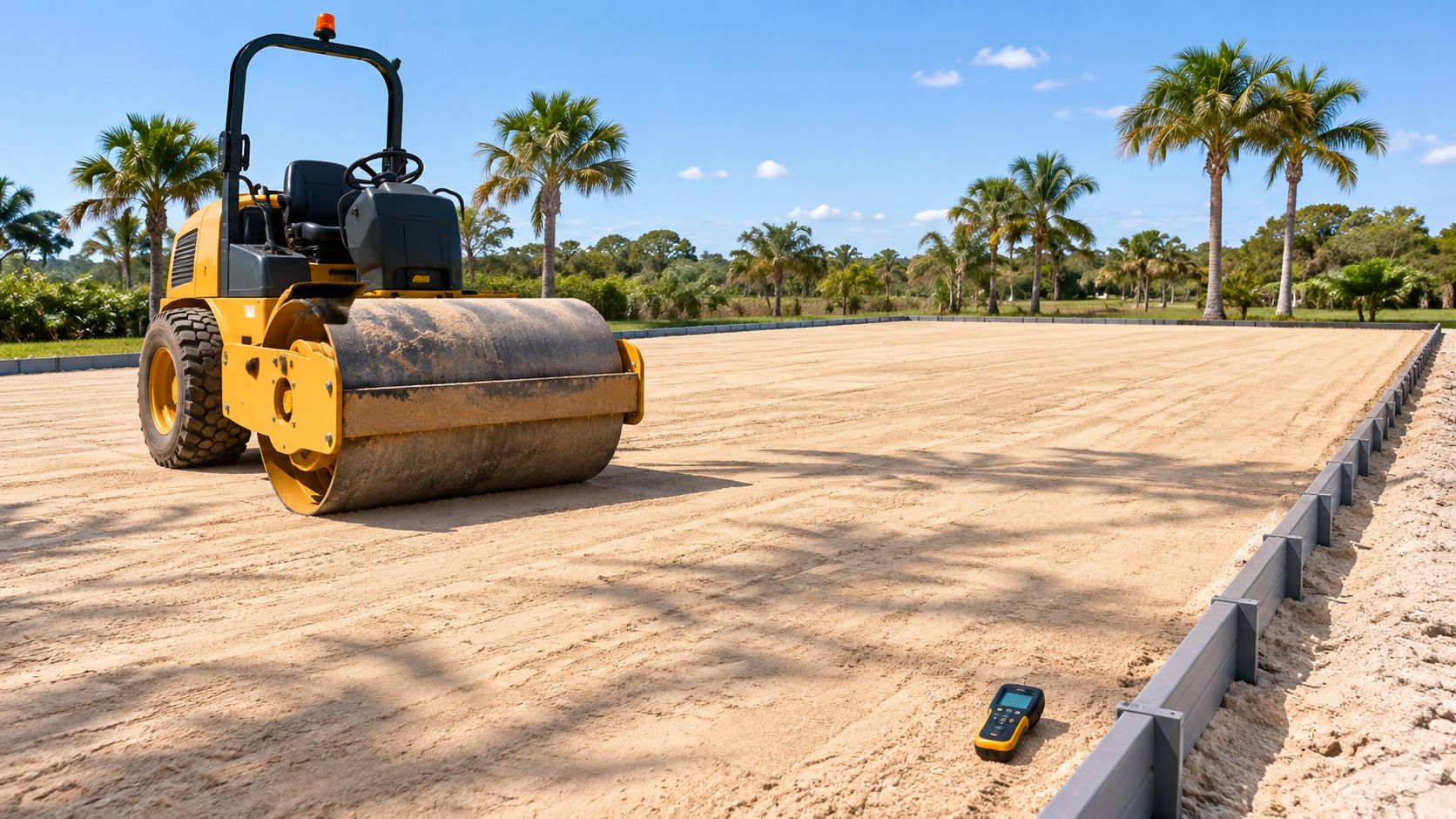
Loose sand around Silver Springs and Dunnellon drains fast, then shifts under a wheel unless it is compacted and held by edge restraint. Summer heat dries a lift before the roller finishes, so crews wet it lightly and compact while moisture is still in the soil.
Afternoon storms and shallow rock
From roughly June through September, storms stop compaction and can wash an unfinished grade toward the street. Build the schedule around a dry window. Put erosion control measures in the plan before the first rain, not after a washout.
Shallow limestone and karst show up in parts of Marion County, including ground around Ocala and Dunnellon. Rock or a void changes how deep you can dig. Fresh settlement, a dipping fence line, or a known sinkhole history calls for a geotechnical evaluation before forms are set.
High water near the coast
Low ground around Crystal River and Homosassa often carries a high water table and pockets of muck. Raising the grade with suitable fill keeps the base above standing water. Heat also speeds how fast fresh concrete loses moisture, so base moisture and curing get decided before the truck is ordered.
On the visit, probe the soil, watch where water sits after rain, and write rain days into the schedule. A lot in Lecanto and a lot in Beverly Hills can need different fill even when the drawings look alike.
Permits and Accessibility Checks Before Work Starts
Who reviews the job depends on the address and the scope. Work in unincorporated Marion County or Citrus County goes through the county building department. An address inside Ocala, Inverness, or Crystal River may go through the city. A driveway that changes a curb cut, or sends water toward a neighbor's swale, often needs that review. Confirm it before the crew is on the calendar. A stop-work order costs more than a week of waiting.
Slopes a restriping job can break
Accessible parking is not only paint. The ADA parking topic page requires accessible spaces and their access aisles to stay level enough for transfers, with a maximum slope of 1:48 in every direction, about 2.08 percent. The surface must be firm, stable, and slip-resistant, and an accessible route must connect the spaces to the entrance. Separate federal guidance on restriping parking spaces also calls for routes with at least 36 inches of continuous clear width.
Replacing a lot surface, cutting a new drain, or restriping a church lot in Hernando can break those limits without anyone meaning to. Measure slope and route width before grading starts. A cheap bid that keeps a bad cross slope can force you to tear the new pavement out.
Practical rule: Treat 1:48 as the acceptance check on the finished accessible surface, not as a number you hope the paver hits.
On a free visit, read four things together. Parking and aisle slopes. Clear route width. Curb-ramp elevations. Drainage that does not sheet across the walk. Underground utility location belongs in that same pass, so a marked line is not graded away before excavation.
Compaction, Drainage and Grade Targets That Matter
These figures are reference values from federal highway guidance and common specifications. Your engineer or contractor sets the final number for the job.
| Requirement | Reference Value | Where It Applies |
|---|---|---|
| Asphalt mixture density | At least 92% of theoretical maximum density | Asphalt layers in driveways and parking areas |
| Fill compaction, upper 12 inches | 95% of AASHTO T99 density | General fill under pavement, per experimental construction guidance |
| Compacted soil moisture | Roughly 85% to 120% of optimum | Subgrade under pavement, per FHWA guidance |
| Subsurface drainage trigger | Subgrade permeability below about 3 m/day (10 ft/day) | Wet climates and poorly draining soils |
| Surface shape | No undulations, with a reasonable crown or cross slope | Pavement layers and finished subgrade |
| Field verification | Density tests, elevation checks, and proof-rolling before placement | Every layer before concrete or asphalt goes down |
Read density as a comparison. 95% of AASHTO T99 means the upper 12 inches of general fill is packed to 95 percent of the densest state that lab test found. The Federal Highway Administration geotech guidance ties rutting, cracking, and water in unbound layers to weak asphalt compaction, and it cites a typical minimum of 92% of theoretical maximum density. That asphalt row is for asphalt driveways and parking areas, not for a plain concrete slab.
Soil that is too wet traps water and settles later. Soil that is too dry will not pack. The moisture line in the table is a working window around optimum, not permission to roll a soupy lift.
When drainage has to go under the surface
That same FHWA guidance says to consider subsurface drainage in wet climates when subgrade permeability falls below about 3 meters per day (10 feet per day). Clean sand across Central Florida usually stays more open than that, so the trigger is uncommon there. A clay pocket or a muck lens falls below it and needs a subsurface review. Surface shape still matters on sand. Grade without dips, and give the layer a reasonable crown or cross slope. A concrete driveway drainage plan fails if the subgrade holds a birdbath under the slab.
Before any surface goes down, ask for density tests, elevation checks, and a proof-roll. Cut soft spots out and replace them. Then the next layer starts.
How a Site Gets Prepared From Survey to Base
A prepared site follows an order. Skip a step and the next one hides the mistake.
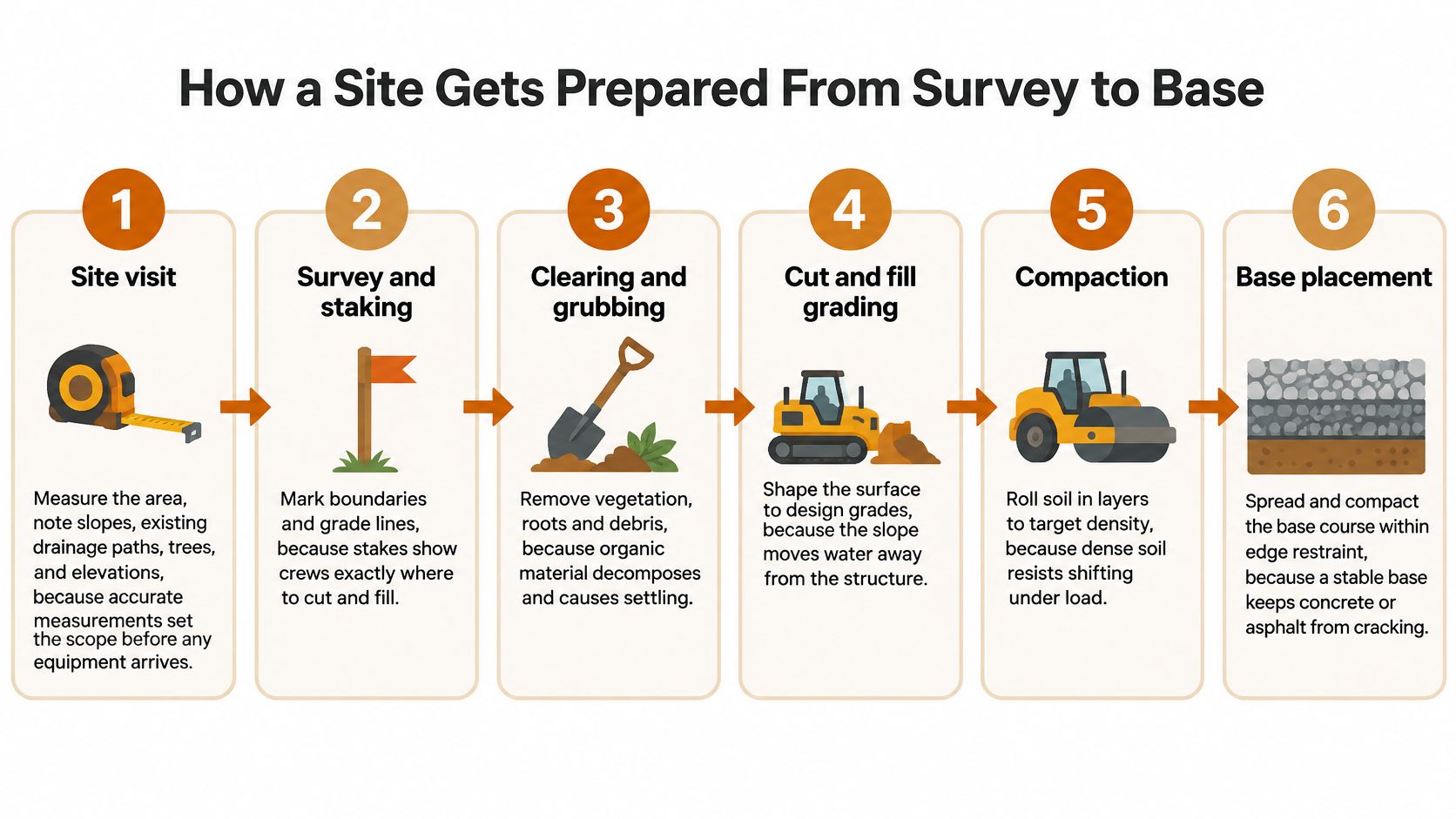
- Site visit. Measure the area. Note slopes, drainage paths, trees, and the garage, sidewalk, or lot elevations the new surface must meet. Those numbers set the scope before a machine arrives.
- Utility locates. Request Sunshine 811 and trace private lines. A struck line stops the job.
- Permits. File where the county or city requires it, and wait for approval before anyone mobilizes. Check accessible slopes and route width in that same review.
- Clear and demolish. Remove vegetation, roots, old concrete, and debris, then haul it off. Organic matter left behind rots and settles.
- Excavate to design depth. Dig to the stakes or the laser. Too shallow, and the base or the slab ends up thin.
- Correct the soil. Pull muck, organics, and soft pockets. Backfill with approved material.
- Shape the drainage. Set cross slope or crown so water moves to an outlet, not the foundation.
- Compact and proof-roll. Compact in lifts at the job's density and moisture targets. Drive a loaded truck across the area. The truck finds soft spots a glance misses. Cut those out before base goes in.
- Place the base. Spread granular base, compact it, and confirm elevation before forms, reinforcement, and concrete.
Staking the grade after the visit, and again after the cut, keeps the laser and the drawing on one elevation. That is how a slab meets the garage instead of leaving a lip.
A field walk-through makes the lifts easier to picture than a spec sheet.
How Long Site Prep Takes and What Drives the Cost
What the clock looks like
The free visit and the written quote come first. Permit review is often the long wait, and it can add weeks before a machine moves. Field work follows. A proof-roll or inspection comes before forms. A residential driveway on clean sand, with no drainage fight, can be prepared in a few working days. An old slab, a muck dig, or a rebuilt swale adds days.
What moves the price
A fair quote splits clearing, demolition, excavation and haul-off, base, compaction, and drainage into their own lines. Compare those lines, not only the total. A bid that drops compaction or drainage often costs more after the first rainy season, because you pay to open the surface again.
| Factor | Effect on Schedule | Effect on Cost |
|---|---|---|
| Clean sand or stable fill | Minimal delay, standard compaction passes | Baseline cost |
| Muck, organic, or soft soil | Adds removal and backfill days | Moderate to high, depending on depth |
| Old concrete removal | Adds demolition and haul-off time | Moderate, scales with area and thickness |
| Excavation depth | Deeper digs add hauling and compaction time | Moderate to high |
| Drainage correction | Adds grading passes and a re-check | Moderate |
| Rain during the job | Stops compaction until the soil dries | Low direct cost, but adds idle days |
| Permit review | Can delay the crew start by weeks | Low direct cost, high schedule risk |
| Tight access or large equipment | Slows hauling and staging | Moderate |
A low total with compaction missing isn't a savings. It's a second project.
No single dollar range fits every lot in Marion County or Citrus County. Muck depth, haul distance, and permit time move the price more than slab thickness does. Write the scope and the dates down at the visit, while the soft spots are still visible.
Site Prep Questions Homeowners Ask
Can new concrete go over an old slab?
Only when the old slab is sound, level, and still bonded to a base that supports it. A slab that is cracked through, sunken, or holding water usually has to come out so the base can be rebuilt. Pouring over a failed slab locks the problem in.
How can you tell muck or clay from good fill?
Walk the area after a rain. Soft pockets that take a footprint, dark spongy soil, or ground that stays wet for days should come out and be tested. Clean sand that firms as it dries is a different case. It still needs compaction, not a free pass.
Should a cracked slab be patched or replaced?
One hairline crack on a level, solid slab can be a repair. A rocking slab, a height step at a joint, or lost edges means the base moved. Patching the crack doesn't put support back under the panel.
Confirm Your Site Plan Before Work Begins
Preparation controls how the surface performs. The targets are measurable. Sandy soil, summer rain, and shallow rock make the order of the work as important as the mix.
Screen the site yourself for a straight crack, a rock underfoot, a step at a joint, or standing water. Bring in a professional when the slab will sit on fill or muck, when a commercial lot needs accessible parking or a route upgrade, or when the job needs a permit or HOA approval. DIY prep hits a hard limit. Density across a full driveway takes a roller sized to the area. A small rented plate won't get there on a wide drive in Homosassa or a long apron in Summerfield.
Bring these to a free, no-pressure consultation.
- A sketch or survey: Lot lines and the tie-in at the garage or walk.
- Photos: Cracks, puddles, and the path water takes after rain.
- The finish you want: Dimensions, concrete or asphalt, and any HOA rules.
- Your timeline: Including dates you can't have the drive closed.
Riverside Sealing & Striping, Concrete and Asphalt Experts in Marion and Citrus County, is a third- and fourth-generation, family-owned, licensed and insured company based in Dunnellon. The crew handles site prep for concrete driveways, patios, and sidewalks, and for asphalt parking lots, with free estimates from 7am to 7pm. Concrete work, asphalt sealcoating, and parking lot striping stay on that same plan, so the base, the surface, and the markings get checked together.
Riverside Sealing & Striping, LLC prepares the ground and then builds or maintains the surface, from concrete driveways and patios to asphalt care on commercial lots across Marion County and Citrus County. If you want slopes, base, and drainage checked before anyone pours, book a free on-site estimate. Visit Riverside Sealing & Striping, LLC to set a time between 7am and 7pm.