
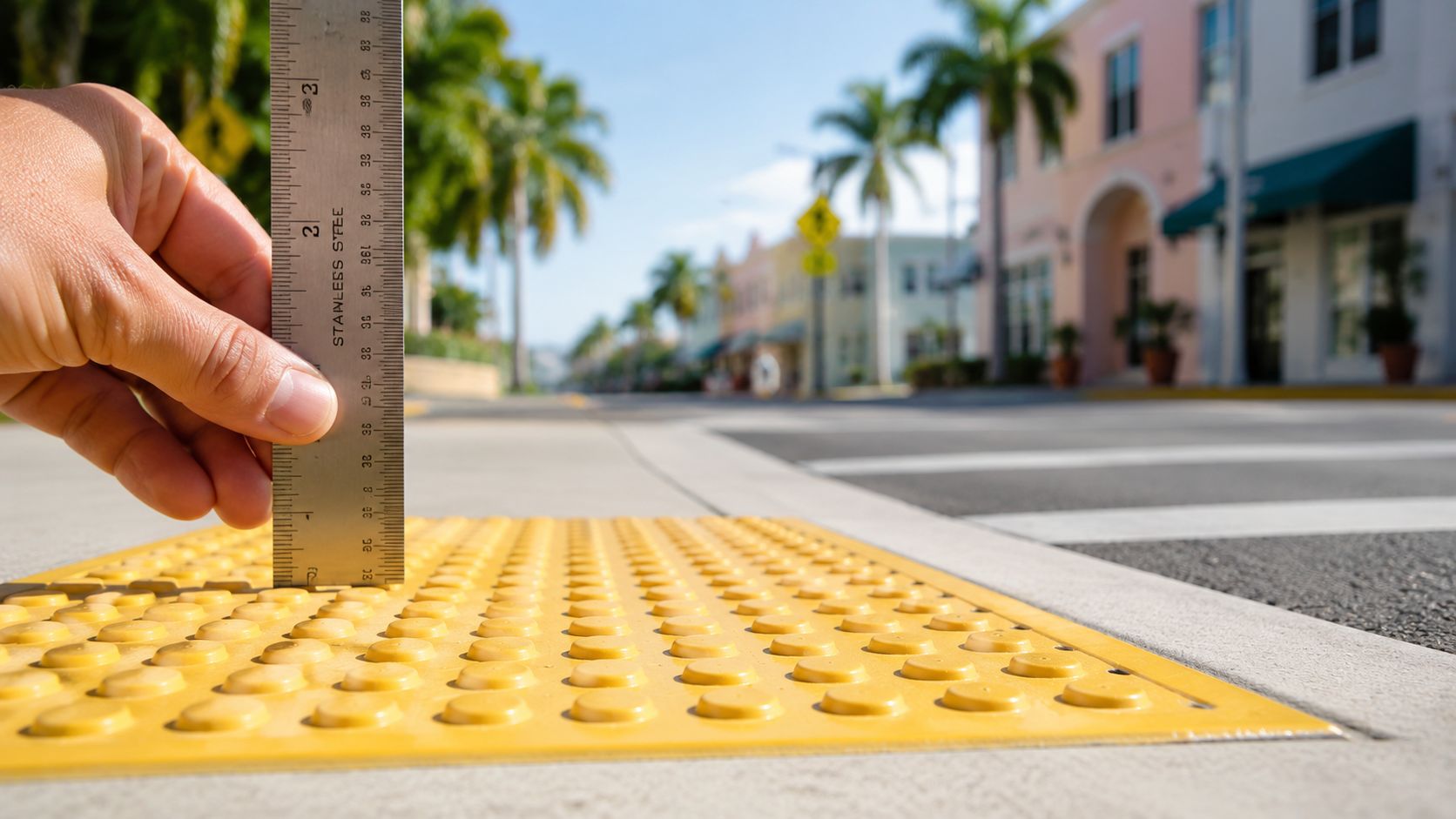
You notice them at a crosswalk in Ocala. Then again outside a retail center in Crystal River. Then outside a clubhouse in The Villages. Those bright, bumpy panels at the edge of a sidewalk start to feel like they're everywhere, and if you manage property in Central Florida, you've probably asked the same question many owners and HOA boards ask.
What are those bumps for, and do I need them on my property?
That question matters in Marion County, FL and Citrus County, FL, because sidewalks, curb ramps, parking lot access routes, and common-area walkways all have to do more than look finished. They have to work safely for real people, including pedestrians who rely on a cane or underfoot texture to detect a change from a protected walking route to a potential hazard.
In places like Dunnellon, Belleview, Summerfield, Inverness, Lecanto, Beverly Hills, Homosassa, and Silver Springs, property managers are also dealing with another layer of complexity. Florida weather is hard on exterior surfaces. Heat, rain, humidity, and UV exposure can turn a compliant installation into a maintenance issue faster than many national guides admit.
For boards and managers handling sidewalks, parking areas, and common spaces, this topic often overlaps with broader accessibility work such as ADA parking lot striping requirements. The key is understanding where tactile warning surfaces belong, how they're supposed to be built, and how climate affects long-term performance.
If you're looking for practical answers from the perspective of Concrete and Asphalt Experts in Marion and Citrus County, start with the basics.
Table of Contents
- Introduction Why Are Those Bumps on Sidewalks Everywhere
- What Exactly Is a Tactile Warning Surface
- Understanding ADA and Florida Compliance Requirements
- Comparing Materials for Tactile Warning Surfaces
- Florida Climate Challenges for Tactile Surfaces
- Professional Installation Costs and What to Expect
- Frequently Asked Questions About Tactile Warnings
Introduction Why Are Those Bumps on Sidewalks Everywhere
If you manage an HOA in Summerfield, a church in Belleview, or a retail property in Crystal River, you've probably had this conversation already. A board member points to a curb ramp and asks why the new panel is bright yellow and covered in raised bumps. Someone else asks if it's just a recommendation, or if it's required.
Those bumps are not decorative. They're a tactile warning surface, and they play a safety role that's easy to underestimate if you don't work in accessibility and site construction every day. For a pedestrian with limited vision, the surface creates a detectable signal that says a protected walkway is ending and a potential hazard is ahead.
That hazard might be a street crossing, a blended transition, or another point where foot traffic meets vehicles. In practical terms, the surface helps someone recognize, underfoot or with a cane, that they need to stop and reassess before moving forward.
For property owners in Ocala, Dunnellon, Hernando, and The Villages, confusion usually comes from two issues. First, people see these surfaces installed in public spaces and assume the same rule applies everywhere. Second, many online guides explain the ADA in broad terms but skip the practical details that matter during budgeting, maintenance, and replacement planning.
Practical rule: If your walkway leads people toward traffic or another defined edge condition, don't guess. Confirm whether that location needs a detectable warning and whether the installation meets the required pattern, size, placement, and contrast.
That matters even more in Central Florida, where a product that looks compliant on installation day can become harder to see and maintain after seasons of rain, sun, and humidity.
What Exactly Is a Tactile Warning Surface
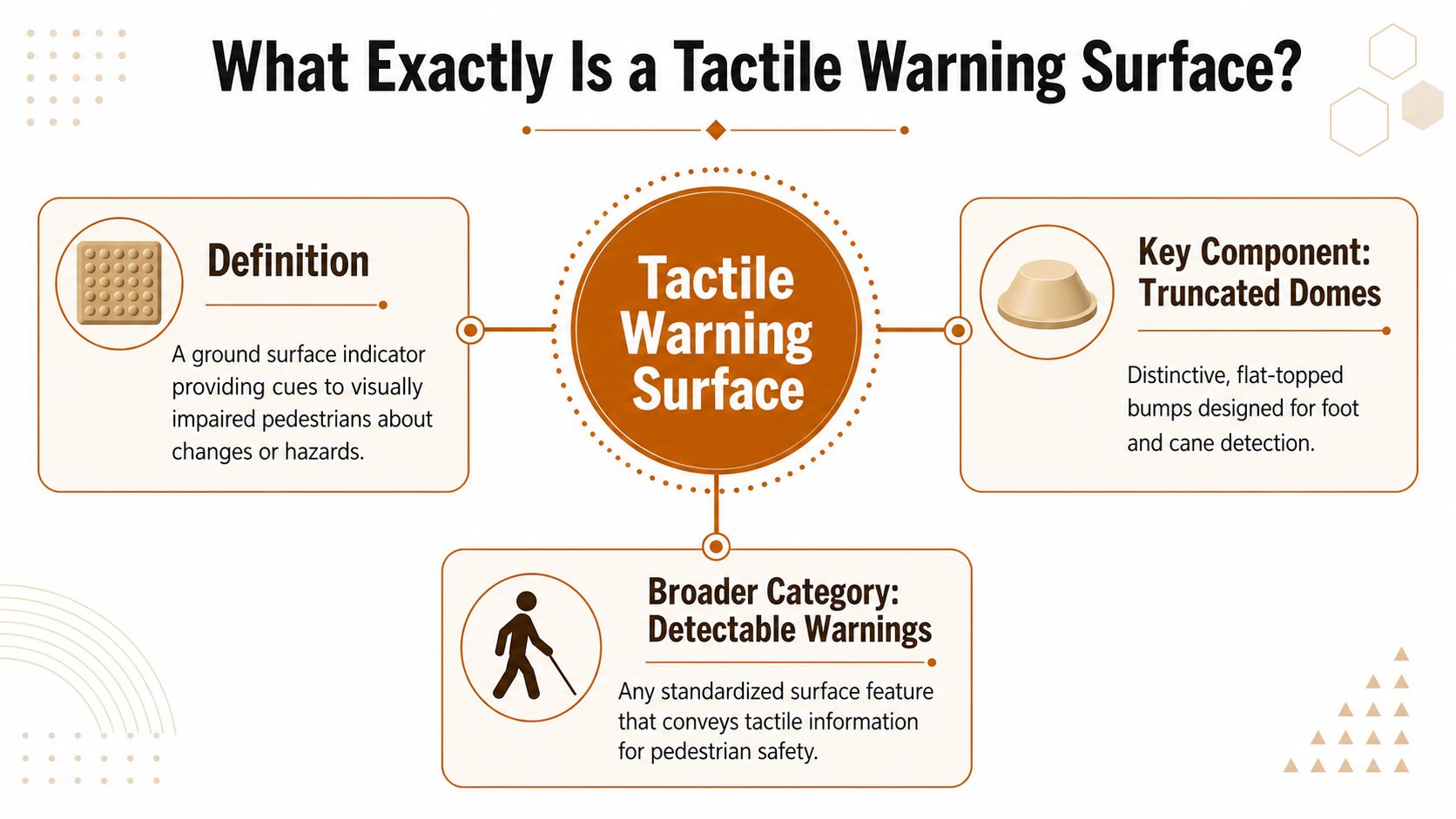
A tactile warning surface is a standardized ground surface indicator designed to alert pedestrians, especially people with visual impairments, that they're approaching a transition or hazard. The most recognizable version is the field of raised, flat-topped bumps you see at curb ramps and crossings.
Here's a quick visual that helps define the terminology.
Why the surface exists
The raised bumps are called truncated domes. They're shaped to be detectable without becoming a trip hazard for everyday pedestrian use. The surface is meant to send a clear warning through touch and texture, not through signage alone.
This idea has a real origin point. The first functional tactile warning surface was invented in 1965 by Japanese engineering student Seiichi Miyake, who developed textured concrete cubes with raised bumps resembling Braille dots to assist visually impaired pedestrians at street crossings, according to the history of tactile walking surface indicators.
That history matters because it explains the purpose. These surfaces weren't added to make sidewalks look official. They were designed to solve a specific safety problem at the exact point where pedestrians face a hazard.
A short video makes the concept easier to picture in the field.
Where people get confused
Most confusion starts with the words themselves. People hear detectable warnings, truncated domes, and tactile warning surface and assume they're separate systems. In day-to-day construction talk, they're usually part of the same discussion.
A simple way to think about it is this:
- Tactile warning surface means the installed warning area as a whole.
- Truncated domes means the individual raised elements on that surface.
- Detectable warnings is the broader accessibility term for standardized tactile features used to signal a hazard or transition.
A painted stripe can catch the eye. It cannot replace a tactile signal that someone can feel underfoot or detect with a cane.
That distinction matters for HOAs in places like Beverly Hills or Lecanto and for commercial properties in Homosassa or Inverness. If a ramp has the wrong texture, the wrong shape, or no tactile field at all, it may look finished to a sighted user while failing the people it's supposed to protect.
Understanding ADA and Florida Compliance Requirements
A curb ramp can look finished, painted, and clean, yet still fail the standard that matters at the edge where a pedestrian enters traffic. That is where compliance problems usually show up in Central Florida. The surface is present, but it is too short, too narrow, the domes are the wrong shape, or the color fades so badly in the sun that the visual contrast weakens after a few seasons.
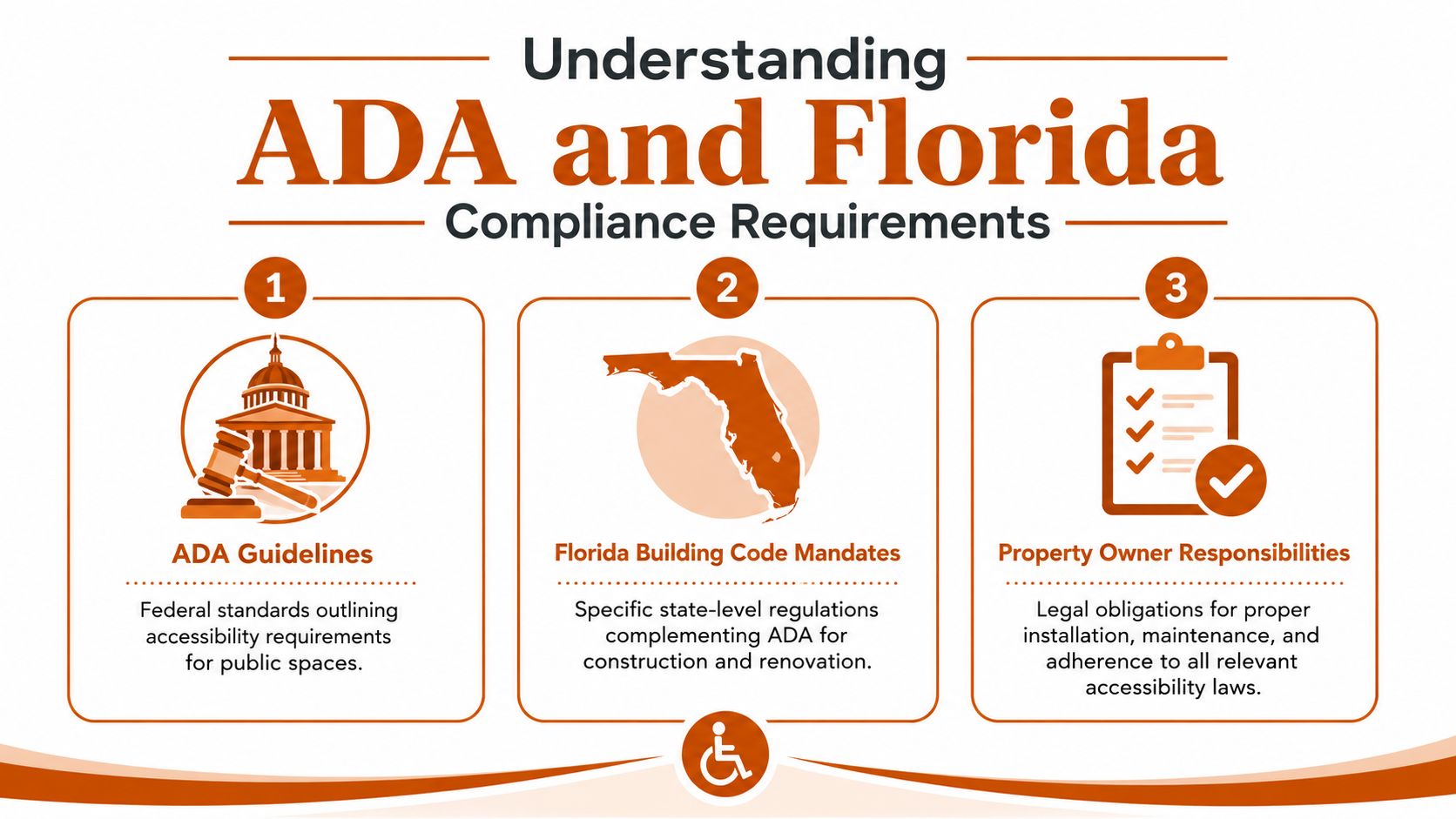
The dimensions that matter
The ADA does not treat detectable warnings as a decorative add-on. It sets measurable rules for both the warning area and the individual truncated domes. The ADA detectable warning guide outlines the dome geometry commonly checked during design review and installation. In plain terms, inspectors are looking for a standardized pattern people can recognize underfoot and with a cane, not a generic textured panel.
For curb ramps, the warning surface also needs to cover the full width of the ramp run and extend at least 24 inches in the direction of travel, as shown in the U.S. Access Board standards for detectable warnings. That measurement causes a lot of punch list corrections because some installers stop short or center a panel only where they expect foot traffic. The rule is broader than that.
A good field check works like checking tile layout before grout sets. Small dimension errors can make the whole assembly wrong.
If you are reviewing a site walk or turnover package, focus on these items:
- Coverage area: The warning surface should run the full width of the curb ramp, not just the middle portion.
- Correct dome geometry: The domes need to match the required profile and spacing, not just look close from a distance.
- Placement at the hazard: The tactile cue needs to be where a pedestrian detects the transition before entering the street or vehicular way.
- Usability in Florida weather: The panel or cast surface has to stay slip resistant and visually distinct after rain, UV exposure, and humidity.
Field note: The failure I see most often is partial compliance. A ramp has detectable warnings, but the panel is undersized, mislocated, or faded enough that replacement should have been planned long before the concrete around it wore out.
Public spaces and private properties are not treated the same
This is one of the biggest points of confusion for HOAs and private owners. A private single-family home is not evaluated the same way as a clubhouse route, a retail sidewalk, or a multifamily common area that residents and guests use every day.
The Florida-focused discussion of detectable warning requirements explains the basic distinction. Private property that functions as a public accommodation or shared-access area can trigger accessibility obligations, while a private residential path often does not. For a board member, the practical question is simple: who uses the route, and is that route part of an accessible path serving the public or a common area?
| Property situation | Likely compliance concern | Practical takeaway |
|---|---|---|
| Private single-family residence | Usually not evaluated like a public access route | A private driveway walk may not trigger the same requirement |
| HOA common area | Shared pedestrian routes can fall under common-area obligations | Review paths to clubhouses, mail kiosks, pools, and internal crossings |
| Retail, church, office, or mixed-use site | Public access changes the compliance standard | Treat these routes as accessible site features, not private residential walks |
| Parking lot curb ramp | Pedestrian route meets a vehicular area | Detectable warning placement and dimensions need close review |
For Central Florida properties, climate affects compliance in a practical way. A panel that meets the standard on installation day can become harder to see after intense UV exposure, algae staining, or repeated storm runoff. That does not change the legal requirement, but it should change how you choose materials, colors, and maintenance schedules. If your property is in Ocala, Crystal River, or The Villages, the smart approach is to review both the code requirement and how the product will hold up three summers from now.
Comparing Materials for Tactile Warning Surfaces
Not every tactile warning surface is built the same way. The right choice depends on whether you're pouring new concrete, retrofitting an existing sidewalk, or planning for easier replacement in a high-wear area.
Cast in place systems
Cast in place systems are embedded during new concrete construction. They're often a strong fit when you're building a new sidewalk, replacing a ramp, or reworking a common-area crossing from the ground up.
For a new concrete approach in places like Dunnellon or Silver Springs, this option usually gives the cleanest integration with the surrounding slab. It can also reduce the patchwork look that happens when a surface-applied product is added later to a finished ramp.
This approach tends to work well when the project already includes formwork, grading, and fresh concrete placement. It's less convenient when the surrounding surface is staying in place.
Surface applied systems
Surface applied panels or mats are used when an existing ramp or walkway needs to be upgraded without full removal and replacement. These products are attached to the existing concrete surface and are common in retrofit work.
They're useful when a property manager wants to correct a noncompliant area with less disruption. That can make sense at a shopping center in Inverness, a church in Belleview, or an HOA common path in Beverly Hills where the base concrete is still structurally sound.
The tradeoff is that the condition of the substrate matters a lot. If the existing concrete is loose, spalled, poorly sloped, or already failing, attaching a panel to it may only postpone a larger repair.
Replaceable tile systems
Replaceable tile systems make sense where owners want a component that can be swapped out if damaged or heavily worn. That can be attractive in commercial settings with repeated use and stricter maintenance schedules.
They can also simplify future repairs if one area takes the brunt of wear. The downside is that the installation still has to align cleanly with the surrounding pavement, and the long-term result depends on the base underneath.
Here's a practical side-by-side view.
| Material Type | Durability | Initial Cost | Best For | Florida Climate Suitability |
|---|---|---|---|---|
| Cast in place | Strong long-term option when integrated into new concrete | Higher when used outside a planned concrete project | New sidewalks, new curb ramps, full replacements | Good fit when the surrounding concrete work is being done correctly from the start |
| Surface applied | Can work well for retrofit use if the existing surface is sound | Often more budget-friendly than full replacement | Existing concrete ramps and walkways needing upgrades | Needs careful surface prep and ongoing inspection in wet, high-UV conditions |
| Replaceable tile systems | Useful where future replacement access matters | Varies by product and installation conditions | High-use areas and managed commercial sites | Practical if the owner expects scheduled maintenance and wants easier swap-out options |
A good rule is to match the tactile system to the pavement plan, not treat it as an isolated accessory. On a concrete sidewalk, integration details matter. On an asphalt-adjacent pedestrian route, transitions and edge conditions matter just as much. That's why the best results usually come from contractors who handle both surfaces well. Concrete and Asphalt Experts in Marion and Citrus County understand those interfaces better than trades that only focus on one material.
Florida Climate Challenges for Tactile Surfaces
National guidance often treats tactile warning surfaces like a static code item. Install it once, check the box, move on. That approach doesn't hold up well in Central Florida.
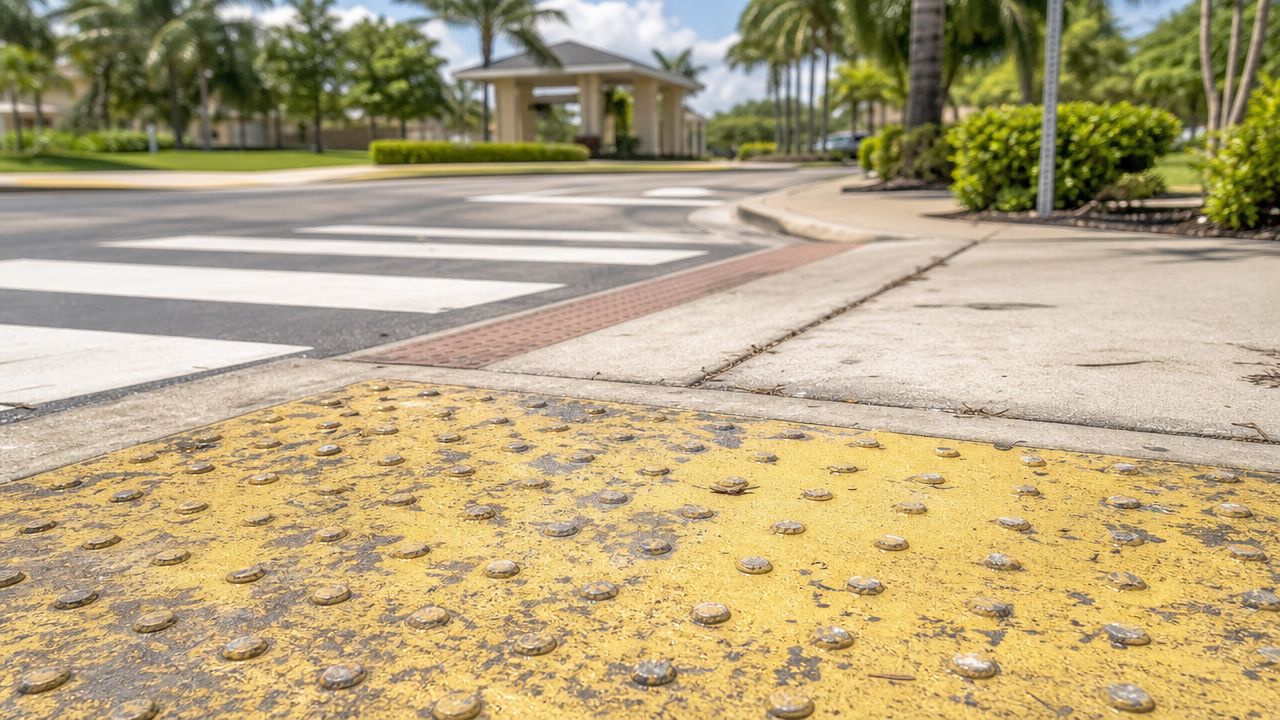
Color contrast is not a one time decision
Luminance contrast between the warning surface and the adjoining walkway must exceed 30%, but studies show that Florida's high humidity and UV exposure can degrade the color and contrast of some materials in as little as 3 years, risking non-compliance, according to the OLEJAR Safety FAQ on luminance contrast.
That single fact changes how a smart property manager should think about product selection. A tactile warning surface isn't just a pattern of domes. It's also a visible warning field that has to remain distinct from the concrete or asphalt around it.
In Central Florida, sun exposure can fade color. Humidity can support surface growth. Repeated rain can leave a surface looking dingy long before the base pavement reaches the end of its service life.
That's why color choice should be tied to maintenance planning. If the site gets full sun in Ocala, frequent storm runoff in Homosassa, or shaded damp conditions in Crystal River, the same product may age very differently.
A surface that starts out bright and compliant can become harder to see if the color fades or darkens from weathering, algae, or grime.
If you're already evaluating walkways and slab condition, it also helps to understand how long concrete lasts in Florida conditions, because the warning system and the surrounding pavement age together.
Moisture changes maintenance priorities
The Florida problem isn't only fading. It's also residue, mildew, algae, and slipperiness. High humidity and repeated rainfall can leave textured surfaces holding more dirt and biological growth than owners expect, especially in shaded areas near landscaping or irrigation.
That means maintenance crews can't treat a tactile warning surface like smooth flat concrete. Aggressive cleaning methods might damage the finish or wear the contrast faster, but neglect can make the surface harder to see and less safe to walk over.
For properties in Lecanto, Hernando, Summerfield, and The Villages, a better approach is to review these surfaces during routine pavement and sidewalk inspections:
- Look for contrast loss: If the panel blends into the surrounding walkway, that's a warning sign.
- Check surface cleanliness: Texture can trap grime and growth more than adjacent pavement.
- Watch drainage patterns: Water flowing across the panel day after day speeds up wear and buildup.
- Review adjacent materials: Light concrete, dark asphalt, and decorative finishes all affect perceived contrast.
Local experience matters. A product that performs well in a mild, dry climate might need a different maintenance rhythm in Marion County, FL or Citrus County, FL.
Professional Installation Costs and What to Expect
Most owners want one simple answer here. How much will it cost? The honest answer is that the price depends on whether you're retrofitting an existing ramp or including the work in a larger concrete replacement project.
What a contractor should evaluate first
A proper site review starts with the location, the existing surface condition, the need for removal and replacement, and whether the route is public-facing or part of a commercial or housing common area. That legal distinction matters because private property owners in Florida are only required to comply if the property is open to the public or part of a commercial or housing common area, as covered in the Florida ADA discussion linked earlier.
The first walkthrough should answer practical questions:
- Is the existing concrete sound enough for retrofit work?
- Does the ramp geometry already support compliant placement?
- Will a surface-applied system hold up, or is replacement the better value?
- Is the surrounding route concrete, asphalt-adjacent, or mixed material?
A contractor should also explain how the tactile panel fits into the larger scope. On some sites, the warning surface is a small part of the job. On others, it only makes sense after curb ramp correction, sidewalk replacement, or grade adjustment.
When retrofit work makes sense
Retrofit work makes sense when the underlying concrete is still serviceable and the issue is missing or outdated warning treatment. Full reconstruction makes more sense when the slab is cracked, settled, or poorly shaped for proper compliance.
For budget planning, the best move is to get a site-specific quote rather than rely on generic online pricing. If you're comparing options tied to sidewalk replacement, this guide to concrete sidewalk installation cost can help you understand the larger pavement context.
For HOA boards, schools, churches, and retail managers in Marion and Citrus County, a good contractor should be licensed and insured, offer reliable scheduling, and provide a clear scope of work rather than a vague allowance line.
Good accessibility work is rarely just about adding one product. It's about getting the whole pedestrian transition right.
Frequently Asked Questions About Tactile Warnings
A lot of confusion around tactile warnings comes from one simple fact. The rules change depending on who uses the property and whether the walking route connects to a public access point.
Do private residential driveways in Florida need tactile warning surfaces
A single-family private driveway usually does not get treated the same as a sidewalk, HOA common area, shopping center, school, or other shared-access route. The question is less about ownership alone and more about whether the path is part of an accessible route used by residents, guests, customers, or the public.
For Central Florida HOAs, boards often make mistakes on this point. A private home lot is one thing. A community sidewalk crossing, clubhouse approach, pool access path, or shared parking area is another. If you manage common elements, get the route reviewed as a system rather than judging one ramp in isolation.
Can I just paint a warning area instead of installing domes
Paint only helps with visual contrast. It does not give a blind or low-vision pedestrian the underfoot and cane-detectable signal that a proper tactile surface provides.
A painted rectangle works like a sign with no raised letters. Someone who can see it may benefit. Someone relying on touch will not.
In Florida, paint also fades faster than many owners expect. Strong sun, standing water, and routine cleaning can dull the color, especially on exposed curb ramps. That is one reason material selection matters here more than a generic national checklist might suggest.
How large does the warning surface need to be on a curb ramp
As noted earlier, detectable warnings at curb ramps are generally required to cover the full width of the ramp or blended transition and extend deep enough in the direction of travel to provide a clear tactile cue. The exact placement has to match the ramp layout, grade transitions, and surrounding walking surface.
This is one of those details that should be field-verified, not guessed from a photo. A ramp can look close to correct and still have the warning panel set too high, too shallow, or out of alignment with the pedestrian path.
Are these surfaces only for sidewalks next to streets
No. They are most familiar at curb ramps, but the primary issue is exposure to a hazardous vehicular way or another location where a detectable warning is required by the applicable standard.
For property managers, the practical takeaway is simple. Do not assume "no public sidewalk" means "no tactile warning needed." Transit-adjacent areas, shared access routes, and some site transitions on commercial or multifamily properties can still trigger review.
How long does installation usually take
Small retrofit work can move quickly if the concrete is sound and the surface-applied product fits the existing conditions. Full replacement takes longer because demolition, forming, concrete placement, finish work, and curing all affect the schedule.
In Central Florida, weather changes the timeline more than many owners realize. Afternoon rain, high humidity, and wet substrates can delay prep and adhesion. UV exposure matters too, especially if you are trying to match color across older and newer panels. A good contractor will explain not just the install day, but how the product is likely to age on your specific site.
If you need help evaluating sidewalks, curb ramps, HOA common areas, or parking lot access routes, Riverside Sealing & Striping, LLC offers free estimates and no-pressure consultations across Central Florida. As Concrete and Asphalt Experts in Marion and Citrus County, the team handles concrete work, asphalt maintenance, ADA-related site upgrades, and practical recommendations for properties in Ocala, Dunnellon, Belleview, Silver Springs, Summerfield, Crystal River, Homosassa, Inverness, Lecanto, Beverly Hills, Hernando, and The Villages.