

You've got fresh asphalt, a parking lot phase change, or a weekend event coming up, and the layout people used last month no longer works. Cars still need to move safely. Pedestrians still need a clear path. Delivery drivers won't slow down just because the site is “temporary.”
That's where temporary pavement markings matter. Around Ocala, Dunnellon, Crystal River, and The Villages, these markings solve a very practical problem. They let you control traffic and foot flow without committing to a permanent layout too early. For property managers, event organizers, HOAs, and homeowners in Marion County, FL and Citrus County, FL, the right marking choice can prevent confusion, reduce callbacks, and protect the surface underneath.
In Central Florida, the choice isn't just about visibility. Heat, UV exposure, sudden rain, and traffic all change how well a temporary marking performs. A product that looks fine on paper can fail fast on a hot lot in Summerfield or on a concrete approach near Inverness.
Table of Contents
- Your Guide to Temporary Pavement Markings
- What Exactly Are Temporary Pavement Markings
- Comparing Temporary Marking Materials and Methods
- Common Use-Cases in Marion and Citrus County
- Durability in the Central Florida Climate
- DIY vs Professional Services for Your Project
- Frequently Asked Questions About Temporary Markings
Your Guide to Temporary Pavement Markings
A common Central Florida job goes like this. A property manager in Ocala needs to re-route parking while a section of the lot is being repaired. Tenants still need access. Delivery vans still arrive on schedule. The old arrows and stall lines no longer match the active traffic pattern, but nobody wants to create a permanent striping problem for a short-term fix.
That same issue shows up in different forms across the region. An HOA in Homosassa needs a temporary walking path during concrete work. A church in Belleview needs overflow parking guidance for a major event. A homeowner in Beverly Hills or Hernando may need short-term markings to direct vehicles around driveway replacement. The need is temporary, but the risk of getting it wrong is very real.
Temporary pavement markings are the practical answer when traffic control, parking flow, or pedestrian movement needs to change for a limited time. They're built to be visible, understandable, and removable. The best installations guide drivers naturally instead of forcing them to guess.
Practical rule: If drivers have to hesitate to understand where to go, the layout isn't clear enough.
For local properties, that matters because Florida sites often combine asphalt drives, concrete aprons, older surfaces, and active traffic. Good temporary marking work has to respect both materials. That's why the smartest approach comes from Concrete and Asphalt Experts in Marion and Citrus County, not from treating every surface like the same blacktop lot.
What Exactly Are Temporary Pavement Markings
A working definition
Temporary pavement markings are short-term lines, symbols, lane cues, and directional guides applied when the normal layout changes. They're used in road work, parking lot phasing, event traffic control, pedestrian rerouting, and access adjustments during repairs.
The easiest way to think of them is as roadway sticky notes. They tell people where to go for now, not forever. But unlike a sticky note, they still need to hold up to traffic, weather, and surface conditions.
These markings aren't random paint lines. They need to create a pattern drivers recognize immediately. That's why standards matter even on temporary layouts. According to the 2003 MUTCD Revision 1, Chapter 6F, all temporary broken-line pavement markings must use the same cycle length as permanent markings and be at least 0.6 meters (2 feet) long, which keeps them visually consistent in work zones.
What separates temporary from permanent
Permanent markings are meant to stay in place for the long haul. Temporary ones are chosen with removal in mind. That affects the material, the bond, the application method, and how much risk you're taking with the surface below.
A professional temporary setup usually balances four things:
- Visibility first: Drivers and pedestrians need to understand the change quickly.
- Surface protection: The markings shouldn't tear up asphalt or concrete during removal.
- Expected duration: A weekend event needs a different material than a long construction phase.
- Weather exposure: What works in Silver Springs under open sun may behave differently from a shaded entrance in Lecanto.
Temporary pavement markings are also different from improvised solutions. Spray paint from a hardware store, tape not designed for traffic, or casual chalk layouts might look cheaper at first. In practice, they often create more confusion, wear out too early, or leave behind cleanup problems.
Temporary markings work best when the installer matches the product to the surface, traffic pattern, and removal plan before the first line goes down.
That planning is what separates a clean temporary solution from a headache that lingers after the project is over.
Comparing Temporary Marking Materials and Methods
Different jobs call for different tools. In Central Florida, the big decision usually comes down to specialized paint, preformed tape, or temporary thermoplastic. None is perfect for every site.
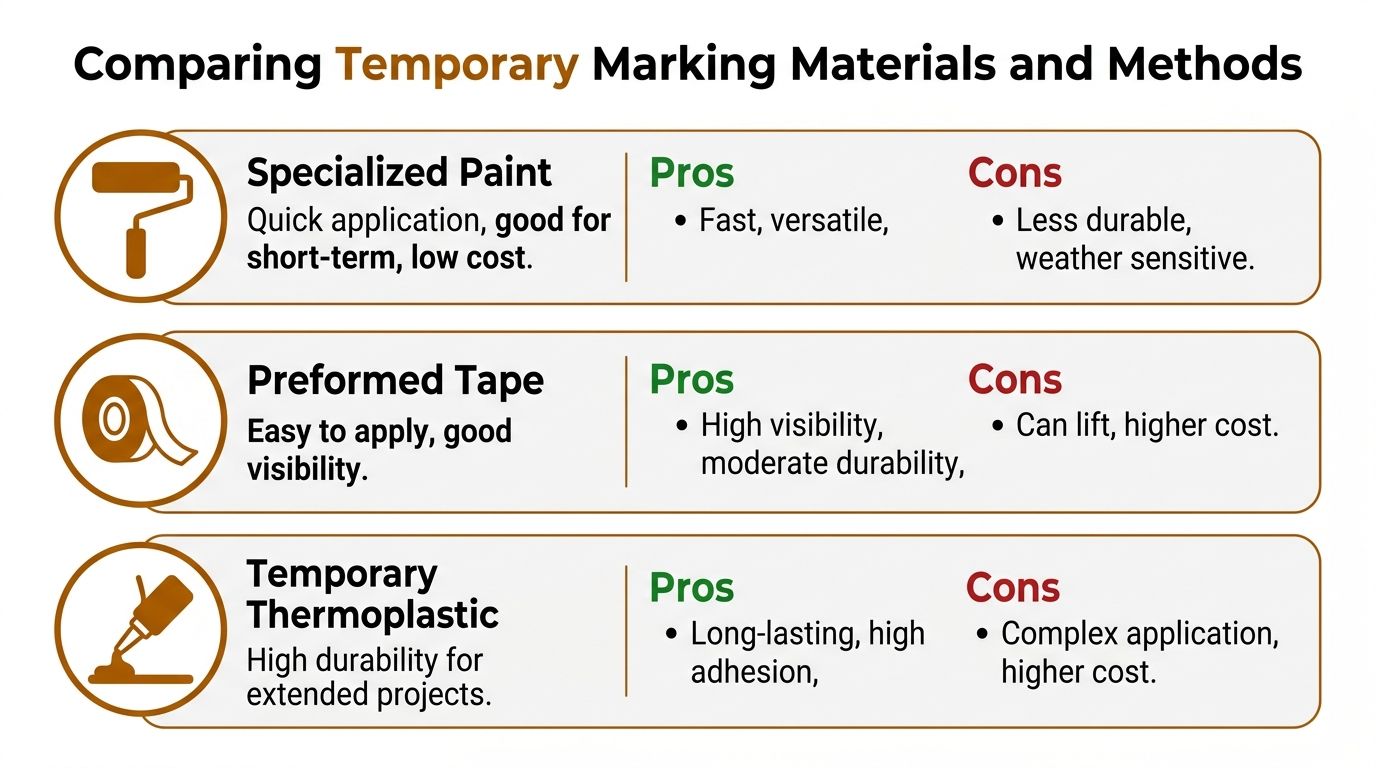
Paint for short windows
Specialized marking paint is often the fastest option to deploy. It's useful when you need a quick layout change for a short event, a brief traffic shift, or a simple reconfiguration on private property.
Paint's biggest advantage is speed. Crews can lay out arrows, temporary stalls, edge lines, and directional cues with minimal setup compared with more involved systems. It's also flexible for odd-shaped spaces, which helps on mixed-use sites in places like Dunnellon or Summerfield.
Its downside is durability. Florida rain, heat, and turning tires can wear paint quickly, especially if the surface is dusty, recently sealed, or still holding residual moisture. If the project timing is uncertain, paint can become a false economy because you may end up remarking sooner than expected.
Preformed tape for cleaner control
Preformed tape is often the better choice when visibility and removal both matter. For many temporary traffic patterns, tape gives a cleaner, more deliberate line than paint and can be a strong fit for commercial properties, phased paving, and controlled detours.
The product standard matters here. ATSSA guidance on short-term and temporary pavement markings states that temporary pavement marking tape must be a matte black, non-reflective, patterned surface precoated with pressure-sensitive adhesive, and it must be weather-resistant with no appreciable fading or lifting when applied per manufacturer procedures. In the field, that means the tape isn't just “sticky.” It's designed to bond correctly and stay put in work-zone conditions.
Tape works well when the surface is properly prepared and the timing is right. It does not work well when crews rush surface prep, apply over contaminated pavement, or ignore temperature requirements.
Temporary thermoplastic for heavier demands
Temporary thermoplastic is usually chosen when a project needs more staying power and a tougher bond than paint can offer. It can make sense on longer jobs or locations with steady traffic where a more durable marking is worth the added effort.
But it's not a universal answer. Application is more involved, and removal can be less forgiving if the wrong product lands on the wrong surface. For private property owners, that often makes thermoplastic a more selective option rather than the default.
What works in one setting can fail in another. A heavily traveled route in The Villages may justify the added durability. A short festival layout in Crystal River usually won't.
Temporary marking material comparison
| Material | Durability | Cost | Best For |
|---|---|---|---|
| Specialized paint | Lower than tape or thermoplastic in harsh weather and traffic | Lower | Very short-term events, simple layout changes, quick private-property adjustments |
| Preformed tape | Moderate to high when surface prep and installation are done correctly | Moderate to higher | Work zones, phased parking lot projects, cleaner removable layouts |
| Temporary thermoplastic | Higher for extended temporary use | Higher | Longer-duration traffic control where stronger adhesion is needed |
A good material decision usually comes down to three questions:
- How long does the layout need to last
- What surface is underneath
- How cleanly does it need to come off
If you're already planning parking lot striping and surface adjustments on a commercial site, it helps to treat temporary markings as part of the project sequence, not as an afterthought added the day before.
Common Use-Cases in Marion and Citrus County
A temporary layout usually gets tested at the worst possible time. The church parking lot fills up in Inverness ten minutes before an event starts. A shopping center in Ocala keeps half its stalls closed during sealcoating. Afternoon rain hits a work zone outside Belleview right as traffic backs up. In Marion and Citrus County, temporary markings have to stay clear under pressure, not just look good at install.
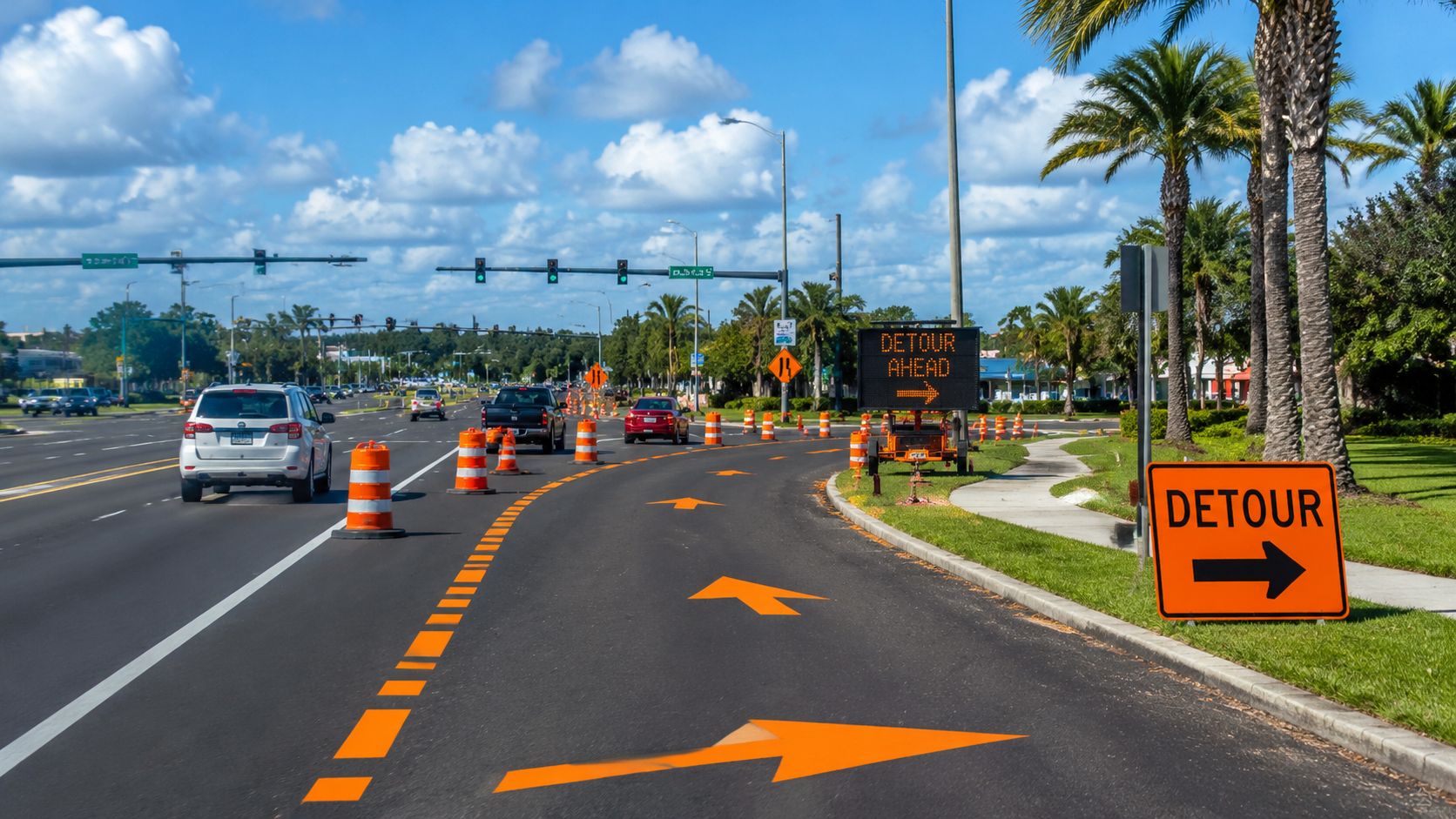
Work zones and lane shifts
Lane shifts are one of the most demanding temporary applications because drivers have almost no time to adjust. On connector roads near Ocala or smaller county routes near Belleview, a few cones and a vague arrow pattern are not enough. Drivers need a repeated path they can read at speed, especially near merges, intersections, and turn lanes.
In work zone transitions, MoDOT's temporary traffic control guidance calls for an intermittent pattern of 2 feet long at a 20-foot cycle for temporary pavement markings in those areas. The exact local setup still depends on the site, but the larger point holds. Repetition improves driver recognition through the shift.
For property managers coordinating resurfacing or utility work on private roads and lots, temporary striping should be planned with the rest of the traffic flow, not added at the end. If the site also needs permanent restriping after the work wraps up, it helps to review parking lot striping and surface planning services before the first closure goes in.
Events parking and phased lot work
This use-case comes up constantly in Central Florida. Crystal River festivals, school functions, church overflow parking, neighborhood events, and seasonal community gatherings all create short-term traffic patterns that were never part of the original lot design.
Quick paint can work for a one-day setup on a low-speed site where removal is not a concern and vehicle volume is manageable. Tape usually holds a cleaner line for multi-day events, vendor loading areas, and lots where cars keep making slow, tight turns. The trade-off is simple. Paint is faster and cheaper up front. Tape often gives drivers better guidance when the layout has to stay readable through weather and repeated traffic.
Phased commercial lot work is another common job in Marion and Citrus County. A medical office in Ocala, a retail center in Inverness, or a small plaza in Dunnellon may need to keep customers moving while one section is patched, sealcoated, or restriped. Temporary arrows, blocked stalls, and rerouted drive aisles keep the property operating and cut down on the confusion that leads to wrong-way moves and last-second backing.
The best temporary layout is the one drivers understand the first time they see it.
Pedestrian paths and access changes
Pedestrian reroutes need more discipline than many owners expect. During sidewalk replacement at an HOA in Homosassa or a multifamily property in Lecanto, the temporary path has to be obvious from a distance and easy to follow at walking speed. If people have to stop and guess where the route goes, the marking plan is already weak.
That problem shows up on mixed surfaces all over this region. A temporary path may cross older asphalt, fresh concrete, curb ramps, and patched sections in the same run. Each surface reacts differently, and removal matters just as much as visibility if the goal is to avoid turning a short-term fix into a cleanup job.
Homeowners run into the same issue on a smaller scale. During a driveway replacement in Beverly Hills, Hernando, or Silver Springs, temporary markings can direct guests, delivery vans, and service trucks away from fresh concrete and unfinished edges. A few well-placed cues often prevent tracking, tire damage, and unnecessary callbacks.
Durability in the Central Florida Climate
Central Florida is rough on temporary markings. A product can look good during installation and still disappoint once heat, rain, and traffic start working on it.

Heat and UV change the equation
In Marion County, FL and Citrus County, FL, summer pavement temperatures climb fast. On open sites around Ocala, Summerfield, and Dunnellon, the surface can get hot enough that poor-quality materials soften, shift, or lose bond. UV exposure adds another layer by fading weak pigments and aging adhesives faster.
That's why cheap temporary products often disappoint on Florida lots. They may look acceptable at installation, then start lifting at edges or losing clarity after repeated heat cycles. The failure usually starts where tires scrub the most, around turns, entrances, and stop points.
A good installer plans for those stress points, not just the straight lines.
Rain surface type and bond strength
Heavy rain is where surface prep gets exposed. If the pavement has dust, moisture, residue, or failing surface texture, tape and other temporary systems won't bond the way they should. Water finds the weak spot fast.
Surface type matters just as much as weather. Florida LTAP and FDOT policy updates covered in this Florida LTAP training video require all pavement markings on concrete bridges to be permanent tape rather than thermoplastic because thermoplastic doesn't bond adequately to concrete bridge decks under vibration. Even if your project isn't on a bridge, the lesson is important. Material-to-surface compatibility matters.
For Central Florida properties, that means:
- Asphalt behaves differently from concrete: A marking that holds on aged asphalt may react differently on hard concrete.
- Freshly sealed areas need caution: Some products won't bond well until the surface is ready.
- Rain timing matters: Applying before a storm window can undo good work.
- Traffic loading changes performance: Slow turns and braking zones are tougher than straight pass-through areas.
A durable temporary marking isn't just about the product. It's about timing, prep, surface condition, and where vehicles actually stress the layout.
That's why local experience matters so much from Crystal River to Belleview. Florida conditions don't forgive rushed installs.
DIY vs Professional Services for Your Project
Temporary markings look simple until the project has live traffic, surface sensitivity, or removal concerns. Then the hidden problems show up.

When DIY can work
DIY can make sense for a very small, low-risk setup on private property. A short-lived event on a simple paved area with light traffic is the usual example. If the layout is straightforward and there's no compliance issue tied to it, a limited do-it-yourself approach may be workable.
That said, “small” needs to stay small. Once the site has active through traffic, pedestrian exposure, delivery access, or a need for clean removal, the project leaves hobby territory.
Where projects go sideways
Most DIY problems aren't dramatic at first. The lines are a little off. The arrows aren't intuitive. The product bonds badly. Removal leaves residue or surface scars. Then the property owner ends up paying for corrections.
Removal is one of the biggest blind spots. A 2025 TRB webinar reported that 42% of DOTs lack standardized protocols for marking removal, which leads to inconsistent surface damage and rework costs. If public agencies still struggle with removal consistency, it's easy to see why private owners get into trouble when they use the wrong material or method.
Professional crews bring more than labor. They bring layout judgment, material selection, surface prep discipline, and a plan for removal before installation starts. That matters whether the project involves asphalt maintenance, concrete access changes, or a phased parking lot sequence tied to parking lot striping best practices.
Here's the practical line:
- Choose DIY for minor, low-speed, low-liability situations.
- Choose a licensed and insured contractor when safety, compliance, traffic flow, or surface protection matter.
- Choose local experience when Florida weather and mixed concrete-asphalt conditions are part of the job.
For most commercial sites, HOAs, churches, and active residential projects, professional work is usually the cheaper decision once you factor in cleanup, rework, and liability exposure.
Frequently Asked Questions About Temporary Markings
Do temporary markings need to be reflective
Not always. The right visibility standard depends on the use case, surrounding markings, and the control plan. Some temporary tape products are specifically described as non-reflective so they don't interfere with permanent reflective markings. The goal is clear guidance, not visual conflict.
How are temporary markings removed without damaging asphalt or concrete
Removal should be planned before installation. The method depends on the product, bond strength, surface age, and whether the base is asphalt or concrete. This is one reason mixed-surface properties need careful handling. If ADA access routes or parking adjustments are involved, it also helps to understand ADA parking lot striping requirements before the temporary layout goes down.
Do I need a permit for a temporary layout in Ocala or nearby towns
Sometimes, yes. It depends on whether the markings affect public access, roadway operations, site circulation, or event management requirements. Private property changes can still trigger local review in some situations. Check with the city, county, HOA, or event authority before assuming a temporary setup is exempt.
Can temporary markings be applied over fresh sealcoat
They can, but timing matters. Fresh sealcoat has to be ready for the marking system you plan to use. If crews rush the process, the bond can suffer and the finish can be damaged during removal. On active lots in Ocala, Inverness, or Crystal River, sequencing the work correctly is usually more important than trying to finish everything in one push.
If you need help planning temporary traffic flow, parking changes, or short-term pedestrian routing, Riverside Sealing & Striping, LLC provides licensed and insured support backed by local Central Florida experience. As Concrete and Asphalt Experts in Marion and Citrus County, the team handles both surface protection and pavement guidance with reliable scheduling, high-quality workmanship, free estimates, and no-pressure consultations for properties across Ocala, Dunnellon, Belleview, Silver Springs, Summerfield, Crystal River, Homosassa, Inverness, Lecanto, Beverly Hills, Hernando, and The Villages.