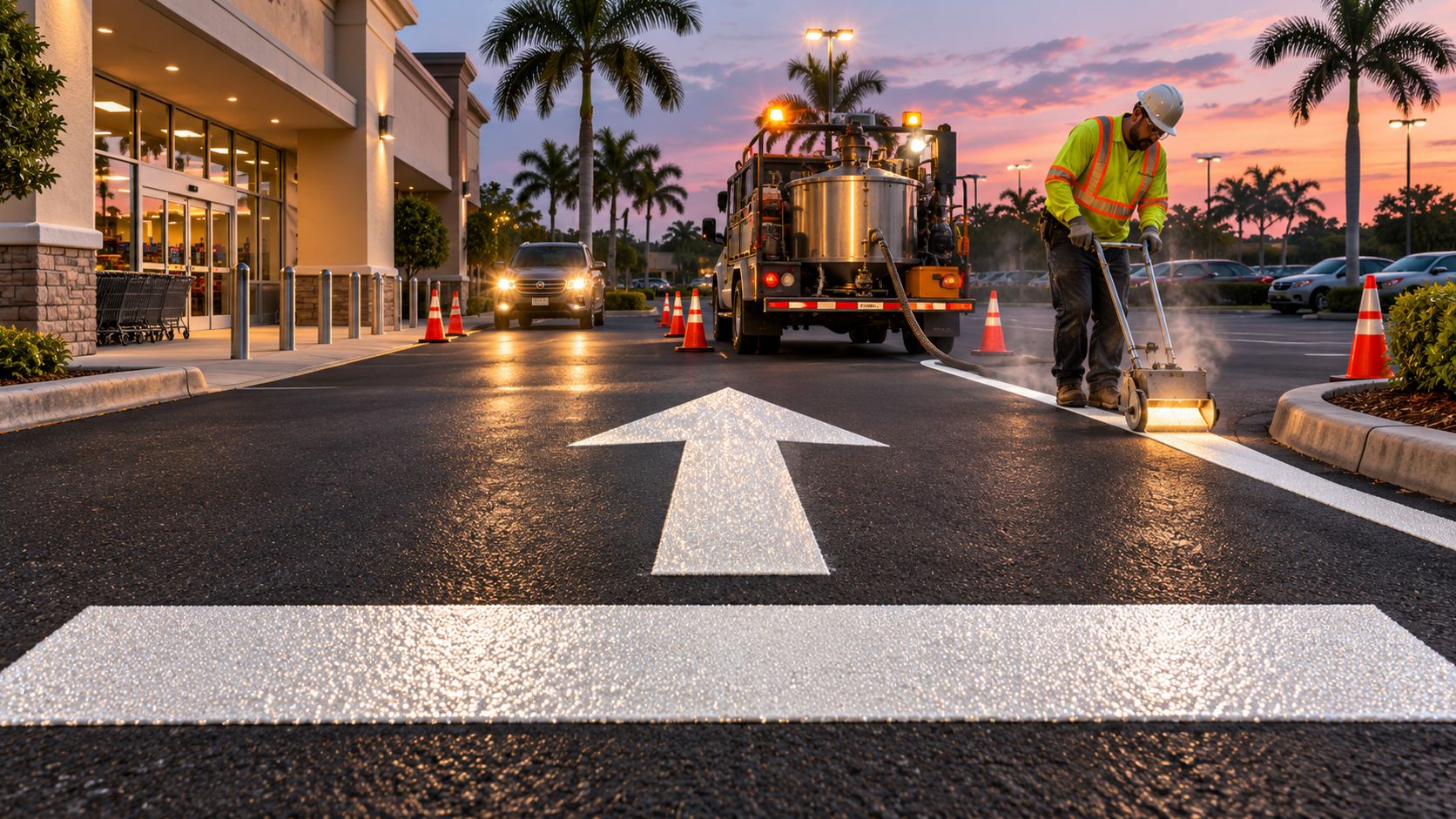
A little after six on a January evening, you're pulling out of a shopping center onto a busy road outside Ocala. The stall lines beside you look fine in the wash of the lot lights. Then your headlights catch the stop bar at the exit and it flares back at you hard enough to make you squint.
Same lot. Same traffic. Two different materials.
Thermoplastic pavement markings are the reason one line vanishes at dusk while the other glows, and the difference has almost nothing to do with color. It comes down to how the material is built, how thick it goes down, and whether the glass beads inside it are still doing their job.
If you own or manage property in Marion County or Citrus County, this matters more than it sounds. A faded stop bar at a retail entrance in Ocala or a dim accessible symbol outside a clinic in Crystal River isn't a cosmetic complaint. It's a safety detail, a liability question, and a line item you'll pay for either way. What follows is a plain-language tour of what thermoplastic is, how long it really lasts here, how crews install it, and where ordinary paint still wins.
Table of Contents
- What Thermoplastic Pavement Markings Actually Are
- Service Life Next to Paint and Epoxy
- How Crews Apply Hot Thermoplastic in the Field
- Heat Rain and Traffic on Central Florida Lots
- Why Thermoplastic Can Fade in Florida Rain
- Markings That Earn Thermoplastic on a Property
- Questions to Settle Before You Restripe
What Thermoplastic Pavement Markings Actually Are
Stand at the in-gate of a retail center near Crystal River at dusk and the split shows up fast. The painted arrows have chalked down to a pale ghost you can barely follow. The stop bar six feet away still throws a bright bar of light back at your bumper.
That stop bar isn't paint that dried thicker. Thermoplastic is a solid blend of binder resin, pigment, filler, and glass beads, shipped as blocks or pellets, heated in a melter until it flows, then laid on the pavement where it cools into a raised, bonded stripe. Think of the difference between a chalk line on a sidewalk and a speed bump. The chalk line has no body. The bump has body, and that body is the entire point.
The mental model: a thermoplastic line is a thin sheet of plastic glued to the pavement. The beads sitting in its top surface, half buried and half exposed, are what your headlights actually see.
Retroreflectivity is the term for the light a marking sends back toward a driver, measured in millicandelas per lux per square meter (mcd/lx·m²). It explains the trick every property manager has seen, where a line photographs beautifully at noon and disappears under headlights at nine at night. This has been the standard durable choice on public roads for a long time. A Vermont Agency of Transportation durability study drawing on four years of field data found thermoplastic had been the most frequently specified marking for new construction in that state since 1992, and that it generally held satisfactory retroreflectivity after nearly four years of service, settling into a range around 100–150 mcd/lx·m². The same body of four-year field measurement put thermoplastic at 89.9% average durability against 79.5% for waterborne paint.
Private property has caught up. The same material now shows up on asphalt lots and concrete drive lanes at HOAs and churches across Marion County and Citrus County, from Dunnellon and Belleview to Inverness and The Villages. It isn't always the answer. If you need a lane marked for one weekend event, temporary pavement markings are the right tool and thermoplastic is overkill. The rest of this guide covers how the material stacks up against paint and epoxy, the Florida thickness rules that decide whether a stripe lasts, how heat and traffic treat it here, and the cases where paint is still the smarter buy.
Service Life Next to Paint and Epoxy
Thermoplastic isn't a forever marking, and anyone selling it that way is overselling. It earns its price when a line has to hold both its position and its nighttime brightness past a single paint cycle. It wastes money where the same stalls get recoated every year anyway.
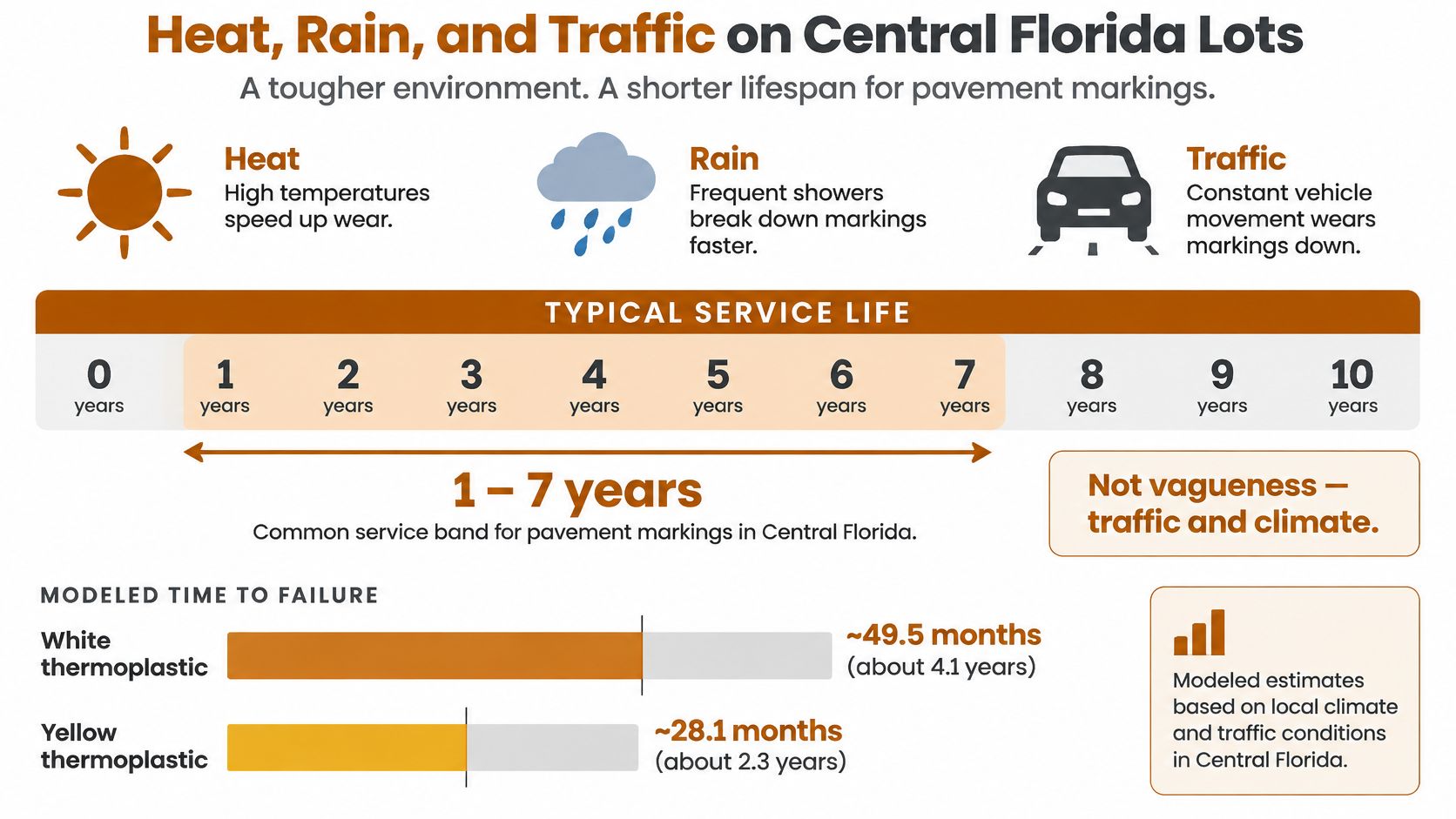
The Federal Highway Administration pavement-marking guidance puts thermoplastic at an approximate service life of 1 to 7 years, water-based paint at about 0.5 to 3 years, and epoxy at 2 to 5 years. The table works best as a buying guide.
| Material | Typical service life | Durability note | Sensible use |
|---|---|---|---|
| Water-based paint | 0.5–3 years | Shortest cycle; lower retroreflectivity in durable-material tests | Low-wear stalls and frequent cosmetic refresh |
| Epoxy | 2–5 years | Mid-range durable option | Moderate-wear lines where heat application is impractical |
| Thermoplastic | 1–7 years | Often 3–15 times longer than paint; best-case installs cited near 7–12 years | Stop bars, arrows, legends, and high-turnover entrances |
Why the thermoplastic row is so wide
That 1-to-7-year band isn't a hedge. It's an admission that traffic loading, climate, pavement condition, install quality, and maintenance timing all move the result. FHWA material on thermoplastic durability reports agency figures that thermoplastic typically lasts three to fifteen times longer than paint, calls it one of the most durable delineation techniques, and ties part of that durability to the material's thickness. A thicker stripe takes longer for tires to wear through, which is why the build specified at install decides so much of the lifespan. Some correctly applied installations have lasted about seven to twelve years in international experience.
Read that range honestly: seven to twelve years is an international best case built on sound pavement, careful prep, and controlled traffic. A Summerfield entrance or a Homosassa shopping lane where delivery trucks turn all day sits at the hard end of that range.
Water-based paint still earns its place. In a low-wear office field where the owner repaints on a yearly grounds budget, paint is cheap and simple, and a fresh coat reads as tidy. Epoxy sits between the two: a step up in durability for lines where melting and hauling hot material isn't practical, but it doesn't match thermoplastic on a surface taking daily braking.
The cost argument runs on restaging, not on material per foot. A stop bar or a turn arrow at the entrance to a shopping center costs money to close off, protect, install, and reopen. Doing that once every several years beats doing it every season. Bulk stall lines in a lot where nobody fights for the space don't earn the same treatment, and paying thermoplastic prices for them is how a striping budget gets wasted.
One more thing trips people up. Color is not brightness. A stripe can still hold most of its white or yellow pigment long after the glass beads that return headlight glare have worn smooth, pulled loose, or filled with dirt. "The lines still look okay" is a weak reason to skip replacement, because the service-life question on your lot is about beads, not pigment.
How Crews Apply Hot Thermoplastic in the Field
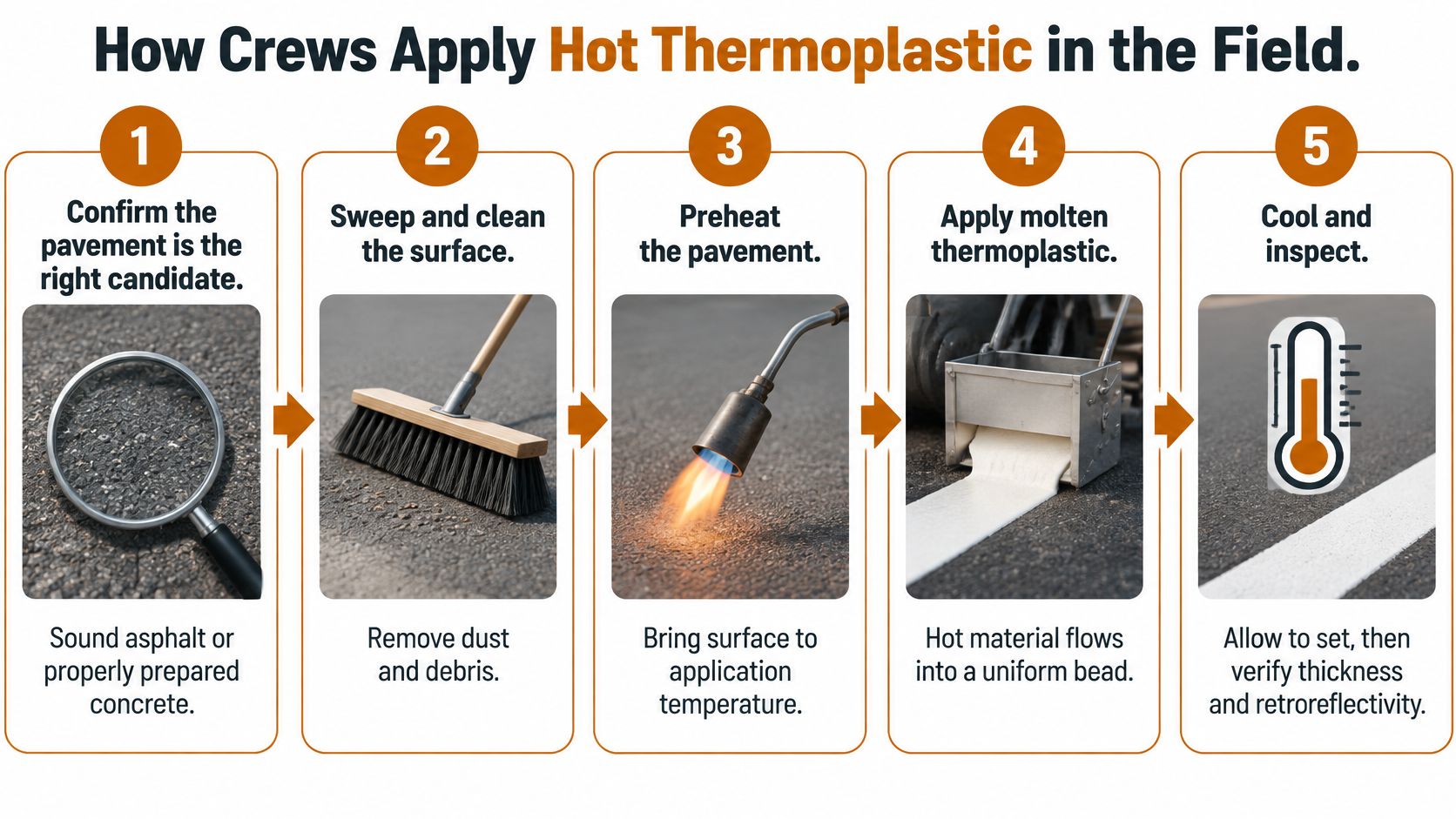
Application is a timed hot process where heat, thickness, glass beads, and cooling work as one system. The material arrives as dry blocks in a melter, comes up to temperature, gets laid at a controlled build, receives beads within seconds while it is still molten, then has to cool before anything drives on it. Miss the timing and the stripe may look bright on day one but lose grip, beads, or edge definition early.
On install day, the sequence is easy to watch if you know what each step protects.
The five field steps
- Confirm the surface will take a bond. Sound asphalt or properly prepared concrete needs to be swept free of sand, oil film, and loose old paint. Thermoplastic sticks to what is under it, so a dusty or greasy surface shortens life no matter how good the material is.
- Lay out before anything melts. Stall lines, arrows, stop bars, and ADA symbols get chalked and measured against the site plan first. Once resin is hot, the crew is on the clock and layout mistakes get expensive.
- Heat to the molten range and hold the specified build. Bulk stall lines and legends do not take the same thickness, and the extrusion shoe or spray gun has to move at a steady speed to hold it.
- Drop glass beads while the surface is tacky, then protect the cooling line. Beads have to land soon enough to grip, and vehicles kept off warm material avoid polishing those beads flat or smearing the edge.
- Check thickness and bead coverage, not color. A stripe can look perfect from the driver's seat and still be under build or poorly seeded.
Florida's specification makes the numbers concrete. The state standard for thermoplastic pavement markings sets standard longitudinal markings at 0.10 to 0.15 inch, or 100 to 150 mils, with chevrons, diagonal lines, stop lines, symbols, arrows, and messages at 0.09 to 0.12 inch, or 90 to 120 mils, sets initial retroreflectivity targets of at least 450 mcd/lx·m² for white longitudinal lines and 350 for yellow, with transverse markings at 300 and symbols at 250, and separates renewal work from new construction with lower minimum builds of 0.06 inch, or 60 mils, over an existing marking and 0.04 inch, or 40 mils, for hot-spray over existing longitudinal lines. New longitudinal work calls for Type 4-or-larger beads first, followed by a Type 1 drop, which makes bead choice and hot-surface timing the field checks that separate a real install from a quick one.
| Marking | Specified build | Acceptance clue |
|---|---|---|
| White longitudinal line | 0.10 to 0.15 in (100 to 150 mils) | 450 mcd/lx·m² initial retroreflectivity |
| Yellow longitudinal line | 0.10 to 0.15 in (100 to 150 mils) | 350 mcd/lx·m² initial retroreflectivity |
| Chevrons, diagonals, stop lines, symbols, arrows, messages | 0.09 to 0.12 in (90 to 120 mils) | 300 transverse; 250 for symbols |
| Renewal over an existing marking | 0.06 in (60 mils) minimum | Lower build than a new full-depth line |
| Hot-spray over existing longitudinal lines | 0.04 in (40 mils) minimum | Thinnest build; watch bead coverage closely |
The practical point is that a renewal coat and a new marking are different products. A quote that prices a skim over old lines as if it were new construction is leaving out material depth, and depth is part of what holds beads under turning tires.
Watching a crew work makes the timing easier to judge.
The link between build and bead performance shows up on small commercial lots. A thin line on a tight turning radius at a Lecanto plaza or a Beverly Hills drive-through loses its beads early, because there is less material holding them and more tire scrub pulling at them. If you are comparing bids for how to stripe a parking lot, ask what build the contractor will hold, whether the work is new construction or renewal, and how bead coverage gets checked before the lot reopens.
Heat Rain and Traffic on Central Florida Lots
Two stripes laid the same day, on the same asphalt, at the same thickness can still age years apart. Color does part of that work. Yellow thermoplastic loses its retroreflectivity sooner than white under the same conditions, so the practical move for a property manager is to budget yellow legends and yellow edge lines for earlier replacement than the white lines beside them.
Traffic exposure decides more than the calendar
A marking's service life works like tread on a tire: wheel passes matter more than the date of purchase. The Arizona Department of Transportation evaluation puts numbers on that idea. Hardened markings there carried estimated service lives of four to eight years, and thermoplastic posted the longest service life of the materials tested in both the colder and warmer climates. The same work found white thermoplastic edge lines on two-lane roads deteriorating more slowly than comparable lines on four-lane highways. A quiet HOA lane in Silver Springs is not living the same life as a four-lane retail drive in Belleview.
Florida gives thermoplastic one real advantage and several real enemies. With no snowplows grinding across the surface, intermix glass beads stay seated in the binder and keep returning light year after year. The enemies are local: UV chalking that dulls the surface, pavement temperatures that can soften fresh material on a July afternoon, summer downpours that leave a film of sand and pollen on the stripe, and turning tires at drive-throughs in Hernando, Homosassa, and The Villages that scrub the same patch of line all day.
Inspection trigger: walk entrances, stop bars, ADA symbols, and arrows twice a year, once after the wet season and once after peak season. Look for bead loss, oil stain, polished wear, and poor contrast against the pavement, not for missing paint.
Plan replacement where a safety mark has gone dim, and protect the pavement under the markings by sealcoating around them rather than over them. Seal coating keeps water, UV, oil, and fuel from breaking down the asphalt the stripe is bonded to, and once that bond fails, the line goes with it.
Why Thermoplastic Can Fade in Florida Rain
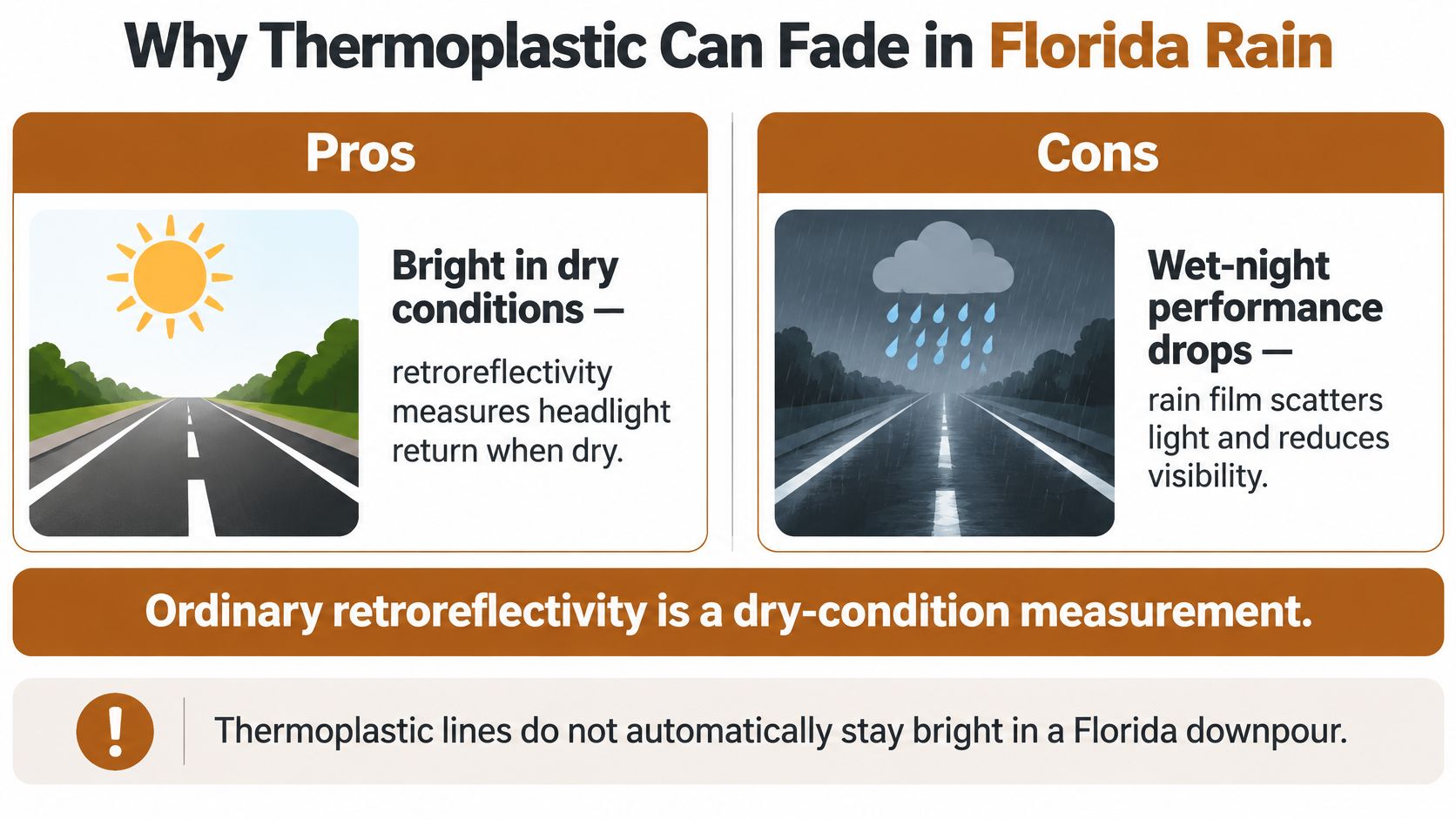
A common assumption is that a thermoplastic line stays bright in a downpour because it's the durable option. It doesn't follow. Ordinary retroreflectivity is a dry-condition measurement, and rain changes the optics.
FHWA research on newer marking systems separates the two cleanly. Measured wet-night detection distances ran only 60 to 80 percent of dry-condition distances, long-lasting wet retroreflectivity was described as not yet widely available, and after one winter just 3 of 16 yellow edge-line sections exceeded 100 mcd/m²/lx in wet retroreflectivity.
What actually improves wet-night performance
- Beads that stay partly exposed. A bead buried under binder returns nothing, and a bead worn flush returns very little.
- Surface texture. A slightly textured stripe scatters and returns more light than a polished one, which is why a glassy looking line can be the worse line at night.
- Drainage. Water has to leave the marking. A stripe sitting in a low spot at the entrance holds a film that kills the return no matter how much bead is in it.
- Clean pavement. Oil, rubber, pollen, and sand fill the gaps between beads and block light from getting back to the driver.
- A night check after rain. That's the acceptance test, aimed at entrances, ADA routes, arrows, and fire lanes, not a noon photograph from a phone.
Those figures come from highway studies rather than private lots, and the same water-and-glare problem shows up on a June afternoon at a Beverly Hills plaza. Inspect after the wet season instead of assuming a thick line solved rain visibility on its own.
Markings That Earn Thermoplastic on a Property
Walk a Marion County or Citrus County site the way a driver experiences it, starting at the street. That order tells you where the durable material belongs and where it's money spent on the wrong lines.
Where durable marks pay first
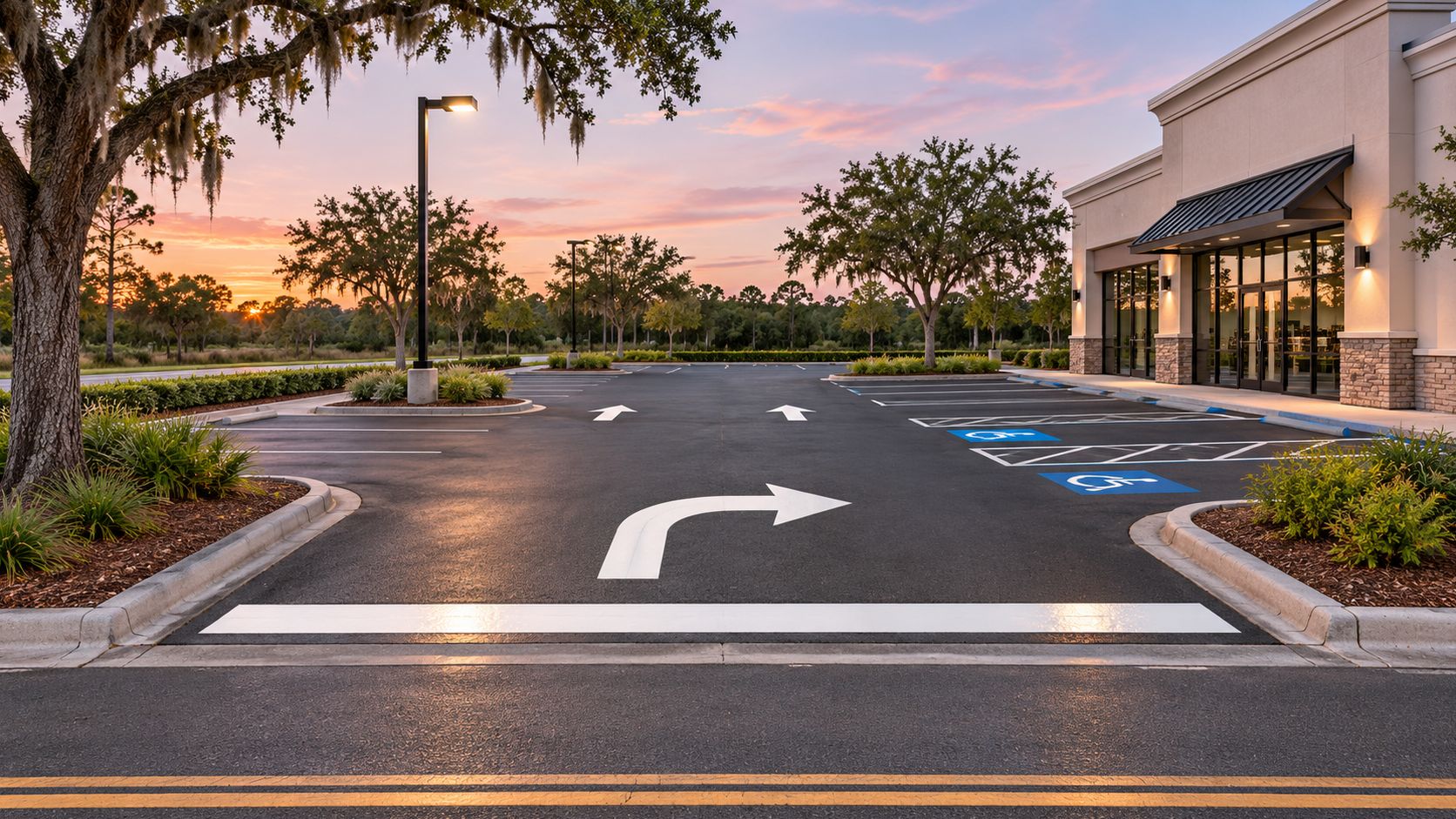
At the street, the stop bar and the turn arrow take the most braking and matter most at night, which makes them the first thermoplastic candidates on an asphalt entrance in Dunnellon or a concrete apron in Crystal River. Crosswalks and fire lanes come next, because a crosswalk nobody can see or a fire lane nobody can read is a safety problem rather than a cosmetic one.
ADA parking symbols, access aisles, and the route from those stalls to an accessible walk follow. The symbol has to stay legible, and the adjacent sidewalk or curb ramp is usually concrete, so the marking decision and the walking surface should be planned in the same conversation. Directional arrows and drive-through lanes wear in a tight radius and repay a thicker mark. The ADA parking lot striping requirements that govern stall and aisle geometry are worth reading before any layout changes.
Three site pictures show how the split plays out in practice:
- An Inverness retail center restripes only the entrance and accessible stalls in thermoplastic and keeps the field on paint, which puts the money where drivers make decisions.
- An HOA in Summerfield puts thermoplastic on the crosswalks across its asphalt spine and treats the concrete sidewalks as a separate repair item, so a spalled panel doesn't stall a striping job.
- A school loop in Lecanto watches the parent queue polish the yellow legends fastest, so yellow gets budgeted for earlier replacement than the white edge lines.
What should wait
- Failing pavement. Repair broken asphalt or a spalled concrete slab before bonding a thick line to it, or the stripe fails with the surface.
- A fresh sealcoat or an oily stall. Neither holds a bond worth paying for.
- A low-traffic church or office field already on a yearly repaint cycle can stay on paint.
- A stall plan a tenant will redraw. Grinding thermoplastic off is a separate project with its own cost, so don't lock in a layout that's still in flux.
The one-line rule: spend the durable material where a faded mark changes a driving or walking decision, and use paint everywhere else.
Questions to Settle Before You Restripe
Can thermoplastic go on concrete as well as asphalt
Yes, when the slab is sound, clean, and dry. A cracked driveway, heaving sidewalk, or spalled apron in Marion County or Citrus County should be repaired before anyone bonds a legend to it, because the stripe can only be as stable as the surface under it. Plenty of properties need a concrete walk or ramp repair and asphalt entrance work in the same plan, and doing them together keeps the finished layout coherent.
How soon can vehicles return
Only after the stripe has cooled and bonded. There's no stock one-hour answer worth trusting, since a thin line on a cool morning sets faster than a heavy build on a sun-baked Citrus County lot in August. Ask the crew to confirm the line is ready before you reopen the drive aisle, and sequence the work so the last stripes to cool sit at the exit rather than the entrance.
When is this a contractor job rather than a maintenance task
When the job includes ADA spaces, stop bars, arrows, or a changed layout, or when nobody on site can manage traffic control and thickness checks between customers. Melting and hauling hot material safely, laying out accessible stalls to the right dimensions, and holding a specified build take equipment and practice.
Riverside Sealing & Striping, LLC is a family owned and operated concrete and asphalt contractor built on 3rd and 4th generation tradespeople, based in Dunnellon and working across Marion County, Citrus County, Ocala, Belleview, and Inverness. Parking lot striping work covers precision layout and line striping, ADA handicap space markings, and arrow and symbol application. Free, no-pressure consultations and estimates run from 7am to 7pm.
Walk the entrance at night before you book anything. If the stop bar, the arrows, or the accessible symbols have gone dim, that's the list to bring to a consultation, and it's a far better starting point than a square-footage count.
Riverside Sealing & Striping, LLC handles both halves of this work for Central Florida properties, the striping side and the pavement side, from layout and ADA markings to sealcoating and concrete repair before a stripe ever goes down. If your stop bars and arrows have gone dim, a free, no-pressure estimate between 7am and 7pm will tell you which markings are worth thermoplastic and which can stay on paint. Visit Riverside Sealing & Striping, LLC to schedule a walkthrough.