
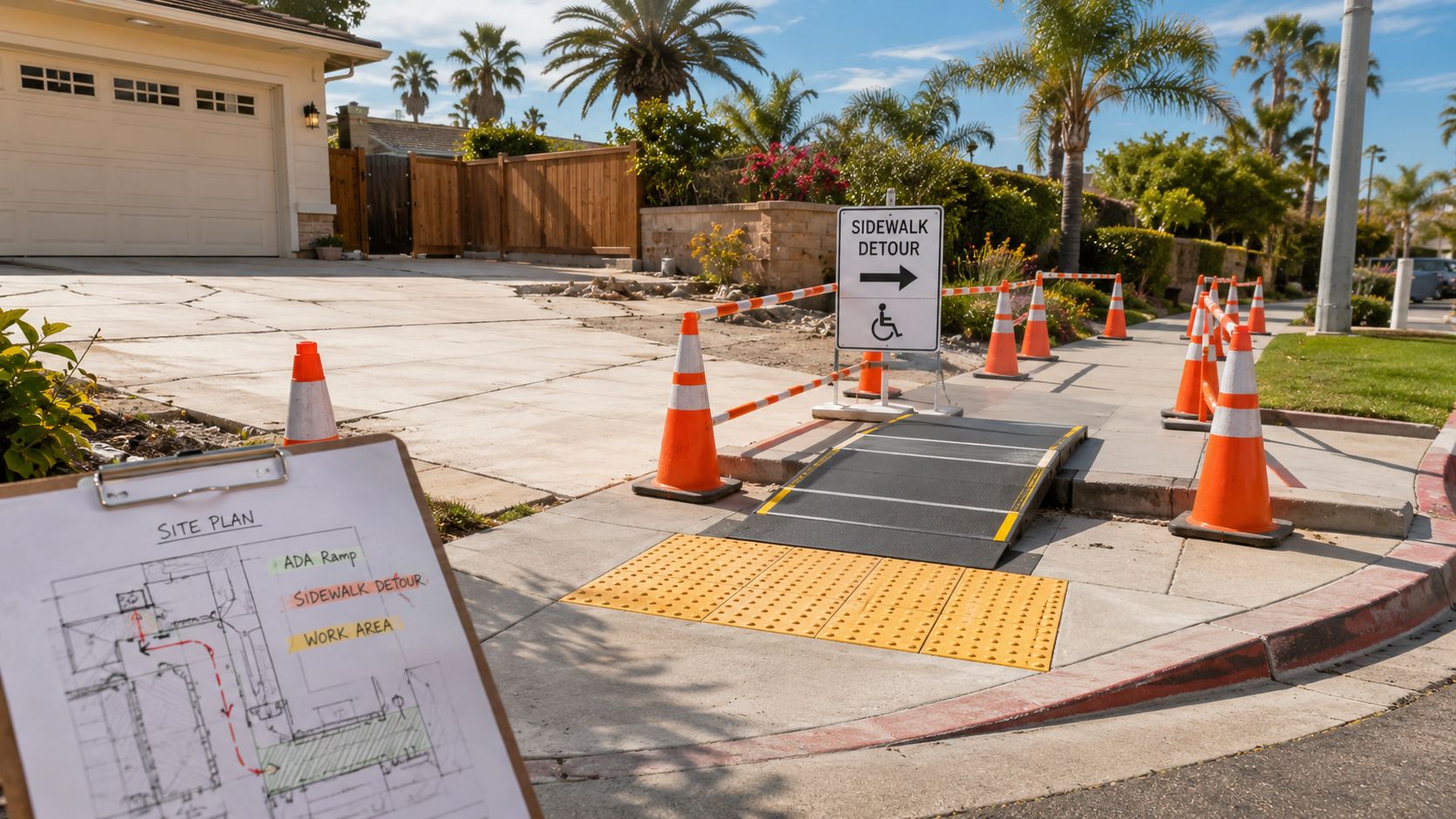
A small project can go sideways before the first piece of equipment ever rolls in. In Ocala, a property manager can be looking at a cracked lot, a church in Inverness might be trying to keep Sunday traffic moving during sealcoating, or an HOA in The Villages may be planning sidewalk replacement and realizing that the problem isn't the concrete, it's keeping people moving while the work happens. That's where traffic management planning earns its keep.
This isn't just a barricade layout. It's the practical work of protecting drivers, pedestrians, deliveries, ADA routes, and emergency access while a site is under construction or maintenance. For driveway and sidewalk projects in Marion County, FL and Citrus County, FL, especially in places like Dunnellon, Belleview, Silver Springs, Summerfield, Crystal River, Homosassa, Inverness, Lecanto, Beverly Hills, Hernando, and The Villages, the difference between a compliant plan and a workable one can be the difference between a smooth job and a shutdown.
Traffic management plans matter because congestion has a measurable cost in time and reliability. FHWA reports that peak-period trips took about 37% more travel time in 2003 than a free-flow trip at midday, up from 28% a decade earlier, and travelers were spending 47 extra hours per year in travel versus 40 hours in 1993, while the share of freeway mileage experiencing congestion grew from 51% to 60% over the same period, with highway usage growing at roughly 2% per year (FHWA congestion summary). That's why a work zone plan has to be written like a field strategy, not a guess.
Table of Contents
- Why Central Florida Sites Need a Traffic Plan Before the First Cone
- Walking the Site to Identify Risks and Access Constraints
- Designing Temporary Traffic Flow Around a Tight Frontage
- Choosing Signs, Barricades, and Channelizing Devices That Actually Work
- Phasing the Work to Shorten Disruption and Control Cost
- Permits, Compliance, and the Paper Trail That Holds Up
- Sample Plan and Common Mistakes to Avoid on Small Florida Jobs
Why Central Florida Sites Need a Traffic Plan Before the First Cone
A cracked parking lot looks like a paving job. In practice, it's also a circulation problem, and in a place like Ocala or Crystal River that can turn into a customer-service problem by lunch.
The common mistake is thinking, “We'll just put up some cones.” That works only when the site has generous frontage, easy detours, and no one depends on the blocked path for daily access. On small Central Florida properties, the closure often touches a driveway, a sidewalk, a tenant entrance, or an ADA route, and that's where the job stops being simple.
A traffic management plan keeps the site functioning while the work is active. It protects the crew, keeps the public out of live work areas, and gives the owner a way to explain who can enter, where they can go, and when access changes. On school-adjacent streets, tourist corridors, and tight commercial lots, that clarity matters because people don't read a site the same way a contractor does.
Practical rule: if a closure changes how someone enters, exits, parks, or crosses the site, it needs to be mapped before the first cone goes out.
For driveway and sidewalk work in Marion County, FL and Citrus County, FL, the plan also has to account for daily operations. A shared driveway in Summerfield, a church lot in Beverly Hills, or a frontage lane in Homosassa can't always tolerate full shutdowns. A plan that looks compliant on paper but kills access on Tuesday morning isn't a good plan.
FHWA's traffic management framework makes the point clearly, planning now centers on measurable performance such as travel time index, planning time index, congested hours, and percent of vehicle-miles traveled under low-speed conditions (FHWA HRT-23-051). That's the right mindset for local work too. You're not just placing cones, you're managing movement.
Walking the Site to Identify Risks and Access Constraints
The best plans start with boots on the ground, not a sketch pad at the office. Walk the site from the street edge inward, and look at it the way a driver, a pedestrian, a delivery truck, and an emergency vehicle would see it.
Start with the entries and exits
Check every driveway throat, every gate, and every side access point. Note where traffic naturally stacks, where backing movements happen, and where vehicles have to turn around. If a box truck, school bus, or citrus hauler uses the same road network, that matters immediately in Hernando and Lecanto, where narrow approaches can leave very little forgiveness.
Then look at pedestrian movement. People don't follow cones as neatly as crews hope, especially when they're crossing between parked cars or cutting through familiar routes. Temporary barriers can't block the only safe path to a front door, mail kiosk, or bus stop.
Catch the site hazards that get hidden later
A good walk reveals the details that disappear once equipment arrives. Drainage grates can get buried by barricades, overhead clearances can limit delivery trucks, and a driveway approach can blind drivers to incoming traffic. In low-lying lots around Dunnellon and Crystal River, afternoon storm cells can change a dry staging area into a flooded pinch point in minutes.
Document the walk with a simple sketch, a photo set, and a short list of conflict points. That becomes your baseline when you decide where to stage materials, where to reroute pedestrians, and which lane can stay open. If you need to verify underground conditions before cutting, use a proper locate process, not assumptions, and keep your records tied to the plan, not your memory. Underground utility location guidance belongs in that file.
The point isn't paperwork for paperwork's sake. The point is to surface the handful of decisions that will make or break the job.
A strong site walk usually reveals fewer than a dozen real conflicts, but those few items drive most of the schedule risk.
Designing Temporary Traffic Flow Around a Tight Frontage
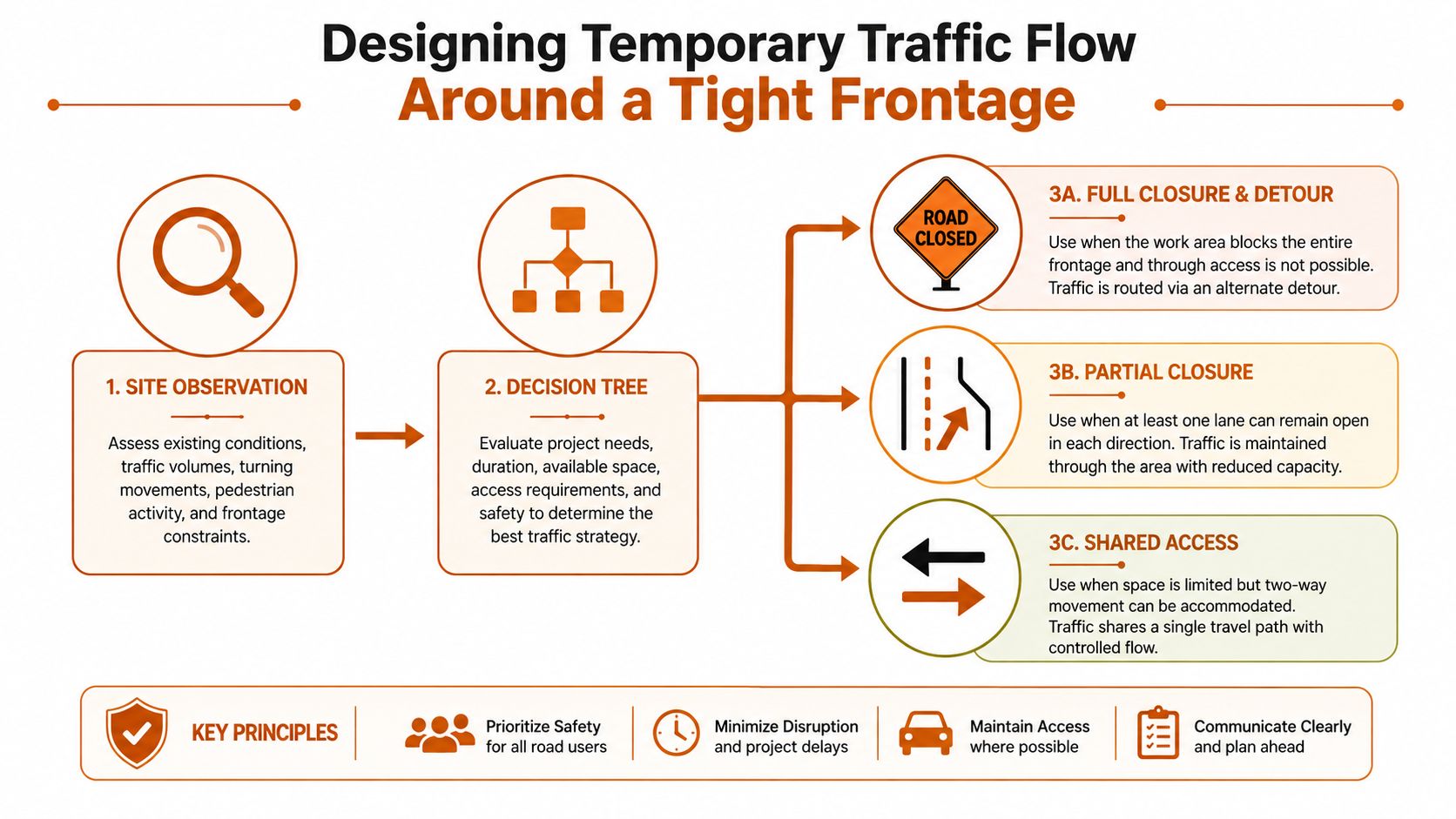
A tight frontage forces choices. You usually have three workable paths, and the wrong one can create more congestion than the repair itself.
Pick the closure type that matches the geometry
A full closure with off-site detour makes sense when the site can't safely keep traffic moving through the work area. A partial closure with one-lane alternating flow works when the frontage is narrow but controlled, and the crew can manage access with spotters, timing, or staging. A staged closure with shared access is the best fit when part of the lot has to stay open all day, especially at properties with active tenants or resident traffic.
A Belleview shopping center with one driveway may need a staged closure so retail stays reachable. A Summerfield HOA with two shared entries might work better with alternating access, especially if residents can enter one side while the other side gets repaired. A Silver Springs museum lot with tour bus drop-offs needs turning space and clear queue control, not just a row of cones.
The geometry tells you what works. Turning radii tell you who can make the turn. Stacking distance tells you how many vehicles can wait without spilling into the street. And if you're dealing with a stop-controlled internal route, you have to think about how many cars can be served before the backup starts affecting the public road.
Decision test: if a truck or resident vehicle has to back out blindly because of your layout, the flow plan isn't finished.
A defensible sketch shows where people enter, where they wait, and where they're supposed to go if the preferred route is blocked. That's also the place to confirm your temporary pavement markings and re-entry logic before anyone starts staging materials. Temporary pavement markings guidance fits here because the markings have to support the movement plan, not fight it.
Choosing Signs, Barricades, and Channelizing Devices That Actually Work
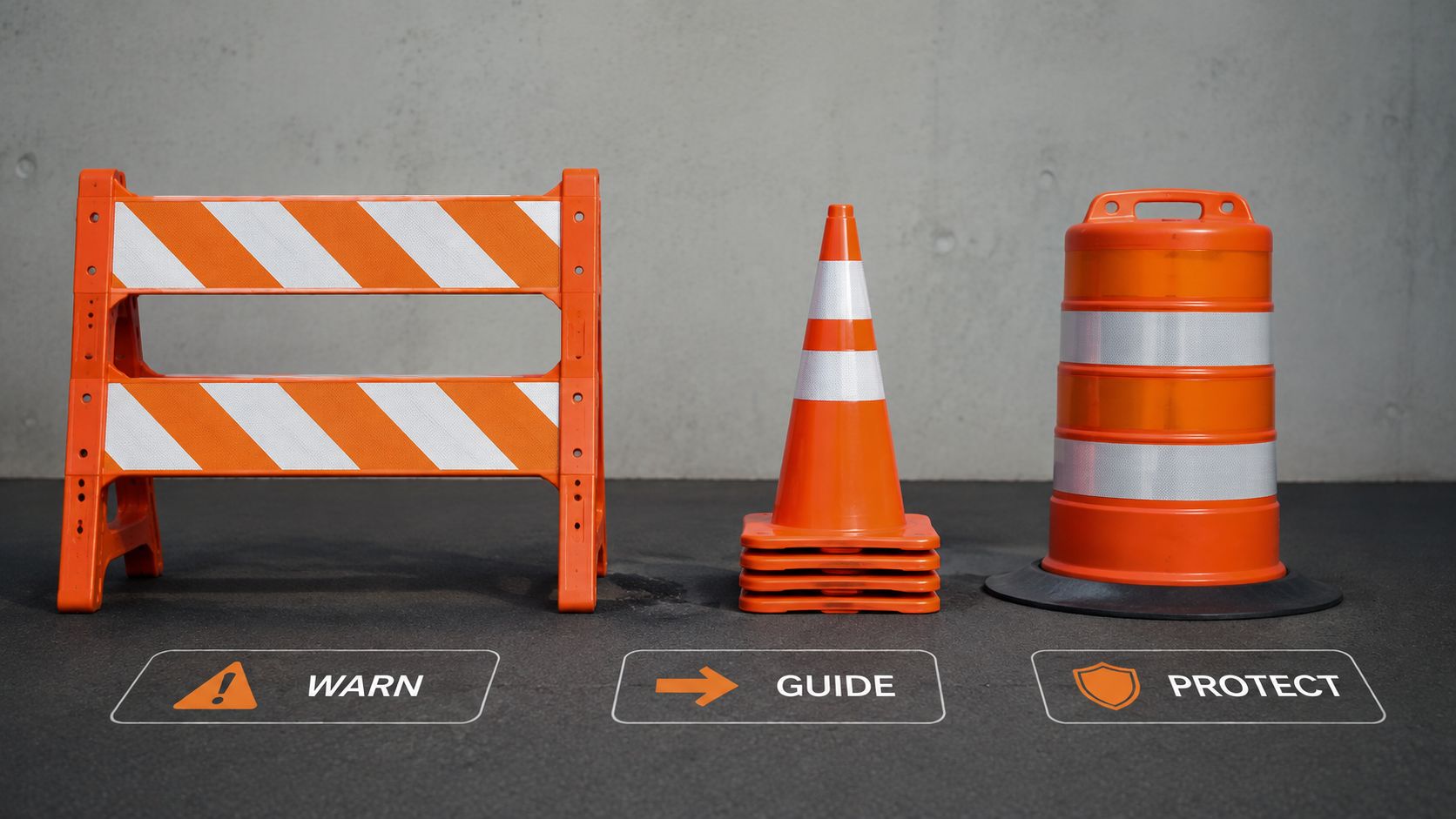
Most field failures start with device choice, not with the sign printer. The right setup separates warning, guidance, and protection, and those jobs aren't interchangeable.
Use the right device for the job
A Type III barricade is for a stronger physical message, especially where a path is closed to pedestrians or vehicles and the barrier needs to be unmistakable. Cones are better for channelizing, defining a path, or narrowing a lane. Drums are heavier, more visible, and harder to blow over when the weather turns rough.
On a hot Central Florida afternoon, retroreflective sheeting and sign placement matter because glare and rain both reduce readability. A cheap cone that tips over in a summer squall is worse than useless, because it tells the public the site wasn't thought through. The device has to match the wind, the speed environment, and the amount of confusion the site already has.
Treat pedestrian routing as a compliance item
A generic “Sidewalk Closed” sign doesn't solve an ADA problem by itself. If the sidewalk is blocked, the alternate route has to be usable, which means stable surface, workable slope, drainage that doesn't create a puddle trap, and a path that doesn't force pedestrians into live traffic lanes. Detectable warnings matter at ramps, and the path has to connect to the next safe point instead of dumping people into the street edge.
In The Villages, that may mean routing residents across a stabilized mulch path during sidewalk replacement if the site conditions support it. At a church entrance in Beverly Hills, it may mean a temporary curb ramp and a clearly marked crossing path that stays out of the vehicle lane. On both, the plan has to be legible to the inspector and the person using it.
Austroads notes that traffic studies commonly collect vehicle and pedestrian flows, waiting-vehicle counts, bicycle flows, parked-vehicle counts, vehicle occupancy, speeds, travel times, and delay components, and recommends automatic counts for at least a three-day period when traffic generation data are being collected (Austroads AGTM03-17). That same measurement mindset applies to pedestrian reroutes. If you can't describe the route plainly, the route probably isn't ready.
The lesson is simple. Spend a little more on the correct device, and you usually avoid citations, complaints, and field improvisation later.
Phasing the Work to Shorten Disruption and Control Cost
Phasing is where a job either stays manageable or turns into a full-site shutdown. A good phase plan lets the owner keep part of the property open, and that often matters more than finishing every square foot at once.
Build the schedule around access, not just production
For parking lot sealcoating and restriping, the usual move is to split the lot so half stays open while the other half cures and gets striped. For a shared HOA driveway, a concrete replacement may need to happen in two halves so residents always have a usable entry. Near schools in Ocala, sidewalk pours often have to be timed around off-peak periods so pickup windows stay clear.
That's why phasing has to be argued in terms of risk, not convenience. Faster completion can mean longer access loss if the site gets shut all at once. Lower mobilization cost can mean more disruption if the owner keeps pushing for a single pass. There isn't a universal answer.
A contractor should be ready to explain why the chosen sequence protects ADA continuity and pedestrian routing. If a ramp or walkway has to stay open, the temporary path has to remain stable and connected while the work advances in segments. That means the phase line belongs on the sketch, not just in the schedule notes.
The cure time matters too, especially when concrete is involved. How long concrete takes to cure affects when a reopened path is safe to use, not just when it looks finished.
If a phase saves a day of production but cuts off the main pedestrian route, it's usually the wrong phase.
A smart sequence is one the property owner can defend to tenants, residents, or board members without hand-waving. That's the standard that keeps the work moving and the complaints down.
Permits, Compliance, and the Paper Trail That Holds Up
The paperwork has to travel with the work. If the plan lives only in someone's email inbox, the site loses time when the first question comes up.
Keep the permit package on site
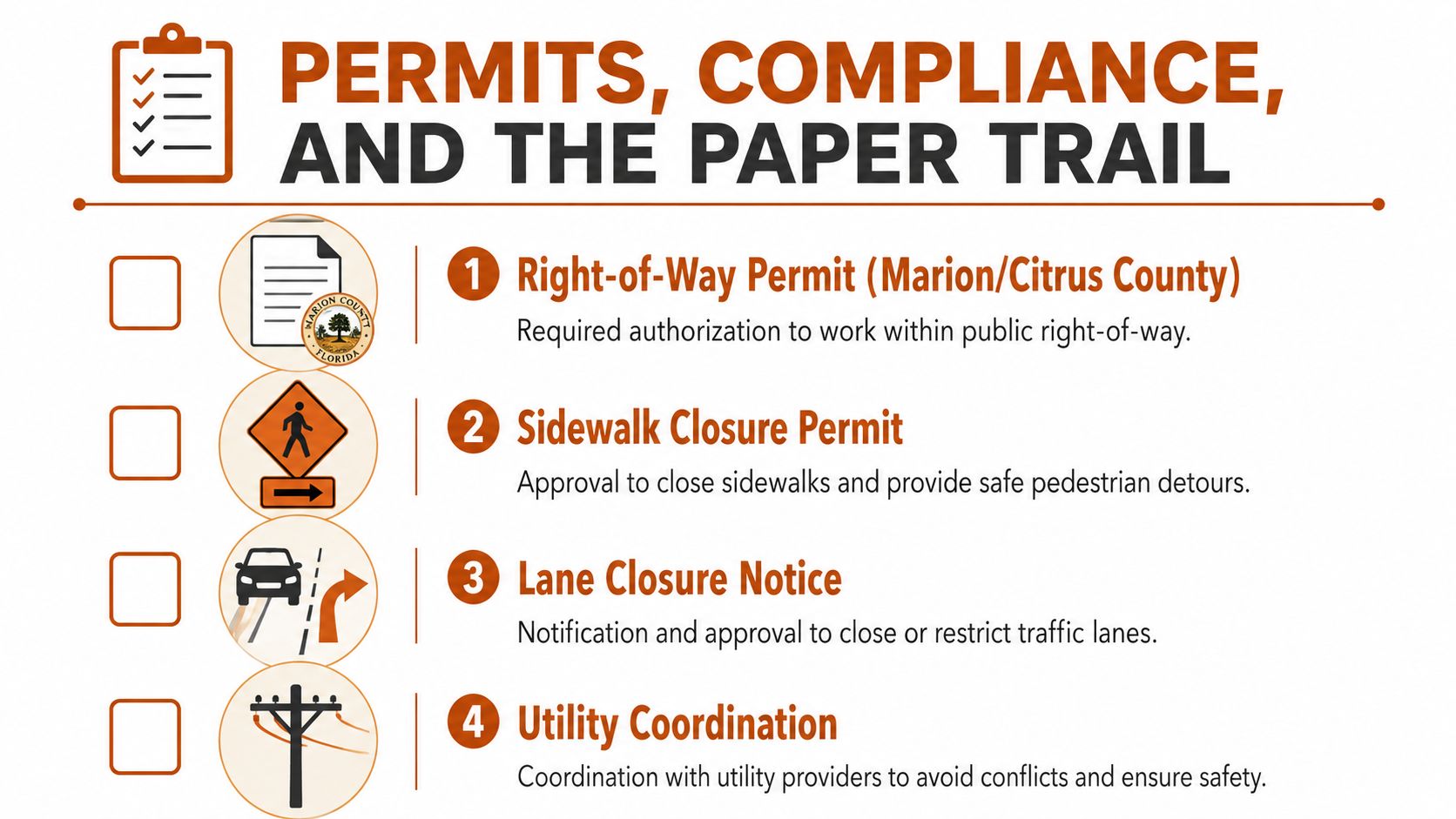
For Central Florida work, the usual checklist starts with the right-of-way permit from Marion County or Citrus County when the job touches public space, plus any sidewalk closure permit, lane closure notice, and coordination with emergency services if access routes change. The field set should also include the approved plan, a contact list, and any required insurance certificates.
The items most often missed on smaller jobs are the ones that create the most friction. Tenants need notice ahead of time, a 24-hour contact line needs to be real, and the contractor's insurance should be aligned with the project requirements before the first barricade shows up. If the owner wants a clean handoff, the documents need to be ready before the crew is.
Use one message and adapt it by audience
A single message can be reshaped for tenants, HOA boards, and the general public without rewriting the whole notice. The core facts stay the same, the tone changes.
- Pre-project notice: “Work will begin on [date]. Portions of the driveway and sidewalk will close in phases, and access routes will change during active work hours.”
- Day-of update: “The scheduled closure is now in place. Please follow posted detours and use the temporary pedestrian route.”
- Post-project thank-you: “The work is complete, and access has been restored. Thank you for your patience during the project.”
For tenants and customers, the message should focus on entry points, deliveries, and parking access. For residents and HOA boards, it should emphasize safety, visitor access, and the phase schedule. For people just driving past the site, a short notice with the basic detour and timing is enough.
FHWA's shift toward performance-based traffic management makes this paper trail more than an administrative habit. The plan should document what was intended, what was implemented, and what changed when field conditions changed. That's the file that holds up when someone asks why the lot was staged a certain way or why the sidewalk detour had to move.
Sample Plan and Common Mistakes to Avoid on Small Florida Jobs
A solid small-job plan doesn't need to be fancy. It needs to be clear enough for the crew, the owner, and the people using the site.
A simple sample plan for a 40-space lot in Dunnellon
For a 40-space lot getting sealcoating and restriping, start by closing one half of the lot and keeping the other half open. Post the closure at the entry, route pedestrians away from active work, and keep the accessible path open until the next phase is ready. Once the first half cures, shift traffic to the finished side and repeat the process.
Checklist, in plain order:
- Confirm access windows: Identify school pickup, tenant deliveries, and resident peak times before setting the schedule.
- Brief the crew: Make sure the sealcoat team knows the pedestrian reroute and the boundary of each phase.
- Verify night work options: Confirm the striping subcontractor can work after hours if the lot needs to stay half-open.
- Keep ADA routes continuous: Don't assume cones alone satisfy the pedestrian access requirement.
- Update the plan after each phase: If field conditions change, the plan should change too.
The most common misses on jobs like this are predictable. Crews ignore the school pickup window. Nobody briefs the sealcoat crew on where pedestrians are supposed to go. The striping subcontractor shows up without a workable after-hours plan. Someone assumes a row of cones handles ADA access by itself, and that's where complaints start.
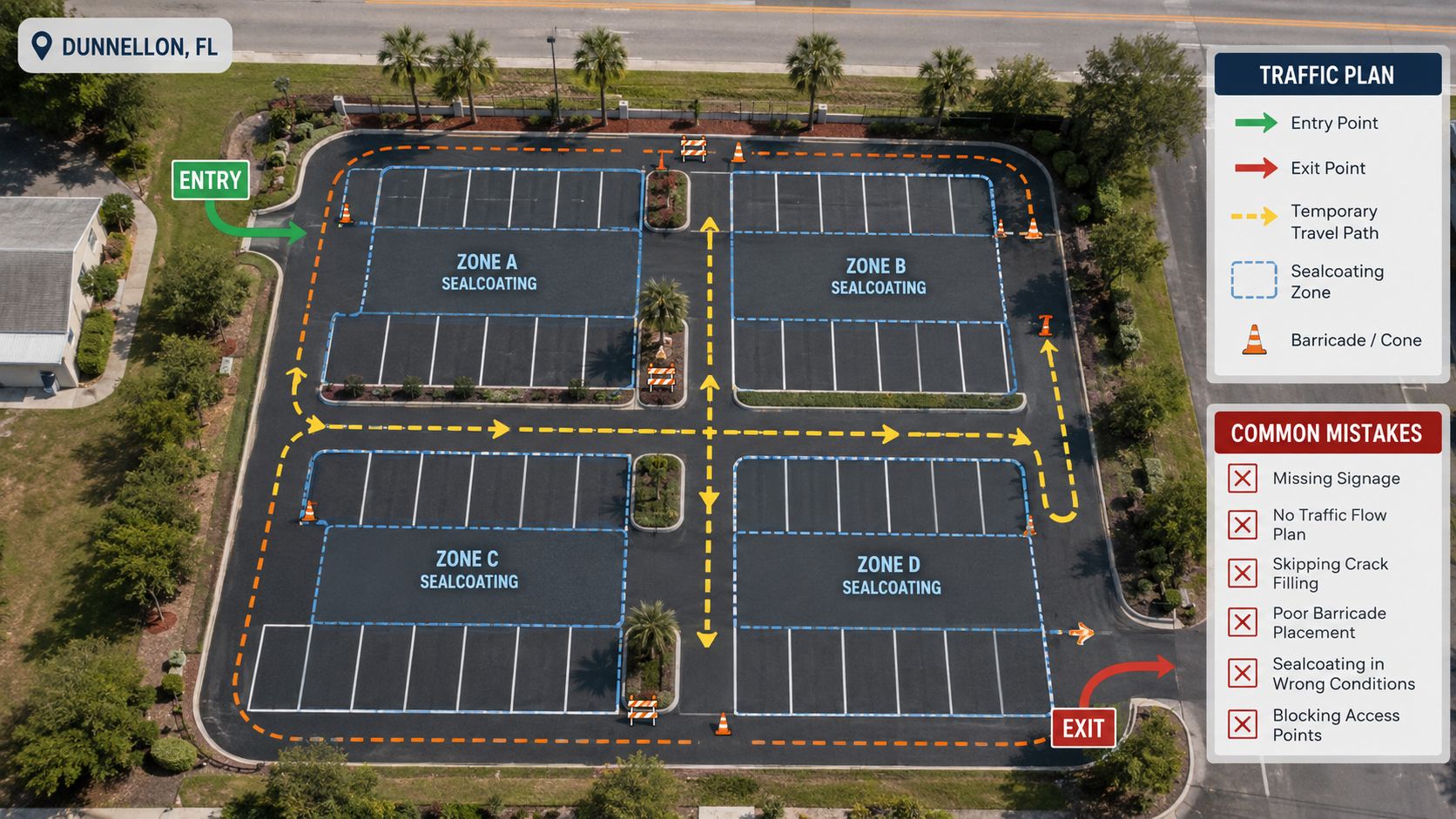
A traffic management plan is a living document. It gets better when the crew updates it after each phase instead of treating the first version like scripture. On small Florida jobs, that kind of discipline is one of the lowest-cost ways to stay on schedule, protect access, and avoid expensive rework.
If you're planning driveway, sidewalk, sealcoating, or striping work in Marion County or Citrus County, Riverside Sealing & Striping, LLC can help you think through the access plan before the first cone goes out. Visit Riverside Sealing & Striping, LLC to request a free, no-pressure on-site consultation and estimate, and get a practical plan that keeps the project moving and the property usable.