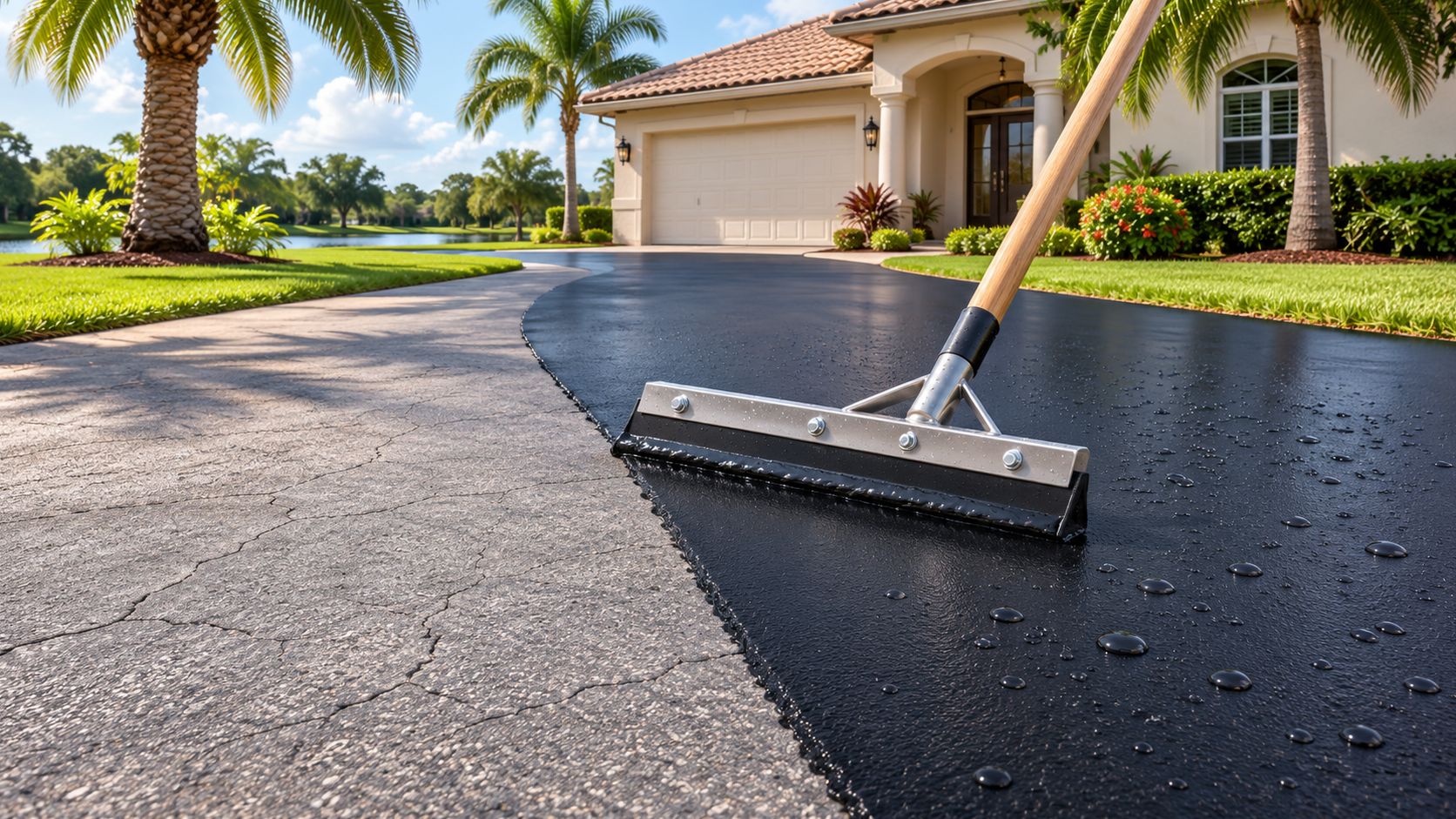
Sealcoating is a thin protective liquid coating, usually an asphalt emulsion, applied over sound existing asphalt to slow water intrusion, oxidation and surface wear. On pavement that suits it, it can extend service life by about 1 to 4 years, while heavier asphalt-and-aggregate surface treatments reach roughly 3 to 7 years.
If a black coat delivers that much value, why does it sometimes peel within a season, or leave a lot looking sharp while a pothole grows underneath? Because sealcoating isn't paint and it isn't a repair. It's preservation, and it only pays off when the pavement beneath the film is still structurally sound. That single distinction separates a smart maintenance decision from an expensive cosmetic one.
Property owners across Marion County, FL and Citrus County, FL face this choice every year, from Ocala and Belleview to Crystal River and Inverness. Sun, summer downpours, delivery trucks and golf carts all work on the same surface. Some of those driveways and lots are asphalt, some are concrete, and the right answer isn't always a new coat of sealer. Here's how to tell which situation you're in.
Table of Contents
- A Thin Shield for Asphalt
- How a Sealcoat Protects Asphalt Layer by Layer
- Sealcoating Compared With Other Pavement Treatments
- When Sealcoating Works and When Repairs Come First
- What Happens During a Sealcoating Job
- How Florida Heat, Rain and Traffic Shape Sealcoating
- Get a Professional Evaluation Before You Seal
A Thin Shield for Asphalt
Sealcoating is a thin protective liquid coating, usually an asphalt emulsion with or without fine aggregate, spread over an existing asphalt driveway, parking lot or road. Think of it as sunscreen and a raincoat for pavement rather than a new roof. It defends the surface you already have, and it does nothing for the structure holding that surface up.
The ASTM International specification for water-based asphalt-emulsion pavement sealer describes the material as a weather-protective coating built from asphalt binders derived from crude petroleum, often blended with mineral fillers such as clay, silica, limestone, slate, basalt or slag, and sometimes clean, durable aggregate. Those fillers aren't decoration. They add body, improve traction, and help the film resist traffic and sunlight.
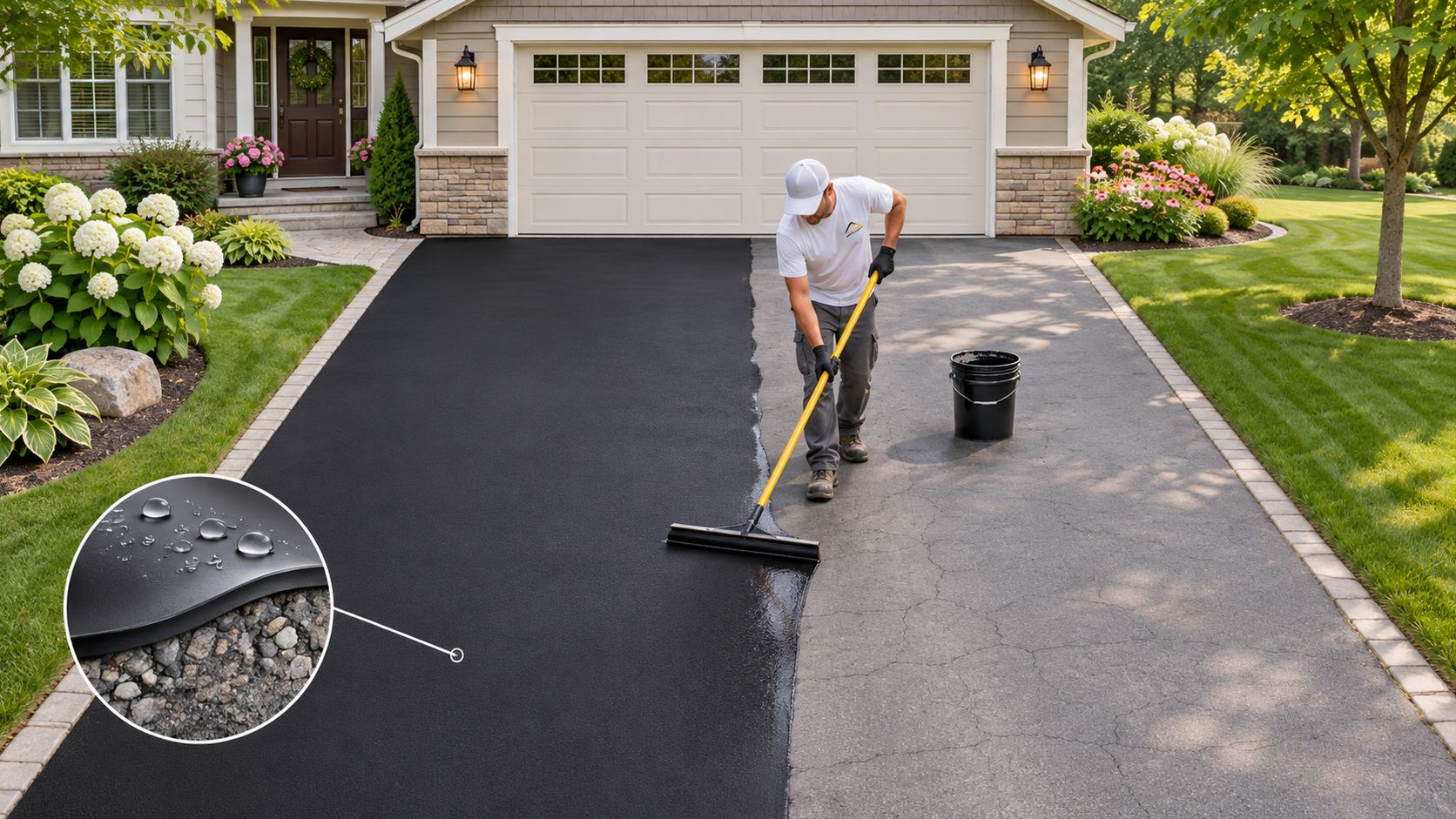
A squeegee pass is what lays that film down evenly and pushes it into the pores of older pavement.
What Is Sealcoating Made Of
Not all black sealer is the same product. Water-based asphalt emulsions dominate modern residential and commercial work. Coal-tar sealers are a different chemistry entirely, and the U.S. Geological Survey's sealcoat research links freshly applied coal-tar-based sealcoat to approximately 1,000 metric tons of polycyclic aromatic hydrocarbon emissions annually in the United States, with releases from newly sealed pavement running tens of thousands of times higher than from unsealed pavement. Some jurisdictions restrict those products outright.
In practical terms, sealcoating works best on asphalt that is still sound. The Federal Highway Administration's preservation guidance makes the point that preservation treatments succeed when the right treatment meets the right pavement at the right time, which rules out pavement with major base failure, deep rutting or widespread cracking.
Driveways and lots in Dunnellon, Summerfield and The Villages sit under intense sun and repeated summer storms, so the coating earns its keep here. It just can't fix a pothole, level a rut, or rebuild a base that has already gone soft.
How a Sealcoat Protects Asphalt Layer by Layer
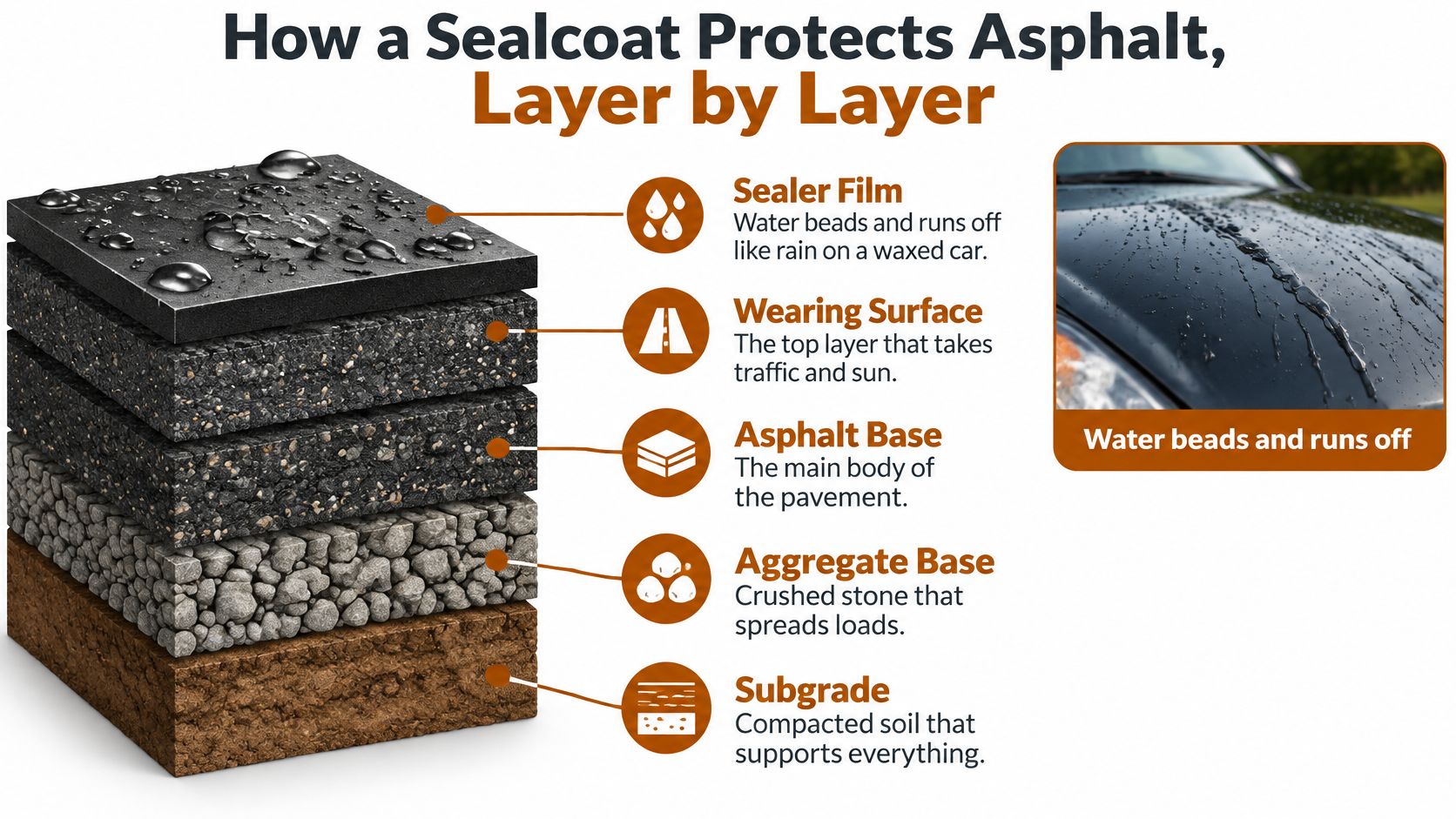
Asphalt is a stack, and every layer has a job. From the top down you have the wearing surface that takes traffic and sun, the asphalt base that forms the body of the pavement, a bed of crushed aggregate that spreads loads sideways, and compacted subgrade soil that carries everything. A sealcoat adds only a film above the wearing surface. It never becomes part of the load-bearing structure.
Waxed car paint is the closest everyday comparison. Water beads and rolls off instead of soaking in. That beading is the whole mechanism, and it's also what tells you the film is still working.
The Three Ways Asphalt Ages
- Water intrusion: Rain finds hairline cracks, runs down into the base, and softens the support under the pavement. Soft support is how potholes begin.
- Oxidation: Sun and air pull the asphalt binder apart over time, turning a flexible black surface gray, dry and brittle.
- Raveling: The surface slowly loses aggregate, so it looks grainy and sheds loose stone under tires.
A sealer closes hairline cracks and restores some of the flexibility the binder has lost, which slows all three processes at once. FHWA guidance on seal coats and chip seals is direct about the boundary: these treatments are not structural layers, even though they create a durable wearing surface. Potholes, base failures, major alligator cracking and severe deformation need repair or reconstruction before any surface protection goes down.
The illustration below shows the stack in order and the one thin film doing the protecting.
A Downspout Example
Picture a driveway where a gutter discharges onto the pavement about six feet from the garage. Every storm sends a concentrated stream across the same strip, which dries into a web of hairline cracks. Sealcoating helps here: it sheds most of that water before it enters the cracks and slows the rate at which the surface breaks down.
What it can't do is dry out soil that has already been saturated for years. If that strip feels spongy underfoot or has settled into a shallow dip, the fix is drainage and base work, then sealing afterward. Seal and you'll be back next spring.
Sealcoating Compared With Other Pavement Treatments
The list below ranks treatments by the pavement condition each one suits, not by price. That ordering matters, because the cheapest option for a failing lot is often the one that fails again in a year.
Sealcoating and other pavement treatments compared
| Treatment | Best-suited pavement | Typical life extension | Fixes cracks or structural damage |
|---|---|---|---|
| Sealcoat or fog seal | Excellent to good condition | About 1 to 4 years (FHWA crack and fog seal range) | Closes narrow cracks only; no structural repair |
| Crack seal | Sound pavement with isolated cracks | About 1 to 4 years (FHWA crack and fog seal range) | Seals the crack; no structural repair |
| Slurry seal | Low-severity surface wear | About 3 to 7 years (FHWA asphalt-and-aggregate range) | Seals low-severity cracks; no structural repair |
| Chip seal | Sound pavement needing a tougher wearing surface | About 3 to 7 years (FHWA asphalt-and-aggregate range) | Seals fine cracks; not a structural layer |
| Mill and overlay | Sound base with a worn surface | Set by the thickness of the new asphalt | Restores the surface; addresses surface distress only |
| Full-depth reconstruction | Failed base, potholes, deep rutting | Full design life of a new pavement | Rebuilds the structure |
The FHWA pavement preservation reference puts crack and fog seals at roughly 1 to 4 years of added life on suitable pavement and heavier asphalt-and-aggregate treatments at roughly 3 to 7 years. It also draws a line between slurry and chip seals. A slurry seal spreads a mixture of asphalt emulsion, well-graded fine aggregate and mineral filler across the surface. A chip seal applies binder and then rolls aggregate chips into it, which produces a beefier wearing course.
What the Field Data Says
Longer-term evidence exists. A 2024 National Center for Asphalt Technology study evaluated preservation treatments on field sections installed between 2012 and 2019, producing four to eleven years of performance data depending on location. In short, the treatment type, the pavement it went on and the climate all show up in the results.
Decision rule: choose the treatment that matches the pavement's condition first, then compare prices between contractors bidding the same treatment. Comparing a sealcoat quote against an overlay quote tells you nothing useful.
A church in Ocala with light oxidation and no cracks is a sealcoat job. A church lot with broken pavement at the entrance needs patching and crack repair first, and the same budget buys less sealer and more repair. For a closer look at how the sealer families differ, see this guide to types of asphalt seal coat.
When Sealcoating Works and When Repairs Come First
A fresh black surface looks finished. On failed asphalt it is only a cover. Sealcoating suits sound pavement that is wearing at the surface: gray from the sun, tight hairline cracks, light staining. A FHWA walkthrough of preservation treatments states the limit directly. Coating a structurally failed or water-saturated area leaves the defect in place and does nothing to restore load capacity.
The sealer works like sunscreen on intact skin, not a cast on a broken bone. It slows water, ultraviolet light, oil, and fuel from working into pavement that still has its strength. It cannot close a wide crack, fill a hole, or firm up a soft base. Coat those problems first and the film peels, while the water underneath keeps breaking the pavement apart.
Pavement condition and sealcoating suitability
| Observed condition | Sealcoating appropriate? | Required first |
|---|---|---|
| Light surface oxidation or graying | Yes | Clean and inspect the surface |
| Hairline to narrow cracks | Yes | Crack fill before sealing |
| Oil or fuel staining | Yes, after treatment | Degrease and clean the stained area |
| Wide cracks or alligator cracking | Not alone | Repair the cracked area first |
| Potholes or soft spots | No | Patch and correct the base |
| Rutting or shoving | No | Correct the structural problem |
| Standing water or drainage problems | Not until fixed | Correct drainage first |
Crack filling is a job of its own. When you are deciding whether the surface needs repair before any coat, this page on asphalt patching before you seal covers that repair side.
Why the condition check comes before the calendar
Coats fail early when they go down over major distress or a weak base that nobody corrected. Service life then depends on the pavement underneath, the traffic, and the weather, not on how recently someone sprayed sealer. Waiting until the lot looks bad enough to bother you often means the damage has already left the surface. Inspect while oxidation and hairline cracks are still the whole story. Once the base is soft, another coat cannot buy that time back.
Two examples
A driveway in Crystal River that has gone gray, with hairline cracks and no soft spots, is a strong sealcoat candidate. Clean it, fill the cracks, seal it, and repeat before the gray turns into raveling.
A church lot in Citrus County with two potholes near the entrance is a different job. Those holes mean water has reached the base. Patch and correct the base first, then seal the rest of the lot on the same visit. The sealer protects the sound pavement. It does not rebuild the entrance.
Before you request a quote, answer three questions. Is any part of the surface soft or sunken? Are the cracks wider than a finger? Does water sit anywhere after a storm? A yes to any of them means repair comes before coating.
What Happens During a Sealcoating Job
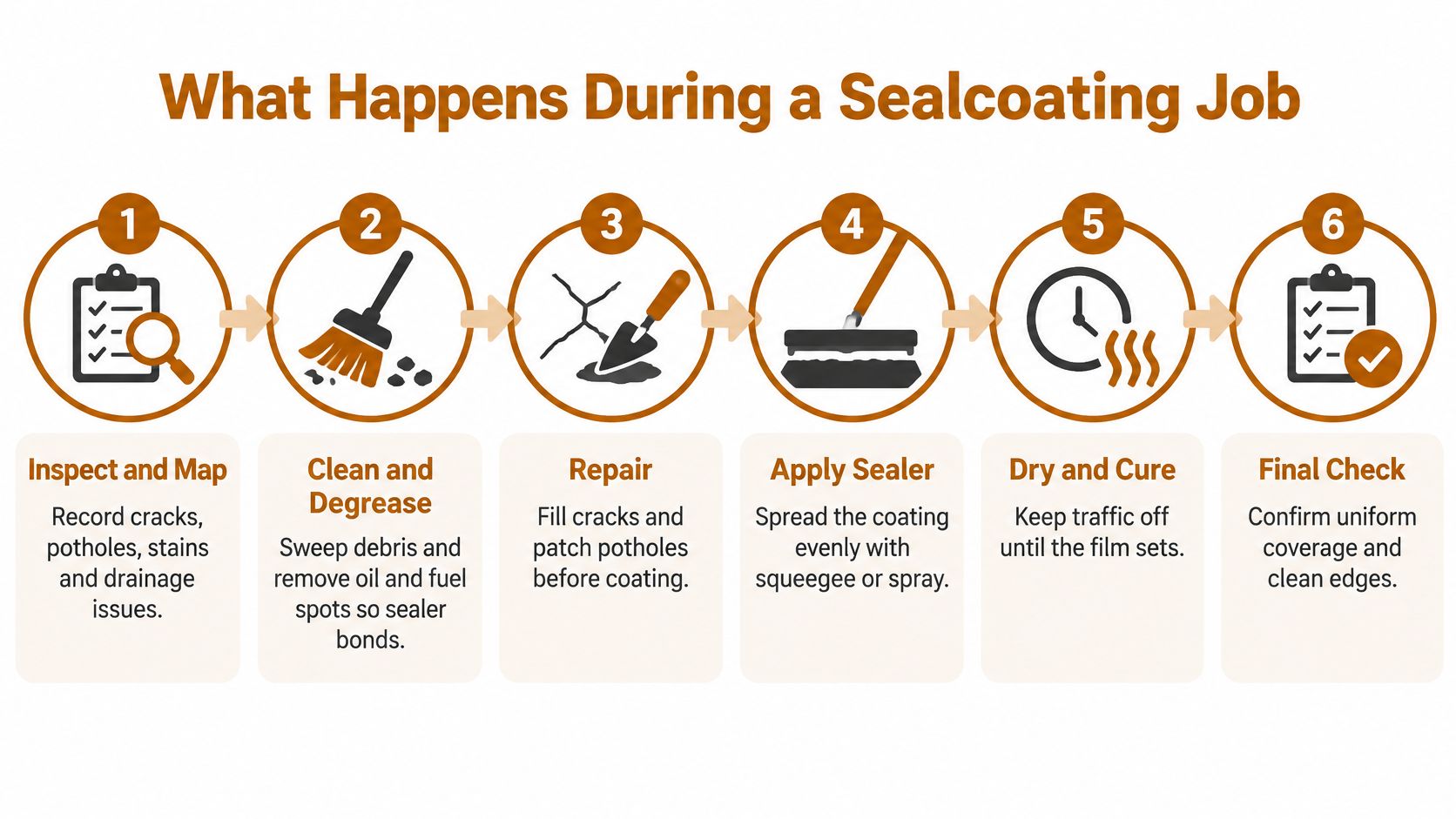
A professional job follows a sequence, and every step exists for a reason. Skip any one of them and the coating fails early, usually in a way that shows up as peeling or bald patches within a season.
- Inspect and map the surface. The crew records cracks, potholes, stains and drainage issues so nothing gets buried under a fresh coat.
- Clean and degrease. Debris comes off with blowers, brooms and edgers, and oil or fuel spots get treated. Sealer won't bond to a contaminated patch.
- Fill cracks and patch potholes. This happens before any coating, because sealer lacks the structure to bridge a crack or level a hole.
- Let repairs cure. Fresh patch material holds moisture. Sealing over it too soon traps that moisture and weakens the bond.
- Apply the sealer in thin, even coats. A squeegee pushes product into the pores on older pavement; spray gives a uniform finish on larger lots. Most jobs get two coats, with the second after the first has set.
- Keep traffic off until it cures. Plan on at least a day with no vehicles or foot traffic, and give it two in humid weather when the emulsion takes longer to lose its water.
- Re-stripe the markings. Lines, arrows and ADA spaces go down after the surface has fully cured, never while it's still tacky.
What You'll See on the Day
Expect a strong smell during application, a crew working in sections, and a barricade line you'll need to respect. Move cars off the surface the night before, keep pets and children clear, and shut the windows on the side of the house nearest the work. One short, heavy shower within hours of application can ruin the finish, which is why scheduling looks at the forecast, not just the calendar. If you're planning around it, this explanation of asphalt seal coat drying time covers how cure works in Florida humidity.
Once it cures, expect a deep, uniform black finish and clean edges. It will fade gradually with sun and tires, and that fade is the signal to start thinking about the next application.
How Florida Heat, Rain and Traffic Shape Sealcoating
Four local forces decide how well a sealcoat performs here, and none of them behave like they do up north.
Heat. Summer surface temperatures soften the film and accelerate aging of the asphalt binder underneath. Sealing in the cooler months gives a better cure and a longer service window, so spring and fall are the busy seasons for a reason.
UV. Constant, intense sun is the main driver of oxidation, and it's why an unsealed lot in Marion County turns gray and brittle faster than the same lot in a milder climate. A sealed surface slows that graying.
Rain. The summer wet season, roughly June through September, brings short violent downpours and ponding. Drainage and timing matter more than any other variable: sealer applied hours before a storm washes away.
Traffic. Golf carts, RVs, delivery trucks and steady customer traffic in places like The Villages, Crystal River and Homosassa wear a surface faster than a residential driveway ever will, so commercial lots need closer attention.
Sandy soils across Citrus County add a wrinkle. Water moves easily through sandy subgrade, so an open crack lets storm water reach the base quickly and soften it. Keeping the surface sealed and the drainage graded away from the pavement is cheaper than rebuilding a base.
A Dunnellon storage facility with box trucks turning in and out all day and a Lecanto driveway used by two cars don't share a schedule. Same climate, different wear.
Get a Professional Evaluation Before You Seal
Sealcoating preserves sound asphalt. It doesn't rebuild a base, level a rut, or rescue pavement that has already failed, and the product and preparation matter as much as the coating itself. Those four sentences carry most of the decision.
Call for an evaluation when you see potholes, cracks wider than a finger, water sitting after a storm, or a lot that needs new striping, ADA spaces or a presentable entrance. A proper evaluation includes a condition survey of the whole surface, a product recommendation that fits local rules and nearby drainage, a preparation and repair plan, and a realistic schedule that accounts for cure time.
Riverside Sealing & Striping, LLC is a family owned and operated concrete and sealing company made up of 3rd and 4th generation professionals, based in Dunnellon and serving Marion County, Citrus County and neighboring communities including Ocala, Belleview, Summerfield, Inverness and Lecanto. We handle both residential and commercial sealing and striping work, and we'd rather tell you a lot needs patching than sell you a coat that hides the problem. Our free on-site consultation and estimate is a no-pressure first step, and it's the right place to start before you choose a treatment.
A failed asphalt driveway isn't the only option to weigh, since Riverside Sealing & Striping, LLC also installs and replaces concrete driveways, patios and sidewalks, and handles asphalt sealcoating and parking lot striping for homes, HOAs, churches and commercial properties across Marion and Citrus County. Request a free, no-pressure estimate and we'll walk the surface with you, flag any repairs that need to come first, and give you a straight answer on whether sealing, patching, or a concrete replacement is the better spend. Visit Riverside Sealing & Striping, LLC to schedule your evaluation.